
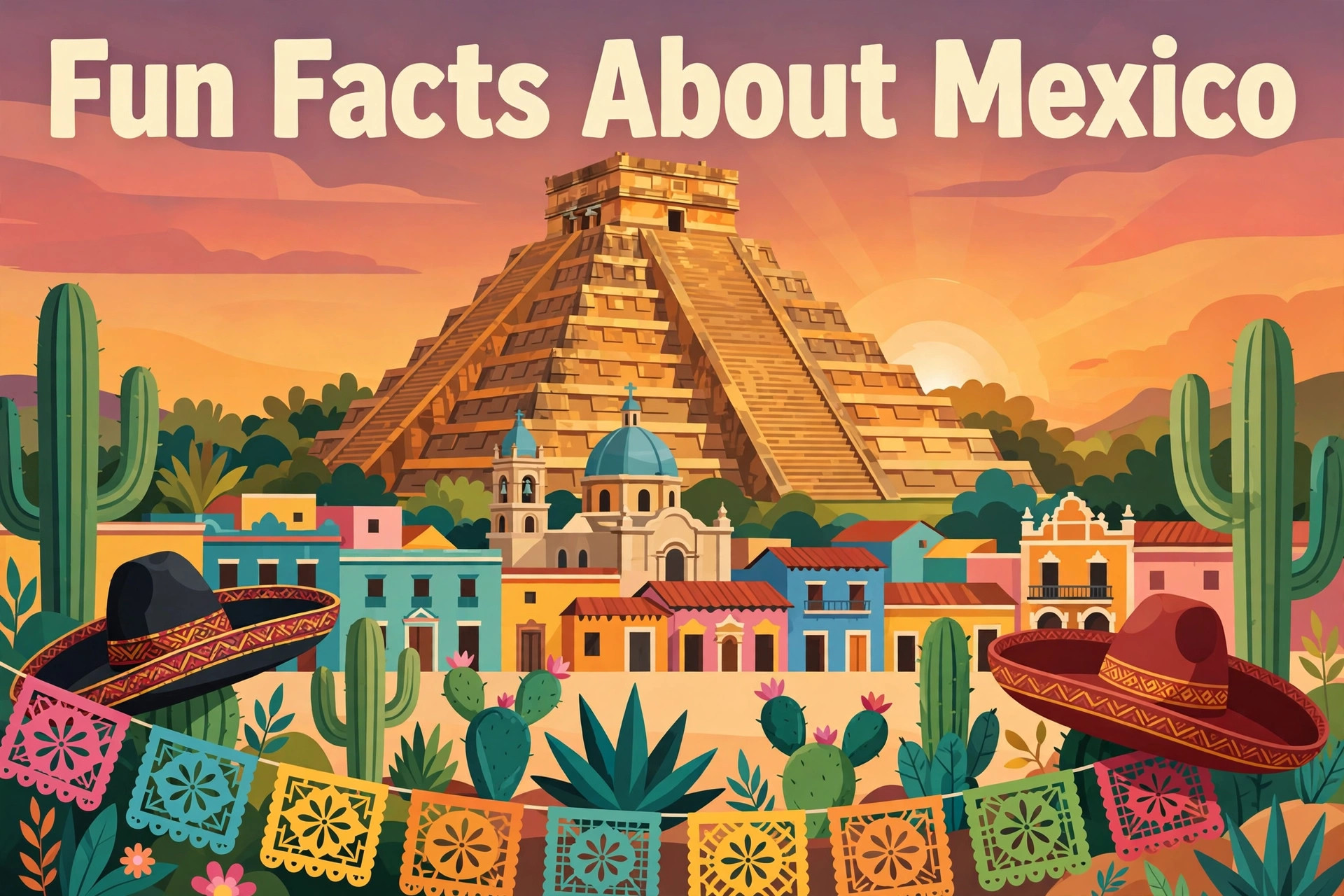
Mexico is more than beaches, tacos, and ancient pyramids. The country covers nearly 2 million square kilometers and holds 32 federal entities, each with its own character. Its landscapes range from northern deserts to tropical rainforests, high volcanic peaks to Caribbean reefs. Mexico is also one of the world’s 17 megadiverse countries, sheltering species found nowhere else on Earth. Its cultural diversity is just as striking: 68 Indigenous language groups and 364 linguistic variants are spoken across the country, and traditional Mexican cuisine holds UNESCO intangible heritage status. One fact I find especially fascinating is how nature, language, food, and history overlap here. Mexico’s maize story shows this clearly. The crop was domesticated in Mexico about 9,000 years ago, and today it still shapes food and culture across the country. These 48 Mexico fun facts trace that connected story, from ancient Teotihuacan to living traditions. It is a country where the past is always present.
Mexico at a Glance
| Fact | Detail |
| Official name | United Mexican States |
| Federal entities | 32 |
| Land area | About 1.96 million km² |
| Indigenous language groups | 68 |
| Indigenous linguistic variants | 364 |
| UNESCO World Heritage properties | 36 as of 2026 |
| Megadiverse status | One of 17 megadiverse countries |
| Maize history | Domesticated in Mexico about 9,000 years ago |
| Major ancient city | Teotihuacan |
| Major cultural tradition | Day of the Dead |
1. Mexico Stretches Across a Huge and Varied Landscape
1. Mexico covers about 1.96 million square kilometers. That makes it one of the world’s largest countries. Its territory includes mainland areas and islands. The country also has long Pacific and Gulf coastlines. This huge area helps explain Mexico’s striking range of climates and landscapes.
2. Mexico has 32 federal entities. These include 31 states and Mexico City. Each state has its own capital and cultural character. Oaxaca, for example, differs greatly from Baja California. This regional variety makes the word “Mexican” surprisingly broad.
3. Mexico reaches from roughly 32°43′ north to 14°32′ north. That north-to-south span crosses very different environments. You can find deserts, mountains, forests, wetlands, and tropical regions. Geography therefore plays a major role in Mexico’s biological and cultural diversity.
4. Mexico borders the United States, Guatemala, and Belize. It also faces the Pacific Ocean, Gulf of Mexico, and Caribbean Sea. This position connects North America with Central America. It also places Mexico between several major marine environments.
Source: INEGI geographic reference for Mexico; see also Britannica’s Mexico overview.
2. Mexico’s Ancient Cities Were Remarkably Advanced
5. Teotihuacan became one of the largest cities of the ancient world. At its height, it covered more than 20 square kilometers. Its population may have exceeded 100,000 people. The city also had planned streets, apartment compounds, temples, and major ceremonial buildings.
6. Teotihuacan was not simply a city of pyramids. Archaeologists have found evidence of neighborhoods and everyday life. Artisans, merchants, priests, and administrators lived there. The city’s remains therefore reveal much about ordinary people, not only rulers.
7. Mexico’s ancient cultures also developed complex farming systems. These systems helped communities grow food in difficult environments. Some traditions used raised fields or carefully managed landscapes. Such methods became part of the wider agricultural history of Mesoamerica.
8. Maize was domesticated in central Mexico about 9,000 years ago. Researchers link modern maize to teosinte. This wild grass looks very different from today’s corn. Over generations, human selection transformed it into one of the world’s most important crops.
Source: INAH research on Teotihuacan and maize domestication
3. Mexico Is a Biodiversity Powerhouse
9. Mexico belongs to the group of 17 megadiverse countries. Together, these nations contain about 70% of the world’s known biodiversity. Mexico’s location helps explain this richness. Its mountains, tropical forests, deserts, islands, and seas create many different habitats.
10. Mexico ranks among the world’s most species-rich countries for several animal groups. CONABIO lists Mexico as especially important for mammals, reptiles, amphibians, and vascular plants. The exact rankings can change as scientists update species records.
11. Mexico has many endemic species. Endemic means a species naturally occurs only in a particular area. More than 45% of Mexican amphibian species are endemic in the cited national biodiversity data. Reptiles show an even higher share, at about 57%.
12. Islands are especially important for Mexican endemism. Geographic isolation can allow populations to evolve separately. Guadalupe Island is one example. It supports several endemic species and subspecies. This makes Mexico’s islands valuable laboratories for studying evolution.
Source: CONABIO’s Mexico biodiversity overview
4. Mexico Has a Remarkably Rich Language Map
13. Mexico has 68 Indigenous language groups. These languages are represented through 364 linguistic variants. They come from 11 language families. This means Mexico’s linguistic diversity is not simply a collection of different accents.
14. Náhuatl is one of Mexico’s most widely spoken Indigenous languages. Maya is another major language group. Other important languages include Tseltal, Mixteco, Tsotsil, and Zapoteco. Each carries its own history, vocabulary, identity, and cultural knowledge.
15. Some Mexican linguistic variants face serious risks. Government sources have reported dozens of variants at high risk of disappearance. Language loss can mean more than losing words. It can also weaken the transmission of stories, traditions, and local knowledge.
16. Mexico’s Indigenous languages occur across all parts of the country. They are especially prominent in places such as Oaxaca, Chiapas, and Yucatán. This distribution shows that Mexican culture cannot be understood through Spanish alone.
Source: Mexico’s Indigenous language information from the Government of Mexico
5. Mexican Food Has a Much Older Story Than Many People Realize
17. Traditional Mexican cuisine is recognized by UNESCO as intangible cultural heritage. It is more than a collection of recipes. The system includes farming, preparation, cooking, eating, and community knowledge. Food therefore connects agriculture with identity.
18. Corn, beans, and chili form the basic foundation of traditional Mexican cuisine. Other important ingredients include tomatoes, squash, avocado, cacao, and vanilla. Many of these ingredients have deep roots in Mesoamerican food traditions.
19. Nixtamalization is a key traditional technique. It involves treating maize with an alkaline solution, commonly limewater. This process improves the nutritional quality of maize. It also changes the grain so it can be ground and used for foods such as tortillas.
20. Mexican cuisine includes farming systems as well as cooking methods. The milpa is one example. Chinampas are another. These human-made agricultural systems show how food production can be closely linked with local landscapes and community traditions.
Source: UNESCO on traditional Mexican cuisine
6. Mexico’s Heritage Goes Far Beyond the Famous Pyramids
21. As of 2026, Mexico has 36 properties on UNESCO’s World Heritage List. These include cultural, natural, and mixed sites. The list ranges from ancient cities to protected ecosystems. Mexico therefore has one of the world’s richest concentrations of recognized heritage.
22. Chichen Itza is one of Mexico’s best-known ancient sites. But it is only one part of a much larger archaeological story. UNESCO also recognizes places such as Teotihuacan, Palenque, Uxmal, and El Tajin.
23. Mexico’s heritage includes remarkable natural places. The Monarch Butterfly Biosphere Reserve is one example. Other natural sites include Sian Ka’an and the Whale Sanctuary of El Vizcaino. These places show that Mexican heritage includes ecosystems as well as buildings.
24. The Agave Landscape and Ancient Industrial Facilities of Tequila also has UNESCO status. The landscape covers more than 35,000 hectares. It links blue-agave fields, historic settlements, and tequila production. The site shows how agriculture can become part of cultural identity.
Source: UNESCO World Heritage properties in Mexico
7. Mexico’s Traditions Keep History Alive
25. Day of the Dead is not simply a Halloween-style celebration. UNESCO describes it as a tradition rooted in Indigenous Mexican communities. It combines pre-Hispanic practices with Catholic traditions introduced after European contact. Families use food, flowers, candles, and offerings to honor deceased relatives.
26. Mariachi is another Mexican tradition with global recognition. UNESCO added mariachi to its Representative List of Intangible Cultural Heritage in 2011. The tradition uses string instruments, singing, and trumpets. It also helps express community identity and continuity.
27. Mexico’s cultural heritage includes living practices, not only old monuments. People continue to transmit food skills, music, ceremonies, languages, and farming knowledge. This makes Mexican heritage dynamic. It changes while remaining connected to older traditions.
28. One of Mexico’s most interesting patterns is this connection between nature and culture. Maize links farming, food, history, and ceremony. Indigenous languages preserve local knowledge. Agave connects landscapes with industry and identity. Mexico’s story is therefore not divided neatly into nature and culture.
Source: UNESCO’s Mexico intangible cultural heritage listings
8. More Surprising Facts About Mexico
29. The axolotl, a salamander found in Mexico, can regenerate parts of its body, including parts of its brain and heart. This ability has made it one of the most studied animals in regenerative medicine.
30. Vanilla comes from an orchid that is native to Mexico. Its flowers were traditionally pollinated by the tiny Melipona bee, which is why vanilla was once so rare and valuable.
31. Millions of monarch butterflies travel up to 3,000 miles from North America to spend the winter in the forests of Michoacan. The migration is one of the most remarkable insect journeys on Earth.
32. The Cave of the Crystals in Naica, Mexico, contains giant gypsum crystals, some more than 10 meters long. The cave is extremely hot and humid, so scientists can only explore it for short periods.
33. The asteroid that ended the age of the dinosaurs struck the Yucatan Peninsula about 66 million years ago. The impact left a crater buried beneath the peninsula and the Gulf of Mexico.
34. Mexico is home to part of the Mesoamerican Barrier Reef, the second-largest barrier reef system in the world. It stretches along the coasts of Mexico, Belize, Honduras, and Guatemala.
35. A small Aztec pyramid stands inside the Pino Suarez Metro station in Mexico City. Workers discovered it during subway construction, and it is now displayed inside the station.
36. Spanish is the most widely spoken language in Mexico, but it is not the country’s official language. Mexico has no single official language at the federal level, and its Indigenous languages are recognized as national languages.
37. The first printing press in the Americas began operating in Mexico City in 1539. It produced some of the earliest printed books in the Western Hemisphere.
38. The Xoloitzcuintli, often called the Xolo, is a hairless dog breed that has lived in Mexico for about 3,000 years. It was considered sacred by the Aztecs and is now one of Mexico’s national treasures.
39. The Great Pyramid of Cholula, in Puebla, is the largest pyramid in the world by volume. Much of it is hidden under a hill, and a church stands on top of it today.
40. Cinco de Mayo is not Mexico’s Independence Day. It commemorates Mexico’s victory over French forces at the Battle of Puebla in 1862, while Mexican Independence Day is celebrated on September 16.
41. The Mapimi Silent Zone, in northern Mexico, is a desert region where radios and compasses are said to behave strangely. The cause is still debated.
42. The builders of Teotihuacan remain unknown. The city had already been abandoned for centuries when the Aztecs found it, and they gave it the name Teotihuacan.
43. Mexico City is slowly sinking, in some places by up to about 20 inches (50 centimeters) per year. The city was built on the soft bed of the former Lake Texcoco, and groundwater pumping has accelerated the sinking.
44. The golden eagle is Mexico’s national animal. It appears on the country’s flag and coat of arms, echoing the Aztec legend of an eagle perched on a cactus.
45. The Caesar salad was invented in Tijuana, Mexico, by chef Caesar Cardini in the 1920s. It became popular with visitors crossing the border from California.
46. Hot chocolate was first enjoyed in Mexico as a bitter, spicy drink made from cacao. The Aztecs and Maya flavored it with chili and vanilla rather than sugar.
47. Poinsettias, the red plants associated with Christmas, are native to Mexico. They were named after Joel Roberts Poinsett, the first U.S. minister to Mexico, who brought them to the United States in the 1820s.
48. Copper Canyon, in Chihuahua, is a network of canyons that is larger and deeper than the Grand Canyon.
Mexico’s Gifts to the World’s Kitchens
Walk through any supermarket on Earth and you will find Mexico. Maize, tomatoes, chilies, avocados, beans, squash, cacao, and vanilla all trace their roots to Mexican soil. Maize was domesticated from wild teosinte about 9,000 years ago. Cacao became chocolate, vanilla perfumed desserts across the globe, and the tomato transformed cuisines far beyond Mexico’s borders. These ingredients traveled the world after European contact, but their stories begin with Indigenous Mexican farmers who selected and perfected them over thousands of years. Few countries have flavored the planet so deeply, and every taco, chocolate bar, and salsa still carries that heritage.
Myths vs. Reality
| Myth | Reality |
| Mexico is mainly tropical. | Mexico has deserts, mountains, forests, wetlands, and tropical ecosystems. |
| Mexican culture is mostly Spanish. | Mexico has 68 Indigenous language groups and deep Indigenous traditions. |
| Tequila represents all Mexican alcohol traditions. | Mexico has many regional drinks and agricultural traditions. |
| Day of the Dead is simply Mexican Halloween. | It has distinct Indigenous roots and later Catholic influences. |
| Mexico’s famous heritage is mostly archaeological. | UNESCO also recognizes natural and living cultural heritage. |
FAQ
What are 5 interesting facts about Mexico?
Mexico is one of the world’s megadiverse countries. Maize was domesticated there about 9,000 years ago. The country has 68 Indigenous language groups. Teotihuacan was once a huge ancient city. Mexico also has 36 UNESCO World Heritage properties as of 2026.
What is Mexico famous for?
Mexico is famous for its food, archaeology, music, landscapes, and cultural traditions. It is also known for tequila, mariachi, Day of the Dead, ancient Mesoamerican civilizations, and diverse ecosystems.
What are some fun facts about Mexican culture?
Mexican culture includes 68 Indigenous language groups and 364 linguistic variants. Traditional Mexican cuisine has UNESCO recognition. Mariachi and Day of the Dead are also recognized as intangible cultural heritage.
Why is Mexico considered a megadiverse country?
Mexico has many ecosystems and a large number of species. It also has high endemism. Its location, mountains, islands, tropical regions, and deserts all contribute to this biological richness.
Where was maize first domesticated?
Current archaeological, genetic, and taxonomic evidence points to central Mexico. Researchers estimate that maize was domesticated about 9,000 years ago from teosinte.
How many UNESCO World Heritage sites does Mexico have?
As of 2026, Mexico has 36 properties on the UNESCO World Heritage List. They include cultural, natural, and mixed properties.
What languages are spoken in Mexico besides Spanish?
Mexico has 68 recognized Indigenous language groups. They include Náhuatl, Maya, Tseltal, Mixteco, Tsotsil, and Zapoteco. These groups contain 364 linguistic variants.
Why is Day of the Dead important in Mexico?
Day of the Dead honors deceased relatives and loved ones. Indigenous traditions and Catholic practices became intertwined over time. Families may prepare offerings, favorite foods, flowers, candles, and other items.
Conclusion
The best Mexico fun facts are not isolated trivia. They form a connected story. A grain of maize links ancient farming with modern food. A language can carry knowledge across generations. A desert can shelter species found nowhere else. An agave field can become cultural heritage. A family altar can connect the living with the dead. That is what makes Mexico so interesting. Its history still lives in landscapes, kitchens, languages, music, and ceremonies. When I look at Mexico this way, the country feels less like a list of facts. It feels like one enormous story, still being written.

Irshad Ullah is a content writer at Fun Facts Horizon. He researches and writes verified fun facts about countries, animals, space, history, and more for curious readers.
2 thoughts on “Mexico Fun Facts: 48 Surprising Facts About Mexico”