
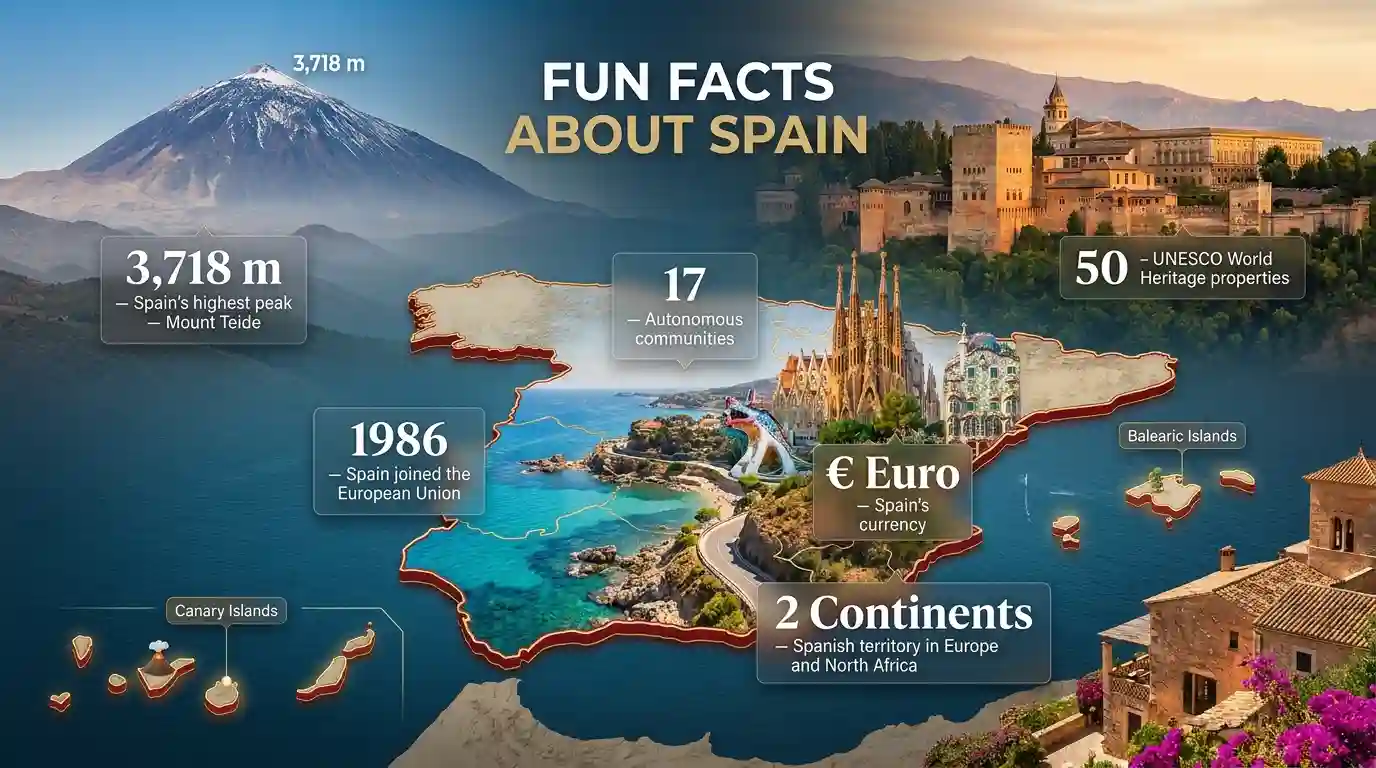
Spain is a country that rewards curiosity. Beyond the postcard images of beaches, flamenco, and paella lies one of Europe’s most layered nations — a parliamentary monarchy where a volcano on an Atlantic island is the highest peak, where several languages share official status, and where dinner often starts late by northern European standards. These 50 fun facts about Spain reveal just how much variety fits inside its borders. Spain holds Europe’s highest number of UNESCO World Heritage properties — 50 at last count — alongside 16 national parks, the continent’s second-largest forest area, and more UNESCO Biosphere Reserves than any other country in the world. Its landscapes stretch from the volcanic Canary Islands to the snow-capped Pyrenees, from Mediterranean coves to the semi-desert of Navarra. Its culture blends Roman aqueducts, Islamic palaces, medieval pilgrimage routes, and avant-garde architecture, seasoned with tapas, olive oil, and world-famous art. Sharing the Iberian Peninsula with neighboring Portugal, Spain has spent centuries at the crossroads of Europe, Africa, and the Americas. This guide walks through the geography, history, languages, food, nature, and traditions that make Spain truly unique — with sources cited so you can check the biggest claims yourself.
Spain at a Glance
| Feature | Quick Fact |
| Capital | Madrid |
| Form of government | Parliamentary monarchy |
| State language | Spanish, also called Castilian |
| Other official languages | Several are co-official in their regions |
| Highest point | Teide, 3,718 m |
| UNESCO World Heritage properties | 50 |
| National parks | 16 |
| Famous island groups | Balearic Islands and Canary Islands |
| National flag | Red-yellow-red, with the yellow stripe twice as wide |
| Famous food traditions | Tapas, olive oil, Iberian ham, Mediterranean cuisine |
Sources: Spain’s Constitution, UNESCO, Spain’s National Geographic Institute, and Spain’s Ministry for Ecological Transition.
A Country With Surprising Geography
1. Spain’s Highest Peak Is on an Island
Spain’s highest point is not in the Pyrenees. It is Teide, a volcano on Tenerife in the Canary Islands. Spain’s National Geographic Institute lists its height as 3,718 metres. The Canary Islands have volcanic origins and lie in the Atlantic Ocean.
Source: Spain’s National Geographic Institute.
2. Spain Has Both Atlantic and Mediterranean River Systems
Much of mainland Spain drains toward the Atlantic Ocean. The National Geographic Institute says this drainage area covers almost 70% of the peninsula. The Mediterranean side covers about 31%. The Ebro is the major river system on that side.
Source: Spain’s National Geographic Institute.
3. The Canary Islands Are Volcanic
The Canary Islands are not simply an extension of mainland Spain. Spain’s National Geographic Institute describes their volcanic relief as an independent geographical unit. This volcanic origin helped create landscapes very different from mainland Spain.
Source: Spain’s National Geographic Institute.
4. Spain Has 16 National Parks
Spain’s National Parks Network currently includes 16 parks. They protect very different ecosystems. These include mountain areas, wetlands, forests, volcanic landscapes, islands, and marine environments.
Source: Spain’s Ministry for Ecological Transition.
5. Doñana Is One of Spain’s Great Natural Treasures
Doñana National Park is one of Spain’s UNESCO-listed natural properties. UNESCO includes it among Spain’s 50 World Heritage properties. The park is especially known for its important natural habitats.
Source: UNESCO World Heritage Centre.
Spain’s Past Is Written in Stone
6. Spain Has 50 UNESCO World Heritage Properties
UNESCO currently lists 50 World Heritage properties in Spain. These include 44 cultural properties, four natural properties, and two mixed properties. The collection shows Spain’s remarkable historical and natural diversity.
Source: UNESCO — Spain World Heritage profile
7. The Alhambra Has Been on the World Heritage List Since 1984
UNESCO inscribed the Alhambra and Generalife in Granada in 1984. The protected property later expanded to include the Albayzín district. It remains one of Spain’s best-known examples of Islamic and Andalusian heritage.
Source: UNESCO World Heritage Centre.
8. Spain Has Famous Prehistoric Cave Art
Altamira Cave and other Paleolithic cave art sites in northern Spain are UNESCO World Heritage properties. UNESCO says the wider property includes Altamira and 17 additional decorated caves — a prehistoric heritage shared with neighboring France, home of the famous Lascaux caves. These works represent a major record of prehistoric art.
Source: UNESCO World Heritage Centre.
9. Spain Preserves a Roman Aqueduct at Segovia
The Old Town of Segovia and its Aqueduct became a UNESCO World Heritage property in 1985. The listing links the city’s historic urban landscape with its famous Roman engineering.
Source: UNESCO World Heritage Centre.
10. The Camino de Santiago Has World Heritage Status
UNESCO lists the Routes of Santiago de Compostela as a World Heritage property. The listing includes the Camino Francés and Routes of Northern Spain. The property received its first inscription in 1993 and an extension in 2015.
Source: UNESCO — Routes of Santiago de Compostela
11. Spain Has a Roman Lighthouse on the UNESCO List
The Tower of Hercules in A Coruña is listed by UNESCO as a World Heritage property. It was inscribed in 2009. Its presence shows how Roman history remains visible in Spain’s modern landscape.
Source: UNESCO World Heritage Centre.
Spain Is More Linguistically Diverse Than Many People Think
12. Castilian Is Spain’s Official State Language
Article 3 of Spain’s Constitution states that Castilian is the official Spanish language of the State. The Constitution also recognizes the country’s wider linguistic diversity.
Source: The Constitution of Spain
13. Other Languages Can Be Official in Their Own Regions
Spain’s Constitution allows other Spanish languages to be official in their respective autonomous communities. Their status depends on the relevant regional statutes. This gives language a strong regional role in Spanish public life.
Source: Official State Gazette of Spain.
14. Around 40% of Spain’s Population Lives in a Region With More Than One Official Language
Official estimates indicate that around 40% of Spain’s population lives in an autonomous community with more than one official language. This makes multilingual life a normal part of daily life for many people.
Source: Official State Gazette of Spain.
15. Several Different Languages Have Official Status
Official sources identify regional official status for Basque, Catalan, Valencian, Galician, and Aranese/Occitan under the relevant regional statutes. These languages form part of Spain’s protected linguistic heritage.
Source: Official State Gazette of Spain.
16. Spain’s Constitution Calls Linguistic Diversity a Cultural Heritage
Spain’s Constitution does more than define official languages. Article 3 also says the richness of Spain’s different linguistic forms is a cultural heritage deserving special respect and protection.
Source: Official State Gazette of Spain.
17. Madrid Is the Capital by Constitutional Law
Article 5 of Spain’s Constitution states that Madrid is the capital of the State. This makes the city’s role a constitutional fact, not simply an administrative tradition.
Source: Official State Gazette of Spain.
Food Is a Major Part of Spanish Life
18. Tapas Are Small Portions Made for Sharing
Spain’s official tourism website describes tapas as small portions traditionally served with drinks in many bars. They can be simple foods or more elaborate dishes. Going from bar to bar for tapas is also a social tradition.
Source: Spain.info.
19. Tapas Have Their Own International Day
Spain’s official tourism website celebrates World Tapas Day on 16 June. The day highlights tapas as a shared food tradition and an important part of Spanish gastronomy.
Source: Spain.info.
20. Spain Is the World’s Leading Olive Oil Producer
Spain’s official tourism website describes the country as the world’s leading producer of olive oil. Olive cultivation is especially concentrated in Andalusia, although other Spanish regions also produce olive oil.
Source: Spain.info.
21. Olive Oil Is Central to Spanish Cooking
Olive oil appears throughout Spanish food culture. Spain’s tourism authority calls it a key ingredient in Spanish cuisine. It also forms an important part of the Mediterranean diet.
Source: Spain.info.
22. Iberian Ham Is a Distinct Spanish Specialty
Spain’s official tourism website says Iberian ham is produced in Spain. Its identity comes from special production systems and pig breeds associated with the Iberian Peninsula. It is one of the country’s best-known foods.
Source: Spain.info.
23. Spanish Cuisine Is Closely Linked to the Mediterranean Diet
Spain is one of the leading countries associated with the Mediterranean diet — a food culture it shares with Italy, another Mediterranean heartland. Its food culture emphasizes olive oil, vegetables, and seasonal ingredients. UNESCO has recognized the Mediterranean diet as Intangible Cultural Heritage.
Source: Spain.info and UNESCO information cited by Spain.info.
Spain Blends Nature With World Heritage
24. Teide National Park Is Also a World Heritage Site
Teide National Park is one of Spain’s natural UNESCO World Heritage properties. UNESCO inscribed it in 2007. The park protects the landscape surrounding Spain’s highest peak.
Source: UNESCO — Spain World Heritage profile
25. Garajonay National Park Is Another UNESCO Natural Site
Garajonay National Park, on La Gomera in the Canary Islands, is also on Spain’s World Heritage list. UNESCO inscribed it in 1986. It adds another island ecosystem to Spain’s rich natural heritage.
Source: UNESCO World Heritage Centre.
26. Spain Has Two Mixed World Heritage Properties
UNESCO classifies two Spanish properties as mixed sites. These are Ibiza, Biodiversity and Culture, and Pyrénées–Mont Perdu. Mixed properties receive recognition for both cultural and natural value.
Source: UNESCO World Heritage Centre.
27. Ibiza’s UNESCO Status Covers More Than Nightlife
UNESCO lists Ibiza, Biodiversity and Culture as a mixed World Heritage property. It was inscribed in 1999. The title itself reflects the island’s combined natural and cultural importance.
Source: UNESCO World Heritage Centre.
28. Spain’s Heritage Includes Both Ancient and Modern Eras
Spain’s UNESCO list includes prehistoric cave art, Roman monuments, medieval cities, Islamic architecture, historic pilgrimage routes, and modern works by Antoni Gaudí. This range covers an unusually broad sweep of human history.
Source: UNESCO World Heritage Centre.
29. Antoni Gaudí Has a Major Place on Spain’s UNESCO List
UNESCO lists the Works of Antoni Gaudí as a Spanish World Heritage property. The property was first inscribed in 1984 and later extended in 2005. It represents Spain’s contribution to modern architectural history.
Source: UNESCO World Heritage Centre.
National Symbols Also Tell a Story
30. Spain Is a Parliamentary Monarchy
Spain’s Constitution defines the country as a social and democratic State governed by the rule of law. It also states that Spain’s political form is a parliamentary monarchy.
Source: Official State Gazette of Spain.
Source: Official Spanish Constitutional Text
31. Spain’s Flag Has a Specific Constitutional Design
The Constitution describes Spain’s national flag as three horizontal stripes: red, yellow, and red. The yellow stripe must be twice as wide as each red stripe.
Source: Official State Gazette of Spain.
32. Spain Recognizes Regional Flags Too
Spain’s Constitution allows autonomous communities to recognize their own flags and symbols. These may be used alongside Spain’s national flag in public buildings and official events.
Source: Official State Gazette of Spain.
33. Spain’s Autonomous Model Is Written Into Its Constitution
Article 2 recognizes Spain’s national unity while also guaranteeing autonomy for its nationalities and regions. This constitutional structure helps explain Spain’s strong regional identities.
Source: Official State Gazette of Spain.
34. Spain Protects Both Nature and Culture at a National Level
The National Parks Network protects major ecosystems, while UNESCO listings recognize sites of outstanding cultural or natural value. Together, these systems show how Spain protects very different forms of heritage.
Source: Spain’s Ministry for Ecological Transition and UNESCO.
35. One Country Contains Remarkably Different Worlds
Spain can move from high mountains to volcanic islands, Roman monuments to modern architecture, and one official language region to another. Its 50 World Heritage properties and 16 national parks show just how varied the country is.
Source: UNESCO, Spain’s National Geographic Institute, and Spain’s Ministry for Ecological Transition.
More Surprising Facts About Spain
36. Spain Has One of the Longest Coastlines in Europe
Spain has about 8,000 kilometers (nearly 5,000 miles) of coastline, including its mainland, the Balearic Islands, and the Canary Islands — a Mediterranean coastline tradition it shares with Greece, another country defined by its seas.
37. Spain Has the Most Biosphere Reserves in the World
Spain has 55 UNESCO Biosphere Reserves, more than any other country in the world.
38. Cordoba’s Old Town Is One of the Largest in Europe
The historic center of Cordoba is one of the largest old towns in Europe and is a UNESCO World Heritage Site.
39. Spain Is Made Up of 17 Autonomous Communities
Spain is divided into 17 autonomous communities, each with its own government, culture, and traditions.
40. Spain Has Two Autonomous Cities in North Africa
Ceuta and Melilla are two autonomous cities of Spain located on the coast of North Africa.
41. Spain’s Population Is Nearly 50 Million
Spain’s population is nearly 50 million, making it one of the most populous countries in the European Union.
42. About 10 Million Foreign-Born Residents Live in Spain
About 10 million people living in Spain were born in another country, making Spain one of the most diverse countries in Europe.
43. Spain’s Autonomy System Took Shape in the 1980s and 1990s
Spain’s autonomous communities adopted their statutes of autonomy between 1979 and 1983, while Ceuta and Melilla received their autonomy statutes in 1995.
44. Flamenco Is UNESCO Intangible Cultural Heritage
UNESCO added flamenco to its Intangible Cultural Heritage list in 2010, recognizing the music, dance, and singing tradition.
Source: UNESCO — Flamenco
45. Human Towers Are a Catalan Tradition
Castellers, the tradition of building human towers, is a Catalan cultural practice recognized by UNESCO.
46. La Gomera Has a Whistled Language
Silbo Gomero, a whistled language used on La Gomera in the Canary Islands, can carry messages across deep ravines. UNESCO recognizes it as Intangible Cultural Heritage.
47. Spain Has a Semi-Desert in Navarra
The Bardenas Reales in Navarra is a semi-desert landscape of eroded clay, sand, and sandstone, and it is a UNESCO Biosphere Reserve.
48. Spain Has the Second-Largest Forest Area in Europe
Spain has the second-largest forested area in Europe, after Sweden, with forests covering a large share of the country.
49. Spain Has About 300 Michelin-Starred Restaurants
Spain is home to about 300 Michelin-starred restaurants, making it one of the world’s leading destinations for fine dining.
50. Spain Produced Some of the World’s Most Famous Artists
Spain’s art traditions include Velazquez, Goya, Dali, Miro, and Picasso, whose works are displayed in museums around the world.
Myths vs. Reality About Spain
Spain Is Not Only About Beaches
Spain has famous beaches, but its geography also includes high mountain systems, wetlands, forests, river basins, volcanic islands, and protected national parks.
Source: Spain’s National Geographic Institute and Ministry for Ecological Transition.
Everyone in Spain Does Not Speak Only One Language
Castilian is the official language of the State. However, other Spanish languages are also official in their respective autonomous communities under regional statutes.
Source: Spain’s Constitution and Official State Gazette.
Spain’s Highest Mountain Is Not on the Mainland
Spain’s highest peak is Teide in the Canary Islands. It rises to 3,718 metres. Mulhacén is the highest peak on mainland Spain, but Teide is higher.
Source: Spain’s National Geographic Institute.
Experience Spain Region by Region: 5 Unmissable Stops
Spain’s 17 autonomous communities each feel like a different country. If you are planning a trip — or just dreaming — these five regional highlights show the country’s remarkable range.
Andalusia: the Alhambra and flamenco’s heartland. Granada’s Alhambra palace complex, a UNESCO site since 1984, is the crown jewel of Islamic architecture in Europe, while Seville keeps flamenco traditions alive.
Catalonia: Gaudí’s Barcelona. The Sagrada Família and Park Güell showcase Antoni Gaudí’s one-of-a-kind modernisme, part of the UNESCO-listed Works of Antoni Gaudí.
The Basque Country: a food pilgrimage. San Sebastián is famed for its concentration of Michelin-starred restaurants, and its pintxos bars turn bar-hopping into an art form.
Galicia: the Camino’s finish line. Walk any route of the Camino de Santiago and you will end at Santiago de Compostela’s cathedral — the goal of a pilgrimage tradition with UNESCO World Heritage status.
The Canary Islands: Spain’s volcanic frontier. Take the cable car up Teide, Spain’s highest peak at 3,718 metres, or explore the ancient laurel forests of Garajonay National Park on La Gomera.
Fun Facts About Spain FAQ
What is Spain most famous for?
Spain is widely known for its historic cities, Mediterranean and Atlantic landscapes, tapas, olive oil, football culture, and major artistic traditions. It also stands out for its 50 UNESCO World Heritage properties.
Source: UNESCO and Spain.info.
How many islands does Spain have?
Spain has two major island groups: the Balearic Islands in the Mediterranean and the Canary Islands in the Atlantic. Spain’s geography also includes many smaller islands and islets.
Source: Spain’s National Geographic Institute.
What is the oldest type of art found in Spain?
Spain is home to major examples of Paleolithic cave art. UNESCO recognizes Altamira and 17 other decorated caves within one World Heritage property.
Source: UNESCO World Heritage Centre.
What are Spain’s most famous national parks?
Well-known parks include Teide, Doñana, Picos de Europa, Timanfaya, Sierra Nevada, and Ordesa y Monte Perdido. All are part of Spain’s 16-park national network.
Source: Spain’s Ministry for Ecological Transition.
Why is olive oil so important in Spain?
Olive oil is a central ingredient in Spanish cooking and the Mediterranean diet. Spain is also the world’s leading olive oil producer, according to its official tourism authority.
Source: Spain.info.
Is Spain a monarchy or a republic?
Spain is a parliamentary monarchy. Its Constitution clearly states that this is the country’s political form.
Source: Official State Gazette of Spain.
What is the official language of Spain?
Castilian, commonly called Spanish, is the official language of the State. Other Spanish languages can also be official in their respective autonomous communities.
Source: Official State Gazette of Spain.
Final Thoughts
These fun facts about Spain show why the country feels so varied. One nation contains prehistoric art, Roman engineering, Islamic architecture, volcanic islands, high mountains, rich languages, and a world-famous food culture. Spain’s 50 UNESCO World Heritage properties and 16 national parks reveal only part of that story. Its real character also lives in regional traditions, shared meals, and different landscapes. Spain is not a place with one simple identity. It is a collection of many histories and worlds, joined together in one remarkable country.
Irshad Ullah is a content writer at Fun Facts Horizon. He researches and writes verified fun facts about countries, animals, space, history, and more for curious readers.
2 thoughts on “50 Fun Facts About Spain That Make It Truly Unique”