
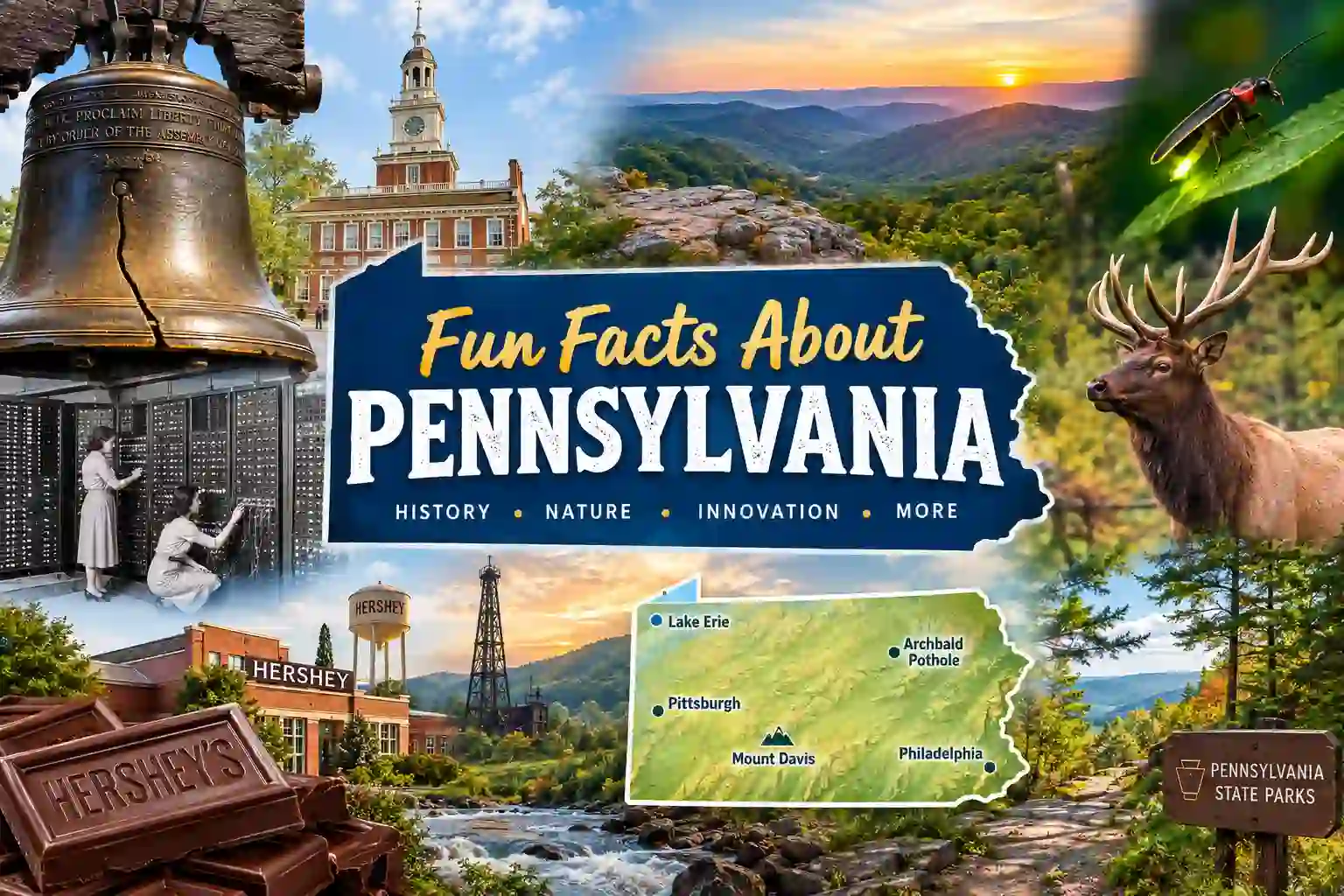
Pennsylvania is more than Philadelphia, Pittsburgh, and the Liberty Bell. The state helped shape American government, modern computing, and the petroleum industry. It also has a strong link to chocolate, forests, wildlife, and unusual geology. For example, the Declaration of Independence and U.S. Constitution were both signed inside the same Philadelphia room. Pennsylvania also gave the world ENIAC, an early general-purpose electronic computer, in 1946. And in Titusville, an 1859 oil well helped launch the modern petroleum industry.
I find Pennsylvania especially interesting because its story keeps changing scale. You can move from a tiny firefly to a giant computer, then from a mountain summit to a historic bell. These fun facts about Pennsylvania show just how varied the Keystone State can be.
Pennsylvania at a Glance
| Fact | Details |
| Official name | Commonwealth of Pennsylvania |
| Capital | Harrisburg |
| Largest city | Philadelphia |
| State population | 13,059,432, as of July 1, 2025 |
| Counties | 67 |
| Statehood | December 12, 1787 |
| Highest point | Mount Davis, 3,213 feet |
| State insect | Firefly |
| State tree | Eastern hemlock |
| State parks | 125 parks, as listed by PA DCNR in 2026 |
Pennsylvania Helped Shape the United States
1. Pennsylvania was the second state to ratify the Constitution.
Pennsylvania ratified the U.S. Constitution on December 12, 1787. Delaware became the first state five days earlier. Pennsylvania later elected the first two U.S. senators. William Maclay and Robert Morris won those seats in September 1788.
2. The Declaration and Constitution share one famous room.
The Assembly Room inside Independence Hall witnessed two major moments. The Declaration of Independence was signed there in 1776. Eleven years later, delegates signed the U.S. Constitution in the same room. That makes one Pennsylvania room central to both events.
3. The Declaration was first read publicly in Philadelphia.
The first public reading of the Declaration took place in Independence Square on July 8, 1776. Crowds gathered near the State House. Today, the area forms part of Independence National Historical Park.
4. Pennsylvania’s State House was built before independence.
Construction of the Pennsylvania State House began around 1732. Work continued through the 1740s. The building later became known as Independence Hall. It originally housed Pennsylvania’s colonial government.
5. Pennsylvania gave the nation its first U.S. senators.
The Pennsylvania legislature elected William Maclay and Robert Morris in September 1788. They became the first senators elected under the new Constitution. Pennsylvania therefore played an early role in creating the new federal government.
Source: U.S. Senate — Pennsylvania Timeline
The Liberty Bell Has a More Complex Story
6. The Liberty Bell was not always called that.
The famous bell was first known as the State House Bell. The name “Liberty Bell” became popular later. Abolitionists helped spread that name as they used the bell’s message of liberty in their campaign against slavery.
7. The Liberty Bell cracked more than once.
The bell first cracked soon after arriving in Philadelphia. Local founders John Pass and John Stow recast it in 1753. A later crack eventually became permanent. The bell has remained silent since the nineteenth century.
8. Nobody alive today has heard the Liberty Bell ring freely.
The bell’s famous crack stopped it from ringing normally. The National Park Service notes that no living person has heard it ring freely with its clapper. Computer modeling now offers clues about its possible sound.
9. The Liberty Bell’s inscription comes from the Bible.
The bell carries words from Leviticus 25:10. The inscription refers to liberty and the biblical Jubilee. Isaac Norris, speaker of the Pennsylvania Assembly, selected the inscription in 1751.
Source: National Park Service — The Liberty Bell
Pennsylvania’s Landscape Reaches From Mountains to Great Lakes
10. Mount Davis is Pennsylvania’s highest point.
Mount Davis rises 3,213 feet above sea level. It sits in Somerset County inside Forbes State Forest. An observation tower near the summit provides broad views across the surrounding landscape.
11. Pennsylvania touches Lake Erie.
Pennsylvania is not an oceanfront state, but it has a Great Lakes shoreline. Its northwestern corner reaches Lake Erie. Some water from northern Pennsylvania also drains toward the Great Lakes.
12. Pennsylvania contains several major drainage systems.
Water from Pennsylvania does not all flow toward one place. Major rivers connect the state to the Atlantic Ocean and Gulf of Mexico drainage systems. The Susquehanna and Delaware are important eastern rivers, while the Ohio system drains westward.
13. Pennsylvania has an enormous natural pothole.
Archbald Pothole is a striking geological feature near Scranton. It is about 38 feet deep and measures roughly 42 feet long by 24 feet wide. Scientists think glacial activity helped create it about 20,000 years ago.
Source: Pennsylvania DCNR — Geological Features
Pennsylvania Helped Build the Modern Energy Age
14. The modern petroleum industry has roots in Pennsylvania.
Colonel Edwin Drake drilled for oil near Titusville in 1859. The successful well helped launch commercial oil production. Thousands of people soon rushed into the region, creating a rapid oil boom.
15. Drake’s well was surprisingly shallow.
The famous well reached oil at about 69.5 feet. That depth sounds small today. Yet the successful drilling operation changed the energy industry and encouraged new methods for finding and producing petroleum.
16. Pennsylvania’s oil boom changed local landscapes.
After Drake’s success, people rushed into the Oil Creek Valley. Derricks appeared across the landscape. Boomtowns grew quickly, while fires and changing oil fields could destroy or relocate communities.
17. Coal became a major part of Pennsylvania’s industrial story.
Pennsylvania coal supported colonial ironmaking and later powered industrial growth. Bituminous coal helped fuel Pittsburgh’s steel industry. Coal production reached a combined peak of 276 million tons in 1918.
Source: Pennsylvania DCNR — Oil and Gas History
Chocolate and Pennsylvania Have a Sweet Connection
18. Milton Hershey was born in Pennsylvania.
Milton S. Hershey was born in Derry Township in central Pennsylvania in 1857. Before becoming famous for chocolate, he learned candy making in Lancaster. His early career included both failures and business experiments.
19. Hershey first became successful with caramels.
Chocolate was not Milton Hershey’s first major success. His Lancaster Caramel Company became successful before he moved his focus to chocolate. In 1900, he sold the caramel company for $1 million.
20. Hershey deliberately built his factory in rural Pennsylvania.
Milton Hershey considered several locations before choosing central Pennsylvania. He valued fresh milk, water, rail access, and available workers. Groundbreaking for his new chocolate factory began in 1903.
21. Hershey planned a community around the factory.
Hershey did more than build a chocolate factory. He developed housing, services, transportation, and other parts of a planned community. The factory began operating in 1905.
Source: Hershey Community Archives — Milton Hershey
Pennsylvania Put an Early Computer to Work
22. ENIAC was built at the University of Pennsylvania.
ENIAC was built at the University of Pennsylvania’s Moore School. It was introduced publicly in 1946. Penn describes it as the world’s first general-purpose, electronic, programmable computer.
23. ENIAC was huge compared with modern computers.
ENIAC used more than 17,000 vacuum tubes. Its size and power were extraordinary for its time. It was designed to handle complex numerical problems much faster than earlier mechanical machines.
24. ENIAC had women programmers.
Six women became the original programmers of ENIAC. Their work was once overlooked in many popular accounts. Their programming helped make the machine useful for complex calculations.
25. ENIAC began with a military problem.
The computer was built during World War II to calculate ballistic trajectories. Teams of mathematicians had previously handled these calculations using mechanical calculators. ENIAC dramatically changed the speed of this work.
Source: University of Pennsylvania — ENIAC at 80
Pennsylvania’s Wildlife and Parks Add Another Layer
26. Pennsylvania’s firefly is actually a beetle.
The firefly is Pennsylvania’s official state insect. Despite its common name, it is not a true fly. Fireflies are beetles. Pennsylvania designated the firefly as its state insect on April 10, 1974.
27. Eastern hemlock is Pennsylvania’s state tree.
Pennsylvania chose the eastern hemlock as its official state tree in 1931. Early settlers used its wood for buildings. They also used its bark to obtain tannic acid for leather production.
28. Pennsylvania’s wild elk disappeared and later returned.
Elk once lived across much of Pennsylvania. By 1867, they had disappeared from the state. The Pennsylvania Game Commission later released elk between 1913 and 1926. Today’s herd descends from those releases.
29. Pennsylvania manages more than 1.5 million acres of game lands.
The Pennsylvania Game Commission manages more than 1.5 million acres of state game lands. These lands support wildlife habitat and provide public opportunities for hunting and other outdoor activities.
30. Pennsylvania has 125 state parks as of 2026.
Pennsylvania’s Department of Conservation and Natural Resources currently lists 125 state parks. Together, they cover more than 300,000 acres. The state says its parks do not charge an entrance fee.
Source: Pennsylvania DCNR — State Parks
Myths vs. Reality
| Myth | Reality |
| The Liberty Bell has always been called the Liberty Bell. | It was originally the State House Bell. |
| Pennsylvania’s oil story began with modern petroleum companies. | Drake’s 1859 well helped launch commercial oil production. |
| ENIAC was a modern laptop-sized computer. | It was a huge early electronic computer using thousands of vacuum tubes. |
| Pennsylvania’s elk are simply remnants of the original herd. | Today’s elk descend from animals released between 1913 and 1926. |
Frequently Asked Questions About Pennsylvania
What is Pennsylvania famous for?
Pennsylvania is famous for its colonial history, Independence Hall, the Liberty Bell, Pittsburgh’s industrial heritage, Hershey chocolate, and early computer technology.
Why is Pennsylvania called the Keystone State?
“Keystone State” is a traditional nickname for Pennsylvania. A keystone is the central stone that holds an arch together. The nickname reflects Pennsylvania’s historic importance in the founding and development of the United States.
What happened in Pennsylvania in 1776?
The Declaration of Independence was adopted in Philadelphia in July 1776. It was signed in the Assembly Room of what is now Independence Hall.
What are some fun facts about Pennsylvania’s geography?
Pennsylvania reaches Lake Erie, contains part of the Appalachian Mountains, and has Mount Davis as its highest point. Mount Davis rises 3,213 feet above sea level.
Was the first oil well in Pennsylvania?
Pennsylvania was home to the successful commercial oil well drilled by Edwin Drake near Titusville in 1859. It helped launch the modern petroleum industry.
Where was ENIAC built?
ENIAC was built at the University of Pennsylvania’s Moore School in Philadelphia. It was introduced publicly in 1946.
Why is Pennsylvania connected with chocolate?
Milton Hershey developed his chocolate business in Pennsylvania. He built his major chocolate factory in the central Pennsylvania community that became Hershey.
What wildlife is Pennsylvania known for?
Pennsylvania supports elk, deer, black bears, and many other species. Its elk population has a particularly interesting history because today’s herd descends from twentieth-century reintroductions.
Conclusion
The most interesting fun facts about Pennsylvania show a state built from many different stories. One room in Philadelphia connects two major American documents. One cracked bell became a global symbol. A small oil well changed an industry. A giant machine helped begin the computer age. A chocolate factory grew into an entire community. Mountains, rivers, forests, wildlife, and unusual rocks add another layer to the picture. Pennsylvania is therefore hard to describe with one image or one nickname. Its real character comes from the surprising links between history, science, industry, nature, and everyday life. That mix makes the Keystone State worth exploring again.

hello! I am Irshad Ullah, and a passionate writer and lifelong learner dedicated to uncovering fascinating facts about science, history, nature, animals, space, and the world around us. I research each topic carefully and transform surprising information into clear, engaging, and enjoyable content. My goal is to satisfy curiosity, inspire learning, and help readers discover something amazing every day.