
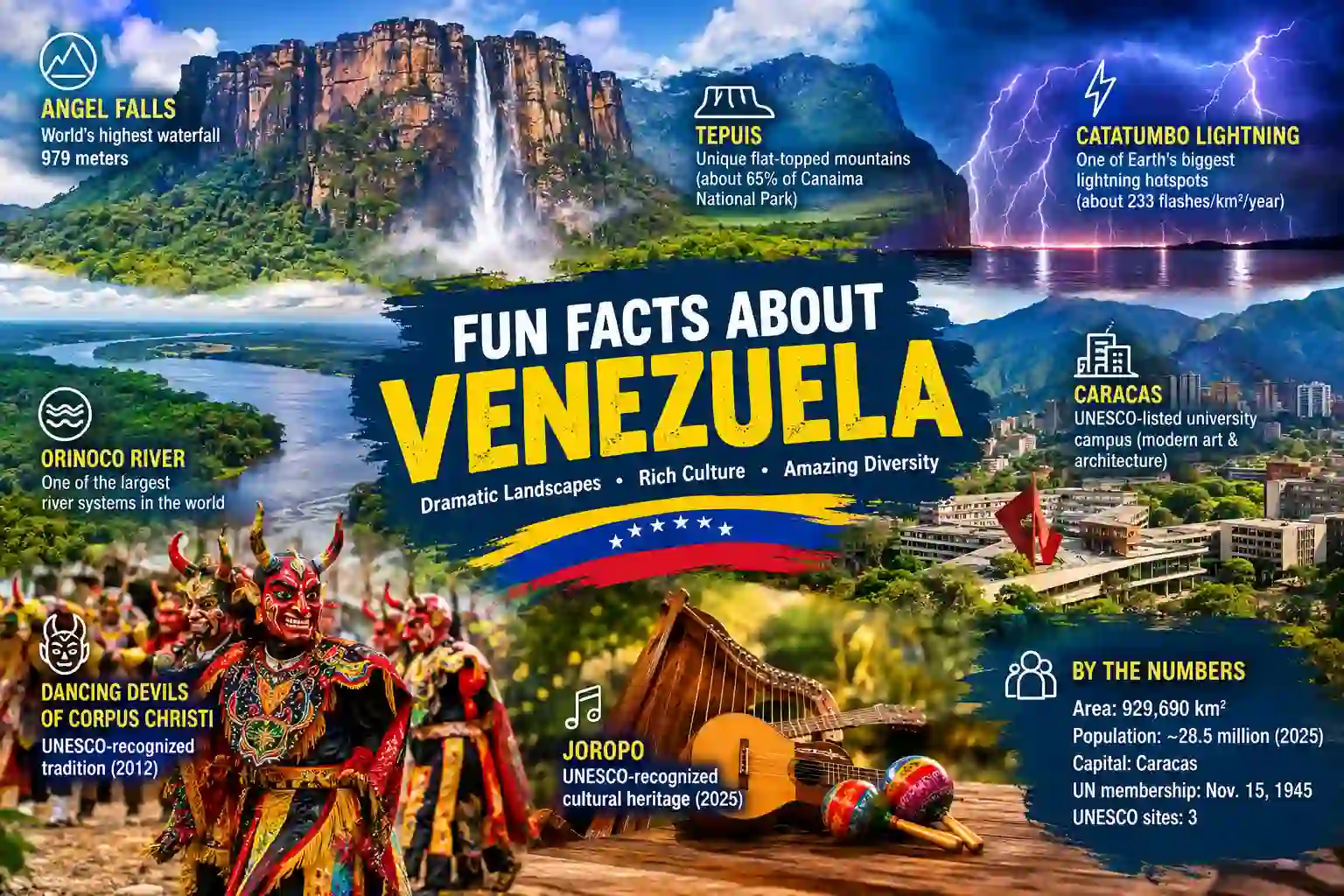
Few countries on Earth pack as many superlatives into one border as Venezuela. This is the country where the world’s tallest waterfall spills off a plateau nearly two billion years old, where a single lake flashes with lightning more nights than not, and where the harp, cuatro, and maracas of joropo became a UNESCO-recognized heritage. Venezuela’s story starts in geology – its tepuis are among the oldest exposed rocks on the planet – and runs through one of the most dramatic independence sagas in the Americas, led by Caracas-born Simon Bolivar. Along the way, the Orinoco, one of the world’s great river systems, carved a vast delta and a plains culture all its own, while the oil beneath Lake Maracaibo and the Orinoco Belt made the country an energy giant.
These fun facts about Venezuela move from its sky to its soil: ancient mountains, record-breaking lightning, heavy oil, a university campus that doubles as a modern-art museum, and living traditions that still dance through its streets. If you want to see how geography shapes a nation, Venezuela is one of the best places to start.
Venezuela at a Glance
| Fact | Detail |
| Capital | Caracas |
| Region | South America |
| Area | 916,445 sq km |
| Population | About 28.5 million, 2025 |
| Official name | Bolivarian Republic of Venezuela |
| UN membership | November 15, 1945 |
| Currency | Bolivar |
| Independence declaration | July 5, 1811 |
| UNESCO World Heritage properties | 3 |
| Famous natural landmark | Angel Falls |
Source: United Nations Data – Venezuela country profile
1. Venezuela Rises Into a World of Tepuis
1. Canaima National Park covers about 3 million hectares. It lies in southeastern Venezuela. Around 65% of the park contains tepui formations. These huge table mountains have steep cliffs. Their isolated tops create unusual habitats.
2. Angel Falls is Venezuela’s most famous waterfall. UNESCO lists it as the world’s highest waterfall. Its total height is about 979 meters. Water drops from the Auyan-tepui plateau. Much of the falling water becomes mist.
3. Tepuis look almost like giant stone islands. Their flat tops rise above forests and savannas. Their cliffs can make access extremely difficult. Isolation also helped unusual species evolve on some summits.
4. Canaima contains more than spectacular scenery. Its ecosystems change across different elevations. UNESCO records landscapes ranging from about 350 to 2,810 meters. Forests, savannas, rivers, and tepuis all occur there.
Source: UNESCO – Canaima National Park
2. Lake Maracaibo Has an Extraordinary Lightning Story
5. Lake Maracaibo is one of Venezuela’s great natural wonders. A 2016 study of NASA satellite data identified it as Earth’s leading lightning hotspot. One study found about 233 flashes per square kilometer each year. That makes its night skies remarkable.
6. Catatumbo lightning is not simply random weather. Lake Maracaibo sits near mountain ranges. Warm, moist air interacts with local wind patterns. These conditions help thunderstorms develop repeatedly over the same region.
7. NASA research found deep convection at Lake Maracaibo on about 297 days per year on average. Storm activity peaks at night. This makes the lake one of the world’s best-known locations for recurring lightning.
8. The lightning has a long cultural history. It was known as the ‘Lighthouse of Catatumbo.’ Historical accounts describe its usefulness to sailors. Today, satellite technology helps scientists study the same phenomenon from space.
Source: Albrecht et al. (2016) – Bulletin of the American Meteorological Society
3. The Country Has More Than One Kind of Giant
9. Venezuela is strongly shaped by the Orinoco River system. The river crosses major landscapes before reaching the Atlantic. Its enormous drainage system connects mountains, plains, forests, and wetlands.
10. The Orinoco Delta has a complex geological history. USGS research shows that the modern delta formed through earlier stages of sediment buildup. Ancient sea-level changes also helped reshape the region.
11. Venezuela also contains the enormous Orinoco Oil Belt. USGS estimated about 513 billion barrels of technically recoverable heavy oil there. The estimate dates from 2009. It remains an important geological reference point.
12. The Orinoco Oil Belt covers roughly 50,000 square kilometers. Beneath it lies more than 1 trillion barrels of heavy oil in place. In-place oil is not the same as oil that can actually be produced.
Source: U.S. Geological Survey – Orinoco Oil Belt assessment
4. Venezuela’s History Changed South America
13. Venezuela declared independence from Spain on July 5, 1811. The declaration became a major moment in South American independence. The struggle, however, did not end there. War and political conflict continued for years.
14. Simon Bolivar was born in Caracas on July 24, 1783. He later became one of South America’s best-known independence leaders. His political and military campaigns shaped several new republics – Bolivia was even named in his honor.
15. The Battle of Carabobo took place on June 24, 1821. It became a decisive victory for the independence forces. Venezuelan historical records recognize its major role in the liberation struggle.
16. Venezuela’s independence story was not simple. The first republic faced military defeats and political divisions. A major earthquake in 1812 also devastated areas supporting independence. Nature and politics both shaped the early struggle.
Source: Library of Congress – Venezuela Country Guide
5. Caracas Blends Modern Art With Architecture
17. Caracas has a remarkable UNESCO-listed university campus. Ciudad Universitaria de Caracas was designed mainly by architect Carlos Raul Villanueva. Construction took place between 1940 and 1960.
18. The campus combines architecture, art, and open spaces. Its famous Aula Magna contains Alexander Calder’s ‘Clouds.’ The complex also includes the Olympic Stadium and Covered Plaza.
19. UNESCO calls the university complex a masterpiece. It reflects modern city planning and architecture. It also adapts modern design to Venezuela’s tropical environment.
20. Caracas has another modern cultural distinction. UNESCO designated it a Creative City of Music in 2023. This recognition highlights the city’s musical ecosystem and cultural activity.
Source: UNESCO – Ciudad Universitaria de Caracas
6. Venezuelan Traditions Are Still Living Heritage
21. Venezuela’s cultural heritage extends beyond buildings. UNESCO recognizes the Dancing Devils of Corpus Christi. The tradition was added to the Representative List in 2012.
22. The dancers wear masks and move backward during the ceremony. Their movements express penitence. The ritual ends with the dancers submitting before the Blessed Sacrament.
23. Venezuela’s joropo tradition received UNESCO recognition in December 2024. Joropo combines music, poetry, singing, and dance. Instruments can include harp, cuatro, maracas, violin, and accordion.
24. Joropo varies across Venezuelan regions. Its forms reflect encounters among Indigenous, African, and European traditions. That makes it more than a single dance style.
Source: UNESCO – Joropo in Venezuela
7. Venezuela’s Numbers Tell Their Own Story
25. Venezuela covers about 916,445 square kilometers. That makes it a large South American country, though smaller than its giant neighbor Brazil. Its landscape includes Caribbean coastlines, mountain systems, plains, forests, and major river basins.
26. The United Nations estimated Venezuela’s population at about 28.5 million in 2025. Caracas had a population of roughly 2.94 million under the UN’s 2025 measure.
27. Venezuela joined the United Nations on November 15, 1945. It was therefore among the organization’s early members. Its international identity has continued through major political and economic changes.
28. Venezuela has three UNESCO World Heritage properties. They are Coro and its Port, Canaima National Park, and Ciudad Universitaria de Caracas. Together, they represent cultural, natural, and architectural heritage.
Source: United Nations Data – Venezuela country profile
Most Surprising Fact Explained: Why Lake Maracaibo Flashes Almost Every Night
Catatumbo lightning is Venezuela’s most electric mystery, and the explanation is pure geography. Lake Maracaibo is a huge, shallow, warm basin ringed by mountains – the Andes to the south and the Perija range to the west. The same Andes chain runs through Ecuador and Peru, but here the mountains trap the lake’s warm, moist air. After sunset, cool air drains off the peaks while warm air rises off the water. The two air masses collide, and the warm air is forced upward into towering thunderheads. Because this mountain-lake machine resets every evening, storms form after dark and flash through the night – which is why sailors once used the glow as a natural lighthouse.
Scientists once debated other causes, including methane rising from the lake’s oil fields, but the current picture points to topography and wind patterns instead. Satellite data shows the lightning concentrated where the lake meets the mountains near the Catatumbo River mouth – exactly where the nighttime air collision is strongest. Today the same storms are watched from orbit, the kind of vantage point explored in our space facts. It is a rare case of watching the planet’s weather engine work on a nightly schedule.
Myths vs. Reality About Venezuela
| Myth | Reality |
| Angel Falls is simply a tall waterfall. | It falls from a tepui in a highly unusual landscape. |
| Catatumbo lightning happens every night without exception. | NASA studies show very frequent activity, not an uninterrupted nightly storm. |
| Venezuela’s oil is all easy to extract. | Much of the Orinoco resource is heavy oil requiring specialized recovery methods. |
| Venezuela’s heritage is mainly colonial. | Its UNESCO heritage also includes modern architecture and living traditions. |
FAQ: Fun Facts About Venezuela
What is Venezuela best known for?
Venezuela is especially known for Angel Falls, Canaima National Park, the Orinoco River, Lake Maracaibo, and its rich cultural traditions.
What is the most interesting fact about Venezuela?
One standout fact is its Catatumbo lightning. Lake Maracaibo is one of Earth’s strongest lightning hotspots.
Why is Angel Falls famous?
Angel Falls is famous because UNESCO identifies it as the world’s highest waterfall. Its height is about 979 meters.
What are tepuis in Venezuela?
Tepuis are large, flat-topped mountains. They are especially common in the Guiana Highlands and Canaima National Park.
When did Venezuela declare independence?
Venezuela declared independence from Spain on July 5, 1811.
Who was Simon Bolivar?
Simon Bolivar was a Venezuelan independence leader. He was born in Caracas in 1783 and became a major figure in South America’s independence movements.
What cultural traditions are famous in Venezuela?
Joropo and the Dancing Devils of Corpus Christi are two internationally recognized Venezuelan traditions.
How many UNESCO World Heritage sites does Venezuela have?
Venezuela currently has three UNESCO World Heritage properties: Coro and its Port, Canaima National Park, and Ciudad Universitaria de Caracas.
Conclusion
That is what makes Venezuela stand out: the extremes are not random, they are connected. Ancient rock creates the waterfalls. Mountains and a warm lake create the lightning. Rivers and plains shaped the history. And the people turned it all into music, dance, and architecture the world now protects. Few countries let you read a landscape this clearly.

Irshad Ullah is a content writer at Fun Facts Horizon. He researches and writes verified fun facts about countries, animals, space, history, and more for curious readers.