
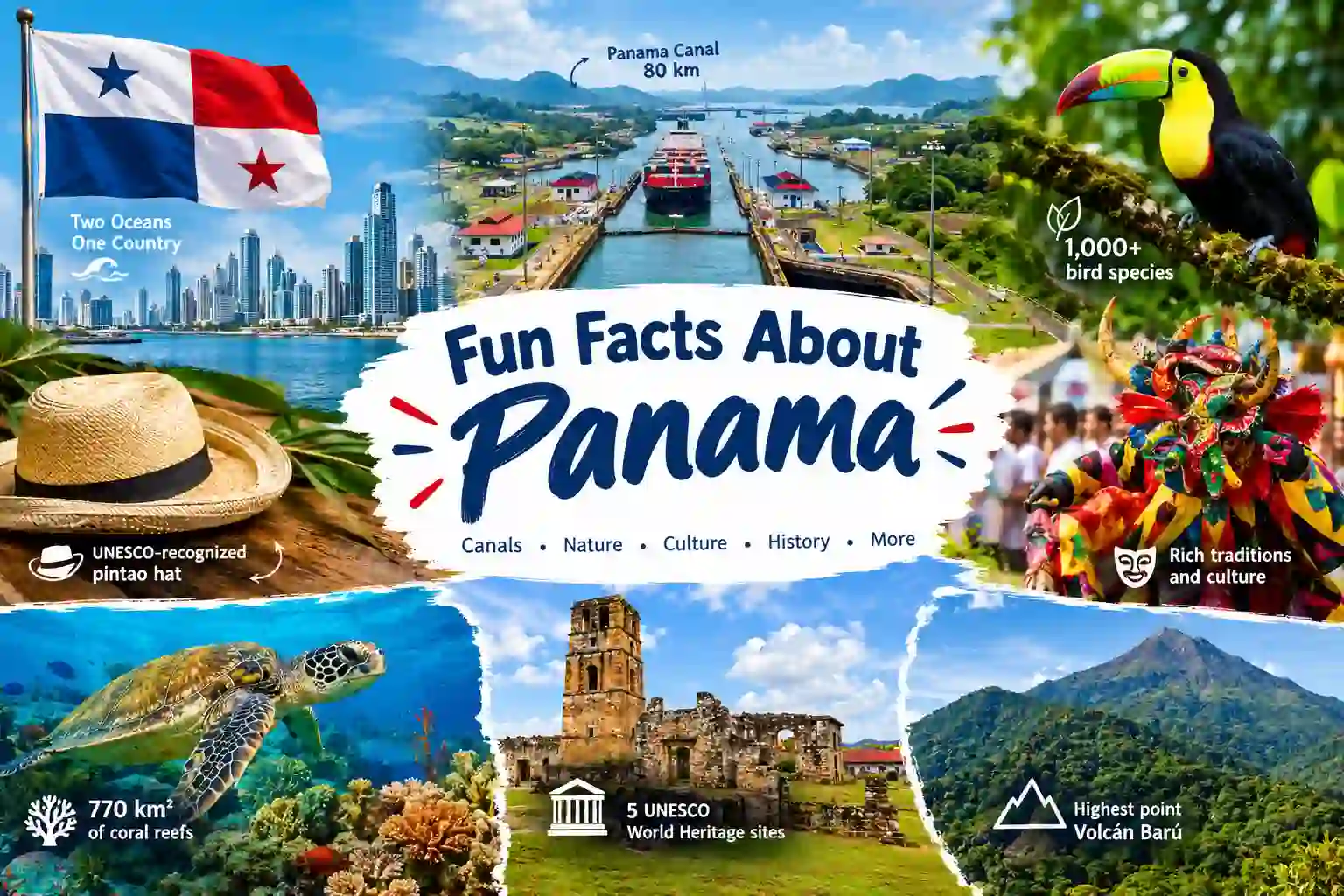
Panama may look small on a map, but its story is huge. The country links two oceans, two continents, and major world trade routes. The Panama Canal stretches about 80 kilometers across the country. Its locks lift ships 26 meters above sea level. Panama is also a biodiversity hotspot, with more than 1,000 bird species and thousands of other plants and animals recorded across its forests, mountains, reefs, and islands. These fun facts about Panama reveal much more than the famous canal. They show a country shaped by geography, trade, science, culture, and nature.
Panama at a Glance
| Feature | Fact |
| Capital | Panama City |
| Population | 4,064,780 people in the 2023 census |
| Area | About 75,000 km² |
| Official language | Spanish |
| Currency | Balboa and U.S. dollar |
| Famous waterway | Panama Canal |
| Canal length | About 80 km |
| World Heritage properties | 5 |
| Forest cover | About 67.1% of the country |
| Highest point | Volcán Barú |
1. The Panama Canal Is an Engineering Giant
1. The Panama Canal is about 80 kilometers long.
The waterway crosses Panama from the Atlantic side to the Pacific side. It uses lakes, channels, and locks rather than simply cutting a sea-level path across the country. The route became one of the world’s major shortcuts for ocean shipping.
Source: Panama Canal Authority. Panama Canal Authority — Canal history and operation
2. Ships are lifted 26 meters above sea level.
Gatun Lake sits about 26 meters above sea level. Locks raise ships from ocean level to the lake and later lower them again. Gravity supplies the freshwater used in the original lock system.
Source: Panama Canal Authority.
3. The original canal opened in 1914.
The official opening took place on August 15, 1914. The steamship SS Ancon made the celebrated opening transit. The event came just days after World War I began in Europe.
Source: Panama Canal Authority.
4. The canal expansion opened in 2016.
The expanded waterway began operating on June 26, 2016. COSCO Shipping Panama made the inaugural transit through the new Agua Clara locks. The expansion allowed much larger ships to use the canal.
Source: Panama Canal Authority.
5. The canal connects an enormous global network.
The Panama Canal currently serves more than 180 maritime routes. These routes connect 1,920 ports in 170 countries. This makes Panama’s narrow land bridge important far beyond Central America.
Source: Panama Canal Authority.
2. Panama’s Geography Creates Natural Surprises
6. Panama connects North and South America.
Panama occupies the narrow land bridge between the two continents. Its location helped make it an important route for people, animals, ships, and trade. The country’s geography also connects the Caribbean Sea with the Pacific Ocean.
Source: UNESCO and Panama Canal Authority. UNESCO — Panama World Heritage information
7. Panama faces two major bodies of water.
The Caribbean Sea lies along its northern coast. The Pacific Ocean lies along its southern coast. This unusual position gives Panama coastlines with very different marine environments.
Source: UNESCO World Heritage Centre.
8. Panama has an unusually narrow shape.
The country forms a long, curved isthmus. This narrow landform helped make a canal possible. It also made Panama a natural crossing point between ocean routes.
Source: Panama Canal Authority.
9. More than 67% of Panama has forest cover.
A 2025 environmental report from Panama’s Ministry of Environment reported about 67.1% forest coverage. These forests include tropical, mountain, and other ecosystems.
Source: Panama Ministry of Environment.
10. Panama’s 2023 census counted over four million people.
The national census recorded 4,064,780 residents. The same census found that 17.2% of the population identified as Indigenous and 31.7% as Afro-descendant.
Source: Panama National Institute of Statistics and Census.
3. Panama Is Packed With Wildlife
11. Panama has more than 1,000 bird species.
Panama’s environmental reporting lists more than 1,000 bird species. Its position between North and South America makes it an important biological bridge for wildlife.
Source: Panama Ministry of Environment. Panama Ministry of Environment — National biodiversity data
12. Panama has about 260 mammal species.
National environmental data estimates nearly 260 mammal species. These include monkeys, sloths, cats, bats, anteaters, and many other animals.
Source: Panama Ministry of Environment.
13. Panama has more than 1,300 fish species.
Its rivers, coastal waters, reefs, and offshore marine zones support exceptional fish diversity. The country’s two-ocean geography helps explain this broad range of aquatic habitats.
Source: Panama Ministry of Environment.
14. Coiba is an important natural laboratory.
Coiba National Park protects Coiba Island, 38 smaller islands, and surrounding marine areas. UNESCO describes the site as an important natural laboratory because of its exceptional biodiversity and endemism.
Source: UNESCO.
15. Panama has about 770 km² of coral reefs.
Panama’s Ministry of Environment reports approximately 770 square kilometers of coral reefs. More than 97% of that area lies in the Caribbean Sea.
Source: Panama Ministry of Environment.
4. Panama Has a Deep and Unexpected History
16. Panama City was founded in 1519.
Panama City was founded in 1519. UNESCO describes it as the first European settlement on the Pacific coast of the Americas. Its location made it an important base for Spanish movement and trade.
Source: UNESCO World Heritage Centre. UNESCO — Archaeological Site and Historic Centre of Panamá City
17. The original Panama City was attacked by Henry Morgan.
The old settlement was destroyed during Henry Morgan’s invasion in 1671. It was never rebuilt in its original location. The city was officially moved to a nearby peninsula in 1673.
Source: UNESCO.
18. Panama separated from Spain in 1821.
Panama declared independence from Spain in 1821. It then became part of Gran Colombia, a political union that included present-day Colombia, Ecuador, and Venezuela.
Source: CIA World Factbook archive.
19. Panama separated from Colombia in 1903.
Panama declared independence from Colombia in 1903. The political change soon became closely connected with plans for constructing the Panama Canal.
Source: CIA World Factbook archive.
20. Panama now has five UNESCO World Heritage properties.
UNESCO currently lists five World Heritage properties for Panama. They include three natural properties and two cultural properties, including the Colonial Transisthmian Route added in 2025.
Source: UNESCO World Heritage Centre.
5. Panama’s Culture Has Global Recognition
21. Panama’s traditional pinta’o hat has UNESCO recognition.
The artisanal techniques used to make Panama’s pinta’o hat were added to UNESCO’s Representative List in 2017. The craft uses plant fibers and traditional processing methods.
Source: UNESCO. UNESCO — Panama’s Intangible Cultural Heritage
22. Congo culture is part of UNESCO’s intangible heritage list.
Panama’s ritual and festive expressions of Congo culture were inscribed by UNESCO in 2018. The tradition reflects African cultural roots and colonial history.
Source: UNESCO.
23. Corpus Christi traditions are also internationally recognized.
Panama’s dances and expressions linked with Corpus Christi were added to UNESCO’s Representative List in 2021. The celebrations combine religious traditions, costumes, masks, dances, and public performances.
Source: UNESCO.
24. Traditional mud-house building became UNESCO heritage in 2025.
The construction of quincha houses and the related junta de embarre technique were placed on UNESCO’s Urgent Safeguarding List in 2025. The practice uses materials such as clay, natural fibers, plants, and wood.
Source: UNESCO.
25. Panama’s national symbols have three official parts.
Panama legally recognizes the national flag, national anthem, and coat of arms as its national symbols. November 4 has been observed as the Day of the Patriotic Symbols since 2013.
Source: Embassy of Panama.
6. Panama Is Also a Living Science Laboratory
26. Barro Colorado Island was created by the canal project.
Barro Colorado Island formed when the Chagres River valley was flooded during canal construction. The island later became a major center for tropical research.
Source: Smithsonian Tropical Research Institute. Smithsonian Tropical Research Institute — Barro Colorado Island research
27. Scientists have studied Barro Colorado Island for about a century.
The Smithsonian’s research station on Barro Colorado Island began its scientific work in the 1920s. Researchers have used the island to study tropical plants, animals, insects, and ecosystems over many decades.
Source: Smithsonian Tropical Research Institute.
28. Panama has become a major center for tropical science.
The Smithsonian Tropical Research Institute operates research facilities in Panama. Scientists study forests, reefs, wildlife, climate, disease, and ecological change across the country.
Source: Smithsonian Tropical Research Institute.
29. Panama’s golden frog disappeared from the wild.
Researchers have not recorded a Panamanian golden frog in the wild since 2009. Conservation groups are now working on captive breeding and reintroduction efforts. In 2026, researchers reported a trial release of 100 captive-bred frogs.
Source: Smithsonian Institution.
30. Scientists recently rediscovered four missing frog populations.
In 2026, researchers reported rediscovering four amphibian populations that had been missing from Panama’s mountain forests for many years. Acoustic technology helped researchers detect their calls.
Source: Smithsonian Institution.
Sounds Fake but True
Panama’s most surprising fact may be its currency system. The country uses the U.S. dollar as its main means of payment. Its national currency, the balboa, exists as coins and is fixed at one balboa per U.S. dollar.
Another strange-sounding fact is that an entire island used for tropical research was created by the flooding caused by Panama Canal construction.
FAQ: Fun Facts About Panama
1. What is Panama best known for?
Panama is best known for the Panama Canal. The canal connects Atlantic and Pacific shipping routes and stretches about 80 kilometers across the country.
2. How many UNESCO World Heritage sites does Panama have?
UNESCO currently lists five World Heritage properties in Panama. They include cultural and natural sites.
3. What is unusual about Panama’s currency?
Panama uses the U.S. dollar as its main means of payment. The balboa remains the national currency unit, with coins circulating alongside U.S. coins. One balboa equals one U.S. dollar.
4. What makes Coiba National Park special?
Coiba protects a large island, smaller islands, and surrounding marine areas. UNESCO highlights its high endemism and importance for threatened wildlife and marine species.
5. When did the Panama Canal expansion open?
The expanded Panama Canal opened on June 26, 2016. COSCO Shipping Panama made the inaugural transit through the new locks.
6. Why is Panama important for biodiversity?
Panama sits between North and South America. Its forests, mountains, wetlands, reefs, and two ocean coastlines create many habitats. Its location also makes it an important biological connection.
7. When was Panama City founded?
Panama City was founded in 1519. UNESCO identifies the original settlement as the founding place of Panama City.
8. What traditional Panamanian craft has UNESCO recognition?
The traditional techniques used to make the pinta’o hat were added to UNESCO’s Intangible Cultural Heritage list in 2017.
Conclusion
These fun facts about Panama show why this small country has global importance. Its canal changed ocean shipping. Its forests and reefs support remarkable biodiversity. Its historic cities preserve centuries of cultural exchange. Panama also protects traditions that range from hat-making to Congo celebrations and traditional house building. Science adds another layer, with researchers using places such as Barro Colorado Island as long-term tropical laboratories. Even its currency has an unusual story. Panama is more than a canal cutting through Central America. It is a meeting point for oceans, continents, cultures, wildlife, and ideas.

hello! I am Irshad Ullah, and a passionate writer and lifelong learner dedicated to uncovering fascinating facts about science, history, nature, animals, space, and the world around us. I research each topic carefully and transform surprising information into clear, engaging, and enjoyable content. My goal is to satisfy curiosity, inspire learning, and help readers discover something amazing every day.