
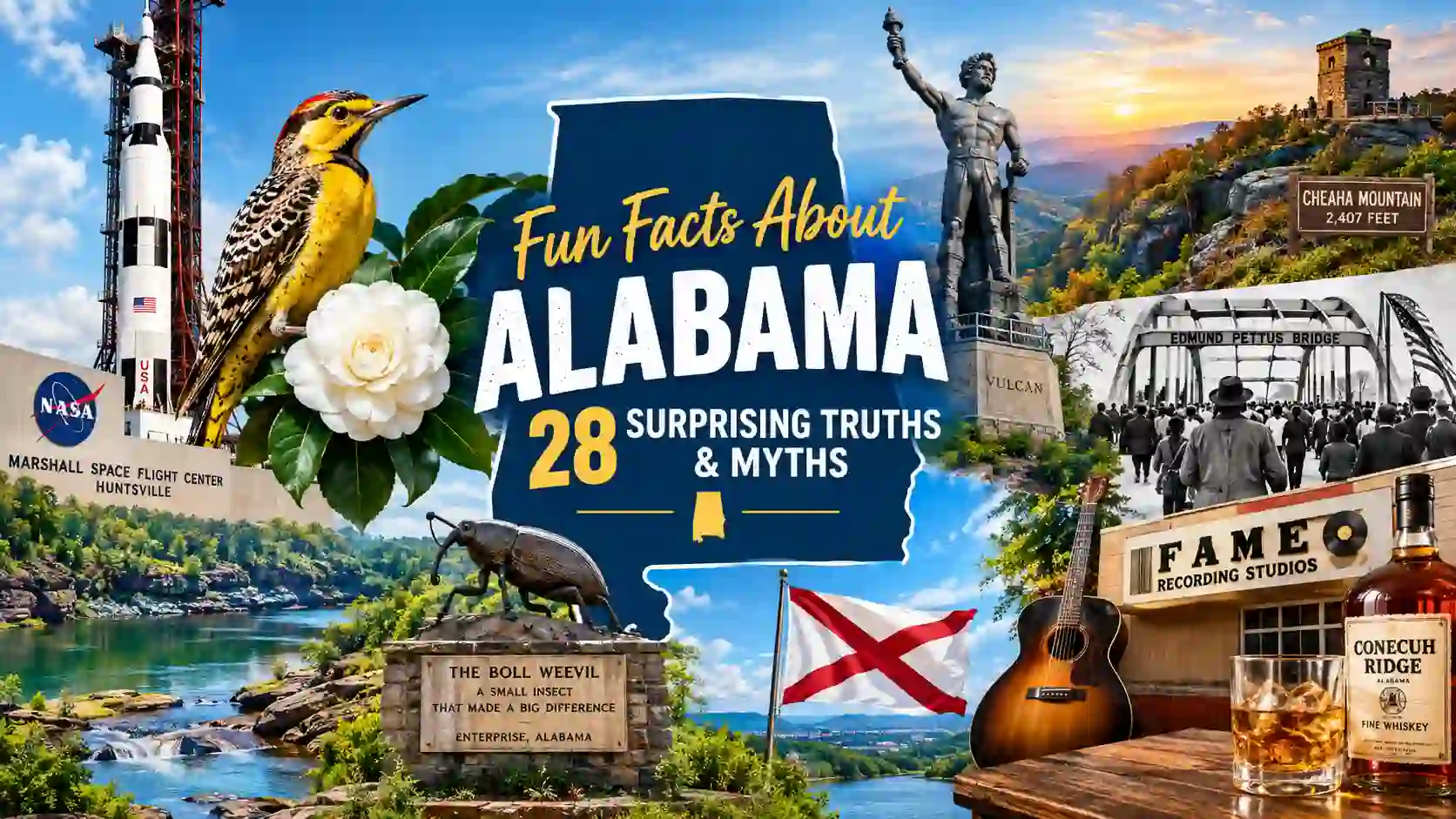
The best fun facts about Alabama rarely make the usual lists. This state leads the nation in freshwater species. One Alabama town built a monument to a beetle. NASA’s Huntsville center led work on the Saturn V rocket that carried astronauts to the Moon. Even the official state whiskey comes from Kentucky.
Alabama also loves a big claim. So I checked each record against archives, park services, and NASA. Where a claim gets shaky, I flag it. You’ll find 28 facts, three popular myths, and quick answers to seven common questions about this Southern state.
Alabama at a Glance
| Detail | Fast fact |
| Statehood | December 14, 1819 (22nd state) |
| Capital | Montgomery, since 1847 |
| Largest city | Huntsville, 215,006 people (2020 Census) |
| Population | 5,024,279 in 2020; about 5.19 million in July 2025 (Census estimate) |
| Size | About 52,400 square miles; 30th largest state |
| Counties | 67 |
| Highest point | Cheaha Mountain, 2,407 feet |
| Lowest point | Gulf of Mexico shoreline, at sea level |
| State bird | Yellowhammer (common flicker), named in 1927 |
| State motto | “Audemus jura nostra defendere” (“We dare defend our rights”) |
More Fun Facts About Alabama Live Underwater
- Alabama ranks first in the nation for five freshwater groups. They are fish, mussels, snails, crayfish, and turtles. One widely cited ranking also puts it fourth among states for total species, with more than 6,350. That makes it the most biodiverse state east of the Mississippi River.
- The shares are huge. The Geological Survey of Alabama says the state holds about 27 percent of North America’s fish species. It also holds roughly 61 percent of its freshwater mussels and 57 percent of its freshwater turtles. Other sources round the mussel share to 59 or 60 percent. The ranking stays the same.
- Alabama has more than 132,000 miles of rivers and streams. State geologists estimate a big share. About 10 percent of the freshwater in the lower 48 states starts in or flows through Alabama. That is an estimate, not a precise count. The fine print is sadder. Dams and pollution helped push Alabama to second place for extinctions, with 82 species lost.
- Alabama also leads the nation in carnivorous plant diversity. Its caves hold the third most diverse cave fauna in the temperate world. In the first decade of the 2000s, scientists found at least 76 new species in the state. Two were trapdoor spiders. One is named for musician Neil Young.
Source: Encyclopedia of Alabama, “Biodiversity in Alabama”
Rocket City: Where the Moon Rocket Took Shape
- NASA’s Marshall Space Flight Center opened in Huntsville on July 1, 1960. Wernher von Braun became its first director. The center grew out of the Army’s rocket team at Redstone Arsenal. That move made Huntsville NASA’s propulsion hub. The city now goes by “Rocket City.”
- The Saturn V stood 363 feet tall. That beats the Statue of Liberty. NASA says its engines made as much power as 85 Hoover Dams. Marshall led the rocket’s development, and Saturn V rockets sent Apollo crews toward the Moon. NASA also lists Skylab, Hubble, and Chandra work in Marshall’s record.
Source: NASA, Marshall Space Flight Center history
- In 1961, Alan Shepard became the first American in space. A Mercury-Redstone rocket lifted him. Its design came from the Marshall team’s Redstone work. Later, Marshall designed the lunar rover. Apollo astronauts drove it on the Moon during the last three landings, in 1971 and 1972.
- Huntsville is now Alabama’s largest city. The 2020 Census counted 215,006 people there, ahead of Birmingham at 200,733. Census Bureau estimates put Huntsville at 230,402 in 2024. The city added 56,790 people between 2000 and 2020. Birmingham still anchors the state’s largest metro area, as of the 2020 Census.
Freedom Trails: Where Alabama Changed the Country
- The Selma to Montgomery route runs 54 miles. Congress made it a National Historic Trail in 1996. The National Park Service runs three visitor centers along it, in Selma, Lowndes County, and Montgomery. You can follow the 1965 voting rights march mile by mile.
Source: National Park Service, Selma to Montgomery National Historic Trail
- On March 7, 1965, about 600 marchers left Selma. Troopers and deputies attacked them on the Edmund Pettus Bridge. The day became known as Bloody Sunday. A later march began March 21. It reached the Capitol on March 25 with about 25,000 people. President Johnson signed the Voting Rights Act five months after that.
- The first Tuskegee Airmen class began training in July 1941 with 13 cadets. Only five earned their wings on March 7, 1942. Moton Field in Tuskegee gave primary flight training to nearly 1,000 Black pilots. Congress created Tuskegee Airmen National Historic Site in 1998.
- On May 14, 1961, a mob attacked a bus of Freedom Riders in Anniston. Attackers then firebombed the bus six miles outside town. President Obama created Freedom Riders National Monument there in January 2017. Anniston’s city website calls it the first national monument about the Freedom Rides.
A Beetle Monument, an Iron Giant, and Kentucky Whiskey
- In 1919, the town of Enterprise built a monument to a beetle. The boll weevil had wrecked local cotton crops. Farmers switched to peanuts and did better. The monument thanks the insect for the prosperity that followed. The Encyclopedia of Alabama calls it the only known memorial to a pest.
- Birmingham’s Vulcan is the largest cast iron statue in the world. He stands 56 feet tall. Sculptor Giuseppe Moretti made him for the 1904 World’s Fair in St. Louis. Vulcan is the Roman god of fire and the forge. Birmingham chose him to show off its industrial might.
- Vulcan was nearly shorter. Planners first wanted a 50-foot figure. They added six feet to top a 52-foot bronze Buddha in Tokyo. The statue now stands on Red Mountain above Birmingham. Its iron roots live on in the state mineral, hematite, or red iron ore, chosen in 1967.
- Alabama’s list of state symbols includes an official spirit: Conecuh Ridge Alabama Fine Whiskey. Lawmakers picked it in 2004. The company is based in Union Springs, Alabama. But the whiskey is made in Kentucky with ingredients shipped from Alabama. The state also has an official cake, the Lane cake, and an official vegetable, the sweet potato.
Source: Encyclopedia of Alabama, Quick Facts and State Symbols
The Sound Made in the Shoals
- FAME Music opened in 1959 in Florence. The Muscle Shoals National Heritage Area calls it the first successful professional recording studio in Alabama. It also calls FAME the birthplace of the Muscle Shoals Sound. The studio still records artists and hosts tours.
Source: Muscle Shoals National Heritage Area, Music Heritage
- In 1961, Arthur Alexander cut “You Better Move On” at FAME. That hit helped launch the Muscle Shoals Sound. Later hits came from Percy Sledge, Aretha Franklin, Wilson Pickett, the Osmonds, and the Rolling Stones. The heritage area calls the region the “Hit Recording Capital of the World.”
- In 1969, four FAME session players opened their own studio at 3614 Jackson Highway in Sheffield. Lynyrd Skynyrd later name-checked them as “the Swampers.” That year, the Rolling Stones recorded “Wild Horses” and “Brown Sugar” there. I found tourism pages that credit other famous songs to the Shoals. I could not confirm them, so I left them out.
- More than a dozen recording studios worked in the Shoals in the second half of the 1900s. Tune Records, the first record company in Alabama, started there in the 1950s. Releases from FAME have sold more than 300 million copies worldwide, the heritage area says.
Peaks, Canyons, and Caves
- Cheaha Mountain is Alabama’s highest point. Alabama State Parks lists it at 2,407 feet. I found figures from 2,405 to 2,413 feet in other references, so treat the last digits with care. The name comes from the Creek word “chaha,” often translated as “high place.”
- Cheaha State Park opened in 1933. It is Alabama’s oldest continuously operating state park. Civilian Conservation Corps crews built its stone Bunker Tower on the summit. The tower’s walls are six feet thick. It houses a CCC museum. It carries the name of Alabama’s first state parks director.
- Little River flows for most of its length on top of Lookout Mountain. The National Park Service calls the river unique for that. It has carved a canyon more than 600 feet deep in places. That makes it the deepest canyon in Alabama and one of the deepest east of the Mississippi River.
Source: National Park Service, Little River Canyon National Preserve
- At Cathedral Caverns State Park, a stalagmite named Goliath stands 45 feet tall and measures 243 feet around. The cave stays about 60 degrees all year. The entrance is 126 feet wide. Another source says 128. Alabama State Parks calls it a “possible” world record for a commercial cave.
Older Than the State: Mounds, Mardi Gras, and a Lost Ship
- Moundville was a planned city on the Black Warrior River, founded around 1120. Its builders shaped a 185-acre site and set 29 earthen mounds around a huge plaza. No written records survive, so archaeology tells the story. Other sources count 26 to 32 mounds. Only Cahokia in Illinois ranks higher in size and complexity.
- Mobile has celebrated Mardi Gras since 1703. French settlers founded the town in 1702 as capital of French Louisiana. New Orleans did not exist until 1718. Historians credit Mobile with the first organized Carnival in the United States. The Mobile Carnival Museum’s curator agrees.
- The Clotilda was the last known ship to bring enslaved Africans to the United States. It reached Mobile in 1860. It carried 110 people from Benin. Its captain burned it to hide the crime. The Alabama Historical Commission confirmed the wreck in May 2019. Descendants of the survivors still live in Africatown.
Source: Encyclopedia of Alabama, “Clotilda”
- Alabama became the 22nd state on December 14, 1819. It has had five capitals, counting its territorial one at St. Stephens. The others were Huntsville, Cahaba, Tuscaloosa, and Montgomery. The Encyclopedia of Alabama dates Montgomery’s start to 1847. Other sources say 1846. Source: encyclopediaofalabamamysticstamp
Myths vs. Reality
Some of the most repeated interesting facts about Alabama fail a fact-check.
| Popular myth | What the record shows |
| “Alabama” means “Here We Rest.” | The phrase spread in the 1850s. Its first known use was an 1842 newspaper article. Experts in Muskogee languages found no such phrase. The state name comes from the Alabama tribe. |
| Alabama was the first state to make Christmas a legal holiday, in 1836. | State archivists found no evidence for the claim. The legislature first named Christmas a bank holiday in 1848. |
| Alabama has an official nickname. | It does not. “Heart of Dixie” and “Yellowhammer State” are common, but neither is official. |
Source: Alabama Department of Archives and History, Alabama Fast Facts
Frequently Asked Questions
How many counties does Alabama have?
Alabama has 67 counties, according to the state archives. Washington County is the oldest. It dates to June 4, 1800, when the land belonged to Mississippi Territory. Houston County is the newest. It dates to February 9, 1903.
Source: alabama
How big is Alabama compared with other states?
Alabama is about 330 miles long and 190 miles wide at its farthest points. It covers roughly 52,400 square miles, which ranks 30th among the states. Sources differ by a few square miles.
Source: alabama
What is Alabama’s state flower?
The camellia. Lawmakers named it in 1959. The Japanese camellia is not native to Alabama. It replaced goldenrod, which had been the state flower since 1927.
Source: encyclopediaofalabama
Why is Alabama called the Yellowhammer State?
The yellowhammer is the state bird. It is a woodpecker also known as the common flicker. Alabama has used the nickname since the Civil War, when Confederate soldiers from the state were called yellowhammers. Lawmakers made the bird official in 1927.
Source: encyclopediaofalabama
When did Alabama become a state, and who was its first governor?
Alabama joined the Union on December 14, 1819. A constitutional convention met in Huntsville that July. William Wyatt Bibb, the territorial governor, became the first state governor.
Source: encyclopediaofalabama
What is Alabama’s state fossil?
Basilosaurus cetoides, a prehistoric whale. It could reach 70 feet long. People first found one in Clarke County in 1833. Alabama named it the state fossil in 1984.
Discover 28 verified fun facts about Alabama, from Huntsville’s Saturn V rocket to a monument honoring a beetle, plus 3 popular myths debunked with sources.
Discover 28 verified fun facts about Alabama, from Huntsville’s Saturn V rocket to a monument honoring a beetle, plus 3 popular myths debunked with sources.
Source: encyclopediaofalabama
What is the Alabama state quilt?
The Pine Burr Quilt. Lawmakers chose it in 1997. It honors the quilters of Gee’s Bend and the Freedom Quilting Bee. It also ties to the civil rights movement.
Source: encyclopediaofalabama
Conclusion
The best fun facts about Alabama share one trait. They reward a second look. A beetle gets a statue. A famous whiskey comes from Kentucky. A mountain gains or loses a few feet depending on who measures it. A popular phrase about the state’s name falls apart in the archives.
Alabama is not a state of easy slogans. Rivers here hold national records. Rockets left its labs for the Moon. Ordinary people walked 54 miles to change a law. Check the fine print. Then go see it. Start on Cheaha’s summit. End on the bridge in Selma.

hello! I am Irshad Ullah, and a passionate writer and lifelong learner dedicated to uncovering fascinating facts about science, history, nature, animals, space, and the world around us. I research each topic carefully and transform surprising information into clear, engaging, and enjoyable content. My goal is to satisfy curiosity, inspire learning, and help readers discover something amazing every day.