
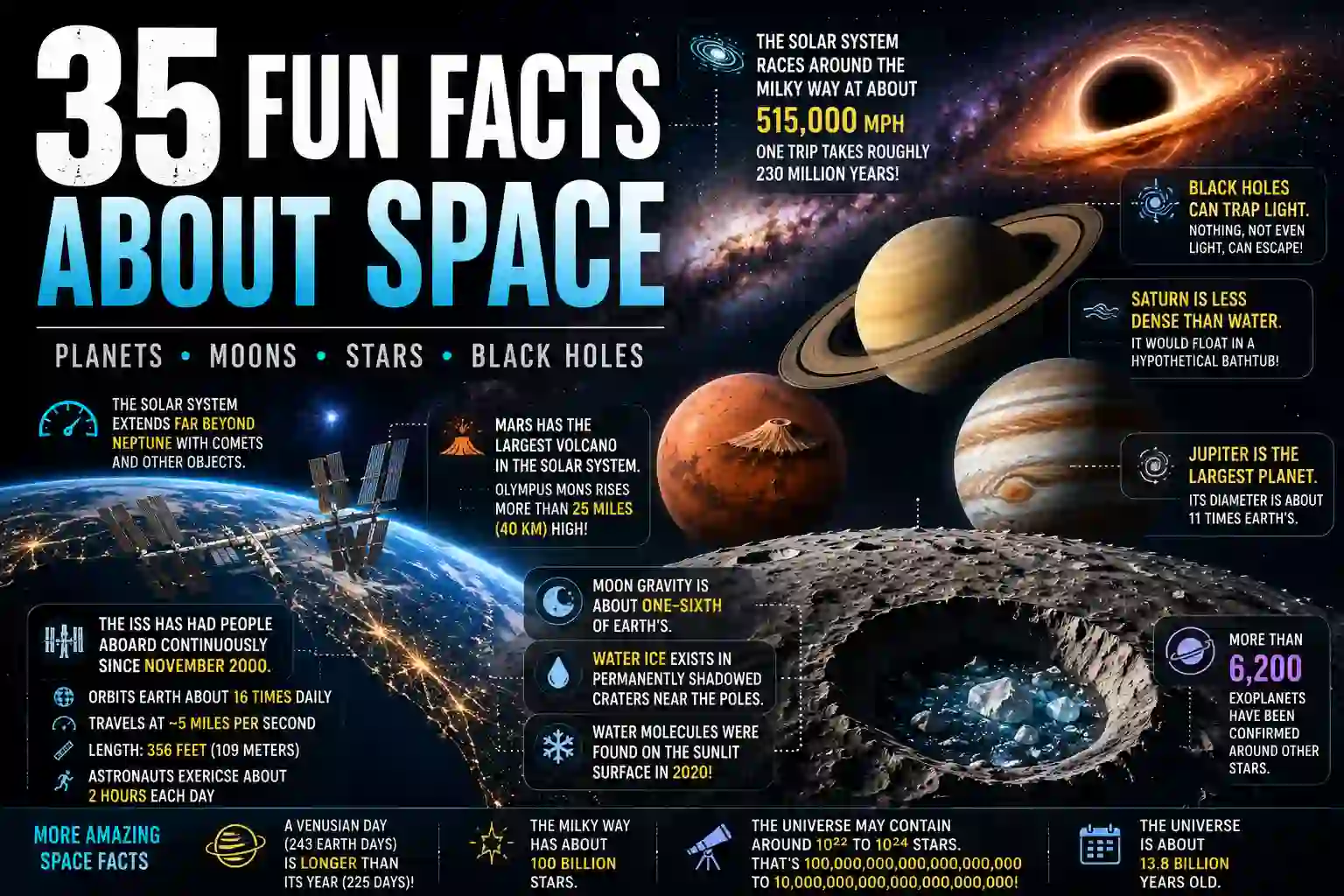
Space is far stranger than most science-fiction stories suggest. Our solar system races around the Milky Way at about 515,000 mph. Venus has a day longer than its year. The Moon has water ice hidden inside permanently dark craters. And scientists have confirmed more than 6,200 exoplanets around other stars.
These fun facts about space show how unusual our cosmic neighborhood really is. Some facts are about planets and moons. Others reveal strange stars, black holes, galaxies, and human activity beyond Earth. The deeper we look, the more surprising space becomes.
Space at a Glance
| Feature | Key fact |
| Planets in our solar system | 8 |
| Officially named dwarf planets | 5 |
| Milky Way | A barred spiral galaxy |
| Solar system galactic speed | About 515,000 mph |
| Solar system orbit around Milky Way | About 230 million years |
| Confirmed exoplanets | More than 6,200 |
| ISS continuous human presence | Since November 2000 |
| Earth’s distance from Sun | About 150.2 million km |
| Moon gravity | About one-sixth of Earth’s |
1. Our Solar System Is Always Moving
1. The Solar System Races Around the Milky Way
Earth may feel still beneath your feet, but it is moving incredibly fast. Our entire solar system orbits the center of the Milky Way at about 515,000 mph. One complete trip takes roughly 230 million years. This cosmic journey is sometimes called a galactic year.
Source: NASA. NASA Solar System Facts
2. The Solar System Has Eight Planets
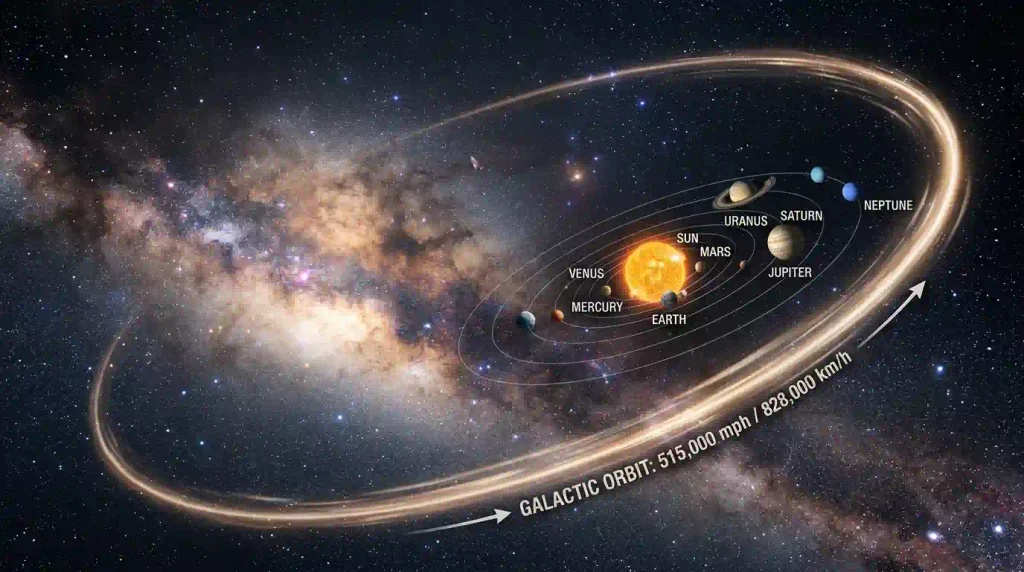
Our solar system contains eight planets. They range from small rocky worlds like Mercury to enormous gas giants like Jupiter and Saturn. It also contains dwarf planets, moons, asteroids, and comets.
Source: NASA.
3. Earth Is the Only Known World With Life
Scientists have searched many worlds for signs of life. So far, Earth remains the only place where life has been found in our solar system.
Source: NASA.
4. The Solar System Has Five Officially Named Dwarf Planets
NASA lists five officially named dwarf planets in our solar system: Ceres, Pluto, Haumea, Makemake, and Eris. They are different from the eight major planets because they have not cleared their orbital neighborhoods.
Source: NASA.
5. The Solar System Extends Far Beyond Neptune
The solar system is not simply the region containing the eight planets. Comets and other objects travel far beyond the planets. Some objects orbit at enormous distances from the Sun.
Source: NASA.
2. Planets Can Break Your Expectations
6. A Venusian Day Is Longer Than Its Year
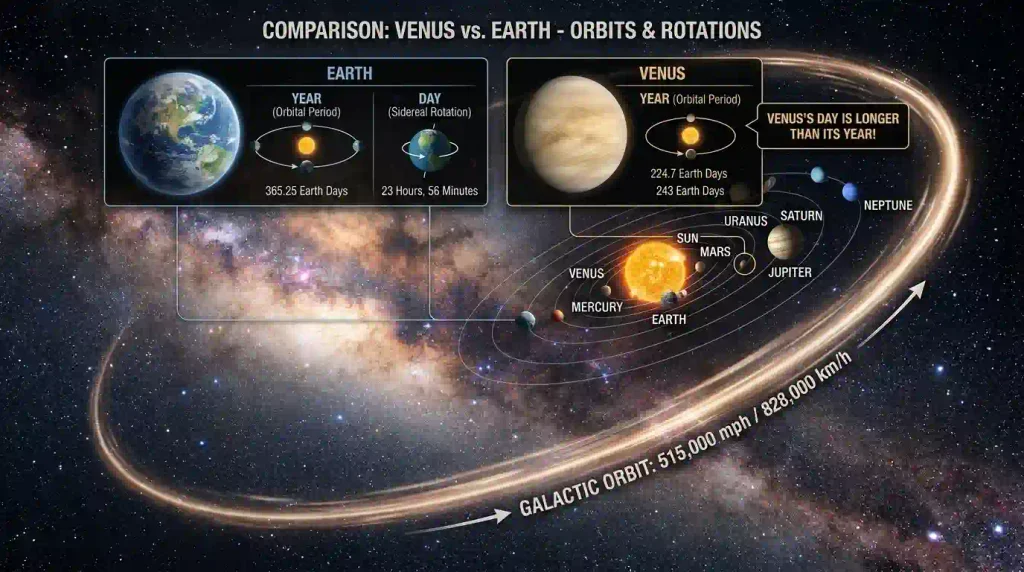
Venus takes about 243 Earth days to rotate once. Yet it completes one trip around the Sun in about 225 Earth days. That means one Venus rotation lasts longer than its year.
Source: NASA. NASA Venus Facts
7. The Sun Rises in the West on Venus
Venus rotates in the opposite direction from Earth. Because of this backward rotation, the Sun would appear to rise in the west and set in the east.
Source: NASA.
8. Venus Is Hotter Than Mercury
Mercury is closer to the Sun. Yet Venus is the hottest planet in our solar system. Its thick atmosphere traps heat through a powerful greenhouse effect.
Source: NASA.
9. Saturn Is Less Dense Than Water
Saturn has an average density lower than water. In a hypothetical bathtub large enough to hold it, Saturn would float.
Source: NASA. NASA Saturn Facts
10. Saturn Has No Solid Surface
Saturn is a gas giant. It does not have a solid surface like Earth. Deeper inside, pressure becomes so extreme that gases and liquids behave very differently from familiar materials.
Source: NASA.
3. The Moon Is Stranger Than It Looks
11. Moon Gravity Is About One-Sixth of Earth’s
The Moon’s surface gravity is about one-sixth of Earth’s. This is why astronauts could make their famous bouncing movements during lunar walks.
Source: NASA. NASA Moon Facts
12. The Moon Contains Water Ice
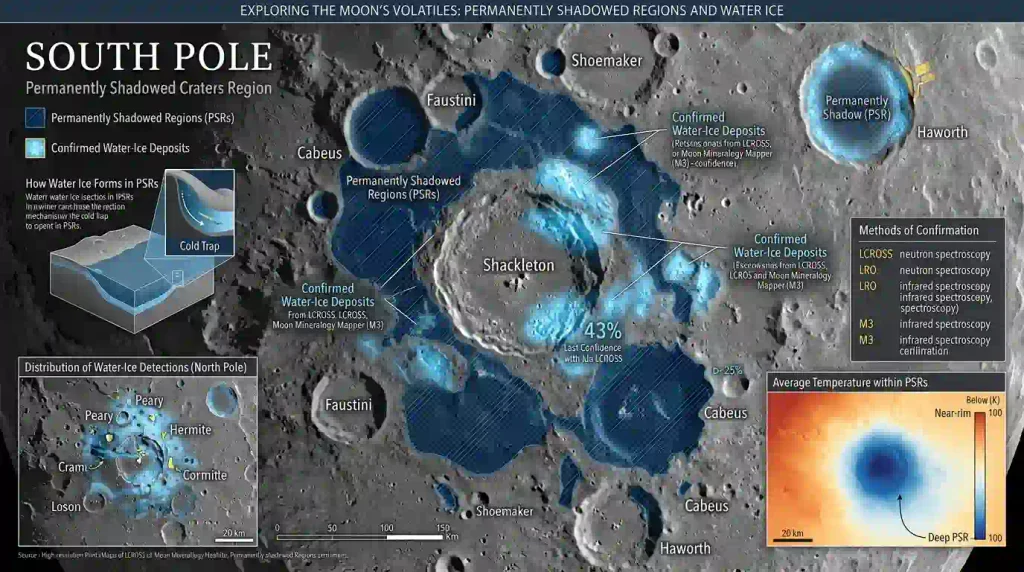
The Moon is not completely dry. Scientists have confirmed water ice in permanently shadowed regions near its poles.
Source: NASA.
13. Some Lunar Craters Never See Sunlight
Certain craters near the lunar poles remain permanently shadowed. Their locations can stay extremely cold because sunlight never reaches their floors.
Source: NASA.
14. Water Also Exists on Sunlit Lunar Ground
NASA’s SOFIA observatory confirmed water molecules on the sunlit surface of the Moon in 2020. The finding showed that lunar water is not limited to permanently dark regions.
Source: NASA.
15. Lunar Water Is Very Different From Earth’s Water
Much of the Moon’s known water exists as ice or as molecules bound within lunar soil. The Moon does not have Earth’s lakes, rivers, and oceans.
Source: NASA.
4. Mars Has Some Huge Surprises
16. Mars Has the Solar System’s Largest Volcano
Olympus Mons on Mars is the largest volcano in the solar system. NASA estimates that it rises more than 25 miles, or about 40 kilometers, from base to summit.
Source: NASA. NASA Mars Facts
17. Olympus Mons Is Wider Than You Might Imagine
Olympus Mons covers an enormous area. Its broad base stretches for hundreds of kilometers across the Martian surface.
Source: NASA.
18. Mars Once Had Flowing Water
Mars has ancient river valleys, deltas, and lakebeds. These features provide strong evidence that liquid water once flowed across parts of the planet.
Source: NASA.
19. Mars Still Has Water Today
Water remains on Mars, mainly as ice beneath the surface and around the polar regions. The thin atmosphere makes stable liquid water difficult on the surface today.
Source: NASA.
20. Mars Can Have Giant Dust Storms
Strong Martian winds can lift dust across huge areas. Some dust storms become large enough to cover much of the planet.
Source: NASA.
5. Stars and Planets Become Mind-Bending
21. The Universe May Contain Around 10²² to 10²⁴ Stars
Scientists cannot count every star individually. ESA explains that rough estimates place the total number of stars in the universe somewhere around 10²² to 10²⁴.
Source: ESA. European Space Agency: How Many Stars Are There?
22. The Milky Way Alone Has About 100 Billion Stars
ESA estimates that the Milky Way contains roughly 100 billion stars. Our Sun is only one member of this enormous stellar population.
Source: ESA.
23. Thousands of Planets Orbit Other Stars
Scientists have confirmed more than 6,200 exoplanets. These are planets outside our solar system that orbit other stars.
Source: NASA. NASA Exoplanet Exploration
24. Exoplanets Were First Confirmed in the 1990s
The idea of planets around other stars is ancient. However, the first confirmed exoplanets were discovered only in the 1990s.
Source: NASA.
25. Many More Exoplanets May Be Waiting
Confirmed exoplanets represent only the planets scientists have identified with enough evidence. Thousands of additional candidates still require further observations.
Source: NASA.
6. Black Holes Rewrite Everyday Physics
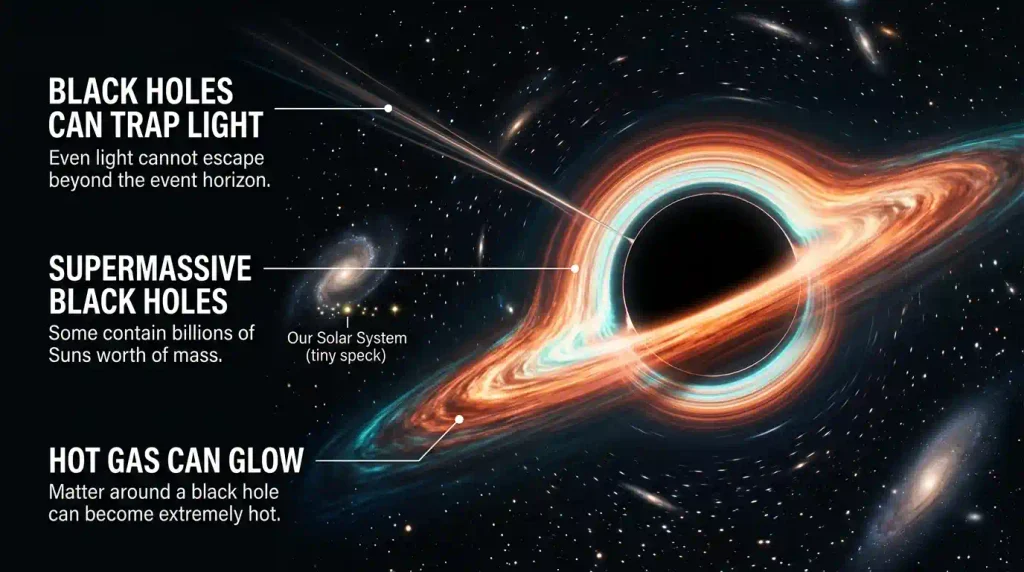
26. Black Holes Can Trap Light
A black hole has an event horizon. Inside this boundary, the escape speed becomes greater than the speed of light. As a result, even light cannot escape.
Source: NASA. NASA: What Are Black Holes?
27. Black Holes Are Not Empty Holes
Despite their name, black holes are not simple holes in space. They are regions containing extremely concentrated matter and gravity.
Source: NASA.
28. Some Black Holes Are Supermassive
Supermassive black holes can contain hundreds of thousands to billions of times the Sun’s mass. They are found at the centers of many large galaxies.
Source: NASA.
29. We Can Detect Black Holes Without Seeing Them Directly
Black holes themselves do not emit visible light from inside their event horizons. Astronomers can detect their presence by observing effects on nearby stars, gas, and other matter.
Source: NASA.
30. Matter Around a Black Hole Can Glow
Gas falling toward a black hole can form a hot accretion disk. Friction and compression can heat this material to extreme temperatures, producing powerful radiation.
Source: NASA.
7. Humans Have Built a Home in Orbit
31. The ISS Has Had People Aboard Continuously Since 2000
The International Space Station has been continuously occupied since November 2000. It serves as a laboratory where astronauts perform experiments in microgravity.
Source: NASA. NASA International Space Station Facts and Figures
32. The ISS Travels Around Earth About 16 Times Daily
The station orbits Earth about 16 times in 24 hours. Astronauts can therefore experience roughly 16 sunrises and 16 sunsets in one day.
Source: NASA.
33. The ISS Travels About Five Miles Per Second
The station moves at roughly five miles per second while orbiting Earth. That is fast enough to circle the planet in about 90 minutes.
Source: NASA.
34. The ISS Is Longer Than a Football Field
The station measures about 109 meters, or 356 feet, end to end. Its solar-array wingspan is longer than an Airbus A380 passenger aircraft.
Source: NASA.
35. Astronauts Exercise for About Two Hours Each Day
Microgravity causes muscles and bones to lose strength. Astronauts therefore exercise for about two hours each day while aboard the station.
Source: NASA.
Sounds Fake but True
Space contains several facts that sound like science fiction.
- A year can be shorter than a day: This happens on Venus because its rotation takes longer than its trip around the Sun.
- A planet can float: Saturn’s average density is lower than water.
- The Moon has water: Much of it is frozen or trapped in lunar soil.
- A volcano can rise 40 kilometers high: Olympus Mons reaches more than 25 miles above its base.
- A station can see many sunsets daily: The ISS circles Earth about 16 times each day.
3-Question Space Quiz
1. Which planet has a day longer than its year?
A. Mars
B. Venus
C. Mercury
D. Saturn
Answer: B. Venus.
2. Where is the largest volcano in the solar system?
A. Earth
B. Venus
C. Mars
D. Jupiter
Answer: C. Mars.
3. Which object has gravity strong enough to trap light?
A. Asteroid
B. Black hole
C. Moon
D. Comet
Answer: B. Black hole.
FAQ: Fun Facts About Space
How many planets are in our solar system?
There are eight officially recognized planets. They are Mercury, Venus, Earth, Mars, Jupiter, Saturn, Uranus, and Neptune.
What is the biggest planet in our solar system?
Jupiter is the largest planet in our solar system. Its diameter is roughly 11 times Earth’s diameter.
How old is the universe?
Current scientific measurements place the universe at about 13.8 billion years old. This estimate comes from observations of the universe’s expansion and its early light.
Is there sound in space?
Ordinary sound needs matter, such as air, to travel. Most of space is an extremely good vacuum, so sound cannot travel through it like it does through Earth’s atmosphere.
Can humans live on Mars without spacesuits?
No. Mars has a very thin atmosphere and cannot provide humans with breathable air or Earth-like pressure. A person would need a life-support system.
Why does space look black?
Space appears black because there is very little matter to scatter sunlight. Stars can shine brightly, but the surrounding vacuum remains dark.
Can a spacecraft fly through a planet like Saturn?
No. Saturn has no solid surface, but its atmosphere becomes increasingly dense and pressurized with depth. A spacecraft would eventually face crushing pressure and extreme temperatures.
Are there planets outside our solar system?
Yes. These worlds are called exoplanets. NASA has confirmed more than 6,200 of them, and researchers continue to discover more.
Conclusion
These fun facts about space reveal a universe full of extremes. Planets can have years shorter than their days. Moons can hide water in permanent darkness. Mars has a volcano far larger than anything on Earth. Black holes can trap light itself. Humans have even built a laboratory that circles Earth every 90 minutes.
Yet these facts are only a tiny part of what scientists know. New telescopes, spacecraft, and missions continue to uncover strange worlds and distant objects. Space reminds us that reality can be more surprising than imagination. The farther we look, the more questions appear.

Irshad Ullah is a content writer at Fun Facts Horizon. He researches and writes verified fun facts about countries, animals, space, history, and more for curious readers.
3 thoughts on “35 Fun Facts About Space: How You See the Universe”