
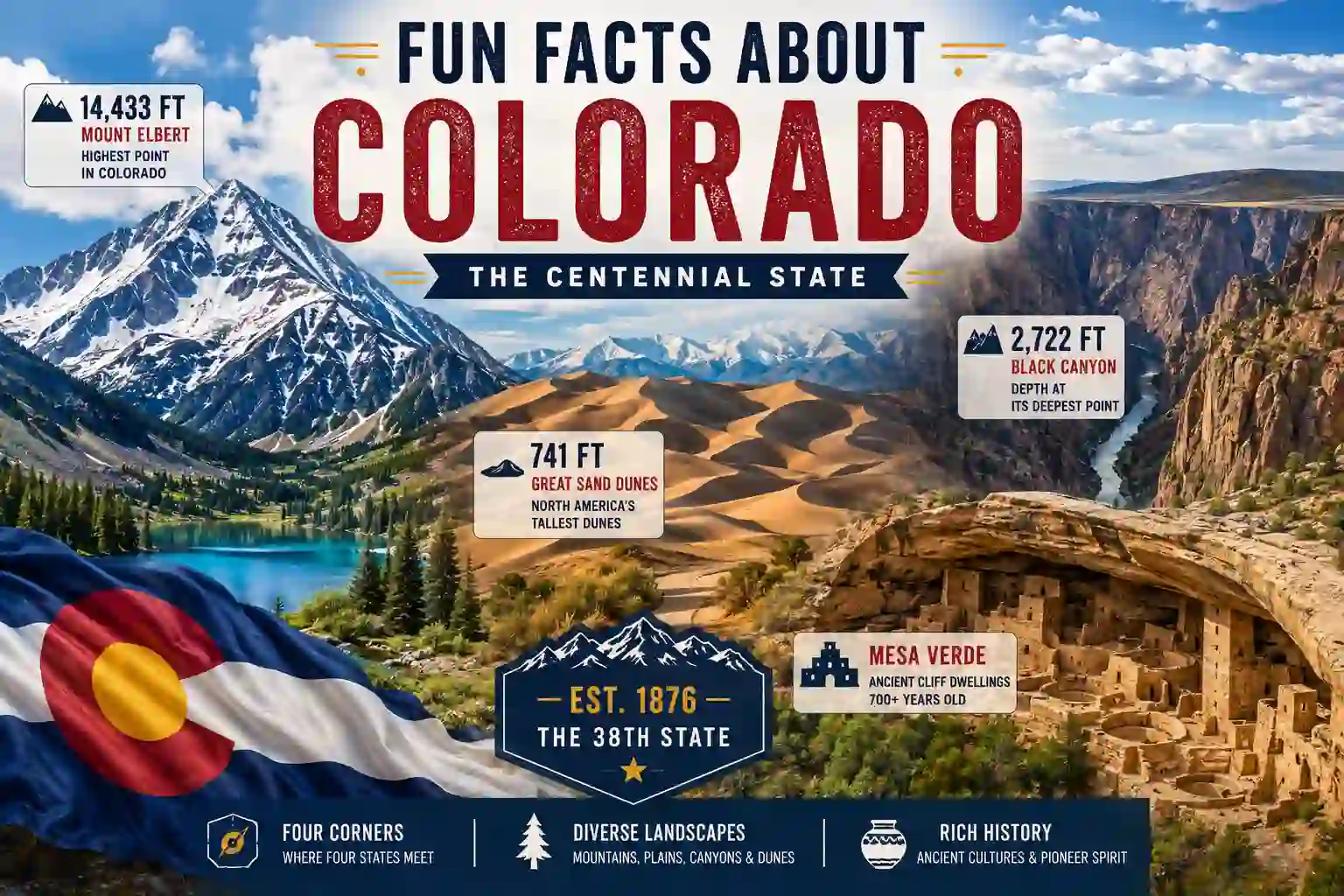
Colorado is the state that refuses to sit still. Its mountains climb past 14,000 feet, its rivers begin journeys toward two oceans, and its sand dunes, the tallest in North America, rise improbably beside snowy peaks. From the plains to the alpine tundra, a single drive can cross several climate zones and nearly two billion years of Earth’s history.
The extremes are what make Colorado memorable. Mesa Verde’s cliff dwellings, home to Ancestral Pueblo communities centuries ago, became a UNESCO World Heritage Site in 1978. Black Canyon drops 2,722 feet into rock nearly two billion years old. Denver’s ‘Mile High’ nickname is not marketing; one step of the State Capitol really sits exactly 5,280 feet above sea level.
And the surprises keep coming. The state fossil is a Stegosaurus, the state gemstone hides near the summit of Mount Antero, and the state rock helped build the Lincoln Memorial. These 28 facts travel from ancient seas to space-age science, through dunes, canyons, and the highest paved road in America.
Colorado at a Glance
| Fact | Quick Answer |
| Nickname | Centennial State |
| Statehood | August 1, 1876 |
| State capital | Denver |
| Famous high point | Mount Elbert |
| Fourteeners | More than 50 |
| Tallest dunes | Star Dune, 750 feet |
| Famous ancient site | Mesa Verde |
| State fossil | Stegosaurus |
| State flower | Columbine |
| Four Corners | Colorado, Utah, Arizona, New Mexico |
1. Colorado’s Mountains Are More Than Just Tall
Colorado’s mountains shape much of the state’s identity. They also influence water, weather, wildlife, and travel. The Rocky Mountains occupy about half the state. More than 50 Colorado peaks reach at least 14,000 feet. That gives Colorado more fourteeners than any other U.S. state.
1. Colorado has more than 50 fourteeners.
A “fourteener” is a mountain reaching at least 14,000 feet. Colorado has more of these peaks than any other state. Their high elevations attract climbers, hikers, photographers, and scientists. The exact count can vary with surveying standards and peak definitions.
2. The Rocky Mountains occupy about half of Colorado.
The mountains are not the whole state. Colorado also has broad plains, grasslands, plateaus, forests, and desert-like landscapes. This mix helps explain why Colorado can look so different from one region to another.
3. Three major U.S. rivers begin in Colorado’s mountains.
The Colorado, Rio Grande, and Arkansas rivers have headwaters in Colorado’s mountains. Water from these high landscapes travels far beyond the state, with the Colorado River eventually reaching Mexico. This makes Colorado important to water systems across the American West.
Source: U.S. Geological Survey — Colorado and Landsat
2. Colorado Has Sand Dunes Taller Than Buildings
One of my favorite Colorado surprises is the sand. Many people picture Colorado as a land of snowy peaks. Yet the state also contains enormous sand dunes. Great Sand Dunes National Park and Preserve sits in the San Luis Valley. Its tallest dune rises 750 feet above its base.
4. Colorado has North America’s tallest sand dunes.
Great Sand Dunes contains the tallest dunes in North America. Star Dune rises about 750 feet from base to crest. The dunes sit beside mountains, creating an unusual landscape of sand, snow, forests, and alpine peaks.
5. The main dunefield covers about 30 square miles.
The main dune field is much larger than it looks. It covers approximately 30 square miles. At its widest point, it stretches about six miles. Its greatest length reaches about eight miles.
6. Great Sand Dunes became a national park in 2000.
The area first became a national monument in 1932. Congress later redesignated it as a national park and preserve in 2000. The protected landscape includes dunes, wetlands, forests, grasslands, and mountain terrain.
Source: National Park Service — Great Sand Dunes National Park
Most Surprising Fact Explained: How Giant Sand Dunes Grew in the Mountains
The strangest sight in Colorado may be the Great Sand Dunes: 750-foot mountains of sand, the tallest dunes in North America, rising directly against the snow-capped Sangre de Cristo Mountains. How did a desert feature end up in the Rockies? The answer involves ancient lakes, relentless wind, and a mountain trap.
Thousands of years ago, large lakes covered parts of the San Luis Valley. When they dried, they left behind vast deposits of sand. Prevailing winds blow that sand toward the mountains, but the Sangre de Cristos block its path. The wind drops its load at the mountain front, and over millennia the piles grew into Star Dune and its neighbors.
A small creek even runs through the dunefield, and the dunes can boom or ‘sing’ when sand avalanches down their faces. The result is a landscape that looks transplanted from the Sahara into the Alps, proof that Colorado’s geography follows its own rules.
3. Ancient Colorado Still Tells Human Stories
Colorado’s history reaches much farther back than 1876. Mesa Verde preserves evidence of Ancestral Pueblo life. People lived across the region for centuries. Their homes changed from pithouses to large masonry villages and later cliff dwellings.
7. Mesa Verde became a national park in 1906.
President Theodore Roosevelt established Mesa Verde National Park on June 29, 1906. Its purpose included preserving remarkable human-built structures. It became one of the most important archaeological landscapes in the United States.
8. Mesa Verde contains more than 600 cliff dwellings.
The park protects more than 5,000 archaeological sites. About 600 are cliff dwellings. These structures show how Ancestral Pueblo communities adapted homes to canyon alcoves and changing environments.
9. Some Mesa Verde cliff dwellings have more than 150 rooms.
Cliff dwellings were not always tiny homes. Some became large villages. Cliff Palace is a famous example. Its complex architecture shows skilled planning, masonry, and community life in a difficult landscape.
10. Mesa Verde became a UNESCO World Heritage Site in 1978.
Mesa Verde was added to the World Heritage List in 1978. The designation recognizes its outstanding cultural importance. It also highlights the remarkable achievements of Ancestral Pueblo people.
Sources: National Park Service — Mesa Verde National Park; UNESCO — Mesa Verde National Park
4. Colorado Has Some Seriously Strange Geography
Colorado’s geography creates unusual contrasts. The state reaches from relatively low plains to high alpine terrain. It also touches the famous Four Corners region. Its landscape includes ancient rock, narrow canyons, giant dunes, and high mountain passes.
11. Colorado is one of four states meeting at Four Corners.
Four Corners is where Colorado, New Mexico, Arizona, and Utah meet. It is the only location in the United States where four states meet at one point. The region belongs to the larger Colorado Plateau landscape.
12. Colorado contains the Continental Divide.
The Rocky Mountains form part of the Continental Divide. This divide separates major drainage systems. Water falling on opposite sides can eventually reach different oceans or seas. That makes Colorado’s mountains important far beyond state borders.
13. Black Canyon is deeper than it is wide in many places.
Black Canyon of the Gunnison is famous for its steep walls. In many places, the canyon is deeper than its width. Its greatest depth reaches 2,722 feet. The narrowest river-level width is only about 40 feet.
14. Some rocks in Black Canyon are nearly two billion years old.
Black Canyon exposes ancient Precambrian rocks. Some formed nearly two billion years ago. The canyon therefore gives visitors a visible window into extremely old geological processes beneath Earth’s surface.
Source: National Park Service — Black Canyon of the Gunnison
5. Colorado Roads Can Take You Above the Trees
Colorado roads can provide more than transportation. Some climb into environments where trees disappear. Trail Ridge Road crosses Rocky Mountain National Park and reaches 12,183 feet. It is the highest continuous paved road in the United States.
15. Trail Ridge Road reaches 12,183 feet.
Trail Ridge Road crosses Rocky Mountain National Park. Its high point reaches 12,183 feet above sea level. The road connects Estes Park and Grand Lake during the summer season.
16. Trail Ridge Road is 48 miles one way.
The road stretches 48 miles across Rocky Mountain National Park. Much of the route crosses high mountain terrain. Weather can change quickly at these elevations, making mountain travel very different from normal road trips.
17. About one-third of Rocky Mountain National Park is alpine tundra.
Alpine tundra covers about one-third of the park. Trees cannot grow normally at these elevations. Small plants survive using special adaptations for cold, wind, dry air, and intense sunlight.
18. The park’s highest visitor center sits at 11,796 feet.
The Alpine Visitor Center stands at 11,796 feet. That makes it the highest visitor center in the National Park Service. It sits along the high section of Trail Ridge Road.
Source: National Park Service — Rocky Mountain National Park
6. Colorado Has Some Unusual Official Symbols
Colorado’s official symbols reveal another side of the state. They include a flower, bird, fossil, mineral, gemstone, and even an insect. Some choices are especially interesting because they connect directly with Colorado’s geology and history.
19. Colorado’s state fossil is the Stegosaurus.
The Stegosaurus is Colorado’s official state fossil. The dinosaur was discovered in northwestern Colorado. Schoolchildren helped push for the fossil’s official status through a letter-writing campaign.
20. Colorado’s state gemstone is aquamarine.
Aquamarine is the official state gemstone. It can be found near the summit of Mount Antero. That mountain is among Colorado’s highest peaks, making the gemstone closely tied to the state’s high-elevation geology.
21. Colorado’s state mineral is rhodochrosite.
Rhodochrosite is Colorado’s official state mineral. The mineral is found in only a limited number of places worldwide. Colorado’s Sweet Home Mine in Park County is one notable location.
22. Colorado’s state rock is Yule Marble.
Yule Marble is Colorado’s official state rock. It comes from the Marble area. The stone has also been used in major buildings, including the Lincoln Memorial in Washington, D.C.
Source: Colorado General Assembly — State Symbols
7. Colorado’s History Is Full of Small Surprises
Colorado became a state in the nineteenth century. Yet its story includes much older landscapes and cultures. Even its official symbols carry pieces of that history. The state blends frontier history with geology, archaeology, and modern conservation.
23. Colorado became the 38th U.S. state.
Colorado entered the Union on August 1, 1876. That date explains its nickname, the “Centennial State.” Colorado joined the United States during the nation’s centennial year.
24. Colorado’s constitution took effect on statehood day.
Colorado voters approved the state constitution on July 1, 1876. It took effect when Colorado became a state on August 1. The constitution remains the foundation of Colorado’s state government.
25. Denver’s “Mile High” nickname has a measurement behind it.
Denver is widely called the “Mile High City.” The thirteenth step of the Colorado State Capitol is marked at exactly 5,280 feet above sea level. That equals one mile.
26. Colorado’s state animal is the Rocky Mountain bighorn sheep.
The Rocky Mountain bighorn sheep is Colorado’s official state animal. It is strongly associated with rugged mountain environments, and its near-vertical climbing skills rank among the animals that sound fake but are 100% true.
27. Colorado’s state insect is a butterfly.
The Colorado hairstreak butterfly is the official state insect. Adults feed on tree sap. The butterfly can be found in and near oak trees on Colorado’s eastern and western slopes.
28. Colorado’s state flower is the Rocky Mountain columbine.
The columbine is Colorado’s official state flower. Its delicate shape fits the state’s mountain identity. The flower is especially associated with high-elevation landscapes and the Rocky Mountains.
Source: Colorado General Assembly — Colorado Constitution and State Symbols
Myths vs. Reality
| Myth | Reality |
| Colorado is only mountains. | Colorado also has plains, plateaus, dunes, forests, and grasslands. |
| Colorado’s tallest features are mountains. | Great Sand Dunes has North America’s tallest sand dunes. |
| All Colorado canyons are wide and open. | Black Canyon is extremely deep and narrow. |
| Mesa Verde is only a scenic park. | It protects thousands of archaeological sites. |
| Denver is called Mile High only as a slogan. | One Capitol step is exactly 5,280 feet above sea level. |
Frequently Asked Questions About Colorado
What is Colorado famous for?
Colorado is famous for the Rocky Mountains, skiing, hiking, national parks, and outdoor recreation. It is also known for its fourteeners, ancient archaeological sites, and Great Sand Dunes.
How many 14,000-foot mountains are in Colorado?
Colorado has more than 50 peaks reaching at least 14,000 feet. It has more fourteeners than any other U.S. state.
What is a surprising fact about Colorado?
One surprising fact is that Colorado has North America’s tallest sand dunes. Star Dune rises about 750 feet from base to crest.
Why is Colorado called the Centennial State?
Colorado became the 38th state on August 1, 1876. This happened during the United States’ centennial year.
What is unusual about Four Corners?
Four Corners is where Colorado, Utah, Arizona, and New Mexico meet. It is the only U.S. point where four states meet.
What is the coolest historical fact about Colorado?
Mesa Verde preserves more than 600 cliff dwellings. Ancestral Pueblo people built many of them between about 1180 and 1280 CE.
What is Colorado’s official state fossil?
Colorado’s state fossil is the Stegosaurus. It was selected after a campaign involving fourth-grade students.
Is Colorado only known for mountains?
No. Colorado has giant sand dunes, deep canyons, plateaus, grasslands, forests, and alpine tundra. Its geography changes greatly with elevation.
Conclusion
Colorado is a state of impossible neighbors. The tallest sand dunes in North America lean against snow-capped peaks. Cliff dwellings built eight centuries ago share a state with the highest paved road in America. Rocks nearly two billion years old sit beneath a constitution barely 150 years young.
What makes these 28 facts worth remembering is not any single record but the pile-up of them. Few places on Earth stack ancient human history, deep geological time, and extreme elevation into one landscape. Colorado does it almost casually, and then asks you to drive Trail Ridge Road in a snowstorm.
So remember the Centennial State as it really is: not just mountains, but several different worlds sharing one border. From Mesa Verde’s silent cliff cities to the singing dunes of the San Luis Valley, Colorado’s greatest surprise may simply be how many different stories its landscape can tell.

Irshad Ullah is a content writer at Fun Facts Horizon. He researches and writes verified fun facts about countries, animals, space, history, and more for curious readers.