
Octopuses have blue blood and three hearts. A shrimp can punch as hard as a bullet. And right now, somewhere on Earth, a jellyfish might be biologically immortal.
These are not exaggerations. Nature is already stranger than fiction. It doesn’t need our help. Fun Facts about animals are unbelievable.
People have swapped animal trivia since we first drew bison on cave walls. But most “fun facts” lists just repeat the same 10 tired lines about octopus hearts and giraffe tongues. This list goes deeper. It has real science, real history, honest myth-busting, and a few mysteries that still stump scientists today. Every fun fact about animals here can survive a fact-check. And it just might make you the most interesting person at dinner.
Quick Snapshot: The 4 Wildest Animal Facts
| Dimension | Fascinating Reality | Why It Matters |
|---|---|---|
| Toughest survivor | Tardigrades survived 10 days in open space, exposed to vacuum and solar radiation | It changed what scientists thought life could endure |
| Fastest strike | The mantis shrimp punches at 23 meters per second — as fast as a bullet | It’s the fastest verified strike by any predator’s limb |
| Longest-lived vertebrate | Greenland sharks may live 250 to 500 years | They’re the longest-living vertebrate species known to science |
| Most “human” grief | Elephants revisit the bones of dead relatives and touch them gently | It hints at memory and emotion beyond simple instinct |
Mind-Blowing Science & Anomalies
1. Octopuses run on three hearts and blue blood
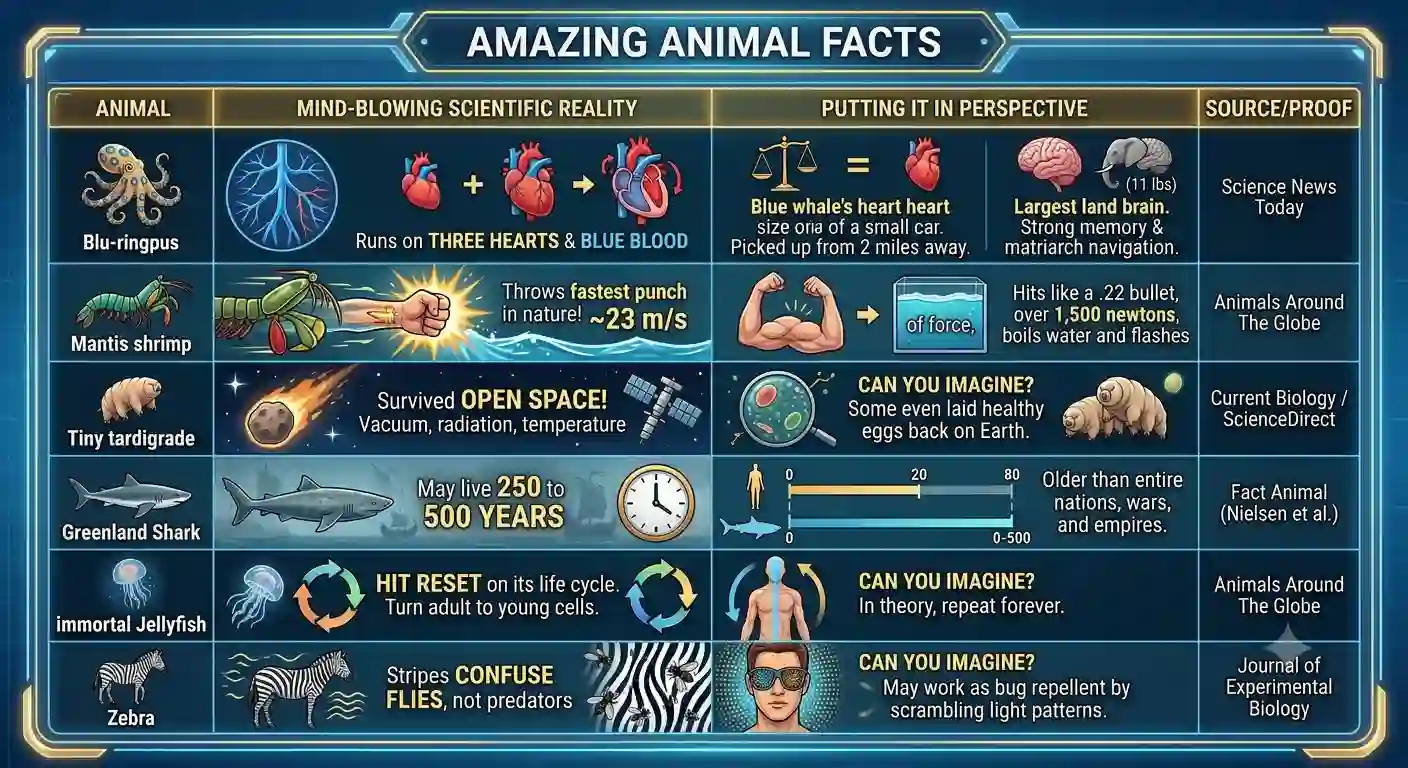
Two hearts pump blood to the gills. A third heart pumps blood to the rest of the body. That third heart actually stops when the octopus swims — which is one reason they’d rather crawl. Their blood is blue, not red, because it uses a copper-based protein called hemocyanin instead of the iron-based hemoglobin found in human blood.
2. Each octopus arm has a mind of its own
About two-thirds of an octopus’s neurons live in its arms, not its brain. Each arm can taste, touch, and react on its own. It can even solve problems and grab food without the brain “thinking” about it first.
Source: Science News Today
3. Tardigrades survived the open vacuum of space
In 2007, the European Space Agency strapped dried-out tardigrades to the outside of a spacecraft. For 10 days, the tiny creatures faced open vacuum, wild temperature swings, and raw solar radiation. Most of them survived. Some even laid healthy eggs after they were rehydrated back on Earth.
Source: Current Biology / ScienceDirect
4. The mantis shrimp throws the fastest punch in nature
Its club-shaped claw swings at roughly 23 meters per second. That’s about as fast as a .22 caliber bullet leaves the barrel, and it hits with over 1,500 newtons of force. The strike is so fast it boils the water in front of it. This creates tiny bubbles that collapse and briefly flash as hot as the surface of the sun.
Source: Animals Around The Globe
5. One jellyfish species can hit reset on its own life cycle
The species Turritopsis dohrnii, nicknamed the “immortal jellyfish,” can turn its own grown-up cells back into young cells when it’s hurt or stressed. Scientists call this transdifferentiation. In theory, the jellyfish can repeat this trick over and over, forever.
Source: Animals Around The Globe
6. Greenland sharks might live for centuries
Scientists tested the proteins in a Greenland shark’s eye using radiocarbon dating. The results suggest some sharks live 250 to 500 years. That makes them the longest-lived animal with a backbone that we know of. Many Greenland sharks alive today were probably already swimming before the 1800s. (Fact Animal, citing Nielsen et al.)
7. A blue whale’s heart is the size of a small car
It’s the biggest heart of any known animal. Researchers have even picked up its heartbeat from up to 2 miles away underwater.
8. Elephants carry the heaviest brain on land
An elephant’s brain weighs nearly 11 pounds — the largest of any land animal. Scientists think this size is linked to their strong memory. It may help matriarchs remember watering holes and migration routes for decades.
9. Pigeons can do basic math
A 2011 study in the journal Science found that pigeons can rank groups of objects by how many items they contain. They did it about as well as monkeys — a skill scientists once thought needed a much bigger, primate-style brain.
10. Zebra stripes may exist to confuse flies, not predators
A 2012 study in the Journal of Experimental Biology found that zebra stripes seem to scramble the light patterns that biting flies use to find prey. So the stripes might work as a bug repellent just as much as camouflage.
Source: Best Life
Historical Secrets & Cultural Quirks (Interesting Fun Fact about Animals)
1. Killing a cat in ancient Egypt could carry a death sentence
Cats were linked to the goddess Bastet and treated as almost sacred. Harming one — even by accident — could bring severe punishment. Some wealthy families even had their cats mummified so they could stay together in the afterlife. (The Collector; History.com)
2. Egyptians mummified millions of animals as religious offerings
At Saqqara alone, archaeologists have found more than 1.75 million mummified ibis birds. Millions more mummified animals have turned up at other burial sites. Egyptians left them as offerings to the gods each animal represented. (Reading Museum)
3. Honey never actually spoils
Sealed pots of honey have been found in Egyptian tombs, including Tutankhamun’s, and they’re still edible after more than 3,000 years. Honey has very little water in it, it’s quite acidic, and bees add an enzyme that produces hydrogen peroxide. Together, these make it almost impossible for bacteria to grow.
Source: History Facts
4. Bees were symbols of royalty in ancient Egypt
The honeybee shows up in hieroglyphs next to pharaohs. It was closely linked to kingship and the divine. Beekeeping in mud and clay hives was already a well-organized practice thousands of years ago.
Source: Archaeo-Acoustics
5. Albatrosses mate for life and travel the globe to prove it
These seabirds form bonds that last a lifetime. They return to the exact same nesting sites year after year, even after flying huge distances across the Southern Ocean between breeding seasons. (Croxall et al., 2005, via Fact Animal)
Fun Facts About Animals By The Numbers
| Metric | Figure |
|---|---|
| Described animal species worldwide | Roughly 1.5–2 million (with millions more thought to be undiscovered) |
| Mantis shrimp strike speed | ~23 meters per second (~51 mph) |
| Mantis shrimp strike force | Over 1,500 newtons |
| Blue whale heart weight | About the size of a small car; heartbeat heard up to 2 miles away |
| Elephant brain weight | ~11 pounds (5 kg) |
| Greenland shark estimated lifespan | 250–500 years |
| Days tardigrades survived unshielded in space | 10 days |
| Age of oldest edible honey found | 3,000+ years |
| Ibis mummies found at Saqqara | 1.75 million+ |
Facts That Sound 100% Fake (But Are Actually True)
- Octopus blood is blue, not red, because it’s built on copper instead of iron.
- Tardigrades have survived open space — vacuum, radiation, and all — then came home and had babies.
- A shrimp can punch as hard as a bullet, hard enough to crack aquarium glass.
- A jellyfish can, in theory, live forever by turning its own cells back into younger ones.
- A blue whale’s heartbeat can be heard 2 miles away underwater.
- Some sharks alive today were already swimming before the United States existed. Greenland sharks may live for centuries.
- Honey buried 3,000 years ago is still safe to eat. Archaeologists have tasted it themselves.
“Can You Imagine?” (Putting the Numbers in Perspective)
- If a mantis shrimp were the size of a human, its punch could seriously hurt a person with just one hit. Pound for pound, it’s the hardest striker in the animal kingdom.
- Shrink a blue whale’s heart down to fit in a driveway, and it would still be roughly the size of a small hatchback car.
- If a Greenland shark born in the 1700s is still alive today, it has outlived entire nations, wars, and empires.
- If tardigrades could talk, they’d be the only animals on Earth who could casually say, “I’ve been to space, and I survived it with no protection at all.”
Debunking the Myths: Fiction vs. Reality
| The Popular Myth | The Actual Fact | The Source/Proof |
|---|---|---|
| Goldfish have a 3-second memory | Goldfish can remember things for months. They recognize their owners and can learn to navigate mazes | Studies from the University of Plymouth’s School of Psychology, via List25 |
| Bulls charge because they hate the color red | Bulls are red-green colorblind. It’s the cape’s movement, not its color, that sets them off | A-Z Animals |
| Bats are blind | Most bats see just fine, and some fruit bats even see color well. Echolocation is a backup tool, not a replacement for sight | NPR Short Wave |
| Camels store water in their humps | Camel humps store fat. The body can turn that fat into water and energy when it’s needed | Animals Around The Globe |
| Touching a baby bird makes its mother abandon it | Most birds barely have a sense of smell. A mother won’t reject her chick just because a human touched it | Sierra Club |
Mysteries Scientists Still Can’t Explain
- How monarch butterflies navigate a route they’ve never flown. No single monarch butterfly makes the whole trip from Canada to Mexico. It takes several generations to finish the journey. Yet each new generation somehow finds the way. Scientists think it’s some mix of the sun’s position, Earth’s magnetic field, and instincts passed down through genes — but they still don’t fully understand how it works. (The Voyaging)
- Why whales sometimes strand themselves on beaches. Some scientists blame confusion from Earth’s magnetic field. Others point to naval sonar, or to healthy whales following sick pod members into danger. No single answer explains every stranding. (Animals Around The Globe)
- What zebra stripes are actually for. Keeping flies away is the leading theory. But camouflage and social signaling are still possible explanations too, and nothing has been proven for certain. (Exploring Animals)
- Why great white sharks swim to one specific patch of open ocean. Trackers have followed sharks to a remote area in the middle of the ocean, nicknamed the “White Shark Café.” There, they dive over and over in a steady rhythm. Nobody knows why.
- How Arctic terns fly nearly 50,000 miles from pole to pole. They return to the exact same nesting spots year after year. But scientists still don’t fully understand how they navigate with such accuracy. (The Voyaging)
Share-This Fact
A mantis shrimp can throw a punch as fast as a bullet — fast enough to boil water and crack aquarium glass.
The Ultimate Animal Facts Brain Teaser
1. How many hearts does an octopus have?
A) One B) Two C) Three D) Four Ans: C) Three — two pump blood to the gills, one to the body.
2. Roughly how fast does a mantis shrimp’s claw strike?
A) 2 m/s B) 10 m/s C) 23 m/s D) 100 m/s
Ans: C) 23 meters per second — about as fast as a .22 caliber bullet.
3. What did ancient Egyptians associate the honeybee with?
A) War B) Royalty C) The underworld D) Bad luck
Ans: B) Royalty — bees appeared in hieroglyphs next to pharaohs.
Frequently Asked Questions
What is the smartest animal besides humans?
Great apes, dolphins, elephants, and some birds like crows and pigeons all show strong problem-solving, tool use, or counting skills. But “smartest” really depends on which kind of intelligence you’re measuring.
Why is octopus blood blue?
Octopus blood carries oxygen using a copper-based protein called hemocyanin, instead of the iron-based hemoglobin in human blood. That’s what gives it a blue tint.
Do goldfish really have a 3-second memory?
No. Research shows goldfish can hold onto memories for months. They can recognize feeding schedules and even learn simple tasks like navigating a maze.
What is the longest-living animal with a backbone?
The Greenland shark. Scientists estimate it can live 250 to 500 years, based on radiocarbon dating of its eye tissue. That makes it the longest-lived vertebrate we know of.
Can any animal really survive in space? Tardigrades came the closest to proving it. In a 2007 European Space Agency experiment, dried-out tardigrades survived 10 days of direct exposure to space vacuum and radiation.
Why do bulls charge at red capes if they’re colorblind to red?
Bulls react to the cape’s movement, not its color. Cattle are red-green colorblind, so the red is really just for show — and to hide bloodstains — not to provoke the bull.
Is honey really safe to eat after thousands of years?
Yes. Sealed honey found in ancient Egyptian tombs has stayed edible for over 3,000 years. It has very little moisture, high acidity, and natural antibacterial properties that keep it from spoiling.
Final Thoughts
From bullet-fast shrimp to sharks older than most nations, the animal kingdom keeps proving one thing: reality doesn’t need exaggeration to be extraordinary. Every fact on this list is a reminder that the “ordinary” natural world is stranger, tougher, and more mysterious than most of us ever learned in school.

hello! I am Irshad Ullah, and a passionate writer and lifelong learner dedicated to uncovering fascinating facts about science, history, nature, animals, space, and the world around us. I research each topic carefully and transform surprising information into clear, engaging, and enjoyable content. My goal is to satisfy curiosity, inspire learning, and help readers discover something amazing every day.