
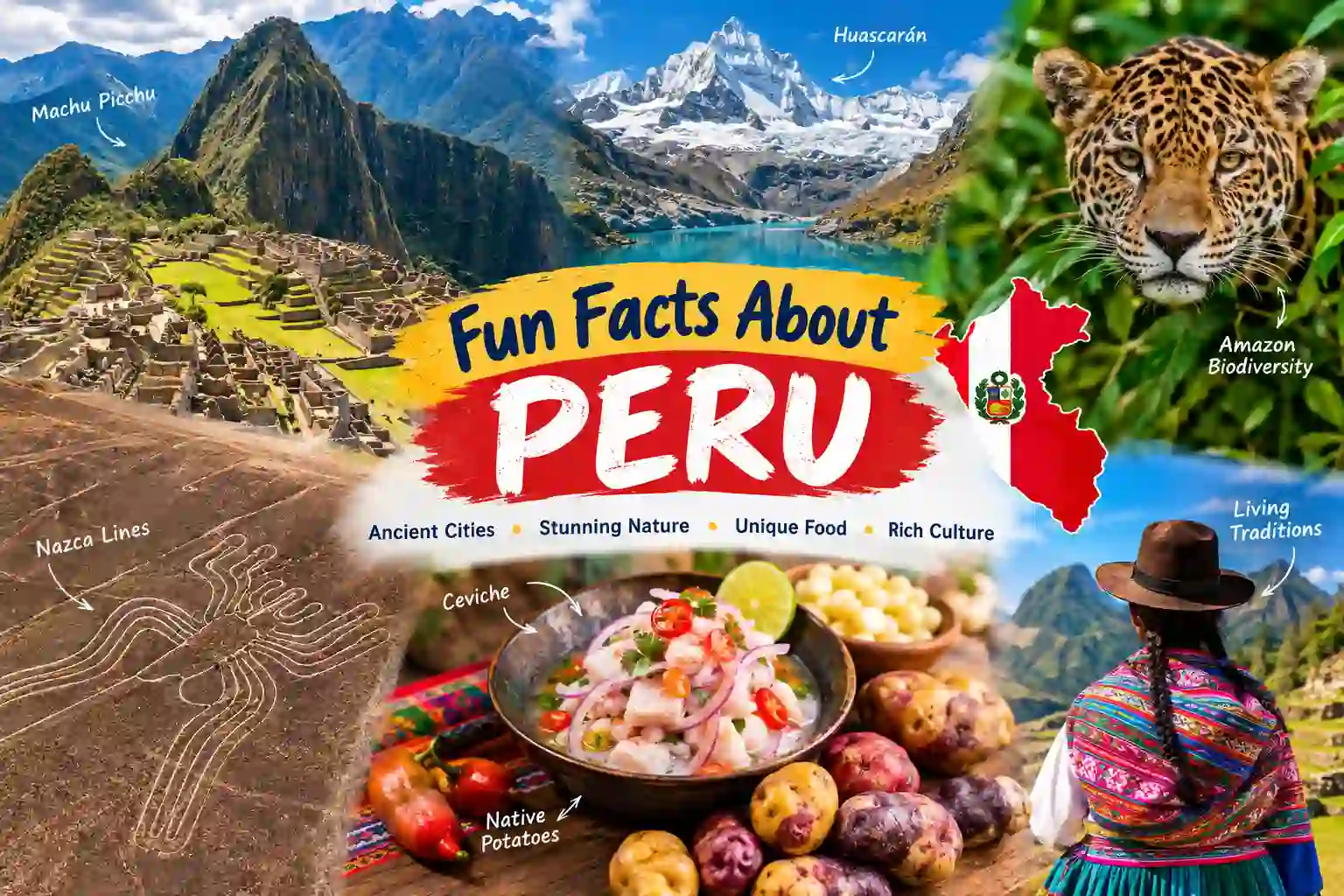
Peru is a country where ancient cities, huge mountains, deep forests, and unusual foods meet. Fun facts about Peru reveal a place far richer than Machu Picchu alone. Peru has 13 UNESCO World Heritage properties, including archaeological sites, national parks, and the famous Historic Sanctuary of Machu Picchu. Its ancient Qhapaq Ñan road network once stretched about 30,000 kilometers across the Andes. Peru is also a major center of potato diversity, with thousands of native varieties growing in the Andes. From the Nazca Lines to ceviche and Manu’s wildlife, Peru offers remarkable stories at every turn.
Peru at a Glance
| Feature | Fact |
| Country | Peru |
| Continent | South America |
| Main geographic regions | Coast, Highlands, and Jungle |
| Area | More than 1.2 million km² |
| UNESCO World Heritage properties | 13 |
| Indigenous languages | 47 listed by Peru’s tourism authority |
| Highest mountain | Huascarán, 6,768 m |
| Famous ancient road system | Qhapaq Ñan |
| Major biodiversity area | Manu National Park |
| Famous traditional dish | Ceviche |
Sources: PROMPERÚ; UNESCO; Peru Travel.
1. Peru Has One of the Americas’ Oldest Civilizations
1. Caral is about 5,000 years old.
The Sacred City of Caral-Supe dates to the Late Archaic period. UNESCO describes it as the oldest center of civilization in the Americas. The huge site includes pyramidal structures and sunken circular courts. Archaeologists also found evidence of an early quipu recording system.
Source: UNESCO. UNESCO: Sacred City of Caral-Supe
2. Chan Chan was built from earth, not stone.
Chan Chan was the capital of the Chimú Kingdom. UNESCO calls it the largest earthen-architecture city in pre-Columbian America. Its planned layout included nine large citadels or palace compounds.
Source: UNESCO.
3. Chankillo used the Sun as a calendar.
Chankillo dates to about 250–200 BC. Its famous line of 13 towers helped ancient people track the Sun across the year. UNESCO says the system could identify dates with an accuracy of about one to two days.
Source: UNESCO.
4. The Nazca Lines are older than 1,500 years.
The Nazca and Palpa geoglyphs were created between about 500 BC and AD 500. They include animals, plants, imaginary beings, and geometric shapes. Some geometric lines extend for several kilometers.
Source: UNESCO.
2. The Andes Create Extraordinary Landscapes
5. Peru’s highest mountain is Huascarán.
Huascarán rises to 6,768 meters above sea level. It stands in the Cordillera Blanca of the Andes. Huascarán National Park was established in 1975 and protects glaciers, valleys, wildlife, and archaeological sites.
Source: Peru Travel. Peru Travel: Huascarán National Park
6. The Cordillera Blanca has hundreds of lakes.
Peru Travel reports more than 500 lakes and about 700 glaciers in the Cordillera Blanca. This mountain region also contains Huascarán and several other major Andean peaks.
Source: Peru Travel.
7. Peru has three major geographic regions.
The country’s landscape is commonly divided into the Coast, Highlands, and Jungle. This creates striking changes in climate, altitude, vegetation, and human settlement across the country.
Source: PROMPERÚ.
8. The Andes and Amazon meet inside Peru.
Some protected areas cross huge elevation ranges. Río Abiseo National Park, for example, extends from lower elevations toward high Andean grasslands. This creates many different habitats in one protected landscape.
Source: UNESCO.
3. Peru Is a Biodiversity Powerhouse
9. Peru is among the world’s most biodiverse countries.
Peru’s protected-area authority, SERNANP, identifies Peru as one of the 10 most biodiverse countries in the world. Its national protected-area system covers more than 29 million hectares.
Source: SERNANP. SERNANP: Peru’s Protected Natural Areas
10. Manu National Park contains extraordinary wildlife diversity.
SERNANP lists 228 mammal species, 1,030 bird species, 1,307 butterfly species, 158 amphibian species, and 132 reptile species in Manu National Park. The park stretches from the Andes toward the Amazon.
Source: SERNANP.
11. Manu also contains thousands of plant species.
SERNANP’s current profile lists about 1,650 tree species and 750 orchid species in Manu. The park’s changing elevations create many ecological zones.
Source: SERNANP.
12. A monkey once thought extinct lives in Río Abiseo.
The yellow-tailed woolly monkey was once believed to be extinct. UNESCO notes that it was rediscovered in Río Abiseo National Park, where it remains a particularly important species.
Source: UNESCO.
13. Río Abiseo has more than 5,000 recorded plant species.
UNESCO reports more than 5,000 plant species recorded in the park. Its forests and grasslands also show high levels of endemism, meaning many species have very limited natural ranges.
Source: UNESCO.
4. The Potato Has Deep Peruvian Roots
14. Peru is a major center of potato diversity.
The International Potato Center says Peru lies within the potato’s center of origin and has the world’s greatest potato diversity. More than 4,000 native potato varieties grow across the Andean highlands of Peru, Bolivia, and Ecuador.
Source: International Potato Center. International Potato Center: Native Potato Varieties
15. Potatoes were domesticated thousands of years ago.
The International Potato Center says wild tubers are believed to have been first domesticated about 8,000 years ago by farmers living around the highlands near Lake Titicaca.
Source: International Potato Center.
16. Native potatoes can survive at extreme elevations.
Many native varieties are grown at about 3,500–4,200 meters above sea level. Farmers selected these varieties over centuries for different colors, shapes, textures, and tastes.
Source: International Potato Center.
17. Peru has dozens of wild potato species.
The International Potato Center reports around 80 wild potato species in Peru. These wild relatives are important genetic resources for future potato breeding and conservation.
Source: International Potato Center.
5. Ancient Peru Built Roads Across Extreme Terrain
18. The Inca road system stretched about 30,000 kilometers.
The Qhapaq Ñan was a huge communication, trade, and defense network. UNESCO estimates the wider Inca road system covered about 30,000 km and crossed mountains, deserts, valleys, and rainforest.
Source: UNESCO. UNESCO: Qhapaq Ñan, Andean Road System
19. Some roads crossed mountains higher than 6,000 meters.
UNESCO notes that the Qhapaq Ñan connected snow-covered Andean peaks above 6,000 meters with coastlines, forests, valleys, and deserts. It was built for communication across very difficult terrain.
Source: UNESCO.
20. The network was larger than Peru alone.
The Qhapaq Ñan formed a vast Andean system rather than a road network confined to modern Peru. Its surviving component sites extend across several countries along the Andes.
Source: UNESCO.
21. Machu Picchu is a mixed natural and cultural heritage site.
The Historic Sanctuary of Machu Picchu is listed by UNESCO as a mixed World Heritage property. This means its importance includes both cultural and natural values.
Source: UNESCO.
6. Peru’s Food Is Part of Its Cultural Heritage
22. UNESCO recognized Peruvian ceviche in 2023.
UNESCO added the practices and meanings connected with preparing and eating ceviche to its Representative List of Intangible Cultural Heritage in 2023. The recognition covers traditions, knowledge, ingredients, and social practices.
Source: UNESCO. UNESCO: Peruvian Ceviche Heritage
23. Ceviche is prepared across Peru.
Ceviche is often associated with Peru’s coast, but UNESCO notes that it is prepared throughout the country’s departments. Local ingredients create regional variations of the dish.
Source: UNESCO.
24. Ceviche connects fishing, farming, and cooking.
UNESCO’s description goes beyond the finished dish. It includes fishing, growing ingredients, preparation methods, family knowledge, and community traditions.
Source: UNESCO.
25. Ceviche traditions include special celebrations.
Ceviche is eaten during everyday meals and festivities. UNESCO also connects it with celebrations of Saint Peter, the patron saint of artisanal fishers.
Source: UNESCO.
7. Peru Has Remarkable Cultural and Linguistic Diversity
26. Peru has 47 indigenous languages.
PROMPERÚ states that 47 indigenous languages are spoken in Peru, alongside Spanish. Quechua and Aymara are among the best-known indigenous languages.
Source: PROMPERÚ. PROMPERÚ: General Overview of Peru
27. Quechua remains an important language.
Peru’s 2017 census found that 13.9% of people aged five and older reported Quechua as the language they learned in childhood. Aymara accounted for another 1.7%.
Source: Peru’s National Institute of Statistics and Informatics (INEI).
28. Arequipa has buildings made from volcanic rock.
Much of the historic center of Arequipa uses sillar, a light-colored volcanic rock. UNESCO says the city’s architecture combines European designs with indigenous construction techniques.
Source: UNESCO.
29. Peru has 13 UNESCO World Heritage properties.
As of 2026, UNESCO lists 13 World Heritage properties for Peru. They include nine cultural properties, two natural properties, and two mixed properties.
Source: UNESCO.
30. Peru’s heritage includes both ancient sites and living traditions.
Peru’s UNESCO recognition is not limited to archaeological ruins. Its heritage listings also include living traditions such as ceviche practices and, in 2025, Sarawja, an Aymara music and dance tradition from Moquegua.
Source: UNESCO.
FAQ: Fun Facts About Peru
What is Peru best known for?
Peru is especially known for Machu Picchu, the Andes, the Nazca Lines, ancient civilizations, Amazonian biodiversity, and its distinctive cuisine. UNESCO lists 13 World Heritage properties in the country.
Why is Peru important to potato history?
Peru lies within the potato’s center of origin and contains exceptional native potato diversity. Thousands of varieties are maintained in Andean farming communities.
What is the oldest civilization in Peru?
Caral-Supe represents one of the earliest known urban civilizations in the Americas. UNESCO describes Caral as the oldest center of civilization in the Americas.
What makes the Nazca Lines unusual?
The Nazca and Palpa geoglyphs were made by removing or disturbing the desert surface. They form animals, plants, geometric shapes, and other designs across a large coastal area.
How many languages are spoken in Peru?
PROMPERÚ reports 47 indigenous languages, in addition to Spanish. The 2017 census also recorded Quechua, Aymara, and other native languages among Peru’s population.
Why is Manu National Park famous?
Manu is famous for its exceptional biodiversity. SERNANP records more than 1,000 bird species and more than 1,300 butterfly species there, along with hundreds of mammal and other animal species.
What is the Qhapaq Ñan?
Qhapaq Ñan is the historic Andean road system associated with the Inca state. UNESCO describes the wider network as roughly 30,000 kilometers long.
When did UNESCO recognize Peruvian ceviche?
UNESCO inscribed the practices and meanings associated with preparing and consuming Peruvian ceviche in 2023 as Intangible Cultural Heritage.
Conclusion
These fun facts about Peru show why the country is much more than a destination for Machu Picchu. Peru preserves ancient cities, enormous mountain landscapes, remarkable biodiversity, thousands of potato varieties, and living food traditions. Its archaeological achievements range from Caral’s ancient urban planning to Chankillo’s solar calendar and the enormous Qhapaq Ñan road system. Its cultural story also continues today through languages, regional foods, music, farming, and community traditions. Peru is unusual because its past and present remain closely connected. In Peru, a potato field, an ancient road, a rainforest, or a plate of ceviche can each tell part of the same long story.

hello! I am Irshad Ullah, and a passionate writer and lifelong learner dedicated to uncovering fascinating facts about science, history, nature, animals, space, and the world around us. I research each topic carefully and transform surprising information into clear, engaging, and enjoyable content. My goal is to satisfy curiosity, inspire learning, and help readers discover something amazing every day.