
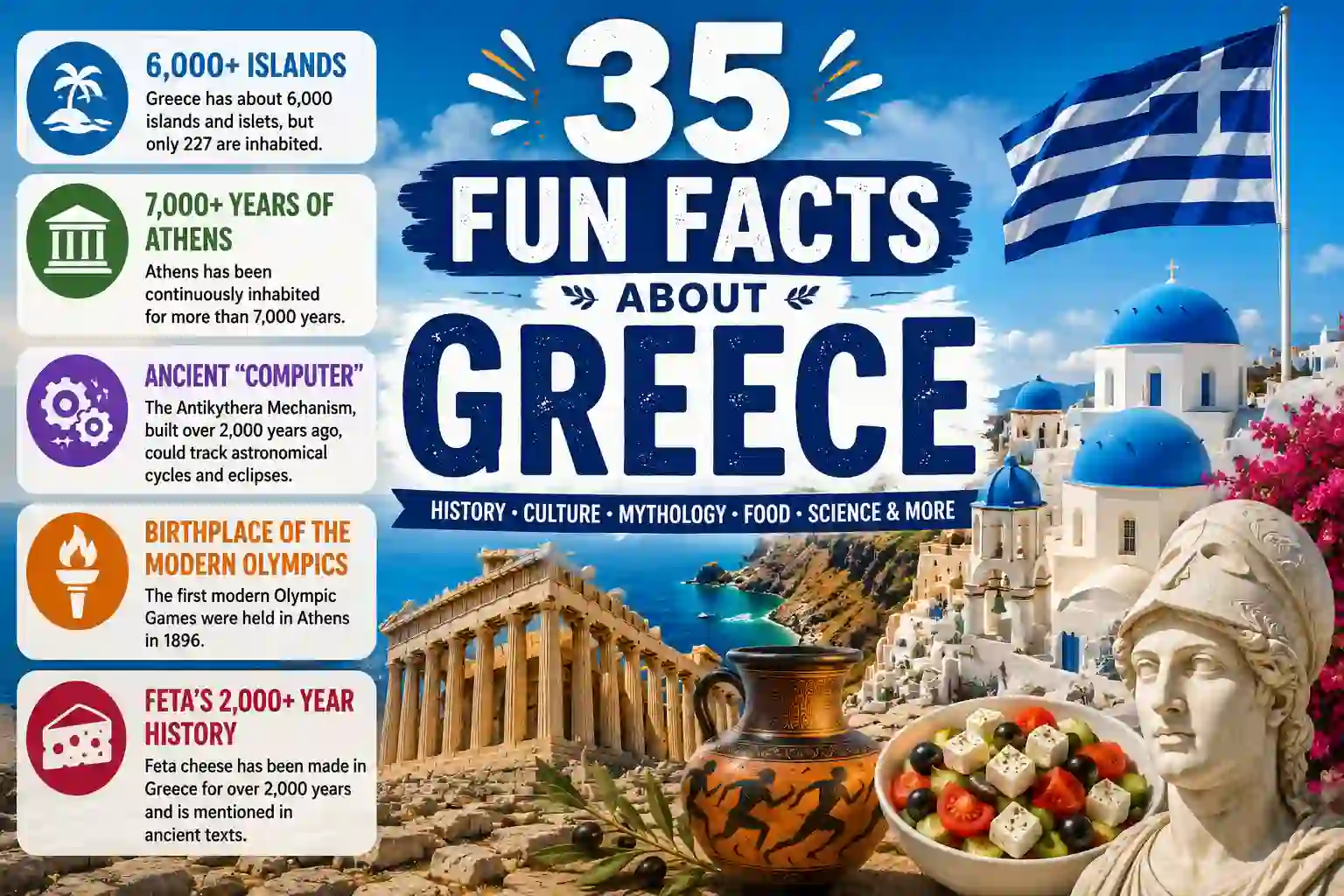
Greece is far more than ancient ruins, sunny islands, and blue seas. It is a country where an ancient astronomical machine, a 7,000-year-old city, painted marble statues, powerful myths, unusual traditions, and thousands of islands all meet.
Greece has about 6,000 islands and islets, but only 227 are inhabited. Its highest mountain is linked to the gods of Greek mythology, while its ancient theaters were built with remarkable acoustics. Greece is also home to feta, a cheese with a history stretching back more than 2,000 years.
Some of fun facts about Greece are famous. Others are surprisingly strange.
Let’s explore the ones that are hardest to believe.
Greece at a Glance
| Quick Fact | Answer |
| Official name | Hellenic Republic |
| Capital | Athens |
| Official language | Greek |
| Islands and islets | About 6,000 |
| Inhabited islands | 227 |
| Highest mountain | Mount Olympus |
| Highest peak | 2,917 m |
| Language history | More than 3,000 years |
| Athens settlement history | More than 7,000 years |
| UNESCO World Heritage properties | 21 |
Greece currently has 21 properties inscribed on the UNESCO World Heritage List. The newest is the Minoan Palatial Centres, added in 2025.
Geography and Nature Facts
1. Greece Has About 6,000 Islands and Islets
Greece is famous for its islands, but the scale is surprising.
The country has about 6,000 islands and islets scattered across its seas. Only 227 of them are inhabited. The inhabited islands range from large places such as Crete to much smaller communities.
So Greece is not simply a country with a few famous islands.
Its islands are a major part of its geography and culture.
2. No Part of Greece Is More Than About 137 Kilometers From the Sea
This is one of the best lesser-known Greece facts.
According to Greece’s official tourism organization, no part of the country is more than about 137 kilometers from the sea.
That helps explain why the sea has played such a large role in Greek travel, trade, food, and history.
3. About 80% of Greece Is Mountainous
Greece may look like a beach destination in travel photos.
In reality, mountains dominate much of the country.
Its landscape is highly mountainous, with ranges stretching across the mainland and into the sea as peninsulas and island chains.
This unusual mix gives Greece both high mountain landscapes and famous coastal scenery.
4. Mount Olympus Is a Real Mountain With a Mythical Past
Mount Olympus rises to 2,917 meters, making it Greece’s highest mountain.
Ancient Greek mythology made it even more famous.
Olympus was believed to be the home of the gods, including Zeus. Today, however, it is a real mountain and a protected natural landscape—not a mythical palace in the clouds.
5. Greece Has About 6,000 Native Plant Species
Greece has an unusually rich variety of plant life.
The official Greek tourism organization reports around 6,000 native plant species and subspecies. About 700 are endemic, meaning they are found only in Greece.
So Greece’s natural diversity goes far beyond its beaches.
6. Greece Has Wildlife You Might Not Expect
Greece is not only home to goats, sheep, and seaside animals.
Its wildlife includes bears, wolves, seals, dolphins, reptiles, birds, and many other species. The Greek National Tourism Organisation highlights the country’s rich wildlife diversity, including 116 mammal species.
A country famous for islands also has surprisingly wild mountain habitats.
Ancient Greece Facts
7. Ancient Greek Statues Were Often Painted
Imagine the Parthenon and its sculptures in bright colors.
That may be closer to their original appearance than the white marble images we usually see today.
The British Museum has found traces of original pigments on Parthenon sculptures. Some surviving blue pigment is linked to Egyptian blue, an ancient synthetic pigment.
The “white marble” look came later as the paint disappeared.
8. Ancient Greek Theater Had Remarkable Acoustics
Ancient Greeks knew how to make a huge theater work.
The Theatre of Epidaurus was built on a natural slope and is famous for its exceptional acoustics. Its design used carefully planned geometry and seating to help sound travel across the theater.
No microphones were needed.
The architecture did the work.
9. Ancient Greece Gave Us the Word “Democracy”
The word democracy comes from the ancient Greek demokratia, meaning roughly “power of the people.”
The concept developed in Athens around the 6th century BCE. But ancient Athenian democracy was very different from modern democracy. It was participatory, but political rights were limited to citizens who met the rules of the time.
So Greece helped create an idea that later changed dramatically.
10. Ancient Olympic Athletes Competed at Olympia
The ancient Olympic Games were held at Olympia and were connected to worship of Zeus.
They were not simply sporting events.
They were part of a major religious festival that brought athletes and spectators together.
The Games became one of the most famous traditions of ancient Greek civilization.
11. The First Modern Olympics Were Surprisingly Small
The first modern Olympic Games were held in Athens in 1896.
Only 241 athletes competed.
They represented 14 national Olympic committees and took part in nine sports and 43 events. All the competitors were men.
Today’s Olympic Games are vastly larger.
12. The First Modern Olympic Champion Was an American
At the Athens Games in 1896, James Connolly won the triple jump.
He became the first Olympic champion of the modern era.
The victory happened on April 6, 1896.
The modern Olympic story began with a triple jump.
Ancient Greek Science and Inventions
13. Greece Had an Ancient Astronomical “Computer”
This may be the most unbelievable fact on the list.
The Antikythera Mechanism was a complex ancient device with gears that could represent astronomical cycles.
Researchers have connected its functions with calculations involving the Sun, Moon, calendars, and eclipses.
It was built long before modern computers existed.
14. The Antikythera Mechanism Could Track Eclipse Cycles
The mechanism was not simply a collection of random gears.
It incorporated known astronomical cycles.
One of them was the Saros cycle, which relates to the repeating pattern of solar and lunar eclipses over roughly 18 years and 11 days.
That makes the device even more impressive.
It was designed to model the sky using mechanical parts.
15. Ancient Greeks Used Mathematics in Theater Design
Theater design was not based only on artistic ideas.
The Theatre of Epidaurus was laid out according to mathematical principles, with geometry influencing its structure. UNESCO notes that its design was linked with mathematical ideas associated with Pythagorean philosophy.
For the ancient Greeks, mathematics and architecture could work together.
16. Greek Philosophy Tried to Explain Nature Without Myth
Ancient Greek thinkers did more than tell stories about gods.
Thales of Miletus, who lived around the 6th century BCE, is traditionally regarded as one of the earliest philosophers to seek a natural explanation of the world rather than relying only on mythology.
That shift helped shape the history of philosophy and scientific thinking.
Greek Mythology Facts
17. Athena and Poseidon Competed for Athens
Greek mythology says that Athena and Poseidon competed to become the patron deity of Athens.
Each offered a gift.
Poseidon offered a water source, while Athena gave the city an olive tree.
Athena won the contest in the traditional story, and the city became associated with her name.
18. Mount Olympus Became the Home of the Gods
Mount Olympus was not just a famous mountain in Greek mythology.
It became the legendary home of the Olympian gods.
Zeus was the most powerful of these gods, while figures such as Hera, Athena, Apollo, Artemis, and Hermes were also associated with the Olympian group.
A real mountain became one of mythology’s most famous imaginary homes.
19. Greek Mythology Helped Explain the Natural World
Ancient myths often connected gods and heroes with things people saw around them.
Storms, seasons, the sea, love, war, death, and natural disasters could all become part of mythological stories.
These stories were not simply entertainment.
They helped ancient Greek communities explore questions about nature, human behavior, fate, and the gods.
20. The “Labyrinth” Has a Connection to Minoan Crete
The famous Greek story of the Minotaur and the Labyrinth is associated with Crete.
Modern archaeology has revealed an impressive Minoan civilization on the island, including large palatial complexes.
UNESCO notes that the complexity of these structures helped shape the later Greek memory of the “Labyrinth.”
Myth and archaeology meet in a fascinating way here.
Greek History and Places
21. Athens Has Been Continuously Inhabited for More Than 7,000 Years
Athens is not merely an ancient city with old monuments.
It has been continuously inhabited for more than 7,000 years.
That means modern people live in a city whose human story began thousands of years before the Classical period.
22. Crete Is the Heart of Minoan Civilization
Crete is Greece’s largest island and was the center of the Minoan civilization.
The Minoans developed a complex society long before Classical Athens reached its height.
Their palaces, artwork, trade networks, and writing systems reveal a sophisticated prehistoric culture.
23. Six Minoan Sites Became UNESCO World Heritage Sites in 2025
This is a particularly important fact for a current Greece article.
In 2025, UNESCO inscribed the Minoan Palatial Centres as a World Heritage property.
The six sites are:
- Knossos
- Phaistos
- Malia
- Zakros
- Zominthos
- Kydonia
UNESCO dates these sites broadly from 1900 to 1100 BCE and describes them as major administrative, economic, and religious centers.
This is a good example of why Greece’s history keeps producing new discoveries and new recognition.
24. Meteora Has Monasteries Perched on Giant Rocks
Meteora looks almost impossible.
Huge rock pillars rise dramatically from the landscape, and monasteries were built on top of them.
The setting gave religious communities a remarkable combination of isolation and protection.
It is one of the most unusual cultural landscapes in Greece.
25. Delphi Was Known as the “Navel of the World”
Ancient Greeks regarded Delphi as a special center of the world.
The sanctuary became famous for the Oracle of Apollo, whose predictions and advice attracted visitors from across the Greek world.
The site was not just religious.
It became an important cultural and political meeting point.
Greek Culture and Language
26. Greeks Call Their Country Hellas
In English, we say Greece.
In Greek, the country is commonly called Hellas or Ellada. Its official English name is the Hellenic Republic.
So “Greece” is not actually the name Greeks use for their country in their own language.
27. The Greek Language Has More Than 3,000 Years of History
Greek has one of Europe’s longest documented language histories.
The Greek National Tourism Organisation says the language has been spoken for more than 3,000 years.
Modern Greek is not identical to ancient Greek, of course.
But the historical connection is remarkable.
28. Greeks Celebrate Name Days
In Greece, a person’s name day can be an important celebration.
Name days are connected with saints in the Greek Orthodox tradition. People may celebrate the day associated with their given name in a way that resembles a birthday celebration.
So in Greece, your name can have its own special day on the calendar.
29. Greece Is Famous for Olive Oil—And Greeks Consume a Lot of It
Olive trees have been cultivated in Greece since antiquity.
The Greek tourism organization says Greece has the highest per-capita olive-oil consumption in the European Union, at around 12 kilograms per person per year.
That makes olive oil much more than an ingredient.
It is deeply tied to Greek food and culture.
30. Ouzo Is Greece’s National Drink
Ouzo is a dry, anise-flavored alcoholic drink strongly associated with Greece.
It is usually enjoyed as an aperitif and is often served with small dishes.
The Greek National Tourism Organisation identifies ouzo as Greece’s national drink.
Its strong anise taste makes it easy to recognize.
Greek Food Facts
31. Feta Is More Than 2,000 Years Old
Feta is not a modern invention.
The European Commission says feta has a history going back more than 2,000 years. A primitive form of the cheese is even mentioned in ancient literature, including Homer’s Odyssey.
So that piece of feta on a modern Greek salad has a surprisingly ancient story.
32. Real Feta Has Protected Status in the European Union
Not every white brined cheese can legally be sold as Feta PDO in the European Union.
Feta has Protected Designation of Origin status.
Its production is tied to Greece and to specific traditional methods and milk sources.
The name therefore carries more legal protection than many people realize.
33. Greece Has Thousands of Plant Species—And They Help Shape Feta’s Flavor
This is an unusual connection between nature and food.
The European Commission notes that Greece has more than 6,000 plant species, with many found nowhere else. Sheep and goats used for traditional feta production graze on this varied Greek vegetation.
The landscape therefore helps influence the character of the cheese.
In a very literal sense, Greece’s landscape can end up on your plate.
Strange and Unexpected Facts
34. You Can Ski in Greece With a Sea View
When people imagine Greece, they usually picture beaches.
But Greece also has snowy mountain resorts.
The Greek National Tourism Organisation even highlights the possibility of skiing with a sea view.
That is not the first combination most people associate with Greece.
35. Greece Has 21 UNESCO World Heritage Properties
Greece’s heritage is much broader than the Acropolis.
As of 2026, UNESCO lists 21 World Heritage properties in Greece. They include archaeological sites, medieval cities, monasteries, Byzantine monuments, and the Minoan Palatial Centres added in 2025.
In other words, Greece’s history is not one chapter.
It is a very large collection of chapters spread across the country.
The 12 Facts Most Likely to Make You Say “Really?”
If you want the fastest version of this article, start here:
- Greece has about 6,000 islands and islets.
- Only 227 of those islands are inhabited.
- No part of Greece is more than about 137 km from the sea.
- Ancient Greek statues were often painted, not plain white.
- Ancient Greek engineers built theaters with remarkable acoustics.
- The Antikythera Mechanism could calculate astronomical cycles.
- Athens has been continuously inhabited for more than 7,000 years.
- The first modern Olympics had only 241 athletes.
- Greek has a history of more than 3,000 years.
- Feta has a history going back more than 2,000 years.
- Six Minoan sites became a UNESCO World Heritage property in 2025.
- Greece has 21 UNESCO World Heritage properties.
Frequently Asked Questions About Greece
What is Greece’s official name?
Greece’s official name is the Hellenic Republic. In Greek, the country is commonly called Hellas or Ellada.
What are the main island groups in Greece?
The major island groups include the Cyclades, Dodecanese, Ionian Islands, Sporades, North Aegean Islands, and Argosaronic Islands. Crete and Evia are also major islands.
What is the most important archaeological site in Greece?
There is no single answer, because Greece has many major archaeological sites. The Acropolis of Athens, Delphi, Olympia, Mycenae, Knossos, and Epidaurus are among the best known.
Why is Greece called the birthplace of democracy?
Athens developed an early form of democracy in which eligible citizens could participate directly in political decisions. It was very different from modern democracy and excluded large parts of the population.
What is the Antikythera Mechanism made for?
It was designed to represent astronomical cycles and help calculate relationships between solar and lunar calendars and phenomena such as eclipses.
Why is feta called Feta PDO?
“PDO” means Protected Designation of Origin. In the European Union, the designation protects the name and connects the product to its defined geographical origin and traditional production requirements.
What was added to UNESCO’s Greece list in 2025?
The Minoan Palatial Centres were inscribed in 2025. The serial property contains six archaeological sites on Crete.
Is ancient Greece the same as modern Greece?
No. Modern Greece has inherited important language, cultural, historical, and artistic traditions from the ancient Greek world, but modern Greek society developed through many later periods, including the Roman, Byzantine, Ottoman, and modern eras.
Final Thoughts
The most interesting fun fact about Greece is not simply that it has ancient ruins or beautiful islands.
It is the way different worlds overlap.
A modern city can sit above thousands of years of history. A real mountain can be the home of mythical gods. Ancient theaters can still demonstrate sophisticated design. An ancient geared machine can look surprisingly like a scientific instrument from a much later age. And a cheese enjoyed today can have a history stretching back more than two millennia.
These fun facts about Greece reveal a country where geography, mythology, science, food, language, and history are closely connected.
And that may be the biggest surprise of all:
Greece is not just a place with an ancient past. It is a modern country still living among the layers of that past.

hello! I am Irshad Ullah, and a passionate writer and lifelong learner dedicated to uncovering fascinating facts about science, history, nature, animals, space, and the world around us. I research each topic carefully and transform surprising information into clear, engaging, and enjoyable content. My goal is to satisfy curiosity, inspire learning, and help readers discover something amazing every day.