
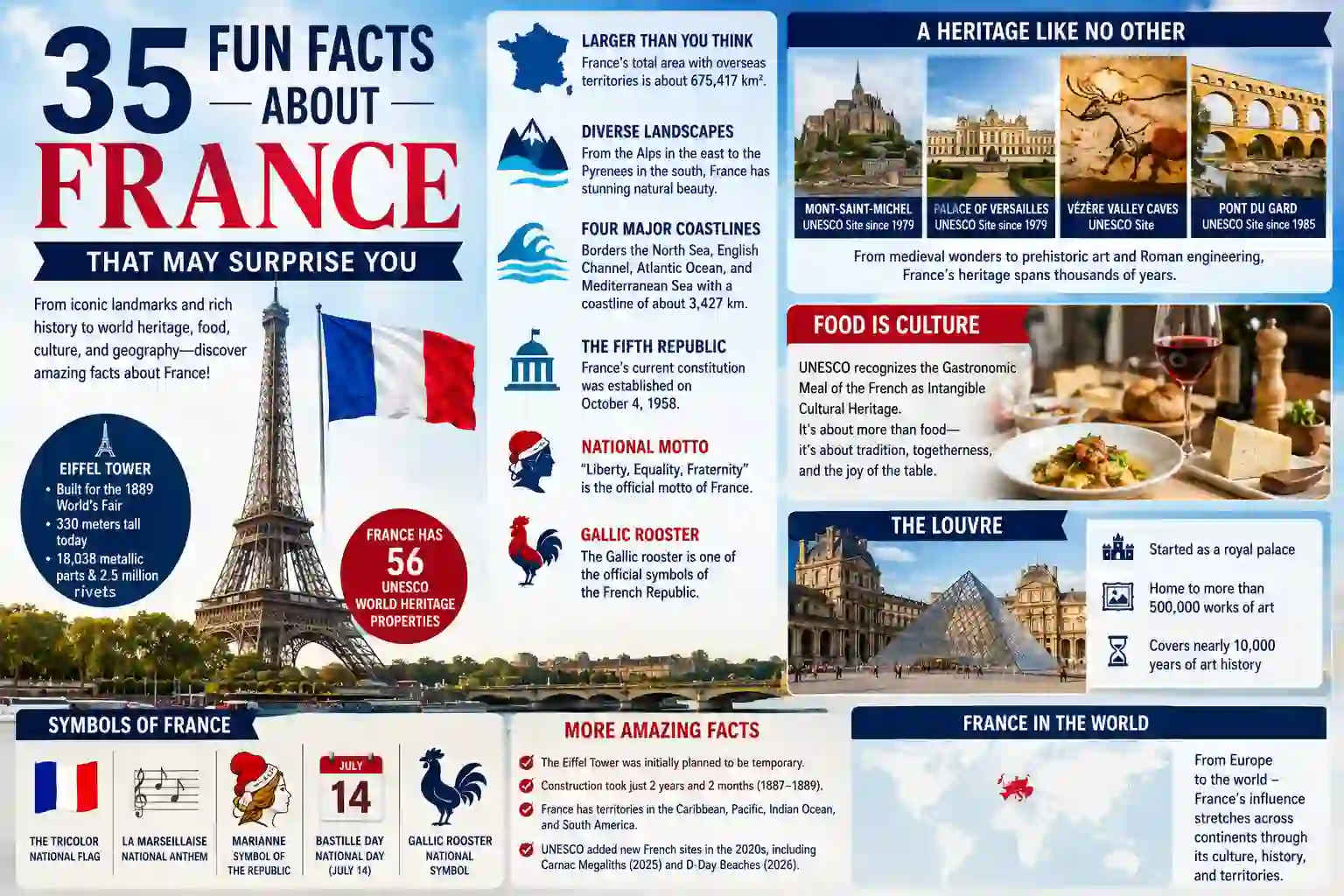
France is famous for Paris, food, art, and fashion. Yet fun facts about France go far beyond the Eiffel Tower. France has a remarkable mix of history, geography, science, culture, and overseas lands. Its territory reaches well beyond Europe. Its heritage includes ancient caves, royal palaces, Roman monuments, and modern cities. France also has 56 UNESCO World Heritage properties, including sites added as recently as 2026.
Here are 35 verified facts that reveal some less obvious sides of France.
France at a Glance
| Feature | France |
| Capital | Paris |
| Official language | French |
| Republic | Fifth Republic |
| Current constitution | 1958 |
| Mainland area | About 551,500 km² |
| Total area with overseas territories | About 675,417 km² |
| Mainland coastline | About 3,427 km |
| UNESCO World Heritage properties | 56 |
| National motto | Liberty, Equality, Fraternity |
| National anthem | La Marseillaise |
Sources: France.fr; Élysée; UNESCO.
A Country Shaped by Geography
1. France reaches far beyond Europe.
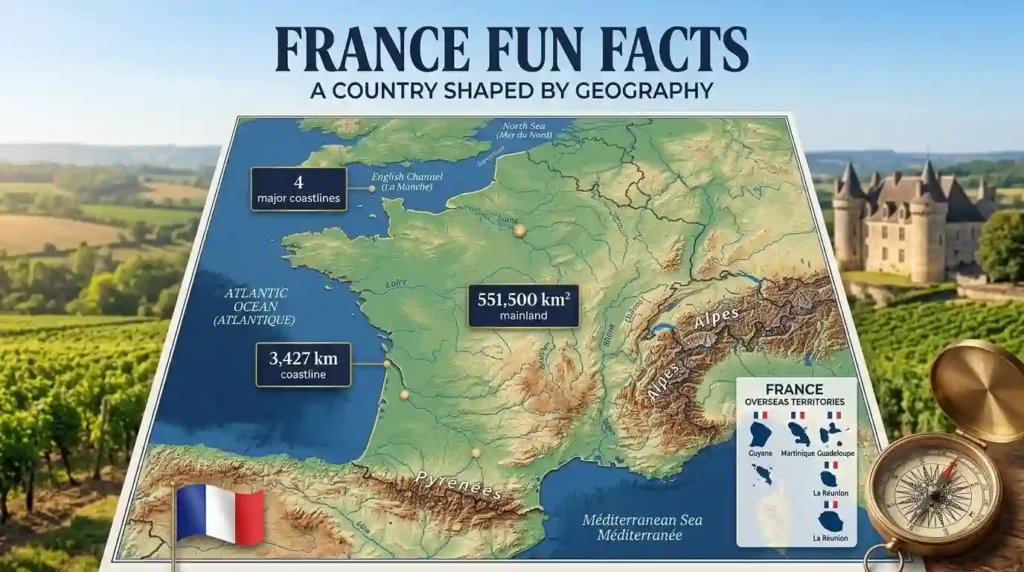
Metropolitan France is in Europe. But French territory also includes overseas lands. These include places in the Caribbean, Indian Ocean, Pacific, and South America. This gives France a much wider geographic presence than its European map suggests.
Source: France.fr.
2. Mainland France covers about 551,500 square kilometers.
France.fr gives this figure for metropolitan France. With its overseas territories, the figure rises to about 675,417 square kilometers. The difference shows how much territory lies outside European France.
Source: France.fr.
3. France has four major mainland coastlines.
Its mainland borders the North Sea, English Channel, Atlantic Ocean, and Mediterranean Sea. These different seas help explain France’s wide range of coastal landscapes and climates.
Source: France.fr.
4. The mainland coastline stretches for about 3,427 kilometers.
That coastline gives France beaches, ports, cliffs, islands, and Mediterranean shores. Its geography changes greatly from one coast to another.
Source: France.fr.
5. France has both the Alps and the Pyrenees.
The Alps rise along France’s eastern side. The Pyrenees form a natural mountain border with Spain. These ranges strongly shape local landscapes, weather, and outdoor life.
Source: France.fr.
Source: France’s official tourism geography guide
History Still Lives in Modern France
6. The Fifth Republic began in 1958.
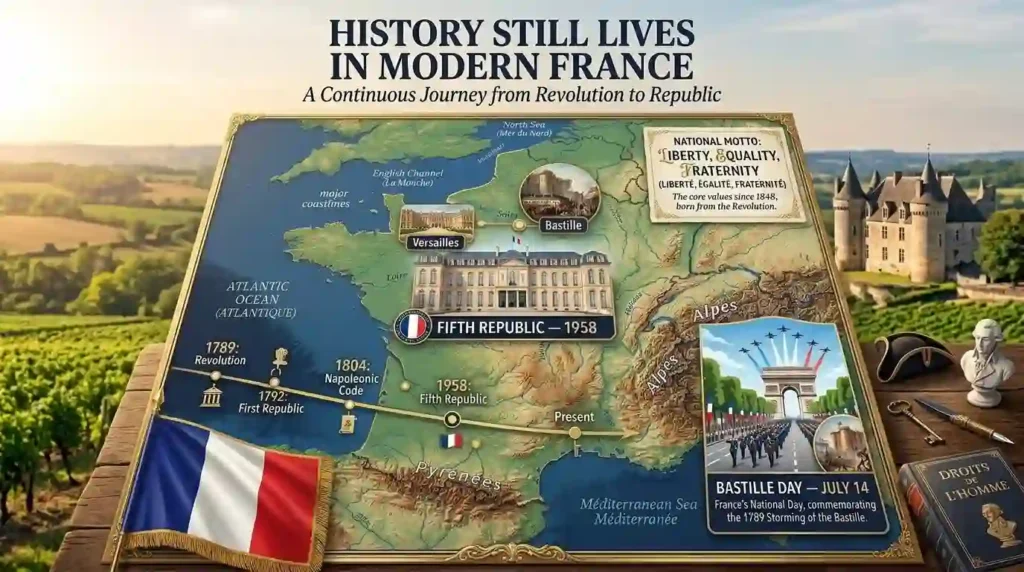
France’s current constitutional system was established when the Constitution was promulgated on October 4, 1958. It created the institutions of the Fifth Republic.
Source: French National Assembly.
7. France’s Constitution names French as the Republic’s language.
Article 2 of the Constitution states that the language of the Republic is French. The same article also defines the national flag, anthem, and motto.
Source: Élysée.
8. The French national motto has three words.
It is “Liberty, Equality, Fraternity.” The motto became part of the Republic’s constitutional tradition and appears in the Constitution of 1958.
Source: Élysée.
9. The French tricolor grew from the Revolution.
The blue and red were linked with Paris, while white represented the monarchy. The three colors were brought together during the French Revolution and later became a national symbol.
Source: Élysée.
10. Bastille Day is July 14.
July 14 is France’s national day. It is one of the official symbols of the French Republic and is commonly associated with the French Revolution.
Source: Élysée.
Source: Élysée — Constitution of the Fifth Republic
The Eiffel Tower Has a Moving Story
11. The Eiffel Tower was built for the 1889 World’s Fair.
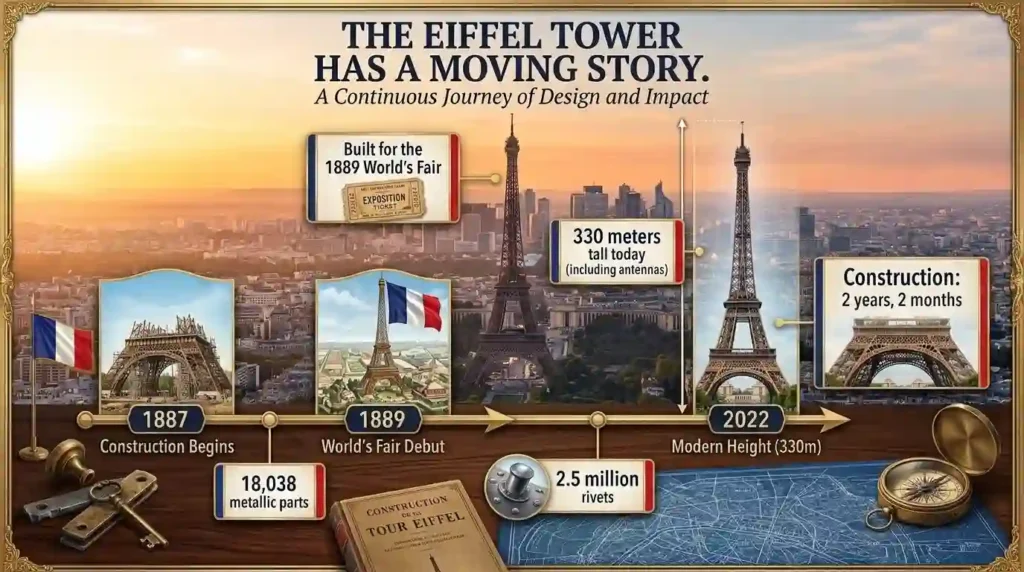
The tower was designed as a major attraction for the Exposition Universelle in Paris. The year also marked 100 years since the beginning of the French Revolution.
Source: Eiffel Tower official website.
12. Construction took about 2 years and 2 months.
Work began in January 1887. The tower was completed on March 31, 1889. Its rapid construction was a major engineering achievement for its time.
Source: Eiffel Tower official website.
13. The tower was once called the “300-meter Tower.”
That name reflected the original design goal. The structure later became known worldwide as the Eiffel Tower, after Gustave Eiffel.
Source: Eiffel Tower official website.
14. The Eiffel Tower is now 330 meters tall.
It was originally about 312 meters high when opened. Radio and television antennas were added over time. A new antenna in 2022 brought its height to 330 meters.
Source: Eiffel Tower official website.
15. The tower contains about 18,038 metallic parts.
Its structure also used about 2.5 million rivets. These numbers show the enormous amount of engineering behind what now looks like a simple silhouette.
Source: Eiffel Tower official website.
Source: Official Eiffel Tower history and facts
France Has an Extraordinary Heritage
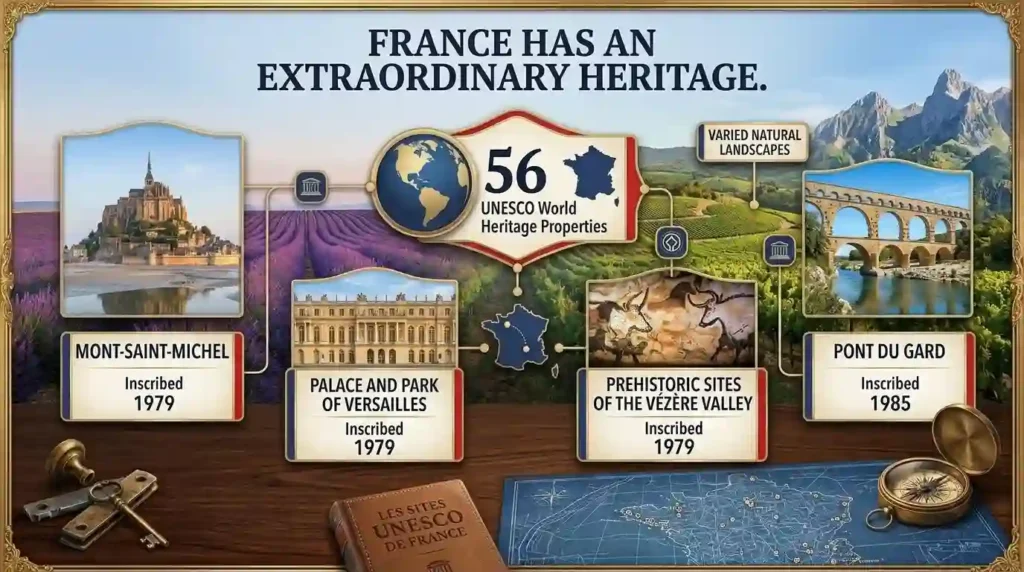
16. France currently has 56 UNESCO World Heritage properties.
UNESCO lists 56 properties for France. They include cultural, natural, and mixed heritage sites. The list continues to change as new sites are added.
Source: UNESCO.
17. France’s UNESCO list includes natural sites.
The list is not limited to castles and churches. It includes places such as the French Austral Lands and Seas, New Caledonia’s lagoons, and volcanic landscapes.
Source: UNESCO.
18. Mont-Saint-Michel is a UNESCO World Heritage site.
The famous medieval island and its bay were added to the World Heritage List in 1979. The site combines architecture with a dramatic coastal setting.
Source: UNESCO.
19. The Palace of Versailles is also protected by UNESCO.
Versailles was inscribed in 1979. The site reflects the enormous political and artistic importance of the French royal court.
Source: UNESCO.
20. France’s UNESCO heritage includes prehistoric art.
The Prehistoric Sites and Decorated Caves of the Vézère Valley are on the World Heritage List. They preserve evidence of early human activity and cave art.
Source: UNESCO.
Source: UNESCO World Heritage — France
Food in France Is More Than a Meal
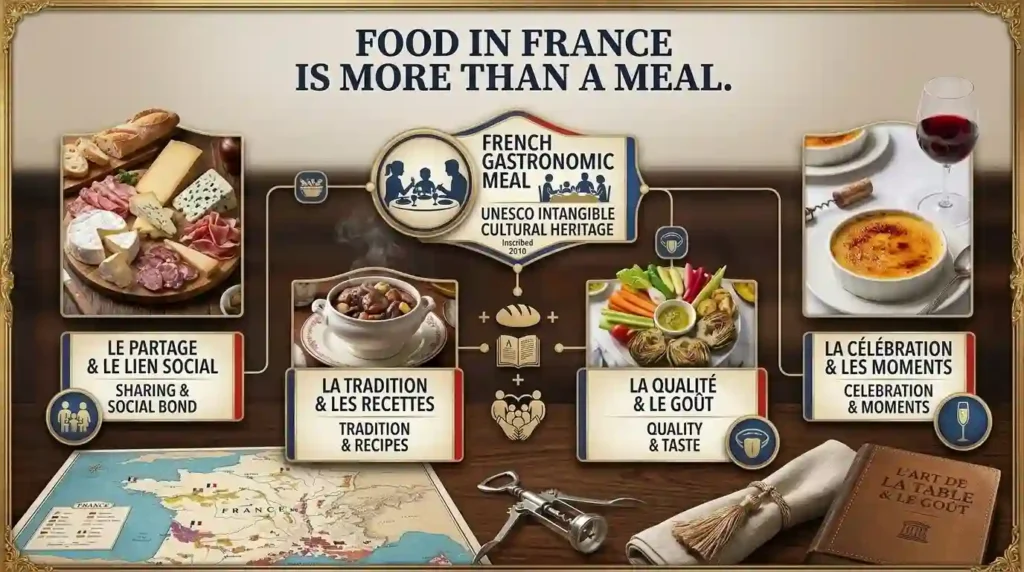
21. The French gastronomic meal is UNESCO heritage.
UNESCO added the gastronomic meal of the French to its Representative List of Intangible Cultural Heritage. The tradition focuses on social connection, taste, and carefully prepared food.
Source: UNESCO.
22. A traditional French gastronomic meal follows a structure.
UNESCO describes a sequence that can begin with an aperitif and continue through several courses. Cheese and dessert are among the traditional elements.
Source: UNESCO.
23. The French gastronomic tradition values the table itself.
UNESCO’s description includes choosing products, arranging the table, pairing food and wine, and paying attention to smell and taste. The experience is social as well as culinary.
Source: UNESCO.
24. French food heritage is about people, too.
The UNESCO tradition emphasizes bringing families and friends together. The meal is treated as a social practice passed between generations.
Source: UNESCO.
25. France’s food culture is officially treated as living heritage.
This matters because intangible heritage is not simply an old object. It is a practice that communities continue to perform and transmit.
Source: UNESCO.
Source: UNESCO — Gastronomic Meal of the French
Art, Museums, and National Symbols
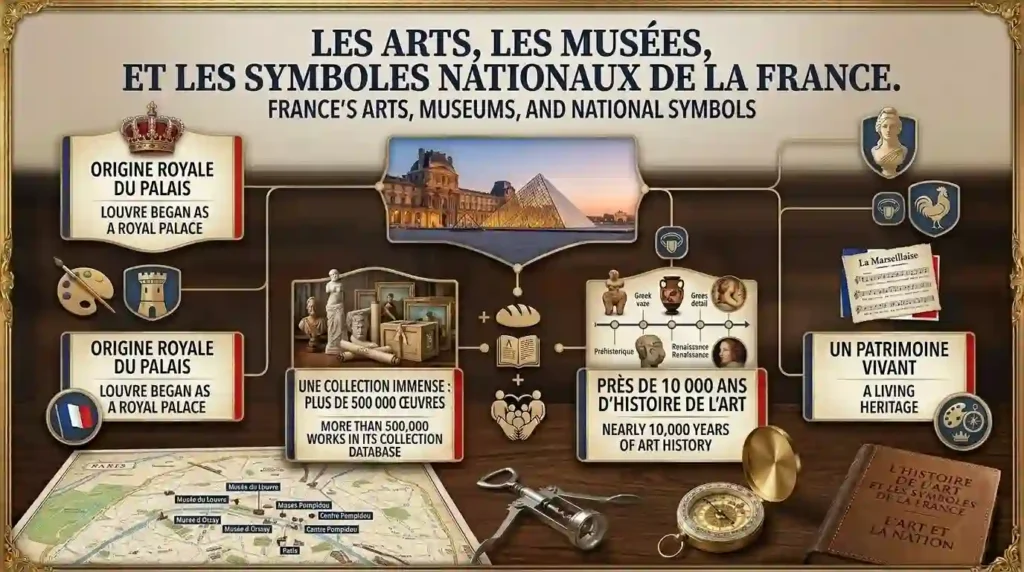
26. The Louvre began as a royal palace.
The Louvre was once a palace for French monarchs. It later became a museum and is now one of the world’s best-known cultural institutions.
Source: Louvre Museum.
27. The Louvre’s collection database contains more than 500,000 works.
The museum’s official collection database covers the Musée du Louvre and the Musée National Eugène-Delacroix. It provides access to information on more than half a million works.
Source: Louvre Museum.
28. The Louvre covers nearly 10,000 years of art history.
The museum describes its collections as spanning nearly 10,000 years. That makes its collection a huge journey through different civilizations and artistic traditions.
Source: Louvre Museum.
29. France’s national anthem is La Marseillaise.
The French Constitution identifies La Marseillaise as the national anthem. It was written by Rouget de Lisle during the French Revolution.
Source: Élysée.
30. Marianne represents the French Republic.
Marianne is one of the official symbols of the French Republic. Her image appears in French public life and represents the Republic’s values.
Source: Élysée.
Source: Louvre Museum — Palace and Collections
Five More France Facts Worth Knowing
31. France has heritage sites added in the 2020s.
France’s UNESCO list is still growing. Recent additions include the Megaliths of Carnac in 2025 and the D-Day Landing Beaches of Normandy in 2026.
Source: UNESCO.
32. France has UNESCO heritage in the Pacific.
Taputapuātea in French Polynesia is a World Heritage property. The Marquesas Islands were added as a mixed site in 2024.
Source: UNESCO.
33. French heritage includes Roman engineering.
The Pont du Gard is a Roman aqueduct in southern France. UNESCO added it to the World Heritage List in 1985.
Source: UNESCO.
34. The Eiffel Tower was originally planned as a temporary structure.
The tower was initially connected to a 20-year operating concession. Its later survival was helped by its usefulness for scientific and radio experiments.
Source: Eiffel Tower official website.
35. France’s national identity has many official symbols.
The Republic recognizes several symbols, including the flag, La Marseillaise, Marianne, the motto, July 14, and the Gallic rooster. Together, they connect modern France with its history.
Source: Élysée.
Source: UNESCO — France country profile
FAQ: Fun Facts About France
1. What is France best known for?
France is widely known for its art, food, fashion, architecture, history, and landmarks. Its heritage is much broader than Paris. UNESCO lists 56 World Heritage properties in France.
Source: UNESCO.
2. How tall is the Eiffel Tower today?
The Eiffel Tower currently measures 330 meters, including its antennas. Its height increased several times because new radio and television antennas were added.
Source: Eiffel Tower official website.
3. What is France’s national motto?
France’s national motto is Liberty, Equality, Fraternity. It is written into Article 2 of the Constitution of the Fifth Republic.
Source: Élysée.
4. Does France have overseas territories?
Yes. French territory extends beyond metropolitan Europe. Its overseas lands include territories in the Caribbean, Pacific, Indian Ocean, and South America.
Source: France.fr.
5. Why is French food considered cultural heritage?
UNESCO recognizes the gastronomic meal of the French as intangible cultural heritage. It focuses on food, taste, preparation, presentation, and social connection.
Source: UNESCO.
6. How many UNESCO World Heritage sites does France have?
UNESCO currently lists 56 World Heritage properties for France. They include cultural, natural, and mixed sites.
Source: UNESCO.
7. Was the Eiffel Tower always 330 meters tall?
No. It was about 312 meters when opened in 1889. Antennas later increased its height, reaching 330 meters in 2022.
Source: Eiffel Tower official website.
8. What was the Louvre before it became a museum?
The Louvre was a royal palace. Its history as a palace is part of the story behind the modern museum.
Source: Louvre Museum.
Conclusion
These fun facts about France show why the country is far more than Paris and the Eiffel Tower. France combines ancient landscapes, royal history, revolutionary ideas, modern engineering, world-famous art, and living food traditions. Its territory reaches across several parts of the world. Its UNESCO heritage includes castles, cities, caves, mountains, islands, and archaeological sites. Even its famous landmarks have surprising stories. The Eiffel Tower grew taller, the Louvre began as a palace, and French dining became recognized as living cultural heritage. France is a country where history is not locked away. It is still part of everyday life.

hello! I am Irshad Ullah, and a passionate writer and lifelong learner dedicated to uncovering fascinating facts about science, history, nature, animals, space, and the world around us. I research each topic carefully and transform surprising information into clear, engaging, and enjoyable content. My goal is to satisfy curiosity, inspire learning, and help readers discover something amazing every day.