
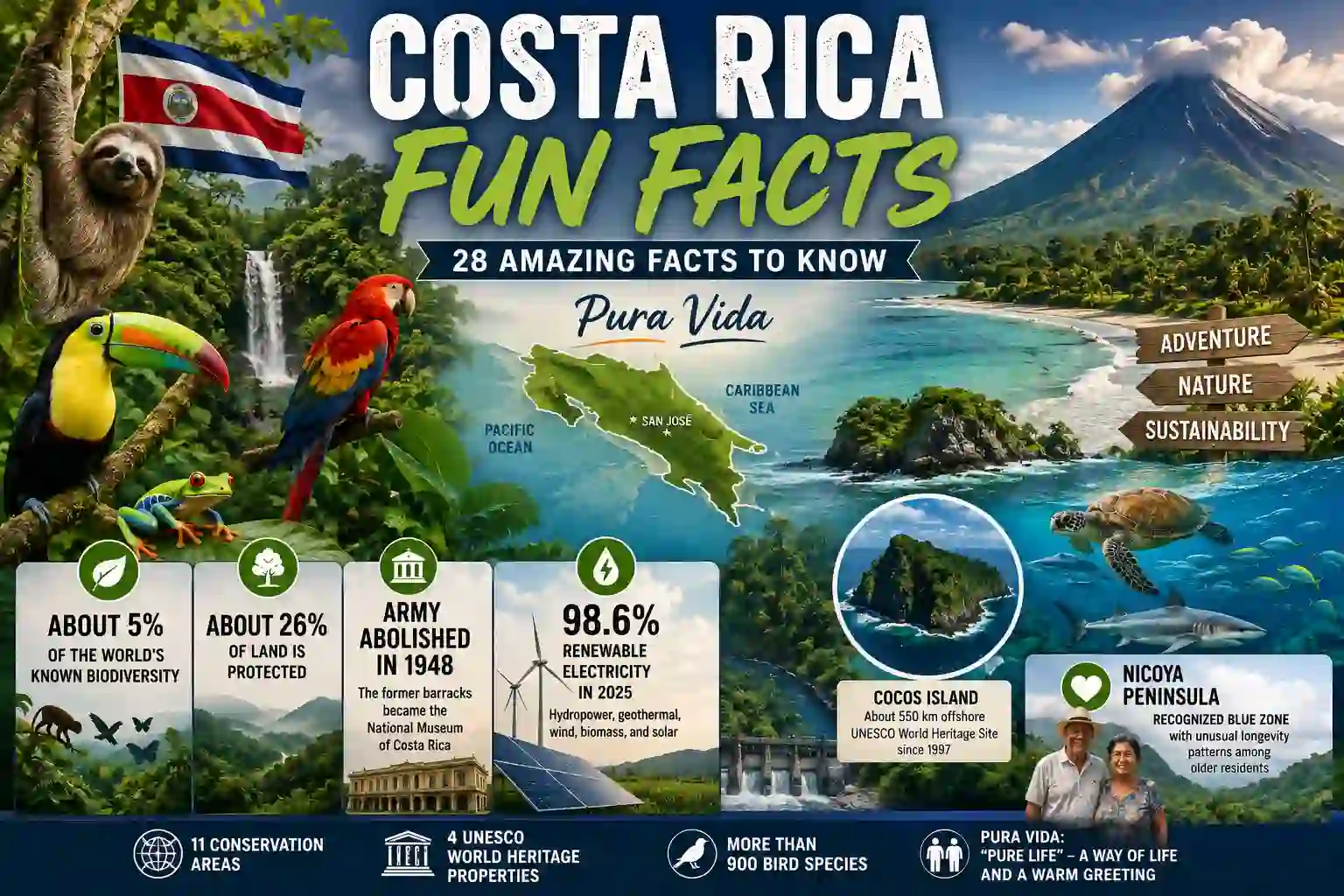
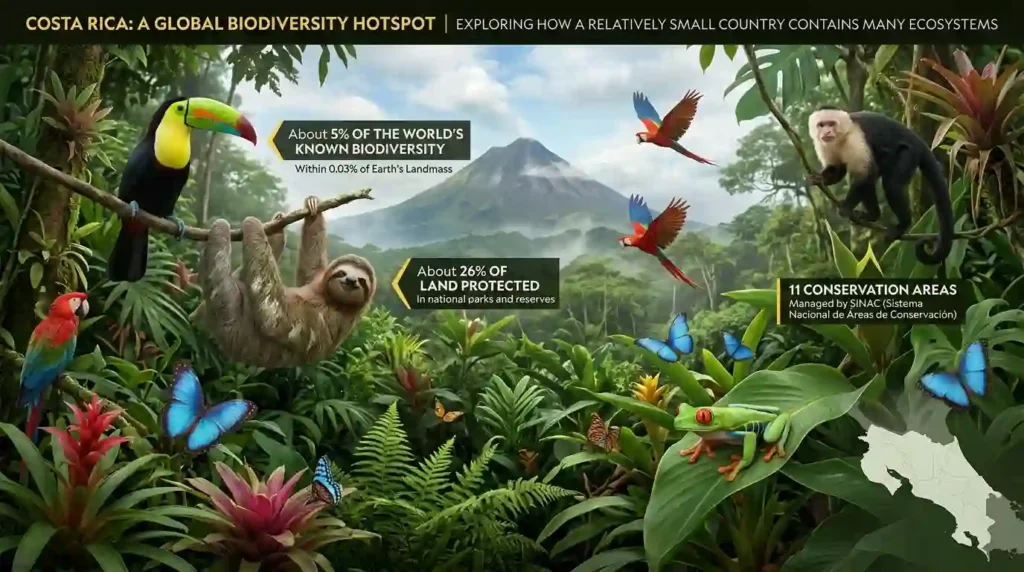
Most countries are defined by what they have. Costa Rica is defined by what it gave up — and what it chose instead. In 1948, it abolished its army and put the savings into schools and parks. Today, about 26% of its land is protected, it holds roughly 5% of the world’s known biodiversity on just 0.03% of Earth’s land surface, and in 2025 it generated 98.6% of its electricity from renewable sources. These are not accidents of geography. They are the compound interest of decisions made decades ago.
But Costa Rica refuses to be only a policy success story. It is also the land of “Pura Vida” — two words that function as greeting, philosophy, and national brand all at once. It has coasts on two oceans, a Blue Zone where scientists study exceptional longevity, glass frogs you can see through, and streets where directions start with “100 meters south of the church.” These 47 Costa Rica fun facts are organized around the choices that made the country — and the wild details that make it unforgettable.
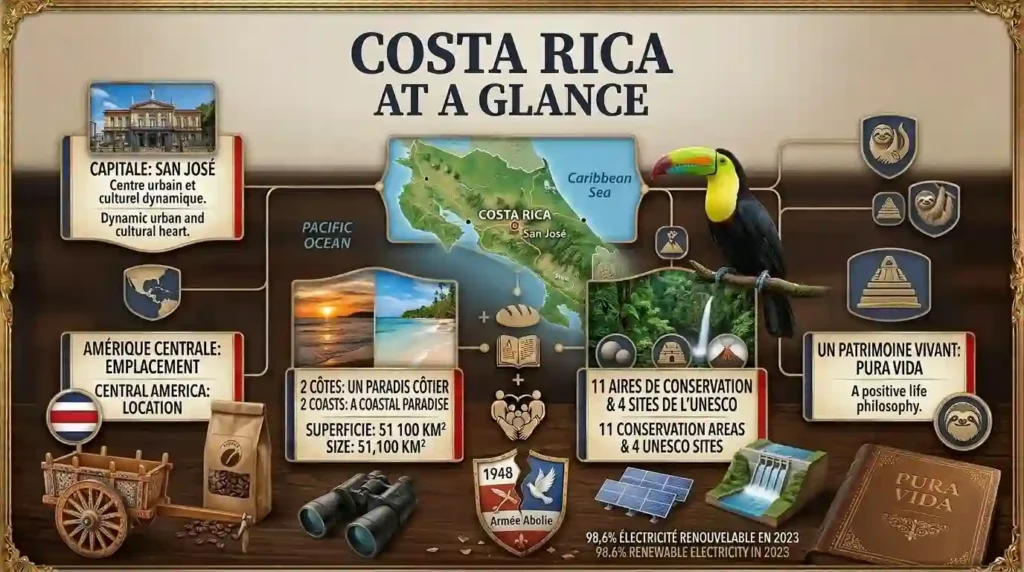
Costa Rica at a Glance
| Fact | Detail |
|---|---|
| Capital | San José |
| Region | Central America |
| Land area | About 51,100 km² |
| Coasts | Pacific Ocean and Caribbean Sea |
| Conservation areas | 11 (SINAC system) |
| World Heritage properties | 4 |
| Army | Abolished in 1948 |
| Signature phrase | “Pura Vida” |
| Renewable electricity | 98.6% in 2025 |
Decision One: The Country That Gave Up Its Army
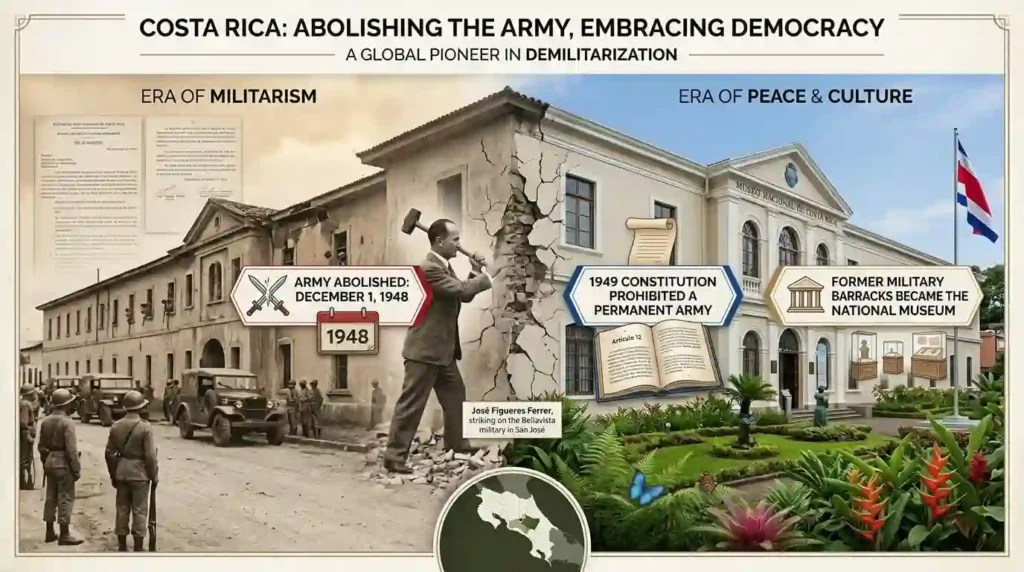
1. Costa Rica abolished its army on December 1, 1948. José Figueres Ferrer formally ended the military at the Bellavista barracks — one of the defining moments in the country’s modern history. Source: Costa Rica Ministry of Education.
2. The ban entered the Constitution. The 1949 Constitution prohibited a standing army as a permanent institution, replacing it with police forces for public order.
3. The barracks became a museum. Bellavista now houses the National Museum of Costa Rica — a military building converted into a place of learning.
4. December 1 is a national observance. The Day of the Abolition of the Army, established by executive decree in 1986, keeps the decision in public memory.
5. The savings went to schools. Costa Rica redirected military spending toward education — today its literacy rate is about 98%, among Latin America’s highest.
Decision Two: Betting the Grid on Nature
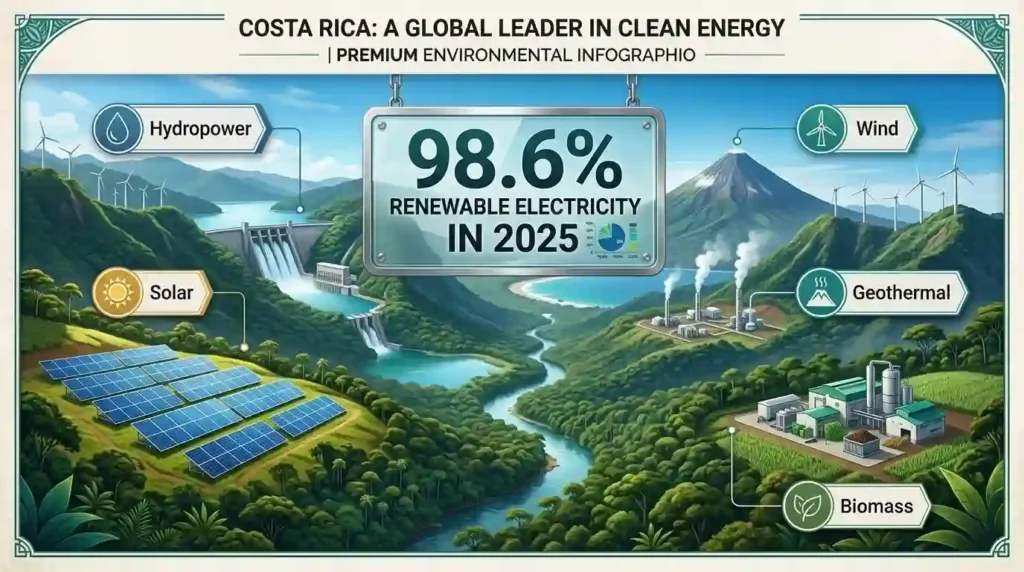
6. In 2025, renewables produced 98.6% of Costa Rica’s electricity. Hydropower, geothermal, wind, biomass, and solar — reported by the national electricity institute, ICE, after verification. Source: ICE Group via Canal Solar.
7. Hydropower does the heavy lifting. Rivers and mountains make hydro the backbone, with geothermal, wind, biomass, and solar diversifying the mix.
8. Volcanoes generate electricity. Geothermal plants tap the underground heat of a volcanically active country — geology as infrastructure.
9. The figure is year-specific. Rainfall, wind, and demand shift every year — 2024’s drought, for instance, temporarily forced fossil-fuel backup. The 98.6% belongs to 2025.
10. Electricity is not the whole energy story. About 70% of Costa Rica’s total energy use, including transport fuel, still depends on imported oil and gas — the grid is green, the roads less so.
Decision Three: Reversing Deforestation
11. Forest cover fell to a quarter of the country in the 1980s. Then Costa Rica reversed course through conservation payments and reforestation.
12. Forests now cover more than half the country. One of the few nations on Earth to significantly regrow its forests in recent decades.
13. About 26% of land is protected. National parks, wildlife refuges, and reserves managed through SINAC’s 11 conservation areas. Source: Costa Rica Tourism Institute.
14. Small country, huge biodiversity. Roughly 5% of the world’s known biodiversity lives in Costa Rica’s forests, wetlands, mountains, and seas. Source: Costa Rica Tourism Board.
15. Two coasts, two climates. The Pacific and Caribbean sides get different rainfall from the same mountains — two tropical worlds in one small country.
16. Habitats stack within hours. Travelers can move from lowland forest to cloud forest in a single day — elevation doing the work of latitude.
Cocos Island: 550 Kilometers of Isolation
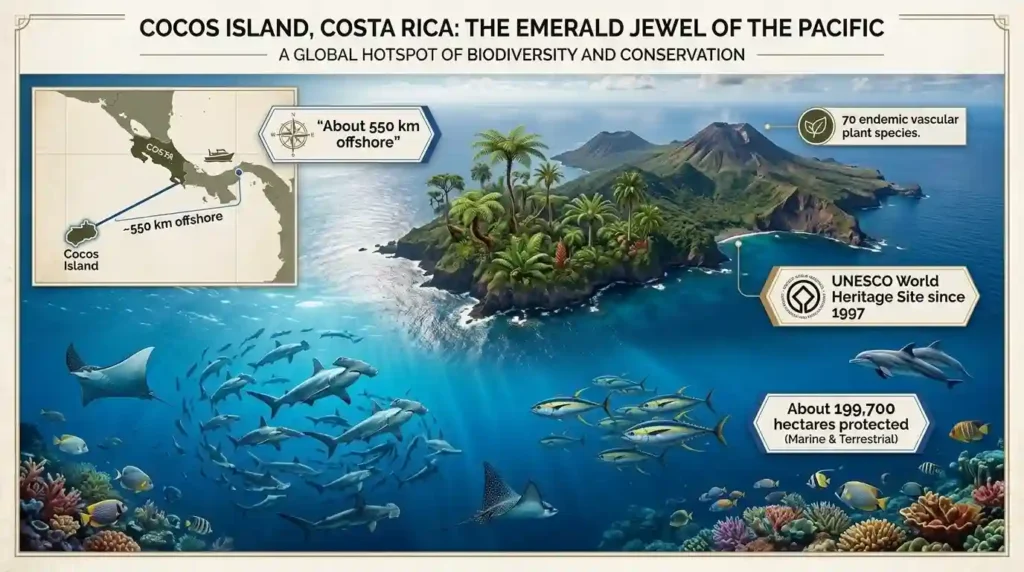
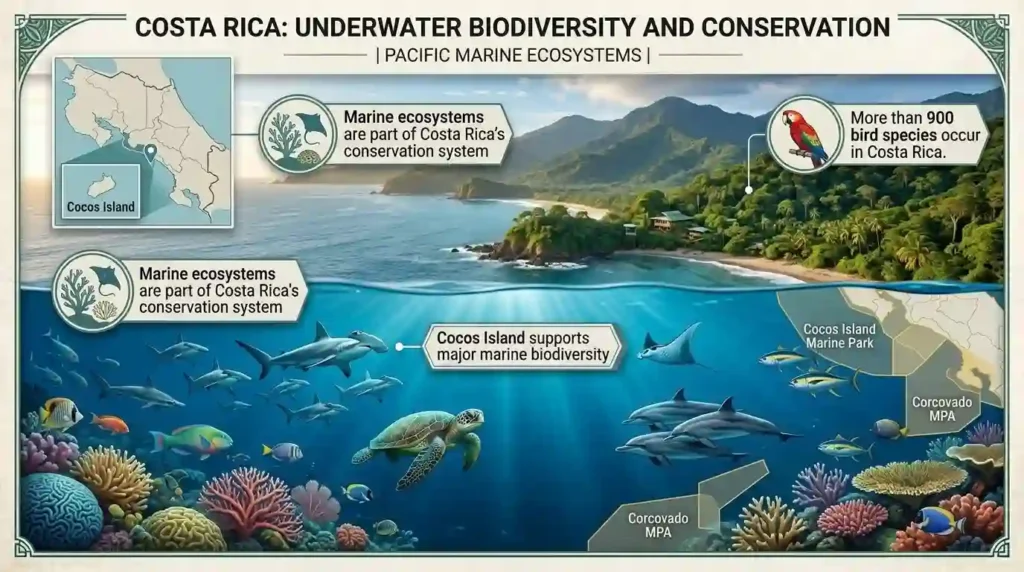
17. Cocos Island sits 550 km offshore. Its extreme isolation makes it utterly unlike mainland parks. Source: UNESCO.
18. It is a World Heritage Site. Listed in 1997 and expanded in 2002; the protected area covers about 199,700 hectares, mostly ocean.
19. Evolution ran experiments there. About 70 endemic vascular plant species, plus endemic birds, reptiles, and freshwater fish. Source: UNESCO.
20. Its waters gather giants. Around 300 recorded fish species, with hammerhead sharks, rays, tuna, and dolphins drawn to its currents.
21. Currents make it a marine crossroads. UNESCO describes the island as a dispersal center for marine larvae — isolation that connects oceans.
“Pura Vida”: Two Words That Became a Country
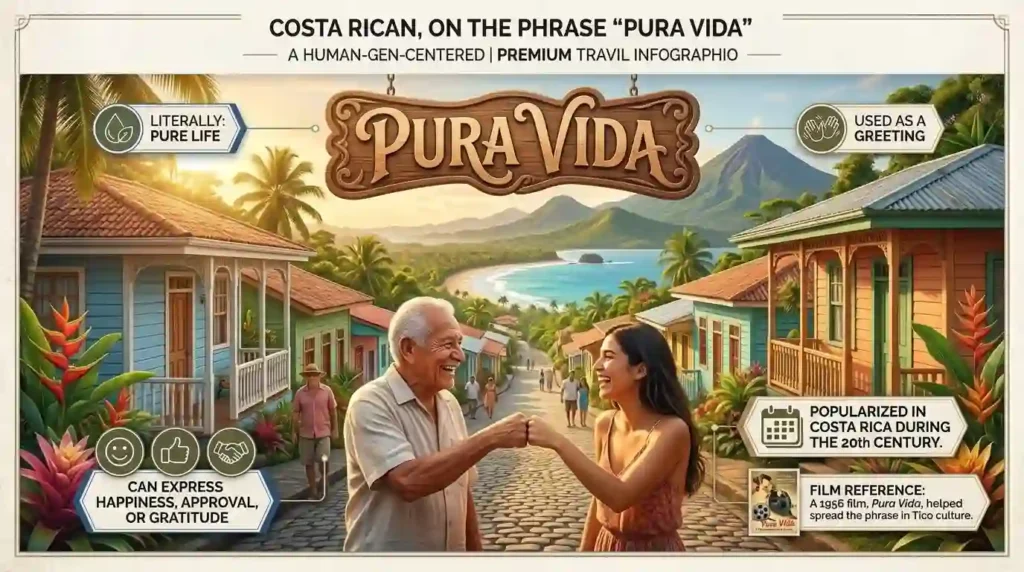
22. It literally means “pure life.” Used as greeting, farewell, and expression of contentment — closer in spirit to “full of life.” Source: Costa Rica Tourism Board.
23. A Mexican film helped spread it. University of Costa Rica research traces the phrase’s modern rise to the 1950s onward; a film titled Pura Vida carried it, and by the 1970s young Costa Ricans had made it their own.
24. It flexes to fit the moment. Approval, gratitude, relaxation, greeting — two syllables doing the work of a dozen phrases.
25. It is unofficial but unmistakable. Not a constitutional motto, yet recognized worldwide as Costa Rica’s signature. Source: University of Costa Rica.
Nicoya: Where Scientists Study Longevity
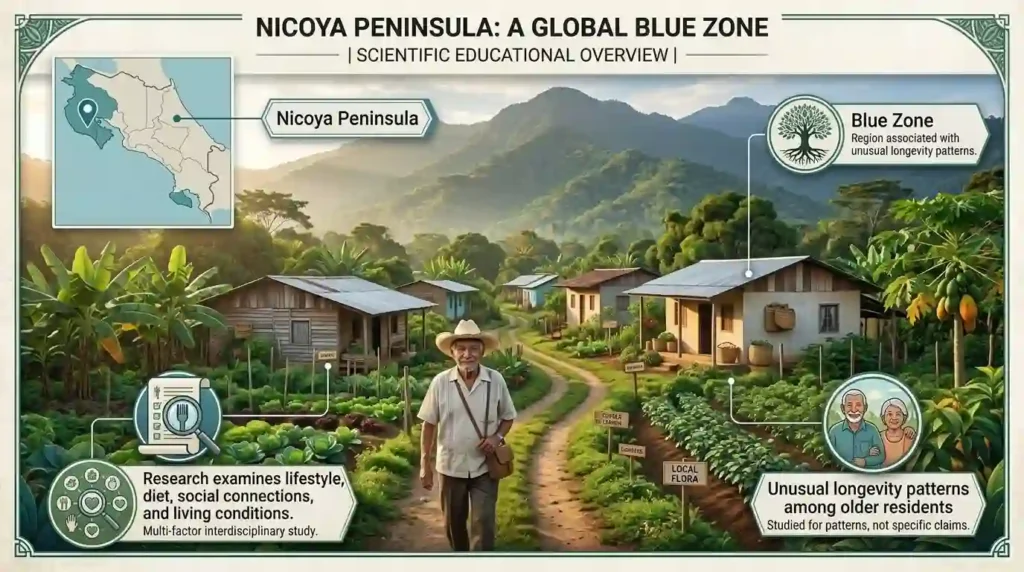
26. The Nicoya Peninsula is a Blue Zone. Researchers found unusual longevity among older residents across five cantons: Carrillo, Santa Cruz, Nicoya, Hojancha, and part of Nandayure.
27. The data is about populations, not promises. Lower mortality showed up in statistics — a group pattern, not a guarantee for any individual.
28. Diet, community, and lifestyle are all suspects. Scientists weigh social connection and living conditions alongside food — no single factor explains it.
29. Beware the lifestyle headline. Population findings get flattened into diet tips; the research itself is more careful than the coverage.
Below the Surface and Above the Canopy
30. Conservation extends underwater. Protected areas include marine zones — sharks, turtles, and coral count as conservation targets too. Source: SINAC.
31. Costa Rica has 900+ bird species. An extraordinary count for 51,100 km², spanning resident and migratory birds. Source: Costa Rica Tourism Institute.
32. Tourism is managed, not just marketed. Visitor activity inside wildlife areas runs through management plans — conservation first, selfies second.
33. Six active volcanoes shape the land. The country rides the Pacific Ring of Fire; eruptions have literally built new ground over millions of years.
34. Corcovado hosts all four monkey species. Howler, spider, white-faced capuchin, and squirrel monkeys share one Osa Peninsula park.
35. Glass frogs are living windows. Their transparent bellies reveal heart and organs — camouflage taken to an anatomical extreme.
36. Whales visit from both hemispheres. Northern and Southern Hemisphere humpbacks both use the Pacific coast, stretching whale-watching season to one of the world’s longest.
Everyday Costa Rica
37. The anthem plays daily at 7 a.m. Radio and TV stations broadcast the national anthem every morning.
38. Addresses use landmarks, not street names. “100 meters south of the church” or “from the old mango tree” — many streets have no formal names.
39. Everyone is Tico or Tica. The nickname comes from the affectionate habit of adding “-tico” to diminutives.
40. Stone spheres still puzzle archaeologists. Hundreds of near-perfect pre-Columbian spheres, some over 2 meters wide, carved by the Diquís culture for unknown purposes.
41. “Sodas” serve the national lunch. Family-run diners dish up the casado — rice, beans, salad, and meat — affordably.
42. Wildlife is on the money. Banknotes and coins feature sloths, butterflies, and sea turtles.
43. From Irazú’s summit you can see two oceans. On a clear day, the Pacific and Caribbean appear at once.
44. Costa Rica is not an island. A mainland country bordered by Nicaragua and Panama — a common mix-up worth correcting.
45. Sloths sleep 8–10 hours, not 20. The “laziest animal” myth overshoots; wild sloths rest about as much as many mammals.
46. Columbus named it in 1502. “Rich Coast” — for the gold ornaments he saw on Caribbean-coast inhabitants during his fourth voyage.
47. The tap water is famously safe. Drinkable in most of the country — unusual in Central America, and a quiet product of public investment.
Myths vs. Reality
| Myth | Reality |
|---|---|
| Costa Rica has no police because it has no army. | The army was abolished; police forces maintain order. |
| “Pura Vida” is the official motto. | It is a beloved unofficial expression, not a constitutional motto. |
| The whole country has the same tropical weather. | Mountains and two oceans create sharp regional differences. |
| The 98.6% renewable figure is permanent. | It describes electricity generated in 2025 specifically. |
| Everyone in Nicoya lives to 100. | Researchers found unusual population-level longevity patterns — not individual guarantees. |
Frequently Asked Questions
Does Costa Rica really have no army?
Correct — no standing army since December 1948, prohibited by the 1949 Constitution. Police handle domestic security.
What does “Pura Vida” mean?
Literally “pure life” — used as a greeting and an expression of happiness, gratitude, or a relaxed outlook.
How biodiverse is Costa Rica?
About 5% of the world’s known biodiversity on 0.03% of Earth’s land, with 26% of national territory protected.
What is the Nicoya Blue Zone?
A region of the Nicoya Peninsula where researchers documented exceptional longevity among older residents.
Conclusion
These Costa Rica fun facts keep circling back to deliberate choices: no army, a green grid, regrown forests, managed tourism. But the country’s deepest fact may be cultural — “Pura Vida” as a working philosophy, not a slogan. Costa Rica suggests that a small country can choose its story, and that nature, treated as infrastructure rather than scenery, pays compound interest for generations.

Irshad Ullah is a content writer at Fun Facts Horizon. He researches and writes verified fun facts about countries, animals, space, history, and more for curious readers.
1 thought on “Costa Rica Fun Facts: 47 Amazing Facts to Know”