
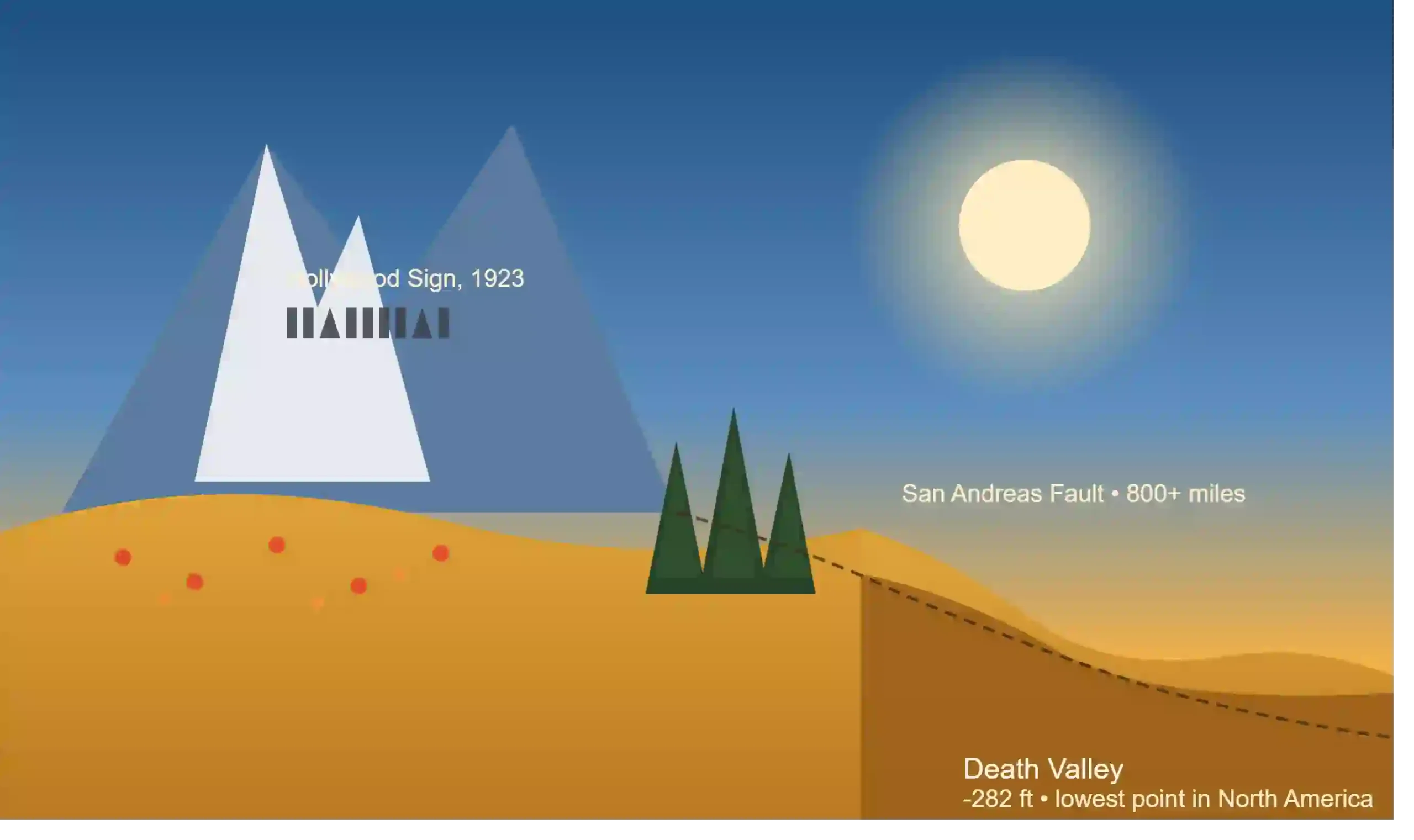
California is a state built out of superlatives that keep colliding with each other. It holds the highest and lowest points in the contiguous United States just 85 miles apart. It grows more food than any other state while running the tech industry that shapes the planet. A former real-estate billboard became the most recognized sign on Earth, and a pair of denim work pants became the state’s official fabric. These contradictions are not accidents — they are what happens when Spanish missions, a gold rush, Hollywood, and Silicon Valley stack on top of each other in one place.
The numbers behind California are almost hard to believe: a $4.25 trillion economy that would rank fourth in the world on its own, nine national parks — more than any other state — and trees that were already ancient when Rome fell. Yet the quirkiest details are the human ones: an official state bat adopted in 2024, a ghost town preserved in “arrested decay,” and surfers who got their sport written into law. Here are 30 fun facts about California that go beyond the beaches-and-freeways cliché.
California at a Glance
| Category | Detail |
|---|---|
| Capital | Sacramento |
| Largest city | Los Angeles |
| Statehood | September 9, 1850 (31st state) |
| Nickname | The Golden State |
| Motto | “Eureka” (I have found it) |
| Population | About 39.5 million |
| Highest point | Mount Whitney, 14,505 feet |
| Lowest point | Badwater Basin, −282 feet |
| National parks | 9 — the most of any state |
Paired Extremes: California Against Itself
No other state contradicts itself this efficiently. Each pair below is real — and each one sits inside the same state border:
| One extreme | The opposite extreme |
|---|---|
| Mount Whitney: 14,505 ft, highest point in the contiguous U.S. | Badwater Basin: −282 ft, the lowest point in North America |
| Redwoods living 2,000+ years | Bodie, a town deliberately frozen in decay |
| The world’s tallest known living tree (Hyperion, 381.3 ft) | Joshua “trees” that aren’t trees at all (they’re yuccas) |
| A $4.25 trillion economy, 4th largest in the world | A ghost town as an official state landmark |
| Silicon Valley’s $58 billion in venture funding | Denim work pants as the official state fabric |
Where Land Reaches Its Extremes
1. Mount Whitney is the rooftop of the contiguous U.S. At 14,505 feet in the Sierra Nevada, on the edge of Sequoia National Park, it is the highest summit in the Lower 48.
2. Badwater Basin is the floor of North America. At 282 feet below sea level in Death Valley, it is the continent’s lowest point — not just the country’s.
3. The two are only 85 miles apart. As the crow flies, America’s highest and lowest points nearly touch; driving between them takes about 135 miles of mountain roads.
4. The San Andreas Fault runs 800+ miles through the state. It marks the boundary between the Pacific and North American tectonic plates. Source: USGS.
5. California has nine national parks — more than any other state. They span desert (Joshua Tree), volcanic peaks (Lassen), and coastal forest (Redwood).
6. Death Valley is enormous. At about 3.4 million acres, it is the largest national park outside Alaska.
Giants of the Forest and Desert
7. The world’s tallest known living tree is a Californian. Hyperion, a coast redwood in Redwood National Park, measures 381.3 feet — taller than the Statue of Liberty including its pedestal. Source: National Park Service.
8. Visiting Hyperion illegally is a crime. Rangers keep its exact location secret, and hiking off-trail to reach it can bring fines and jail time — foot traffic was damaging its roots.
9. Redwoods drink the fog. Coast redwoods can live 2,000+ years, and coastal summer fog supplies up to 40% of their water.
10. The biggest tree is not the tallest. California’s giant sequoias win on trunk volume, not height — the General Sherman Tree in Sequoia National Park holds that title.
11. Joshua trees are impostors. The Mojave Desert’s Joshua trees belong to the yucca family, not to any tree family — yet they can live for hundreds of years.
From Missions to the Gold Rush
12. California skipped being a territory. Admitted September 9, 1850 as the 31st state, it jumped straight to statehood — the Gold Rush population boom made the usual territorial phase unnecessary.
13. The Gold Rush started at Sutter’s Mill in 1848. Within a few years, roughly 300,000 people poured into California from around the world.
14. Bodie is frozen mid-collapse. California’s official Gold Rush ghost town is preserved in “arrested decay” — maintained as it was, not restored. Source: California State Parks.
15. The 1906 earthquake reshaped a city and a science. Estimated today at magnitude 7.9, the San Francisco earthquake destroyed much of the city and led to the elastic rebound theory, still foundational in earthquake science.
16. America’s oldest Chinatown is in San Francisco. Established in the 1850s by Gold Rush-era immigrants, it remains the oldest Chinatown in North America.
The World’s Fourth-Largest Economy
17. California’s economy topped $4.25 trillion in 2025. That is larger than the entire economies of the United Kingdom or France. Source: Governor of California, citing U.S. Bureau of Economic Analysis data.
18. As a country, it would rank fourth in the world. Only the United States, China, and Germany produce more — California sits just ahead of Japan in the 2025 rankings.
19. It hosts 58 Fortune 500 companies. More than any other state; Texas is second with 54.
20. Silicon Valley dominates startup funding. The region has pulled in over $58 billion in venture capital in a single recent year — more than 40% of all U.S. venture funding.
21. It feeds the country. California produces more food than any other state, supplying the bulk of America’s almonds, artichokes, dates, figs, and raisins.
Hollywood and Everyday Culture
22. The Hollywood Sign was a housing ad. Built in 1923, it originally read “Hollywoodland” to promote a hillside real-estate development. Source: Britannica.
23. It was lit by 4,000 bulbs and meant to be temporary. The original sign cost about $21,000 and was designed to last only 18 months.
24. The sign lost its “land” in 1949. After decades of disrepair, the last four letters came down; volunteers rebuilt the remaining nine in steel in 1978.
25. Surfing is the official state sport. Designated in 2018, honoring California’s Pacific beach culture.
26. The official state dance is West Coast Swing. Danced to everything from blues to pop, its roots in the state go back to Gold Rush-era social dances.
Official (and Unofficial) State Symbols
27. The state fossil is a saber-toothed cat. Adopted in 1973; its fossils come from the La Brea Tar Pits in Los Angeles. Source: California State Capitol Museum.
28. The poppy became the state flower in 1903. Every April, Lancaster hosts a festival for its bloom.
29. California has an official state bat. The pallid bat joined the symbol list in 2024 — one of more than 40 official state symbols.
30. Denim is the official state fabric. Adopted in 2017 to honor Levi Strauss, who began making denim work pants in San Francisco during the Gold Rush.
By the Numbers
| Figure | What it measures |
|---|---|
| 14,505 ft | Elevation of Mount Whitney |
| −282 ft | Elevation of Badwater Basin |
| 800+ miles | Length of the San Andreas Fault |
| 381.3 ft | Height of Hyperion, tallest known living tree |
| $4.25 trillion | California’s 2025 GDP |
| 9 | National parks — the most of any state |
| 58 | Fortune 500 companies headquartered in California |
| 300,000 | People who migrated during the Gold Rush |
Conclusion
These fun facts about California keep returning to the same theme: extremes sharing one border. The highest and lowest points nearly touch. A ghost town and a $4.25 trillion economy coexist. Trees older than empires grow within driving distance of startups younger than a year. California’s real story isn’t beaches or freeways — it’s a place where opposites don’t just meet, they move in together.
Irshad Ullah is a content writer at Fun Facts Horizon. He researches and writes verified fun facts about countries, animals, space, history, and more for curious readers.