
El Salvador is a pocket-sized paradox: the smallest country on the Central American mainland, yet densely packed with stories. Volcanoes crowd its skyline, Pacific surf pounds its beaches, and maize fields roll toward mountains farmed for centuries. It is a place where deep history and startling modernity share one small map.
Few countries pack this much contrast into 21,041 square kilometers. El Salvador is the Land of Volcanoes, and one ancient eruption buried the farming village of Joya de Cerén so completely that it is called the Pompeii of the Americas. That same volcanic soil now grows the corn for pupusas, the griddled cakes at the heart of Salvadoran food culture.
Then came a modern jolt: in 2021, El Salvador became the first country to adopt Bitcoin as legal tender, placing a land of ancient villages at the center of a global money debate. These 28 facts trace how volcanoes, food, history, and technology collided in one small country, and why its story keeps surprising those who look closer.
El Salvador at a Glance
| Fact | Detail |
| Official name | Republic of El Salvador |
| Capital | San Salvador |
| Region | Central America |
| Population | 6,365,503 in 2025 |
| Area | About 21,041 sq. km |
| Official language | Spanish |
| Main currency | U.S. dollar |
| Pacific coastline | Along the Pacific Ocean |
| UNESCO World Heritage site | Joya de Cerén |
| Independence from Spain | 1821 |
A Small Country With a Big Population
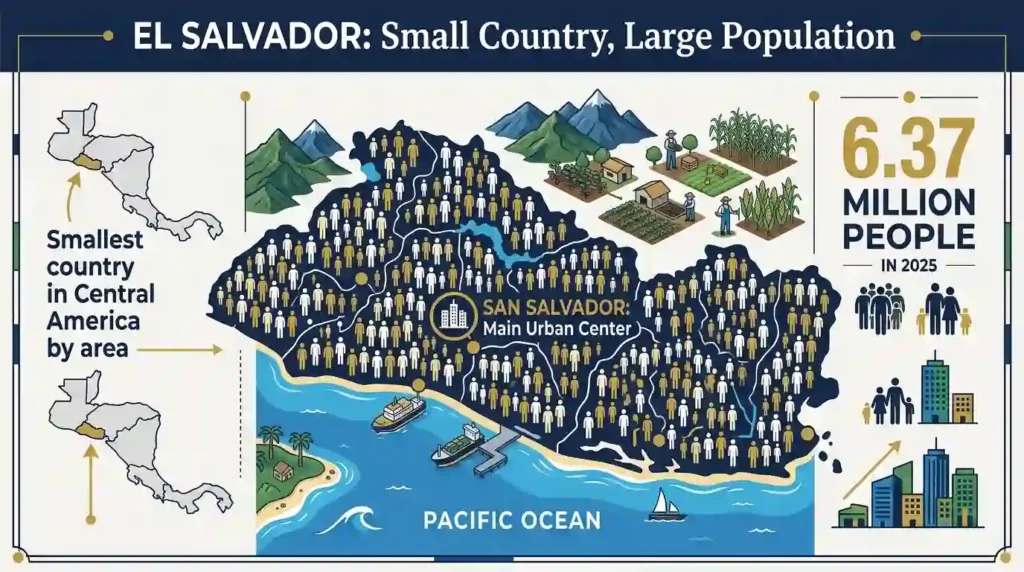
1. El Salvador is Central America’s smallest country by area.
El Salvador covers about 21,041 square kilometers. That makes it the smallest country on the Central American mainland. Its small size does not mean it lacks variety. You can find cities, mountains, volcanoes, beaches, lakes, and farming areas within a relatively compact space. That makes geography one of the country’s most interesting features. Elsewhere on the isthmus, Costa Rica shows how another small Central American country can hold remarkable variety.
Source: Britannica — El Salvador
2. More than six million people live there.
The World Bank recorded 6,365,503 people in El Salvador in 2025. That population is large compared with the country’s land area. This helps explain why El Salvador has a high population density. Population figures can change, so this number should always be treated as a dated statistic.
3. San Salvador is the national capital.
San Salvador is the capital and largest major urban center of the country. The city sits close to the San Salvador volcano. This creates a striking setting, with urban life developing beside a major volcanic landscape. The capital also serves as an important political, economic, and cultural center.
4. El Salvador is shaped by the Pacific Ocean.
The country sits on Central America’s Pacific side. Its coast supports beaches, fishing communities, tourism, and surfing. The government tourism site highlights destinations ranging from beaches and lakes to volcanoes and colonial towns. When I think about El Salvador’s geography, that contrast stands out: mountains and ocean exist within a surprisingly small space.
Volcanoes Are Part of Everyday Geography
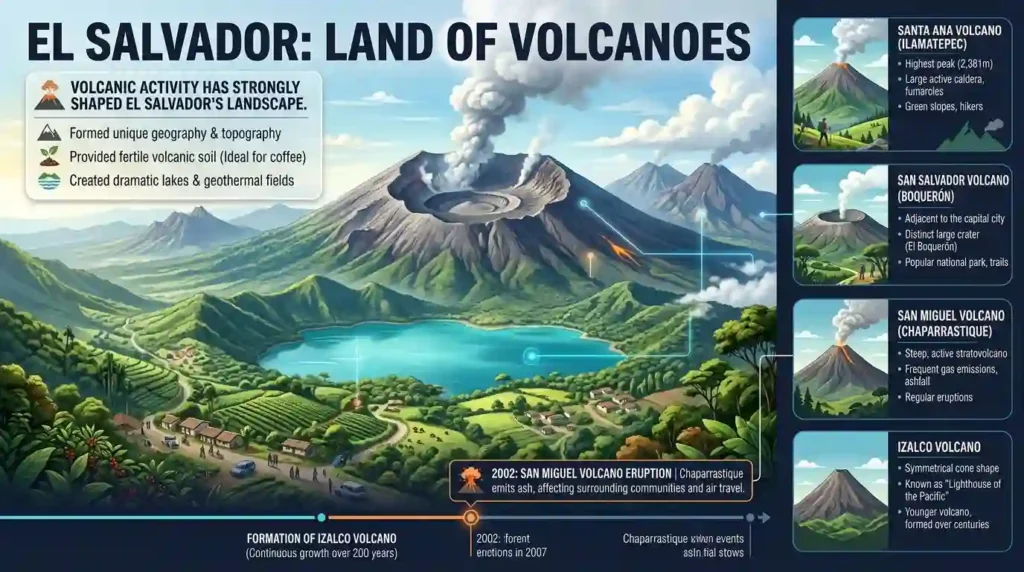
5. El Salvador is known as the “Land of Volcanoes.”
Volcanoes are one of the country’s defining natural features. Several historically active volcanoes have shaped the landscape. These include Santa Ana, San Miguel, San Salvador, Izalco, and others. Volcanic activity has also created fertile soils and dramatic scenery. The same forces that can threaten communities have helped shape the land people farm and live on.
Source: Volcano data: Smithsonian Institution Global Volcanism Program
6. Volcanoes helped preserve an ancient village.
Joya de Cerén was buried by volcanic ash around the seventh century. The eruption covered buildings and everyday objects. This unusual event protected materials that would normally disappear over time. The result is an archaeological site that shows how ordinary farming families lived, rather than focusing only on rulers and monuments.
7. San Miguel is one of the country’s active volcanoes.
San Miguel Volcano is among El Salvador’s historically active volcanoes. Its most recent significant eruption occurred in December 2013, when ash plumes rose high above the crater and authorities evacuated thousands of people from nearby communities. The event was a reminder that volcanism is not simply an ancient part of Salvadoran history. It remains a living part of the country’s natural environment.
8. Izalco became famous for its volcanic activity.
Izalco is one of El Salvador’s best-known volcanoes. Its volcanic history helped give it a strong place in the country’s landscape and tourism. The volcano is also closely linked with the western highlands. Today, volcanic scenery is one of the features that makes travel through El Salvador visually distinctive.
An Ancient Village Frozen in Time
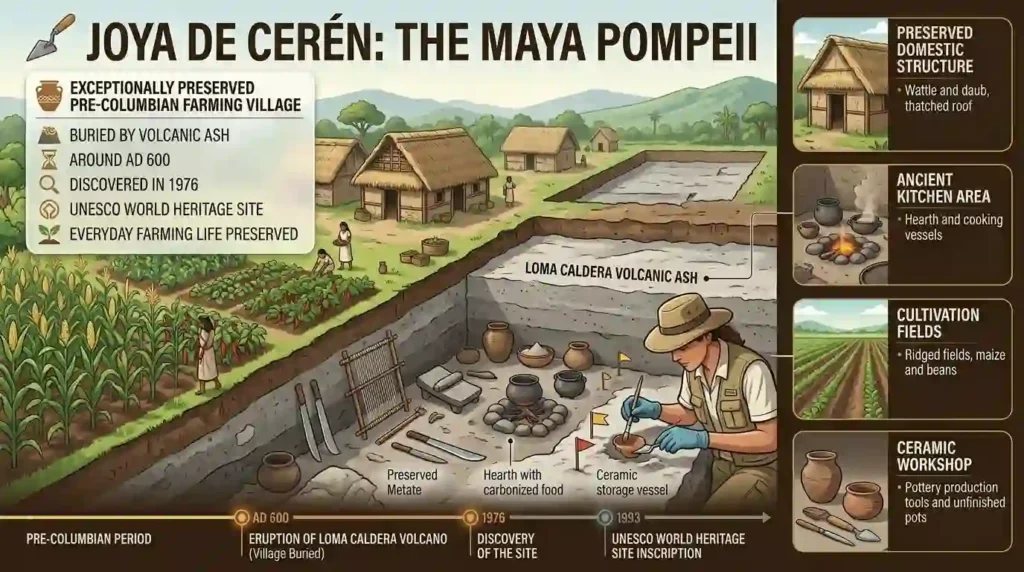
9. Joya de Cerén is a UNESCO World Heritage Site.
Joya de Cerén was added to the UNESCO World Heritage List in 1993. UNESCO recognizes it for the exceptional evidence it provides about ordinary life in a pre-Hispanic farming community. The site is especially valuable because it preserves homes, work areas, crops, and household objects together.
Source: UNESCO — Joya de Cerén Archaeological Site
10. The village was buried by the Loma Caldera eruption.
The settlement was destroyed when the Loma Caldera volcano erupted. Ash fell rapidly over the village. People abandoned the settlement, leaving many objects where they had been used. The sudden burial created an archaeological time capsule. It is one reason Joya de Cerén gives researchers such a detailed look at daily life.
11. Archaeologists found ordinary household spaces.
Joya de Cerén contains remains of houses, kitchens, storehouses, public buildings, and a sweat bath. Archaeologists have also found tools, pots, sleeping mats, and other objects. These discoveries reveal practical details of everyday life. They help researchers study farmers and families, not just political leaders or wealthy elites.
12. The site was discovered by accident.
Joya de Cerén was discovered in 1976 during work connected with grain-storage construction. A bulldozer exposed part of an ancient structure. What first looked like ordinary earth turned out to contain preserved archaeological remains. The accidental discovery eventually revealed one of the most important archaeological sites in Central America.
Most Surprising Fact Explained: Joya de Cerén, the Pompeii of the Americas
Of all the facts on this list, Joya de Cerén may be the most astonishing, and UNESCO itself invites the comparison. The organization’s World Heritage listing describes the site as a pre-Hispanic farming community that, like Pompeii and Herculaneum in Italy, was buried by a sudden volcanic eruption. UNESCO added it to the World Heritage List in 1993. Source: UNESCO — Joya de Cerén Archaeological Site
The eruption came from the Loma Caldera volcano around AD 600. Unlike Pompeii, where a Roman city was entombed, Joya de Cerén was a modest farming village, and that is exactly what makes it precious. The ash sealed kitchens with utensils still in place, storehouses holding harvested crops, a sweat bath used for ritual cleansing, and even cultivated maize fields with plants preserved where they grew.
Because the villagers fled in a hurry, archaeologists found daily life frozen mid-motion rather than the palaces of rulers. Few archaeological sites in the Americas preserve ordinary domestic life in such detail, which is why the “Pompeii of the Americas” nickname has stuck. It is the closest thing the ancient Americas have to a time capsule of everyday farming life.
Pupusas Tell a Story Through Food
13. The pupusa is El Salvador’s national dish.
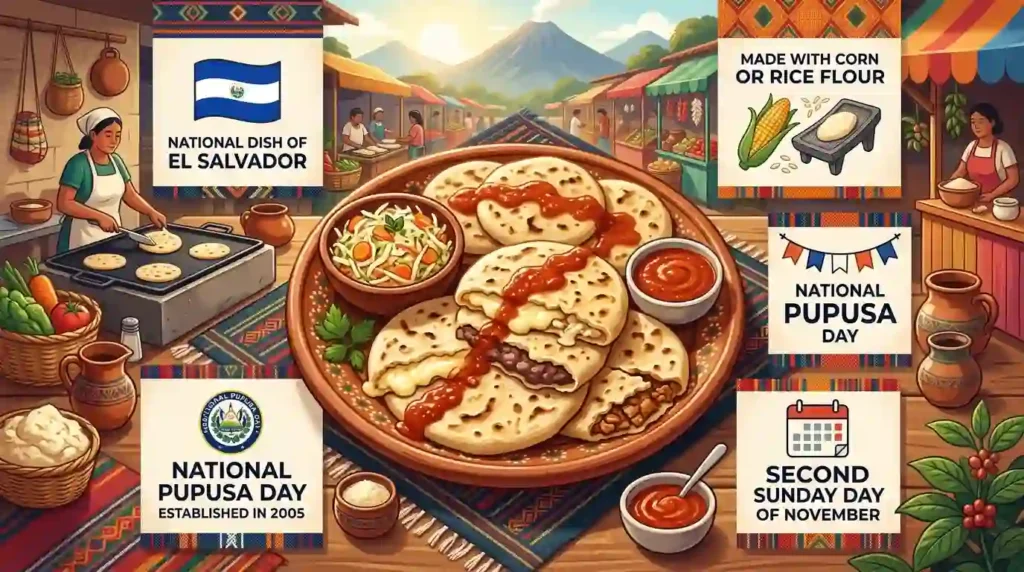
Pupusas are a central part of Salvadoran food culture. They are made from maize or rice dough and filled with ingredients such as cheese, beans, or chicharrón. The country’s tourism authority describes pupusas as a typical national dish. For me, they are more than a food fact. They show how maize remains tied to daily culture.
Source: El Salvador Travel — National Pupusa Day and food culture
14. Pupusas can be made from rice flour.
Many people associate pupusas with corn masa, but rice flour is also used. The town of Olocuilta is especially known for rice pupusas. This small detail shows how one national food can develop local styles. The basic idea stays familiar while the ingredients and preparation can vary between places.
15. National Pupusa Day is celebrated each November.
El Salvador officially established National Pupusa Day in 2005. It is celebrated on the second Sunday of November. The day turns a popular food into a national cultural celebration. Pupusas are served with different fillings, including traditional combinations and newer variations.
16. Pupusas are usually served with curtido.
A traditional pupusa is often served with curtido and tomato sauce. Curtido is a lightly pickled cabbage mixture. The crisp, sour topping creates a contrast with the warm and soft pupusa. This pairing is one of the simple details that makes the dish recognizable beyond its basic ingredients.
History Left Deep Marks
17. El Salvador declared independence from Spain in 1821.
El Salvador became independent from Spanish rule in 1821. The country later separated from the Central American Federation, a union it had shared with Guatemala and other neighbors, in 1839. These two dates matter because independence was a process rather than a single political change. Modern El Salvador developed through several stages after Spanish colonial rule ended.
Source: Britannica — El Salvador
18. The country experienced a 12-year civil war.
El Salvador endured a civil war that lasted from 1980 until 1992. The conflict ended with peace agreements that included political and military reforms. This history still matters when studying the country’s modern identity. It also helps explain why peace, migration, politics, and social change remain important themes in Salvadoran history.
19. Joya de Cerén gives history a human scale.
Many ancient sites focus on temples, kings, or monuments. Joya de Cerén is different. It shows ordinary agricultural life. Researchers found evidence of homes, crops, cooking, storage, and work. That makes the site unusually useful for understanding what everyday people did, ate, grew, and used many centuries ago.
20. The ancient settlement preserved crops too.
Archaeologists found evidence of cultivated fields at Joya de Cerén. These included maize and other plants. The remains help researchers understand agriculture in the ancient settlement. Instead of seeing only stone ruins, visitors can learn about food production and household survival. That makes the site unusually personal for an archaeological landmark.
A Modern Country With a Surprising Digital Story
21. El Salvador adopted Bitcoin as legal tender in 2021.
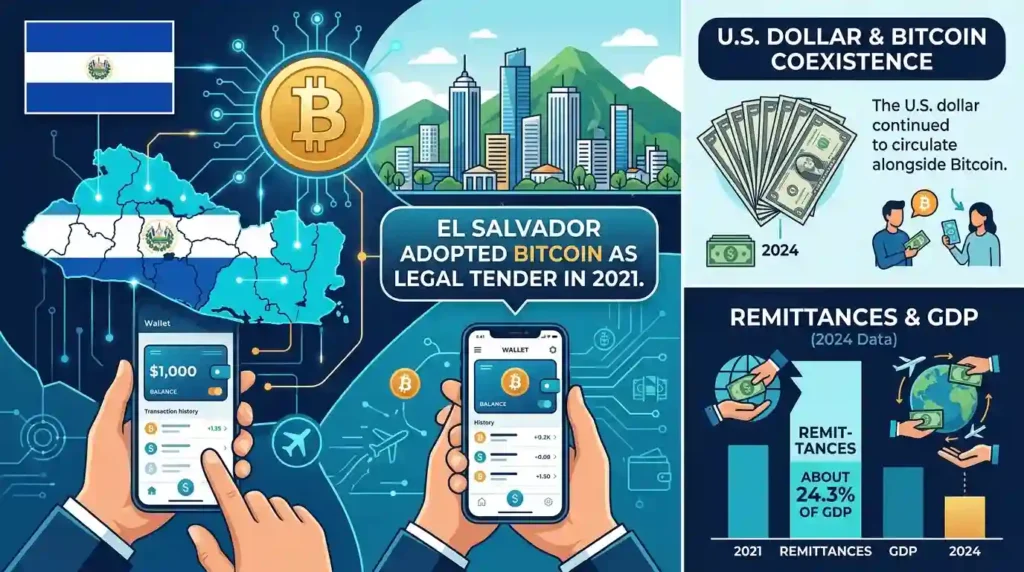
El Salvador became the first country to adopt Bitcoin as legal tender. The Bitcoin Law took effect in September 2021. The government kept the U.S. dollar in circulation as well. This made El Salvador a major case study in the use of cryptocurrency within a national monetary system.
Source: Government of El Salvador — Bitcoin Law announcement
22. The U.S. dollar still matters in the country’s economy.
El Salvador uses the U.S. dollar alongside its Bitcoin policy. The government’s explanation of the Bitcoin Law stated that dollar accounts would remain dollar accounts. This point is important because Bitcoin did not simply replace the dollar. The two systems were designed to operate together under the law. El Salvador is not alone in relying on the dollar: Panama also uses the U.S. dollar as everyday money.
23. Bitcoin use was presented as optional in the original policy.
The Salvadoran government’s explanation said people could choose whether to receive Bitcoin payments. It also described automatic conversion into dollars for users who preferred dollars. This distinction matters when discussing the policy. “Bitcoin became legal tender” does not mean every person had to hold or receive Bitcoin.
24. El Salvador’s economy relies heavily on remittances.
Money sent home by people living abroad is important to El Salvador’s economy. Recent World Bank data puts personal remittances at roughly one-quarter of GDP. That is a striking figure. It shows how closely the country’s economy is connected to Salvadorans living and working outside the country.
Culture Keeps Changing While Traditions Stay Strong
25. Spanish is the official language.
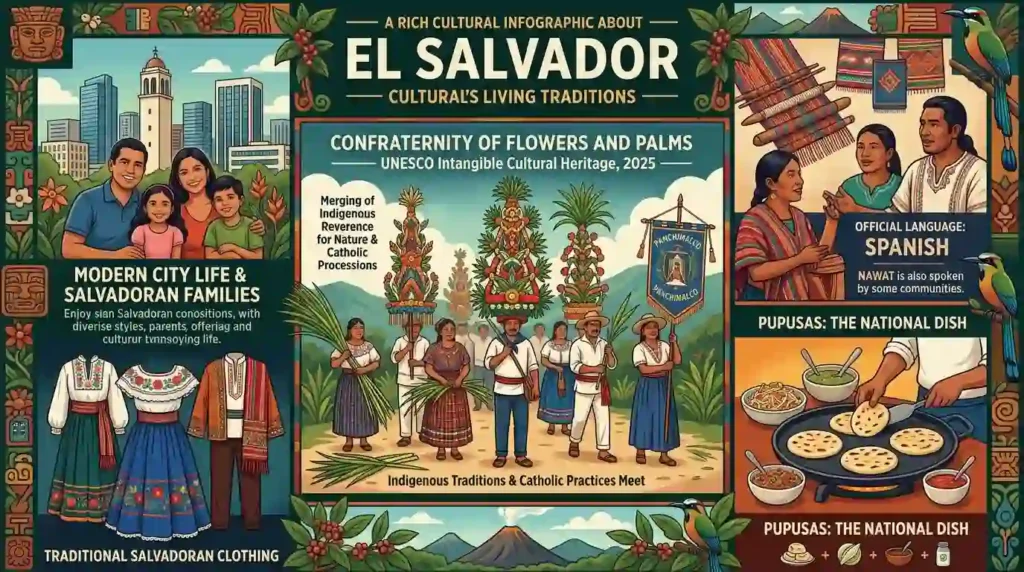
Spanish is El Salvador’s official language. Nawat, an Indigenous language, is also spoken by some communities. The continued presence of Nawat reflects the country’s Indigenous heritage. Language is therefore another place where older traditions and modern national life meet.
Britannica — El Salvador: people and languages
26. Living traditions remain strong in El Salvador.
Towns such as Panchimalco keep colorful religious festivals alive, including processions of palms decorated with flowers that blend Indigenous and Catholic heritage. El Salvador celebrates customs like the Confraternity of Flowers and Palms as part of its living culture, and traditions of this kind are a major draw for cultural tourism.
27. The country now has one UNESCO World Heritage property.
As of 2026, UNESCO lists one World Heritage property for El Salvador: Joya de Cerén Archaeological Site. Living traditions such as festival customs belong to a different heritage category from World Heritage sites, so the two should not be counted together.
28. Volcanoes, food, and heritage connect the country.
Some of the best fun facts about El Salvador are connected. Volcanic eruptions shaped its land and preserved Joya de Cerén. Maize connects ancient agriculture with modern pupusas. Traditional celebrations continue alongside new technology such as Bitcoin. That mix gives El Salvador a distinctive story: its past is still visible in its present.
Myths vs. Reality
| Myth | Reality |
| El Salvador is simply a small beach country. | It has volcanoes, lakes, archaeological sites, cities, farms, and Pacific beaches. |
| Bitcoin replaced the U.S. dollar. | The dollar continued to circulate after Bitcoin became legal tender. |
| Joya de Cerén is a huge stone city. | It is a preserved farming settlement with earthen structures. |
| Pupusas only use corn flour. | Pupusas can also be made with rice flour. |
| El Salvador has no UNESCO heritage. | Joya de Cerén has been a World Heritage Site since 1993. |
FAQ About El Salvador
What is El Salvador best known for?
El Salvador is best known for its volcanoes, Pacific beaches, pupusas, surfing culture, and archaeological heritage. It is also internationally known for its 2021 Bitcoin policy. Its small size makes the combination of these features especially striking.
Why is El Salvador called the Land of Volcanoes?
El Salvador has many volcanoes and a long history of volcanic activity. Several volcanoes have erupted during historical times. Volcanic landscapes are a major part of the country’s geography and tourism.
What food is El Salvador famous for?
El Salvador is especially famous for pupusas. These stuffed corn or rice cakes can contain cheese, beans, chicharrón, and other fillings. They are commonly served with curtido and tomato sauce.
What happened at Joya de Cerén?
A volcanic eruption buried the farming settlement under ash around the seventh century. The rapid burial preserved buildings, tools, crops, and household objects. UNESCO later recognized the site as a World Heritage property.
Is Bitcoin still important to El Salvador?
Bitcoin remains an important part of El Salvador’s modern economic story. However, current rules and usage can change. Any financial or legal claim should therefore be checked against current government information before publication.
How many people live in El Salvador?
The World Bank recorded a population of 6,365,503 in 2025. Population estimates change each year, so the year should always accompany the figure.
What language do people speak in El Salvador?
Spanish is the official language. Nawat is also spoken by some Indigenous communities. English is common in some tourism-related settings, but it is not the country’s official language.
What living traditions does El Salvador celebrate?
El Salvador celebrates living traditions such as the flower-and-palm processions of Panchimalco, which blend Indigenous and Catholic customs. Its only UNESCO World Heritage property, Joya de Cerén, belongs to a separate category from these living cultural practices.
Conclusion
El Salvador proves that size is a poor measure of story. A country you can drive across in a few hours holds a Pompeii-like time capsule, a volcano that erupted within living memory, the birthplace of the pupusa, and the first national Bitcoin experiment. These 28 facts keep circling the same idea: ancient farming villages, living festivals, volcanic landscapes, and digital money are not separate chapters here but one continuous narrative. For a small country on the Pacific edge of Central America, that is an unusually large footprint, and the most surprising fact of all may be how much of the past is still visible in its present.
Irshad Ullah is a content writer at Fun Facts Horizon. He researches and writes verified fun facts about countries, animals, space, history, and more for curious readers.
1 thought on “Fun Facts About El Salvador: 28 Facts That Tell a Bigger Story”