
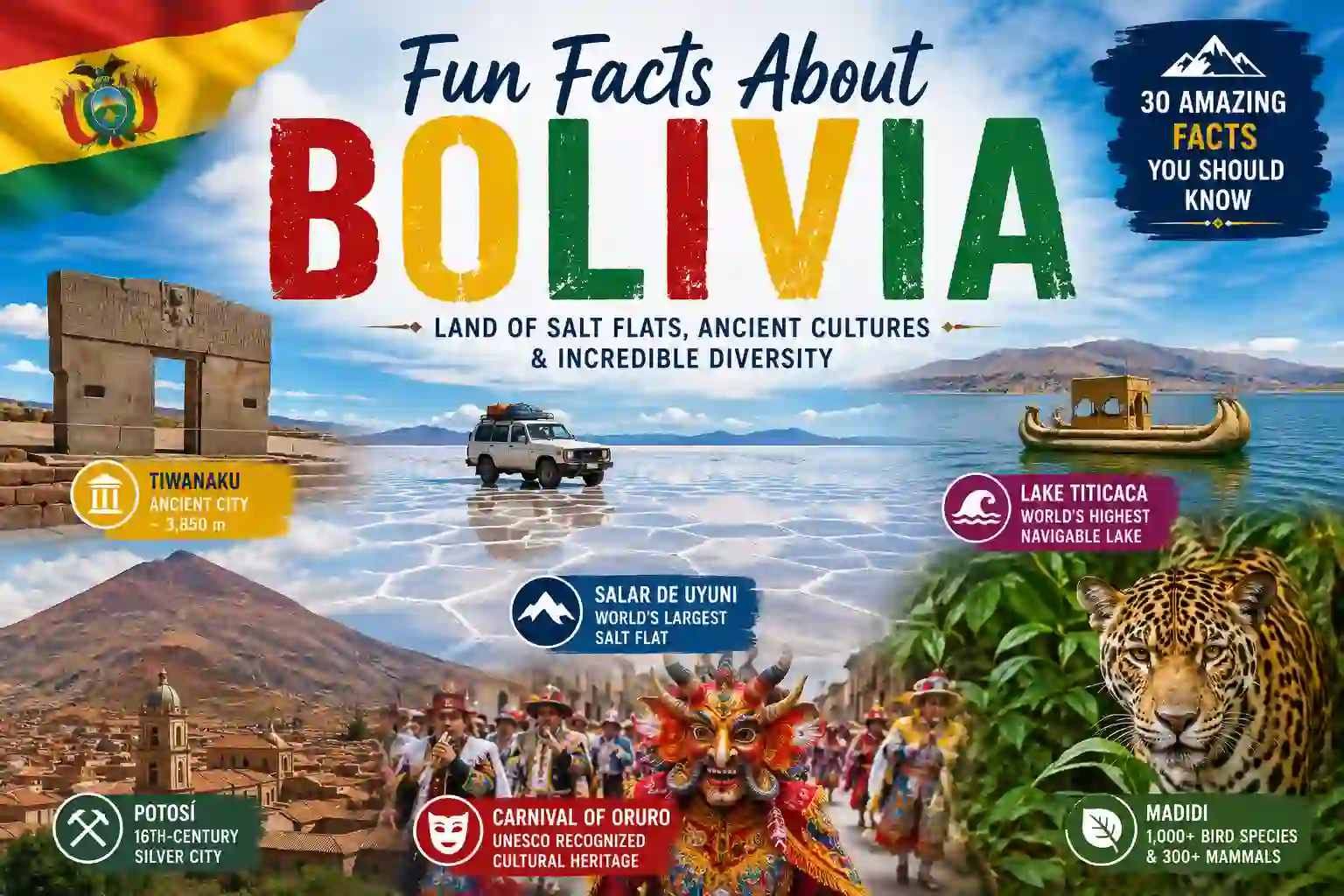
Bolivia is a country of sharp contrasts. It has snowy Andes peaks, vast Amazon forests, and giant salt flats that turn into the world’s largest mirror after rain. It is the only country with two capitals, one of the few with a navy but no coastline, and a place where dinosaur footprints, silver-mountain legends, and cable cars over a canyon city all share the same map. In 2024 the country counted 11,365,333 people in its national census, speaking Spanish alongside dozens of Indigenous languages.
What makes Bolivia genuinely unusual is how much of its story runs counter to expectation: the highest navigable lake on Earth sits in its highlands, its ancient Tiwanaku civilization flourished centuries before the Inca, and its salt desert holds some of the planet’s largest lithium reserves. These 30 fun facts about Bolivia go far beyond the tourist sights — through extreme geography, lost coastlines, living traditions, and the numbers that define one of South America’s most distinctive countries.
Bolivia at a Glance
| Fact | Detail |
|---|---|
| Continent | South America |
| Population | 11,365,333 (2024 census) |
| Area | 1,098,581 km² |
| Independence | August 6, 1825 |
| Official name | Plurinational State of Bolivia |
| Capitals | Sucre (constitutional), La Paz (seat of government) |
| Languages | Spanish plus 36 recognized Indigenous languages |
| UNESCO World Heritage sites | 7 |
| Major natural landmark | Salar de Uyuni |
A Country Without a Coastline
1. Bolivia is completely landlocked. It has no coastline today, bordered by Brazil, Peru, Chile, Argentina, and Paraguay across about 1.1 million square kilometers of territory.
2. It lost its coast in a 19th-century war. In the War of the Pacific (1879–1884), Bolivia lost its Pacific coastline to Chile — a loss still taught in schools and marked every March 23 on the Day of the Sea. Source: Britannica.
3. Bolivia still has a navy — with no sea. The Bolivian Navy patrols Lake Titicaca and the country’s great rivers instead of an ocean. Its sailors train for the day Bolivia regains sovereign sea access, a standing national aspiration.
4. The country is named after Simón Bolívar. The liberator who helped free it from Spanish rule in 1825 gave the new republic his name — one of very few countries named after a person.
Life at the Top of the World
5. La Paz is the world’s highest seat of government. The city where the presidency and congress sit lies at about 3,640 meters (11,942 feet) above sea level — higher than most ski resorts.
6. Its twin city is even higher. El Alto, sprawling above La Paz, sits around 4,150 meters — one of the highest major cities on Earth. The two are linked by Mi Teleférico, the world’s largest urban cable-car network, carrying commuters over the canyon between them.
7. Bolivia’s highest peak tops 6,500 meters. Sajama, an extinct volcano in the west, rises to 6,542 meters. Nearby Illimani’s triple peaks tower directly over La Paz and appear on countless postcards of the city.
8. Lake Titicaca is the highest navigable large lake on Earth. Straddling the Bolivia–Peru border at about 3,812 meters, it is big enough for ships and ferries — and sacred in Inca mythology as the birthplace of the sun. Source: UNESCO.
9. Altitude shapes daily life. Visitors often feel soroche (altitude sickness) for their first days in the highlands, and even footballs behave differently — FIFA once tried to ban high-altitude international matches before Bolivia and others fought the rule off.
The Mirror of the Sky
10. Salar de Uyuni is the world’s largest salt flat. Covering about 10,582 square kilometers, this ancient dried lakebed in the southwest holds an estimated 10 billion tons of salt.
11. After rain it becomes a giant mirror. A thin layer of water turns the flat into the world’s largest natural mirror, reflecting the sky so perfectly that the horizon disappears — a favorite calibration target for satellites.
12. It sits on a fortune in lithium. The salt flat holds some of the largest known lithium reserves on the planet, the metal inside rechargeable batteries — making this remote desert central to the electric-vehicle age. Source: U.S. Geological Survey.
13. A cactus island rises from the salt. Isla Incahuasi, a rocky outcrop in the middle of the flat, is covered in giant Trichocereus cacti, some centuries old and over 10 meters tall — an island of green in a sea of white.
Empires Before the Inca
14. Tiwanaku flourished centuries before the Inca. Near Lake Titicaca, this pre-Inca civilization built a ceremonial capital with precisely cut stonework around 300–1000 AD. Its Gate of the Sun, carved from a single block, is a UNESCO World Heritage monument. Source: UNESCO.
15. A silver mountain bankrolled an empire. Cerro Rico at Potosí held so much silver that it funded the Spanish Empire for centuries — and the Spanish saying “vale un Potosí” (“it’s worth a Potosí”) still means something of immense value.
16. Sucre guards a dinosaur dance floor. Near the constitutional capital, the Cal Orck’o quarry wall preserves thousands of dinosaur footprints — one of the largest track sites in the world, with trails running across a near-vertical limestone face.
17. Fuerte de Samaipata is a carved mountain. This UNESCO-listed site in the eastern foothills features a massive sandstone rock carved with geometric channels and animal figures — a ceremonial center whose full purpose is still debated.
The Green Half
18. A third of Bolivia is Amazon rainforest. The lowlands of the north and east plunge from Andes peaks into Amazon basin jungle — the country spans from 6,542-meter summits to steamy lowland forest.
19. Madidi is among Earth’s most biodiverse parks. Madidi National Park packs an extraordinary range of habitats into one protected area, home to thousands of plant and animal species — jaguars, giant otters, and hundreds of bird species among them.
20. Noel Kempff Mercado is a World Heritage wilderness. This vast national park in the northeast protects one of the largest intact stretches of Amazonian and cerrado ecosystems, with dramatic waterfalls like Arco Iris.
21. Pink dolphins swim its rivers. The Amazon river dolphin, or bufeo, lives in Bolivia’s lowland rivers — a freshwater dolphin that really does blush pink, especially the males.
Living Culture
22. The Oruro Carnival dances with devils. The Carnival of Oruro, a UNESCO Intangible Heritage event, centers on the Diablada — dancers in elaborate devil costumes performing a centuries-old Andean-Catholic ritual drama. Source: UNESCO Intangible Heritage.
23. The cholitas wear bowler hats with pride. Aymara and Quechua women in distinctive layered pollera skirts and bowler hats are an iconic sight — and in El Alto, cholita wrestlers perform spectacular lucha libre bouts that draw big crowds.
24. La Paz has a Witches’ Market. The Mercado de las Brujas sells herbs, amulets, and traditional remedies — including dried llama fetuses used in Indigenous offerings to Pachamama (Mother Earth).
25. Coca leaf is a legal tradition, not just a drug. Chewing coca leaves and drinking coca tea are centuries-old Andean practices for altitude and hunger — legally distinct in Bolivia from cocaine production, and culturally defended as heritage.
26. Dozens of languages share official status. The 2009 constitution recognizes Spanish alongside 36 Indigenous languages, with Quechua and Aymara the most widely spoken — a multilingualism few countries match.
27. Salteñas are a national obsession. These juicy baked empanadas, eaten mid-morning across the country, have their own etiquette: bite the top, sip the broth, then eat — spill it and everyone will know you are a beginner.
Bolivia by the Numbers
One glance at the figures shows how extreme this country is:
| Measure | Number | Why it stands out |
|---|---|---|
| Elevation of La Paz (seat of government) | ~3,640 m | Highest seat of government in the world |
| Size of Salar de Uyuni | ~10,582 km² | Largest salt flat on Earth |
| Height of Sajama | 6,542 m | Bolivia’s highest peak |
| Officially recognized languages | 37 (Spanish + 36 Indigenous) | Among the most multilingual states in the world |
| UNESCO World Heritage sites | 7 | From Tiwanaku to Noel Kempff Mercado |
| Dinosaur footprints at Cal Orck’o | Thousands | One of the world’s largest track sites |
28. Independence came on August 6, 1825. After Bolívar’s campaigns ended Spanish rule, the new republic was proclaimed in Chuquisaca — the date Bolivians still celebrate as their national day.
29. The 2024 census counted 11,365,333 people. Most Bolivians live in the highland cities of La Paz, El Alto, and Cochabamba or the booming lowland metropolis of Santa Cruz de la Sierra.
30. Gas and lithium power its economy. Bolivia exports natural gas to Brazil and Argentina, and its salt-flat lithium has drawn global attention as battery demand grows — the country’s geology keeps shaping its future. Source: Britannica.
From a mirror that swallows the horizon to cities floating above the clouds, Bolivia rewards travelers who look past the obvious. It is a country that lost its sea but kept its navy, speaks dozens of languages, and dances with devils every February — proof that the most interesting places are rarely the most convenient ones.
Irshad Ullah is a content writer at Fun Facts Horizon. He researches and writes verified fun facts about countries, animals, space, history, and more for curious readers.
1 thought on “Fun Facts About Bolivia: 30 Fascinating Facts You Should Know”