
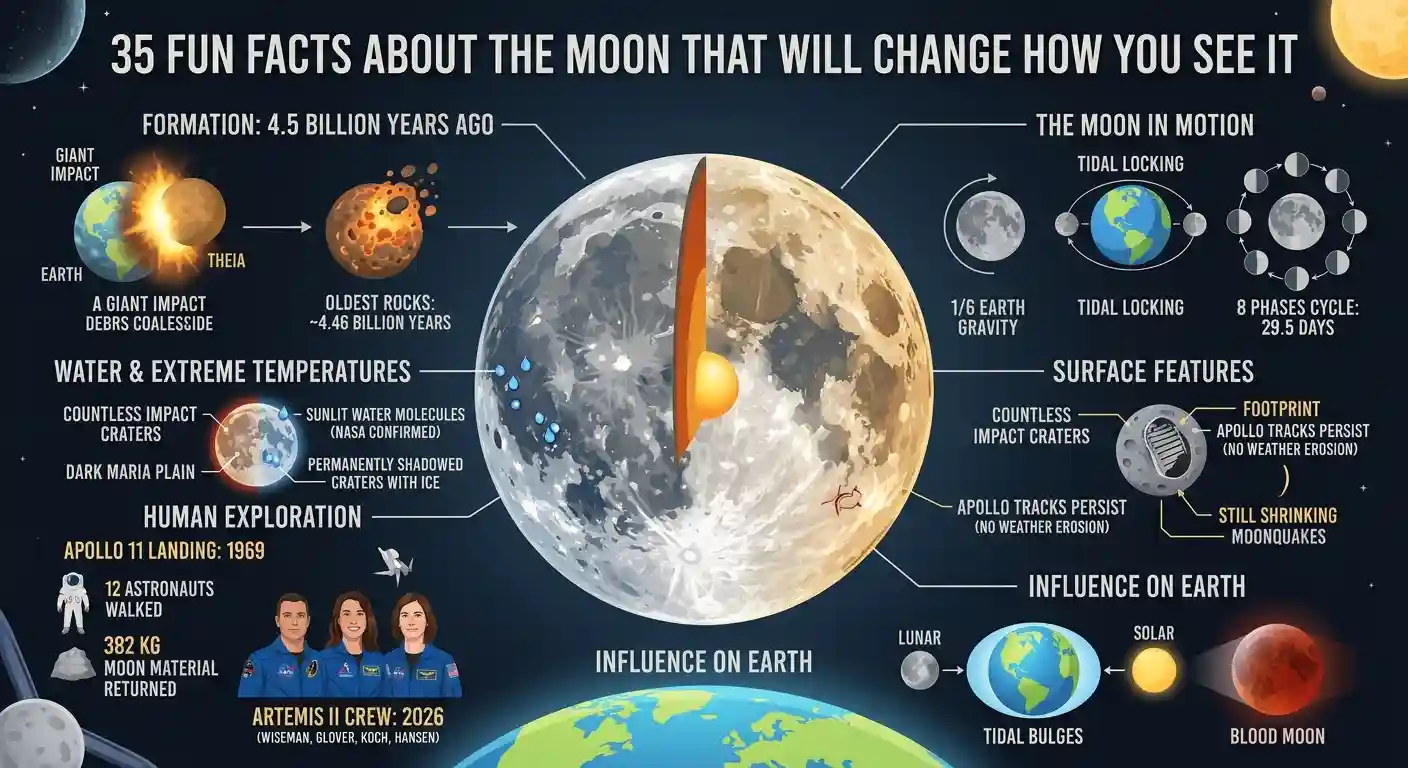
The Moon is the most familiar object in the night sky, yet almost everything you think you know about it has a twist. It looks bright, but its surface is as dark as worn asphalt. It seems to hang still, yet it is drifting away from Earth every year. Humans have walked on it, but no human has been there in more than fifty years — and the next crew is already training to return. In 2023, India became the first nation to land near the lunar south pole, and China has been quietly building a far-side research program while the world’s attention was elsewhere.
What makes the Moon endlessly fascinating is how personal it is: the same face greets every person who has ever lived, the same phases once set the first calendars, and its gravity still pulls the oceans twice a day. These 35 fun facts about the Moon go beyond the obvious — from moonquakes and a shrinking lunar surface to a glowing sodium tail, the smell of moon dust, and why a total solar eclipse is a cosmic coincidence that will not last forever.
The Moon at a Glance
| Fact | Detail |
|---|---|
| Type | Natural satellite of Earth |
| Estimated age | About 4.5 billion years |
| Average distance from Earth | 238,855 miles (384,400 km) |
| Diameter | About 2,159 miles (3,474 km) |
| Gravity | About one-sixth of Earth’s |
| Orbital period | About 27.3 days |
| Atmosphere | Extremely thin exosphere |
| Moons of its own | None |
| Rings | None |
| Humans who walked there | 12 (all Apollo, 1969–1972) |
Born From a Cosmic Collision
1. The Moon formed about 4.5 billion years ago. It appeared very early in solar-system history, only tens of millions of years after Earth itself coalesced. Source: NASA.
2. It was likely born from a giant impact. The leading explanation says a Mars-sized body, sometimes called Theia, struck the young Earth, and debris from that collision gathered in orbit to become the Moon. Lunar rocks returned by Apollo missions share Earth’s oxygen-isotope fingerprint, supporting the idea.
3. The Moon is unusually large for a planet’s moon. At 3,474 km across, it is about one-quarter of Earth’s diameter — proportionally the largest moon relative to its planet in the solar system. It is bigger than the dwarf planet Pluto.
4. It holds only about 1/81 of Earth’s mass. That low mass explains its weak gravity and why it could never hold a thick atmosphere: gas molecules simply escape into space.
5. The Moon is drifting away from Earth. Laser reflectors left by Apollo astronauts let scientists measure the distance precisely: the Moon recedes about 3.8 centimeters per year. Millions of years from now, total solar eclipses will be impossible.
The Moon You Actually See
6. The Moon produces no light of its own. Every bit of moonlight is reflected sunlight. The side facing away from the Sun at any moment is dark — the phases are just our changing view of the sunlit half.
7. Its surface is as dark as worn asphalt. Lunar rock reflects only about 7–12% of the sunlight hitting it, comparable to coal or old pavement. It looks brilliant only because it sits against the blackness of space.
8. The same face always points at Earth. The Moon is tidally locked: its rotation period matches its 27.3-day orbit, so one hemisphere permanently faces us. Ancient observers never saw the far side — the first images came from the Soviet Luna 3 probe in 1959.
9. There is no permanently “dark side.” The far side gets just as much sunlight as the near side over a lunar day. “Dark” originally meant unknown, not unlit — though permanently shadowed craters at the poles really do never see the Sun.
10. The Moon looks bigger near the horizon because of your brain, not the sky. The Moon illusion is a psychological effect: when the Moon hangs near trees and buildings, your brain judges it larger. Photographs prove its actual size barely changes.
11. A lunar day lasts nearly a month. From one sunrise to the next is about 29.5 Earth days — the same cycle as the phases. That is why the daytime heat has so long to build and the nighttime cold so long to deepen.
A World of Extremes
12. Temperatures swing by nearly 300°C. Daytime highs reach about 127°C (260°F); at night they plunge to about −173°C (−280°F). With no real atmosphere to hold heat, the change is brutally fast. Source: NASA.
13. You would weigh one-sixth as much there. Lunar gravity is about 1.62 m/s². A 90-kg person would weigh roughly 15 kg — which is why Apollo footage shows astronauts bounding in slow, floating hops.
14. The Moon has only an exosphere, not a real atmosphere. Its gas envelope is so thin that atoms rarely collide. Without air, there is no wind, no weather, and no sound — and the sky is black even at noon.
15. The Moon has quakes. Apollo-era seismometers recorded thousands of moonquakes, including shallow ones up to about magnitude 5.5. Some are caused by the crust flexing as the Moon’s interior cools and shrinks; others come from the violent day–night temperature cycle.
16. Lunar dust is razor-sharp and dangerously clingy. With no wind or water to round the grains, regolith particles are jagged glass. They are also electrostatically charged, so they stuck to Apollo suits and equipment — and they are sharp enough to be a real hazard for future habitats.
17. Astronauts say moon dust smells like spent gunpowder. After moonwalks, the dust tracked into the lunar module had a distinct burnt, metallic smell, reported independently by several Apollo crews. Source: NASA Apollo Lunar Surface Journal.
Water, Ice, and New Discoveries
18. There is water ice hiding at the poles. Craters near the lunar poles lie in permanent shadow, some for billions of years. In 2009, NASA’s LCROSS mission slammed a probe into the crater Cabeus and detected water in the ejected plume — ice that never sees sunlight. Source: NASA LCROSS.
19. India made the first landing near the south pole. Chandrayaan-3 touched down in August 2023, making India the fourth nation to soft-land on the Moon and the first to do it near the south pole — the region targeted for future bases because of its ice deposits.
20. China brought moon rocks home in 2020. The Chang’e-5 mission returned about 1.73 kg of lunar samples — the first since the Soviet Luna 24 in 1976. Scientists identified a new mineral in them, Changesite-(Y), and found the rocks were surprisingly young, about 2 billion years old.
21. The Moon is shrinking. Images from NASA’s Lunar Reconnaissance Orbiter revealed thousands of small cliff-like scarps formed as the Moon’s interior cooled. Researchers estimate it has shrunk by roughly 100 meters in diameter over the past several hundred million years. Source: NASA.
22. Its soil may hold fusion fuel. The regolith contains helium-3, deposited by the solar wind over billions of years. It is often cited as a potential future fusion fuel — though mining it remains firmly in the realm of speculation.
Footprints, Flags, and the Road Back
23. Only 12 people have ever walked on the Moon. All were American men, all flew on Apollo missions between 1969 and 1972. No human has set foot there in more than five decades.
24. Apollo 11 landed on July 20, 1969. Neil Armstrong and Buzz Aldrin spent about 21 hours on the surface while Michael Collins orbited above. Armstrong’s first step was watched by an estimated 600 million people.
25. The last footprints are from December 1972. Apollo 17’s Eugene Cernan and Harrison Schmitt were the final Moon walkers. Cernan, the last to climb back into the lander, remains — so far — the last human to stand on another world.
26. China landed on the far side first. In January 2019, Chang’e-4 touched down in the South Pole-Aitken Basin — the first soft landing on the Moon’s far side, which never faces Earth and cannot be reached by direct radio. A relay satellite made it possible.
27. The far side looks completely different. It has a thicker crust, far more craters, and almost none of the dark lava plains (maria) that mark the near side — likely because Earth’s gravity heated and thinned the near-side crust early on.
28. Four astronauts are going around the Moon next. NASA’s Artemis II mission will send four crew members on a lunar flyby — the first crewed mission beyond Earth orbit since 1972. Artemis III aims to land astronauts near the south pole after that.
Tides, Eclipses, and Lunar Oddities
29. The Moon pulls Earth’s oceans — and slows our spin. Its gravity drives the tides, and the tidal friction is gradually slowing Earth’s rotation by about 1.7 milliseconds per century. It also stabilizes Earth’s axial tilt, which keeps our climate relatively steady.
30. A total solar eclipse is a cosmic coincidence. The Sun is about 400 times wider than the Moon but also about 400 times farther away, so the two appear almost exactly the same size in our sky. Because the Moon is drifting away, this perfect alignment will not last forever.
31. A “blood moon” is Earth’s shadow in disguise. During a total lunar eclipse, the Moon turns copper-red because sunlight filtering through Earth’s atmosphere — the light of every sunrise and sunset on Earth at once — is bent onto its surface.
32. A blue moon has nothing to do with color. It is simply the second full moon in a calendar month (the older almanac definition: the third full moon in a season with four). The Moon can look genuinely blue only when volcanic ash or smoke fills the air.
33. A supermoon really is bigger — slightly. When a full moon coincides with perigee, its closest approach, it appears about 14% larger and 30% brighter than a full moon at apogee. The difference is subtle but measurable.
34. Full moons have folk names for every season. Names like the Harvest Moon, Hunter’s Moon, and Wolf Moon come from Algonquian traditions popularized by colonial almanacs — practical labels for farmers and hunters, not astronomy.
35. The Moon has a glowing tail. The solar wind strips sodium atoms off the lunar surface, stretching them into a faint tail hundreds of thousands of kilometers long. During a new moon it appears as a dim spot opposite the Sun — invisible to the naked eye but real. Source: Boston University Center for Space Physics.
Moon Myths vs. Facts
Centuries of moon-gazing produced some persistent myths. Here is how they hold up:
| Myth | Reality |
|---|---|
| The Moon is made of cheese | Its crust is mostly anorthosite rock; the “cheese” idea is folklore, famously joked about since the 1500s |
| A full moon makes people act strangely | Large studies find no link between lunar phases and crime, hospital visits, or behavior — the “lunar effect” is a myth |
| You can see the Great Wall of China from the Moon | No human-made structure is visible from the Moon with the naked eye; the Wall is barely visible even from low orbit |
| The Moon has a dark side | The far side gets equal sunlight; only deep polar craters are permanently dark |
| Moonlight is cold light | It is simply reflected sunlight — the same light, dimmed about 400,000 times |
From a collision-born rock to the staging ground for humanity’s return to deep space, the Moon keeps rewarding a closer look. The next time it rises, remember: you are looking at the only world humans have ever visited — and at a place that still holds ice older than human civilization, waiting in the dark.

Irshad Ullah is a content writer at Fun Facts Horizon. He researches and writes verified fun facts about countries, animals, space, history, and more for curious readers.
2 thoughts on “35 Fun Facts About the Moon: How You See It”