
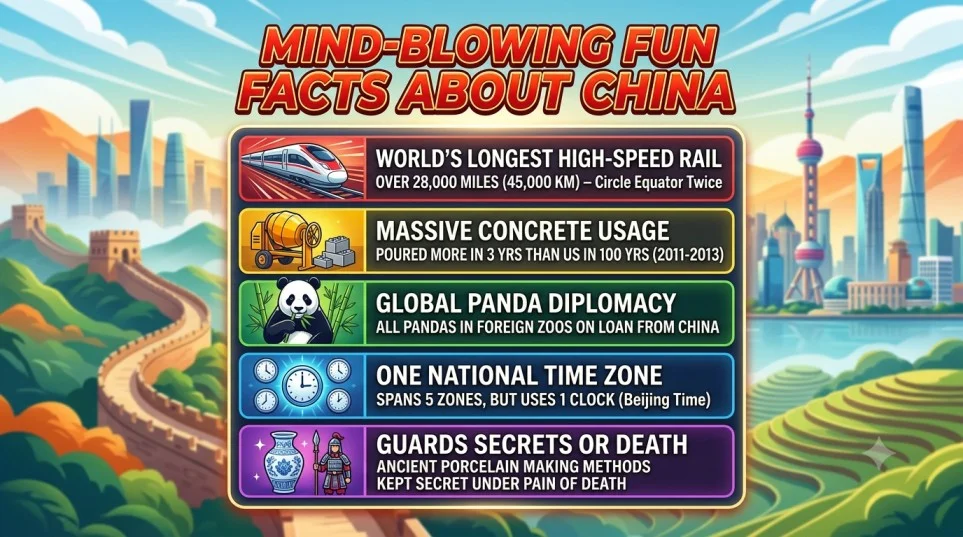
Most people know China is huge, drinks a lot of tea, and built the Great Wall. But beyond the famous tourist spots lies a country full of bizarre geography, giant buildings, and ancient mysteries that even modern scientists cannot fully solve. It runs on a single clock even though it spans five time zones, operates more high-speed rail than the rest of the world combined, and keeps millions of people living in homes carved into cliffsides.
If you think you already know everything about China, think again. Its western deserts hide the ruins of Silk Road cities, its mountains inspired floating islands in a Hollywood blockbuster, and its emperors built a palace with nearly nine thousand rooms — then filled an underground army to guard one of them forever. These 27 fun facts about China go past the postcards: one clock, impossible engineering, landscapes that don’t look real, and five thousand years of history still standing in stone.
China at a Glance
| Fact | Detail |
|---|---|
| Official name | People’s Republic of China |
| Population | About 1.41 billion |
| Area | About 9.6 million km² (3rd/4th largest country) |
| Capital | Beijing |
| Time zone | Single national time (Beijing Time, UTC+8) |
| Official language | Mandarin (Putonghua) |
| UNESCO World Heritage sites | 59 |
| High-speed rail network | Over 45,000 km — most in the world |
| Major landmark | The Great Wall |
One Clock for Five Time Zones
1. All of China runs on one time zone. Despite spanning roughly five geographical time zones, the entire country uses Beijing Time (UTC+8) — a policy adopted in 1949 to project national unity.
2. In the far west, sunrise comes at “mid-morning.” In Kashgar, Xinjiang, the sun can rise around 10 a.m. by the clock and set after 10 p.m. in summer — so locals unofficially live two hours behind Beijing time. Source: Britannica.
3. China once had five time zones. Before 1949, the country used five regional zones. The single-time policy was a deliberate break with that past — one of the boldest timekeeping experiments any large country has tried.
4. The experiment creates real quirks. Schools and offices in western China often shift their schedules unofficially, and travelers crossing from neighboring countries can gain or lose hours in strange jumps at the border.
Engineering on a Continental Scale
5. China has more high-speed rail than the rest of the world combined. Over 45,000 km (about 28,000 miles) of high-speed track — more than two-thirds of the global total — with trains routinely cruising at 350 km/h. The Beijing–Shanghai run covers 1,318 km in as little as four and a half hours.
6. It built the world’s longest sea crossing. The Hong Kong–Zhuhai–Macau Bridge stretches about 55 km across the Pearl River Delta, combining bridges, artificial islands, and an undersea tunnel — built to survive typhoons and earthquakes. Source: Britannica.
7. The Three Gorges Dam is the world’s largest power station. By installed capacity (22,500 MW), no power plant on Earth is bigger. Its reservoir also made the Yangtze navigable far inland — at enormous human and environmental cost.
8. Shanghai’s maglev is among the fastest trains in commercial service. The magnetic-levitation line to Pudong Airport hits 430 km/h, floating above its track with no wheels touching rail — the 30-km trip takes about seven minutes.
Landscapes That Don’t Look Real
9. Zhangjiajie’s pillars inspired a Hollywood world. The towering sandstone columns of Zhangjiajie National Forest Park — some rising 200 meters straight up — inspired the floating Hallelujah Mountains of Pandora in James Cameron’s Avatar. The park later named one pillar “Avatar Hallelujah Mountain.”
10. The Li River karst is on the money. The limestone peaks and glassy river around Guilin are so iconic that the scene appears on the back of China’s 20-yuan banknote. Source: UNESCO.
11. Jiuzhaigou’s lakes change color. This Sichuan valley’s travertine lakes glow in shifting shades of blue and green from mineral deposits and algae — so clear that fallen trees are visible dozens of meters down.
12. The Taklamakan is a “sea of death.” One of the world’s largest shifting-sand deserts fills the Tarim Basin; its Uyghur name is often translated as “go in and you won’t come out.” Ancient Silk Road cities lie buried at its edges, preserved by the dry sand.
Five Thousand Years in Stone
13. The Great Wall is over 21,000 km long. A 2012 government survey measured all its branches and walls at 21,196 km — built, rebuilt, and connected across many dynasties, with the famous Ming-era sections only the youngest part. Source: UNESCO.
14. The Forbidden City has nearly nine thousand rooms. Beijing’s imperial palace complex holds 980 buildings with a traditionally cited 8,886 rooms — the world’s largest imperial palace, home to 24 emperors over nearly 600 years.
15. An underground army guards one emperor. Farmers digging a well in 1974 uncovered the Terracotta Army near Xi’an: about 8,000 life-sized soldiers, each with a unique face, built to protect Qin Shi Huang — China’s first emperor — in the afterlife.
16. The Leshan Buddha took 90 years to carve. At 71 meters tall, the Giant Buddha of Leshan in Sichuan — begun in 713 AD — is the largest stone Buddha in the world, with a drainage system hidden in its robes that has protected it for 1,300 years.
17. The Mogao Caves hold 45,000 m² of murals. Near Dunhuang on the Silk Road, 492 cave temples are painted with Buddhist art spanning a thousand years — one of the greatest art archives of the ancient world. Source: UNESCO.
The Four Great Inventions — and Everyday Ones
18. Paper, printing, gunpowder, and the compass came from China. These Four Great Inventions reshaped civilization worldwide — paper in the Han dynasty, woodblock and movable-type printing centuries before Gutenberg, gunpowder first used for fireworks and weapons, and the magnetic compass guiding ships by the 1100s.
19. All true tea comes from one Chinese plant. Green, black, oolong, and white tea are all made from Camellia sinensis, first cultivated in China; legend credits the emperor Shennong with discovering tea around 2737 BC. Source: Britannica.
20. Chopsticks are over 3,000 years old. Invented in China during the Shang dynasty, they spread across East Asia — and the etiquette around them (never stick them upright in rice) is still taken seriously.
21. Dumplings carry a 1,800-year-old legend. The jiaozi is traditionally linked to the physician Zhang Zhongjing, who supposedly invented the ear-shaped dumpling to treat frostbitten ears — which is why many families still eat them at Chinese New Year.
People, Pandas, and the Calendar
22. China is no longer the world’s most populous country. With about 1.41 billion people, it was overtaken by India in 2023 according to UN estimates — ending a centuries-long run at the top of the population table. Source: United Nations.
23. It officially recognizes 56 ethnic groups. The Han majority is about 91% of the population; the other 55 groups — including the Zhuang, Hui, Uyghur, and Tibetans — have their own languages, festivals, and autonomous regions.
24. “Chinese” is many languages, one script. Mandarin (Putonghua) is the official language, but hundreds of dialects and minority languages are spoken — many mutually unintelligible when spoken, yet readable to each other in writing thanks to shared characters.
25. New Year triggers the largest human migration on Earth. The Spring Festival travel rush, Chunyun, sees billions of trips as workers return home — the zodiac animal of the year (rat, ox, tiger, and nine more in a 12-year cycle) sets the theme for celebrations worldwide.
26. Every panda abroad is on loan from China. Giant pandas are native only to central China’s bamboo forests, and all pandas in foreign zoos technically remain Chinese property — the famous “panda diplomacy” that has sealed friendships since the 1970s.
27. China holds 59 UNESCO World Heritage sites. From the Great Wall to the Mogao Caves, it ranks among the top countries in the world for inscribed sites — a list that keeps growing. Source: UNESCO.
China by the Numbers
A few figures that show the scale of the place:
| Measure | Number | Context |
|---|---|---|
| Geographical time zones spanned | ~5 | All run on one national clock (UTC+8) |
| High-speed rail track | 45,000+ km | Over two-thirds of the world’s total |
| Total length of the Great Wall system | 21,196 km | Measured across all dynasties’ walls |
| Rooms in the Forbidden City | ~8,886 | In 980 buildings, world’s largest palace complex |
| Terracotta warriors | ~8,000 | Each with a unique face |
| Officially recognized ethnic groups | 56 | Han ~91%, 55 minorities |
| UNESCO World Heritage sites | 59 | Among the most of any country |
China is a country that runs five time zones on one clock, buries armies for emperors, and paints mountains onto its currency. Whether it is the mirror-calm Li River or a maglev floating at 430 km/h, the pattern is the same: whatever China does, it does at a scale the rest of the world has to measure itself against.

Irshad Ullah is a content writer at Fun Facts Horizon. He researches and writes verified fun facts about countries, animals, space, history, and more for curious readers.
1 thought on “27 Mind-Blowing Fun Facts About China”