
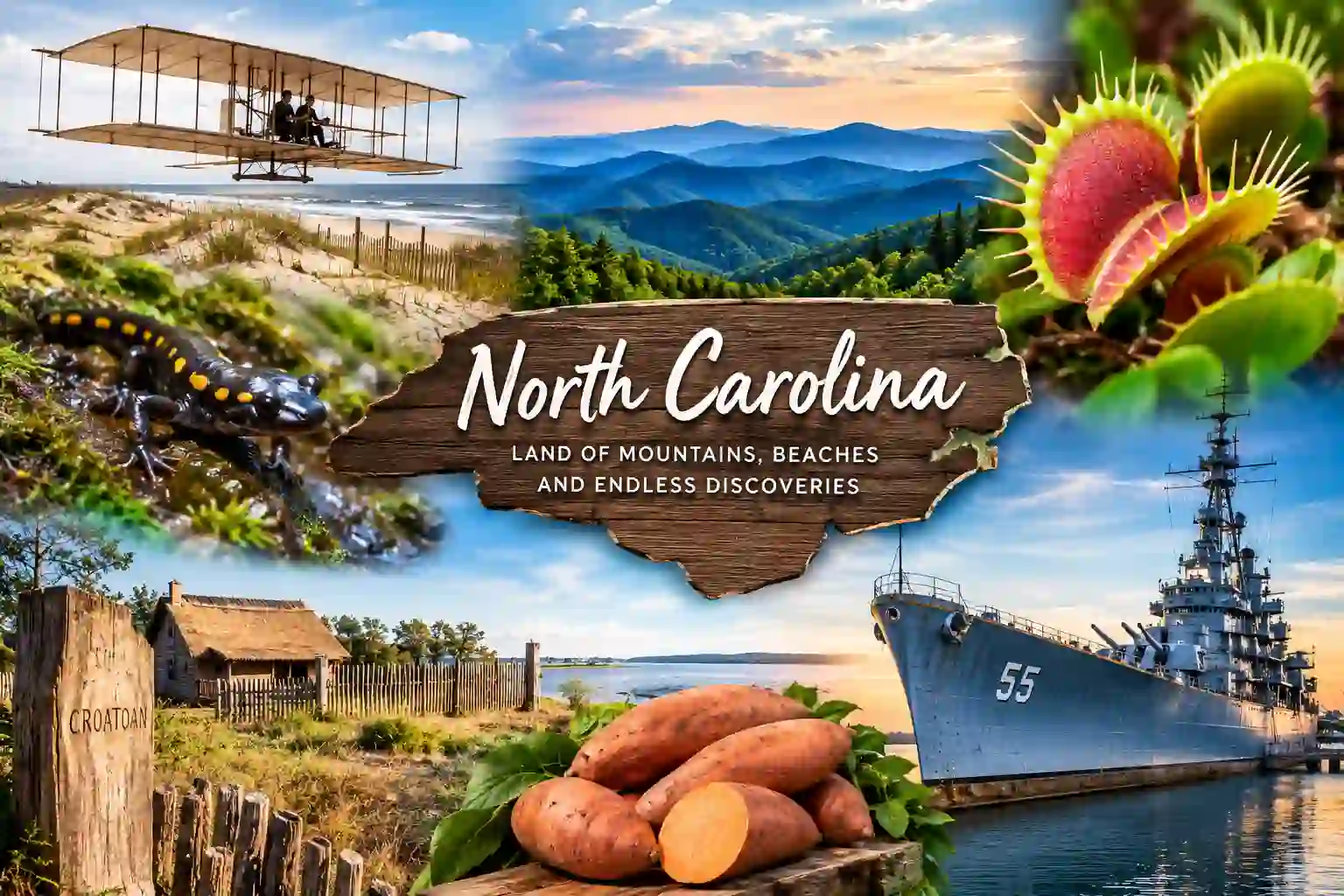
North Carolina stretches from Atlantic beaches to high Appalachian peaks. That range helps explain its unusual mix of history and nature. The state is home to the Venus flytrap, a plant that catches insects. Its mountains shelter 31 salamander species in Great Smoky Mountains National Park. Its coast also gave the Wright brothers the wind and sand they needed for their famous experiments.
North Carolina also holds stories from the Lost Colony to World War II. As I explored these facts, one theme stood out: the state changes dramatically as you travel inland. Here are 28 fun facts about North Carolina that show why.
North Carolina at a Glance
| Feature | Fact |
| Capital | Raleigh |
| State motto | Esse Quam Videri |
| Highest point | Mount Mitchell, 6,684 feet |
| Official carnivorous plant | Venus flytrap |
| State vegetable | Sweet potato |
| First powered airplane flights | December 17, 1903 |
| Famous early settlement | Roanoke Island |
| Major scenic road | Blue Ridge Parkway |
| World War II landmark | USS North Carolina |
| Famous mountain wildlife | 31 salamander species in the Smokies |
1. Where Flight Changed Forever
North Carolina’s Outer Banks became a laboratory for flight. The Wright brothers needed wind, sand, and open space. They found all three near Kitty Hawk. Their work eventually produced the first successful powered airplane flights. The story also has a small twist: today’s memorial is in Kill Devil Hills, while the brothers called the area Kitty Hawk.
1. Wilbur and Orville Wright made their first successful powered flights on December 17, 1903. The flights took place near present-day Kill Devil Hills. Orville made the first successful flight. Their achievement followed four years of experiments in North Carolina.
2. The Wright brothers did not simply choose Kitty Hawk by chance. They wanted steady wind, sand dunes, few obstacles, and privacy. Kitty Hawk offered those conditions. Its average wind speed was about 15–20 mph around 1900.
3. Orville flew first, but Wilbur had won the earlier coin toss. Wilbur’s first attempt happened on December 14, 1903. The aircraft stalled after climbing too steeply. Three days later, Orville took the successful first flight.
Source: Wright Brothers National Memorial — National Park Service
2. Mountains Full of Tiny Survivors
North Carolina’s western mountains hold an extraordinary biological story. Great Smoky Mountains National Park is famous for its salamanders. These small amphibians thrive in cool, wet mountain habitats. Some breathe through their skin. Others live beside streams, under rocks, or deep within forests.
4. Great Smoky Mountains National Park has 31 salamander species. The National Park Service calls it the “Salamander Capital of the World.” The park has more salamander species than any other known location on Earth.
5. Some Smokies salamanders have no lungs. Lungless salamanders exchange gases through their skin and mouth tissues. The park contains 25 species of lungless salamanders. Several new species were discovered between 2020 and 2024.
6. The Smokies contain more than 22,000 identified species. As of 2025, researchers estimated the actual number could approach 100,000. That makes the park an important natural laboratory for studying biodiversity.
7. Great Smoky Mountains National Park contains over 100 native tree species. Its elevation changes create many different habitats. This helps explain the area’s remarkable variety of plants and animals.
Source: Great Smoky Mountains National Park — Amphibians and Biodiversity
3. A Plant That Bites Back
North Carolina has a botanical celebrity unlike most state symbols. The Venus flytrap grows naturally in a limited part of the southeastern United States. North Carolina officially recognized it as the state’s carnivorous plant. Its conservation also has legal protection.
8. The Venus flytrap is North Carolina’s official carnivorous plant. The state adopted it officially in 2005. Its scientific name is Dionaea muscipula.
9. Venus flytraps do not eat insects for entertainment. Their traps help them obtain nutrients in poor soils. An insect touching the trap’s trigger hairs can cause the two sides to close around it.
10. North Carolina protects Venus flytraps under plant conservation laws. Unauthorized taking of the plant can bring serious legal consequences. The state’s agriculture department notes that taking Venus flytraps can constitute a felony.
11. The state has an unusually large collection of official plant symbols. Its official symbols include the sweet potato, strawberry, blueberry, muscadine grape, Carolina lily, Fraser fir, and Venus flytrap.
Source: North Carolina General Statutes — Official State Symbols
4. From Roanoke to the Mystery of Virginia Dare
Long before modern North Carolina existed, Roanoke Island became a major English colonial site. Its story includes one famous birth and one enduring mystery. When I read through the historical record, the most striking detail was how quickly the settlement became difficult to trace.
12. Virginia Dare was born on August 18, 1587, on Roanoke Island. She was the first English child born in the New World. Her baptism followed several days later.
13. The Roanoke settlement later became known as the Lost Colony. When Governor John White returned in 1590, the colonists were gone. The word “CROATOAN” had been carved at the settlement.
14. The Lost Colony story produced generations of theories. Historians have proposed several possible explanations for the settlers’ disappearance. No simple explanation has become universally accepted as the complete answer.
15. Roanoke was not America’s first English permanent colony. Its voyages were earlier attempts that helped shape later English colonization. Jamestown was established in Virginia in 1607.
Source: NCpedia — Roanoke and Early North Carolina History
5. A Road Through an Ancient Mountain World
North Carolina’s mountain landscape is more than a beautiful backdrop. It contains some of the oldest mountain terrain in the world. The Blue Ridge Parkway crosses this landscape while connecting major protected areas. Its route reveals how quickly elevation and ecosystems can change.
16. The Blue Ridge Parkway stretches 469 miles between Virginia and North Carolina. It connects the area near Shenandoah National Park with Great Smoky Mountains National Park. The route crosses the Blue Ridge Mountains.
17. The Parkway’s highest point reaches 6,047 feet at Richland Balsam in North Carolina. Its elevation changes create many different habitats. Those habitats support hundreds of animal species.
18. The Parkway supports 225 bird species, 70 mammal species, 43 amphibian species, and 31 reptile species. It also supports 99 fish species. These figures show the biological variety along the route.
19. Mount Mitchell rises 6,684 feet above sea level. It is the highest point in North Carolina and the highest summit east of the Mississippi River. USGS lists Mount Mitchell at 6,684 feet.
Source: Blue Ridge Parkway — National Park Service
6. Sweet Potatoes, Forests, and a Different Kind of North Carolina
North Carolina’s agricultural identity reaches beyond tobacco. Today, sweet potatoes are one of its most striking agricultural strengths. The state also played an important role in the development of professional forestry. These facts connect farming, forests, and modern industry.
20. North Carolina is the leading U.S. producer of sweet potatoes. The state’s agriculture department says farmers produce about 54% of the nation’s sweet potatoes. This makes the crop a major part of the state’s agricultural identity.
21. North Carolina also has a long tobacco-growing tradition. The state agriculture department currently identifies North Carolina as the country’s leading tobacco producer. Agricultural data can change, so this status should be rechecked before publication.
22. The Biltmore Forest School opened near Asheville in 1898. It is recognized as the first forestry school in the United States. The school helped establish professional forestry education in America.
23. North Carolina’s state symbols include several food plants. The sweet potato is the official state vegetable. The muscadine grape is the official state fruit. Strawberries and blueberries hold official red and blue berry status.
Source: North Carolina Department of Agriculture and Consumer Services
7. The Battleship That Became a Museum
North Carolina’s history is also tied to the Pacific theater of World War II. The USS North Carolina became one of the state’s most important military landmarks. Today, the preserved ship in Wilmington connects visitors with that wartime history.
24. USS North Carolina was commissioned on April 9, 1941. It became the first new American battleship to join the fleet in nearly two decades. The ship later served in the Pacific during World War II.
25. The battleship participated in major Pacific operations. These included Guadalcanal, the Gilbert Islands, Luzon, Iwo Jima, and Okinawa. The ship earned 15 battle stars during its wartime service.
26. The USS North Carolina was a 35,000-ton battleship. It carried nine 16-inch guns in three main turrets. Its design represented major advances in American battleship construction.
27. The Japanese claimed several times that the battleship had been sunk. It survived those attacks and continued operating. The ship is now preserved as a museum and memorial in Wilmington.
28. North Carolina’s story is unusually varied for one state. One coastline helped launch powered flight. One island holds a colonial mystery. One mountain shelters rare wildlife. One battleship preserves World War II history.
Source: USS North Carolina — Naval History and Heritage Command
Myths vs. Reality
| Myth | Reality |
| The Wright brothers first flew in modern-day Kitty Hawk town. | The first powered flights occurred in the area now called Kill Devil Hills. |
| Virginia Dare was the first European-born person in America. | She was the first English child born in the New World. |
| Venus flytraps are only decorative plants. | They are carnivorous plants adapted to nutrient-poor soils. |
| North Carolina is mainly coastal. | The state rises from Atlantic beaches to a 6,684-foot mountain peak. |
FAQ About North Carolina
What is North Carolina famous for?
North Carolina is famous for the Wright brothers’ first successful powered flights, the Blue Ridge Mountains, the Lost Colony, the Venus flytrap, agriculture, and major military history.
What is a fun fact about North Carolina?
A fun fact about North Carolina is that it has 31 salamander species in Great Smoky Mountains National Park. The park has more salamander species than anywhere else on Earth.
Why did the Wright brothers choose North Carolina?
They needed steady winds, sand dunes, open space, and isolation. Kitty Hawk provided those conditions.
What is North Carolina’s highest mountain?
Mount Mitchell is North Carolina’s highest point. USGS lists its elevation at 6,684 feet.
What plant is North Carolina known for?
The Venus flytrap is one of North Carolina’s best-known plants. It is also the state’s official carnivorous plant.
Where was the Lost Colony?
The Lost Colony was established on Roanoke Island. The settlement disappeared after Governor John White left for England and returned years later.
What food is North Carolina famous for?
North Carolina is strongly associated with sweet potatoes, tobacco, and other agricultural products. The state is currently the leading U.S. sweet potato producer.
Is the USS North Carolina still in North Carolina?
Yes. The historic battleship is preserved in Wilmington as a museum and memorial.
Conclusion
North Carolina feels like several worlds joined together. You can stand beside the Atlantic where aviation history began. You can climb toward Mount Mitchell and enter a cooler mountain world. You can find a plant that catches insects and salamanders without lungs. You can also walk through the history of Roanoke and World War II. That mix makes fun facts about North Carolina more than a list of state trivia. The state shows how geography can shape human history, wildlife, farming, science, and culture. Its biggest surprise may be how much changes between the coast and the mountains.

hello! I am Irshad Ullah, and a passionate writer and lifelong learner dedicated to uncovering fascinating facts about science, history, nature, animals, space, and the world around us. I research each topic carefully and transform surprising information into clear, engaging, and enjoyable content. My goal is to satisfy curiosity, inspire learning, and help readers discover something amazing every day.