
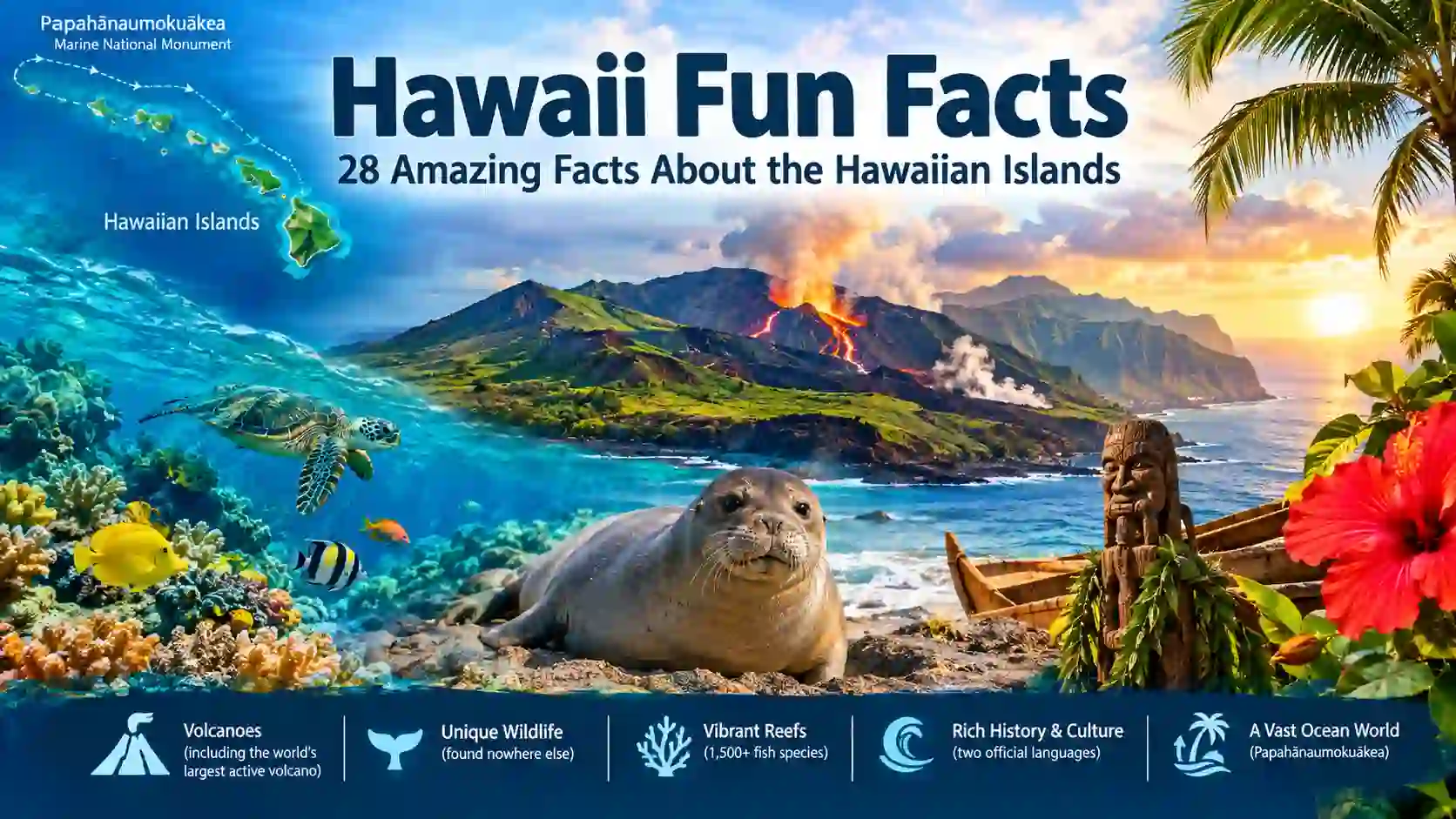
Hawaii looks like a small group of islands on a map. In reality, it is the exposed top of a huge volcanic mountain chain. The Hawaiian Archipelago stretches about 1,500 miles across the Pacific. Its reefs shelter hundreds of unique species. Its volcanoes are still building new land. Hawaii also has two official languages: English and Hawaiian.
As I researched these Hawaii fun facts, one theme stood out: Hawaii is a place shaped by movement. Islands rise, volcanoes change, reefs grow, species evolve, and cultures preserve knowledge across generations. That story makes Hawaii much more than a tropical destination.
Hawaii at a Glance
| Fact | Quick Answer |
| Statehood | August 21, 1959 |
| U.S. state number | 50th |
| Main Hawaiian Islands | 8 |
| Smaller islands/islets | 124 |
| Archipelago length | About 1,500 miles |
| Official languages | English and Hawaiian |
| Largest island | Hawaiʻi Island |
| Largest active volcano | Mauna Loa |
| Famous native seal | Hawaiian monk seal |
| Major marine protected area | Papahānaumokuākea |
1. Hawaii Is the Top of a Giant Underwater Mountain Chain
1. Hawaii sits on a huge volcanic mountain chain.
The Hawaiian Islands are not isolated volcanic bumps. They are the exposed peaks of the Hawaiian-Emperor seamount chain. Much of this mountain system lies underwater. The chain stretches for more than 3,700 miles. Only its highest volcanic peaks rise above the Pacific Ocean.
2. The Hawaiian Archipelago stretches about 1,500 miles.
The main islands form only part of the larger Hawaiian Archipelago. The chain extends roughly 1,500 miles across the Pacific. This long distance helps explain Hawaii’s unusual range of habitats. It also gives native animals and plants many isolated environments.
Source: U.S. National Park Service — Hawaii Geology & Volcanoes
3. Hawaii formed above a volcanic hotspot.
A hotspot is an area where hot material rises from deep inside Earth. The Pacific Plate moves over this hotspot. Volcanoes form as the plate passes across it. Older islands slowly move away from the active volcanic zone. New volcanic land can then form farther southeast.
4. Hawaii is still changing today.
The islands show different stages of volcanic life. Hawaiʻi Island has young, active volcanoes. Maui has older volcanic landscapes. Farther northwest, islands and reefs show more erosion and sinking. Hawaii therefore works like a natural timeline of volcanic island development.
2. Volcanoes Help Explain Hawaii’s Extraordinary Landscape
5. Mauna Loa is the world’s largest active volcano.
Mauna Loa rises dramatically from the Pacific floor. From its seafloor base, it reaches almost 33,500 feet. Its huge size is easy to miss when viewed only from land. Much of this enormous volcano remains hidden beneath the ocean surface.
6. Kīlauea is one of Earth’s most active volcanoes.
Kīlauea has produced repeated eruptions over modern history. Its volcanic activity has created lava fields, craters, vents, and other dramatic features. Scientists continue to monitor it closely. Its activity also shows how Hawaiian shield volcanoes can build land with flowing lava.
Source: National Park Service — Hawaiʻi Volcanoes National Park
7. Hawaiian lava has two famous names.
Two Hawaiian words became part of global volcanic vocabulary. Pāhoehoe describes smoother, often rope-like lava. ʻAʻā describes rough, broken lava. These names are now widely used by volcanologists when describing basaltic lava flows.
8. Haleakalā’s famous “crater” is not really a crater.
The large summit feature at Haleakalā is mainly an erosional valley. Water and landslides carved the landscape over time. Later lava flows partly filled it. The result looks like a giant crater, but its origin is more complex.
3. Hawaii’s Mountains Reach Far Below the Sea
9. Haleakalā stands 10,023 feet above sea level.
Haleakalā rises high above Maui. Yet its visible summit shows only part of the volcano. Much of the mountain extends beneath the ocean. The volcano’s immense underwater foundation helps explain its broad shape and huge overall size.
10. About 97% of Haleakalā’s volume is below sea level.
This is one of the most surprising Hawaii fun facts. The mountain looks enormous from Maui, but most of its volcanic body remains underwater. Its visible summit is only a small part of the entire shield volcano.
Source: National Park Service — Haleakalā Volcano Facts
11. Mauna Kea rises roughly 30,000 feet from its base.
Mauna Kea reaches about 13,803 feet above sea level. Its base lies deep beneath the Pacific. Measured from the ocean floor, the mountain rises roughly 30,000 feet. That makes its full vertical scale far greater than its familiar summit elevation suggests.
12. Hawaiian mountains can be measured in two very different ways.
A mountain’s height above sea level tells only part of its story. Hawaiian volcanoes begin on the ocean floor and rise through the water. Measuring from their underwater bases reveals their extraordinary vertical scale. This is why Hawaii’s mountains can seem surprisingly modest on ordinary elevation lists.
4. Hawaii Has Wildlife Found Nowhere Else
13. Hawaii has many endemic species.
Island isolation creates powerful evolutionary pressure. Hawaii’s reefs alone contain more than 1,250 endemic species according to the U.S. Coral Reef Task Force. Endemic means a species naturally occurs in that location and nowhere else. Isolation helped produce Hawaii’s unusual biological diversity.
14. The Hawaiian monk seal lives nowhere else naturally.
The Hawaiian monk seal is endemic to the Hawaiian Archipelago. NOAA estimates about 1,600 remain, including animals in the Northwestern Hawaiian Islands and the main islands. The species is endangered and remains a major conservation focus.
Source: NOAA Fisheries — Hawaiian Monk Seal
15. The Hawaiian monk seal is a tropical seal.
Most people associate seals with cold coastal waters. The Hawaiian monk seal breaks that expectation. It lives in warm Pacific waters around the Hawaiian Islands. It spends much of its life at sea and comes ashore to rest, molt, and raise pups.
16. Hawaiian honeycreepers show remarkable island evolution.
Hawaiian honeycreepers became famous for their unusual diversity. Different species developed different body shapes and feeding adaptations. Smithsonian researchers recently reconstructed relationships among honeycreeper species known around European arrival. The work helps scientists understand both evolution and biodiversity loss.
5. Hawaii’s Reefs Are Full of Life
17. Hawaii has about 640 square miles of coral reef around its main islands.
The main Hawaiian Islands contain extensive coral reef habitat. These reefs support fish, corals, turtles, and many other marine organisms. They also help protect shorelines. Reef ecosystems are therefore important both biologically and physically.
18. Hawaiian waters contain about 80 coral species.
Coral reefs may look like underwater rock gardens. But corals are animals. Hawaii’s reefs contain about 80 coral species, along with many other organisms. Their structure creates shelter and feeding areas for a large marine community.
Source: U.S. Coral Reef Task Force — Hawaiʻi
19. Hawaii’s reefs support more than 1,500 reef fish species.
The waters around Hawaii support an extraordinary variety of reef fish. Many species are adapted to very specific habitats. Some Hawaiian reef organisms are also endemic. This combination makes Hawaii important for marine research and conservation.
20. Papahānaumokuākea protects huge marine habitats.
Papahānaumokuākea extends for roughly 1,931 kilometers northwest of the main Hawaiian Archipelago. Its waters include coral reefs, lagoons, deep habitats, and submerged banks. UNESCO recognizes its exceptional natural and cultural importance.
6. Hawaiian Language and History Tell Another Story
21. Hawaii has two official languages.
English and Hawaiian are the official languages of Hawaiʻi. This status is written into the state constitution. The constitutional recognition dates from 1978. Hawaiian language therefore has a formal place in the state’s public identity and legal framework.
22. Hawaiian was once pushed close to extinction.
Hawaiian language use declined sharply during the modern period. Hawaii legislative records note that speaker numbers fell from nearly 40,000 in 1896 to about 2,000 in 1978. Language revitalization efforts later helped rebuild Hawaiian-language education and use.
Source: Hawaiʻi State Legislature — Hawaiian Language History
23. Hawaii became the 50th U.S. state in 1959.
Hawaii entered the Union on August 21, 1959. President Dwight D. Eisenhower issued the proclamation admitting Hawaii as the 50th state. The event followed decades of political debate and a 1959 statehood process.
24. Hawaii’s history includes a contested path to U.S. annexation.
The Hawaiian Kingdom was overthrown in 1893. The United States later annexed Hawaii through a congressional joint resolution in 1898. The historical record includes strong Hawaiian opposition to annexation, including the 1897 Kūʻē Petitions. This history remains important when discussing Hawaii today.
7. Hawaii’s Remote Ocean World Is Bigger Than It Looks
25. Papahānaumokuākea has deep cultural meaning.
Papahānaumokuākea is not simply a protected ocean area. UNESCO describes it as a place with deep significance in Native Hawaiian culture. It reflects ideas about ancestry, kinship, life, and the natural world. Archaeological remains also show earlier human use of parts of the region.
26. The area is one of the world’s largest marine protected areas.
Papahānaumokuākea covers about 362,075 square kilometers. Its enormous area includes reefs, lagoons, seamounts, deepwater habitats, and remote islands. Its isolation has helped preserve ecosystems with unusually high levels of endemism.
Source: UNESCO World Heritage Centre — Papahānaumokuākea
27. About 25% of Papahānaumokuākea’s species are Hawaiian endemics.
NOAA reports that approximately one-quarter of the species found in Papahānaumokuākea are Hawaiian endemics. These species occur nowhere else on Earth. Such endemism reflects the long isolation of the Hawaiian Islands and surrounding ocean habitats.
28. Papahānaumokuākea protects 3.5 million acres of coral reef.
NOAA reports that the monument protects about 3.5 million acres of coral reef. That represents roughly 70% of the total coral reef area in the United States. The region also supports large fish, sharks, turtles, seals, and many other species.
Myths vs. Reality
| Myth | Reality |
| Hawaii is just eight islands. | The eight main islands are part of a much larger archipelago. |
| Haleakalā has a giant volcanic crater. | Its summit valley was mainly carved by erosion. |
| Mauna Kea is only 13,803 feet tall. | That is its height above sea level. Its underwater base adds much more height. |
| Hawaiian is only a cultural language. | Hawaiian and English are official state languages. |
| Hawaii’s volcanoes are all extinct except Kīlauea. | Mauna Loa and other Hawaiian volcanoes remain geologically active or potentially active. |
| Coral is a type of underwater plant. | Coral is an animal living with symbiotic algae. |
Hawaii Fun Facts: Frequently Asked Questions
How many main islands does Hawaii have?
Hawaii has eight main islands: Hawaiʻi, Oʻahu, Maui, Kauaʻi, Molokaʻi, Lānaʻi, Niʻihau, and Kahoʻolawe. The wider Hawaiian Archipelago also contains many smaller islands, islets, reefs, and atolls.
What is the most interesting fact about Hawaii?
One striking fact is that Hawaii’s visible islands are only the tops of enormous underwater volcanoes. The Hawaiian mountain system continues thousands of feet below the Pacific surface.
Why does Hawaii have so many unique animals?
Hawaii developed far from major continental landmasses. Long geographic isolation allowed populations to evolve separately. Over time, this produced many endemic plants and animals found nowhere else.
Is Hawaiian an official language?
Yes. Hawaiian and English are the official languages of Hawaii. The state’s constitution recognizes both languages.
What is the largest volcano in Hawaii?
Mauna Loa is the world’s largest active volcano. It rises almost 33,500 feet from its base on the seafloor.
What animal is unique to Hawaii?
The Hawaiian monk seal is endemic to the Hawaiian Archipelago. NOAA estimates that about 1,600 remain as of 2026.
When did Hawaii become a U.S. state?
Hawaii became the 50th U.S. state on August 21, 1959. President Eisenhower issued the official admission proclamation that day.
What makes Papahānaumokuākea special?
Papahānaumokuākea combines enormous marine ecosystems with deep Native Hawaiian cultural meaning. UNESCO recognizes both its natural and cultural importance.
Conclusion
Hawaii is easy to picture as beaches, palms, and bright blue water. The deeper story is far more remarkable. Volcanoes built these islands from the ocean floor. Isolation shaped species found nowhere else. Reefs created rich underwater worlds. Hawaiian language and culture carry knowledge across generations. Far beyond the busy beaches, Papahānaumokuākea stretches into a vast Pacific world.
The most memorable Hawaii fun facts are therefore connected. Hawaii is always changing, yet its natural and cultural history runs deep. Every mountain, reef, species, and Hawaiian name adds another part to that story.

hello! I am Irshad Ullah, and a passionate writer and lifelong learner dedicated to uncovering fascinating facts about science, history, nature, animals, space, and the world around us. I research each topic carefully and transform surprising information into clear, engaging, and enjoyable content. My goal is to satisfy curiosity, inspire learning, and help readers discover something amazing every day.