
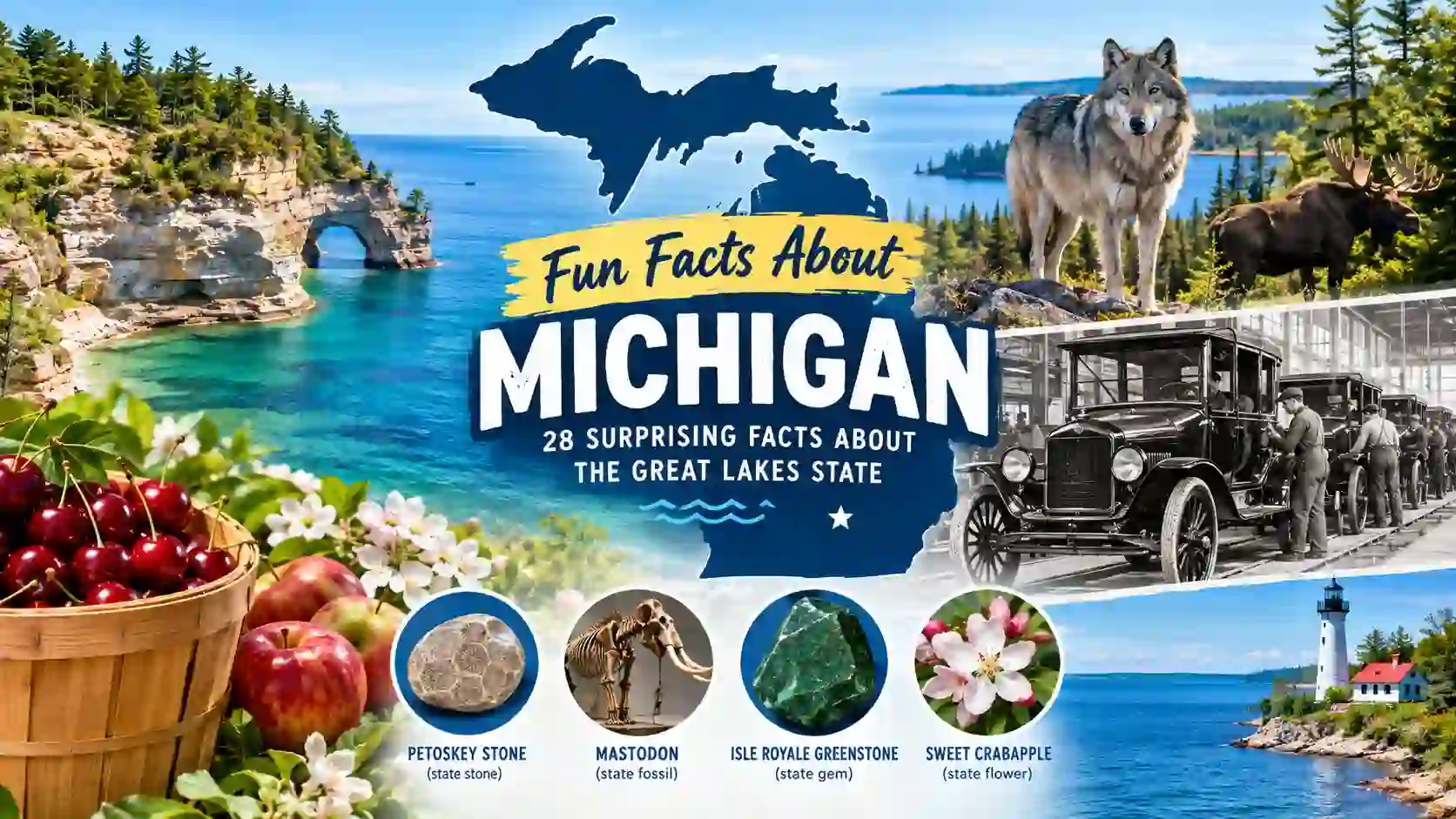
Michigan is a state shaped by water, industry, forests, and invention. It touches four Great Lakes and has the longest freshwater coastline in the United States. Its story also reaches far beyond cars. Indigenous people mined Keweenaw copper thousands of years ago. Detroit later helped transform modern manufacturing. Michigan even has a fossilized coral as its official state stone.
I was especially struck by how often water connects Michigan’s stories. Lakes shaped its land, trade, wildlife, farming, and cities. From Isle Royale wolves to tart cherries, Michigan has unusual facts in every direction. Here are some of the most interesting fun facts about Michigan.
Michigan at a Glance
| Fact | Detail |
| Statehood | January 26, 1837 |
| Capital | Lansing |
| 2025 population | 10,127,884 |
| Great Lakes touched | 4 of 5 |
| Great Lakes shoreline | About 3,288 miles |
| Inland lakes | 10,899 lakes of 5+ acres |
| State stone | Petoskey stone |
| State fossil | Mastodon |
| State gem | Isle Royale greenstone |
| State nickname | Wolverine State |
Population figure is as of July 1, 2025. Shoreline and lake figures come from Michigan state agencies.
1. Michigan Is Almost Surrounded by Fresh Water
1. Michigan has more than 3,200 miles of Great Lakes shoreline.
Michigan has about 3,288 miles of Great Lakes shoreline. That figure includes island shorelines. Michigan’s coastline is therefore a huge part of its identity. The state borders Lakes Superior, Michigan, Huron, and Erie. Only Lake Ontario does not touch Michigan.
2. Michigan has 10,899 inland lakes.
The Michigan DNR counts 10,899 inland lakes measuring at least five acres. Water is never far away in the state. The DNR says residents are never more than six miles from a body of water.
3. Michigan has the longest U.S. freshwater coastline.
Michigan’s coastline is unusual because it borders freshwater. State officials describe it as the longest freshwater coastline in the United States. The shoreline includes mainland beaches, rocky coasts, islands, dunes, and wetlands.
4. Michigan touches four Great Lakes.
Michigan reaches four of the five Great Lakes. They are Superior, Michigan, Huron, and Erie. This gives Michigan an unusual geographic position. Its two peninsulas sit between major freshwater systems.
Source: Michigan DNR — Natural Resources at a Glance
2. Michigan’s History Runs Deep Underground
5. Indigenous people mined Michigan copper thousands of years ago.
Copper mining in Michigan did not begin with modern industry. Indigenous people mined Keweenaw copper at least 7,000–8,000 years ago. They shaped the copper into tools, ornaments, and trade goods. Some copper objects traveled across large parts of North America.
6. Keweenaw copper helped drive an early mining rush.
Industrial copper mining expanded rapidly during the 1840s. The Keweenaw became one of America’s earliest major mineral rush regions. By 1849, the area supplied 96% of U.S. copper production, according to the National Park Service.
7. About five billion kilograms of copper came from the Keweenaw.
Industrial mines extracted roughly five billion kilograms of copper from the Keweenaw between 1845 and 1968. That copper supported transportation, defense, electrical technology, and industry. The mining era also changed local communities and landscapes.
8. Michigan has a national park built around mining history.
Keweenaw National Historical Park preserves Michigan’s copper-mining story. It has two main units, Calumet and Quincy. The park also works with many local heritage sites. This makes the park different from many traditional national parks.
Source: National Park Service — Keweenaw National Historical Park
3. Cars Changed Michigan—and the World
9. Michigan helped perfect the modern moving assembly line.
Ford developed its famous moving assembly-line methods at Highland Park, Michigan. Experiments began in 1913. Workers divided production into smaller tasks. Parts then moved between workers instead of each worker building a whole car.
10. A Model T once took 12½ hours to build.
Before Ford’s improved assembly methods, a Model T could take about 12½ hours to build. By early 1914, improved moving lines could produce a finished Model T in about 93 minutes. That was a dramatic manufacturing change.
11. Ford eventually built more than 15 million Model Ts.
Ford produced more than 15 million Model T cars between 1908 and 1927. The car became closely linked with Michigan’s growing automobile industry. Its production methods also influenced factories far beyond automobiles.
12. The first Ford assembly line was surprisingly simple.
Ford’s first assembly-line experiment was not a complete car line. In April 1913, workers assembled Model T magnetos in stages. Each worker handled a small part of the job. The idea was later expanded to larger components and complete chassis.
Source: The Henry Ford — Henry Ford: Assembly Line
4. Michigan Has Some Remarkable State Symbols
13. Michigan’s state stone is fossilized coral.
The Petoskey stone became Michigan’s official state stone in 1965. It is fossilized coral from an ancient marine environment. The distinctive pattern comes from fossil coral structures that can look like small flower shapes.
14. Michigan’s state fossil is the mastodon.
Michigan chose the mastodon as its state fossil in 2002. Fossils of this prehistoric animal have been found at more than 250 locations across Michigan. The mastodon lived in North America long before modern Michigan existed.
15. Michigan has a green gemstone with a long name.
Michigan’s official state gem is chlorastrolite. It is commonly called Isle Royale greenstone. The stone can range from yellow-green to almost black. It occurs mainly in Michigan’s Upper Peninsula.
16. Michigan’s official flower is a native crabapple.
The sweet crabapple became Michigan’s state flower in 1897. It is native to Michigan. The state selected it partly because of its fragrant and attractive flowers.
Source: State of Michigan — State Facts and Symbols
5. Michigan’s Wild Side Is Full of Surprises
17. Isle Royale has a famous wolf-and-moose ecosystem.
Isle Royale National Park sits in Lake Superior. Wolves and moose form a closely studied predator-prey system there. Scientists have tracked these populations for decades. Their changing numbers show how predators, prey, food, weather, and isolation interact.
18. Wolves reached Isle Royale by an ice bridge.
Wolves are believed to have reached Isle Royale around 1948. The National Park Service says they likely crossed an ice bridge from the Canadian mainland. Their isolated population later became central to long-term ecological research.
19. Isle Royale research has lasted since the 1950s.
Scientists have studied Isle Royale’s wolf-moose relationship since 1958. The National Park Service describes it as the longest continuous study of its kind. The island’s isolation makes it especially useful for ecological research.
20. Sleeping Bear Dunes has a 450-foot overlook.
One overlook at Sleeping Bear Dunes stands about 450 feet above Lake Michigan. The height comes from a perched sand dune. The area offers a dramatic view, but descending the bluff can be dangerous.
Source: National Park Service — Isle Royale National Park
6. Michigan Has a Special Place in American Agriculture
21. Michigan produces large quantities of tart cherries.
Michigan is well known for tart cherries. USDA data recorded about 109.3 million pounds of utilized tart cherries in 2025. Production changes each year with weather and growing conditions.
22. Michigan also grows millions of pounds of apples.
USDA’s 2026 preliminary state agriculture overview lists about 1.05 billion pounds of apples for Michigan. The figure is current as of September 17, 2026. Agricultural numbers can change as USDA data are updated.
23. Michigan’s agriculture is more varied than cherries.
Michigan farms produce much more than fruit. USDA data include corn, soybeans, wheat, potatoes, sugarbeets, hay, peaches, asparagus, and maple syrup. The state’s climate and water resources support many different crops.
24. Michigan has a federal marketing order for tart cherries.
Michigan tart cherries are covered by a federal marketing order. The order supports quality rules, research, promotion, and volume-control programs. It covers Michigan and several other tart-cherry-producing states.
Source: USDA National Agricultural Statistics Service — Michigan Agriculture Overview
7. Michigan’s Landscapes Have National Firsts
25. Pictured Rocks became America’s first national lakeshore.
Congress authorized Pictured Rocks National Lakeshore on October 15, 1966. The National Park Service identifies it as America’s first national lakeshore. Its cliffs, beaches, dunes, forests, and waterfalls line Lake Superior.
26. Pictured Rocks was formally established in 1972.
Authorization came in 1966, but formal establishment followed later. Ceremonies marking establishment took place at Munising on October 6, 1972. This distinction matters when discussing the area’s history.
27. Michigan has two very different peninsulas.
Michigan is divided into the Lower Peninsula and Upper Peninsula. The Upper Peninsula extends between Lake Superior, Lake Michigan, and Lake Huron. The two peninsulas give Michigan a distinctive shape and varied landscapes.
28. Michigan’s nickname is the Wolverine State.
Michigan’s official state nickname is the Wolverine State. The state’s name comes from an Indigenous word associated with a great or large lake. Michigan became the 26th state on January 26, 1837.
Source: National Park Service — Pictured Rocks National Lakeshore
Myths vs. Reality
Myth: Michigan is surrounded by ocean water.
Reality: Michigan is surrounded by freshwater. Its shores meet four Great Lakes.
Myth: Michigan’s name means “wolverine.”
Reality: The state says its name comes from the Native American word Michigama, meaning “great” or “large lake.” The wolverine is the state’s nickname.
Myth: Michigan’s auto story began with the assembly line alone.
Reality: Ford’s production system developed through many stages. The Highland Park plant gradually refined moving production during 1913 and 1914.
Michigan Fun Facts FAQ
What is Michigan famous for?
Michigan is famous for automobiles, the Great Lakes, forests, cherries, and copper mining. Detroit became a major center of automobile manufacturing. The state also has major natural attractions such as Isle Royale and Pictured Rocks.
How many Great Lakes touch Michigan?
Michigan touches four Great Lakes. They are Lake Superior, Lake Michigan, Lake Huron, and Lake Erie. Lake Ontario is the only Great Lake without a Michigan shoreline.
What is Michigan’s state stone?
Michigan’s state stone is the Petoskey stone. It is fossilized coral and became the official state stone in 1965.
What is Michigan’s state fossil?
Michigan’s state fossil is the mastodon. The state adopted it in 2002. Mastodon fossils have been found at more than 250 Michigan locations.
Why is Michigan called the Wolverine State?
Michigan’s official nickname is the Wolverine State. The exact historical reason for the nickname is less certain than the official nickname itself. The state does not use the nickname as evidence that wolverines were once common statewide.
What is Michigan’s most unusual natural feature?
Its enormous freshwater shoreline is one strong candidate. Michigan has about 3,288 miles of Great Lakes shoreline. Much of that shoreline includes islands, dunes, wetlands, cliffs, and beaches.
What is Michigan’s most famous food crop?
Cherries are among Michigan’s best-known specialty crops. USDA data show substantial tart-cherry production, though yearly harvests can vary sharply. Apples are also produced on a very large scale.
Conclusion
Michigan is more than cars and cold winters. Its story stretches from ancient copper mines to modern factories. Its freshwater coastline shaped trade, farming, travel, and daily life. Its forests shelter unusual wildlife research. Its fossil coral became a state symbol. Its cherries and apples remain important crops. Even its landscapes tell different stories in every region. That mix makes fun facts about Michigan especially rewarding to explore. Michigan is a state where water, industry, nature, and history meet. Look closely, and almost every corner has another surprising story.

hello! I am Irshad Ullah, and a passionate writer and lifelong learner dedicated to uncovering fascinating facts about science, history, nature, animals, space, and the world around us. I research each topic carefully and transform surprising information into clear, engaging, and enjoyable content. My goal is to satisfy curiosity, inspire learning, and help readers discover something amazing every day.