
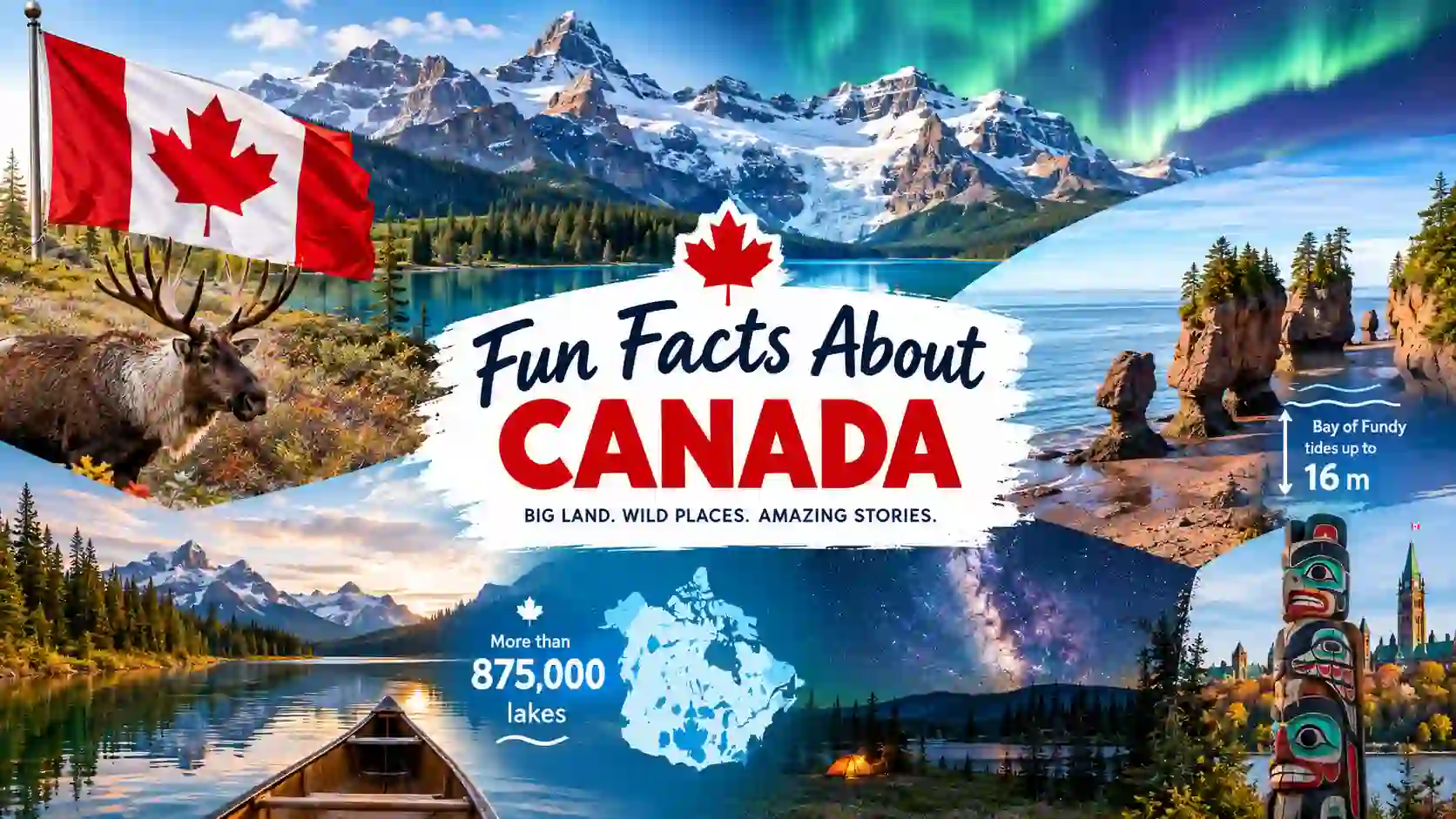
Canada is huge, but its surprises are not only about size. It has the world’s longest coastline and thousands of lakes. Its Bay of Fundy has tides that can rise about 16 metres. Canada also has 10 provinces and three territories. More than 70 distinct Indigenous languages were reported in the 2021 Census. Even time works differently across this vast country. Canada uses several time zones from coast to coast. I find Canada’s most interesting facts are the ones that connect nature, people, and place. These facts show a country shaped by oceans, ice, freshwater, mountains, languages, and long northern nights.
Canada at a Glance
| Fact | Detail |
| Country size | Second-largest country in the world by area |
| Provinces | 10 |
| Territories | 3 |
| Oceans | Pacific, Atlantic, and Arctic |
| Highest mountain | Mount Logan, 5,959 metres |
| Longest coastline | About 243,000 km |
| National parks | 37 national parks and 11 national park reserves, as of 2026 |
| Official languages | English and French |
| Indigenous languages | More than 70 distinct languages reported in 2021 |
| Time zones | Several standard time zones span the country |
A Country Built on an Enormous Map
1. Canada is the world’s second-largest country.
Canada covers about 10 million square kilometres. Only Russia has a larger total area. Three oceans touch Canadian shores: the Pacific, Atlantic, and Arctic. This huge geography creates major differences in climate and landscape. Canada includes mountains, grasslands, forests, tundra, glaciers, islands, and enormous river systems.
2. Canada has 10 provinces and three territories.
The Canadian federation contains 13 provinces and territories. The three territories are Yukon, Northwest Territories, and Nunavut. Territories differ constitutionally from provinces. Their powers come through federal legislation. Nunavut became Canada’s newest territory in 1999. Its creation made Canada’s present territorial structure much closer to today’s map.
3. Canada has the world’s longest coastline.
Canada borders three oceans and has the longest coastline of any country. Natural Resources Canada describes Canada as having the world’s longest coastline. Much of that coast lies around the Arctic islands. This coastline helps explain Canada’s enormous maritime geography. It also shows why Canada’s landmass cannot be understood without its surrounding waters.
4. Canada’s international border with the United States is 8,891 kilometres long.
The Canada–United States boundary stretches for 8,891 kilometres. It crosses landscapes from the Atlantic region to the Pacific and reaches the Beaufort area. The boundary developed through many treaties and agreements. It is therefore not simply one line drawn at one moment. Its history stretches across centuries.
Mountains, Ice, and Northern Landscapes
5. Mount Logan is Canada’s highest mountain.
Mount Logan rises 5,959 metres above sea level. It stands in Yukon within Kluane National Park and Reserve. In 1992, a Canadian expedition used GPS to measure its elevation more precisely. The expedition announced the new official height on Canada Day that year. Mount Logan is also the second-highest peak in North America.
6. Kluane contains enormous non-polar ice fields.
Kluane National Park and Reserve is dominated by mountains and ice. Parks Canada reports that mountains and ice cover about 82% of the park’s surface. Some icefields reach depths of about one kilometre. The region contains one of the world’s largest non-polar icefield systems. Glaciers spread outward from these immense frozen landscapes.
7. Canada’s northern territory of Nunavut covers three time zones.
Nunavut is not simply one clock from east to west. The territory stretches across a vast part of Canada’s Arctic. Canada’s official time-zone information shows Nunavut spans three time zones. Southampton Island is an unusual case. It remains on Eastern Standard Time throughout the year, rather than changing clocks seasonally.
8. Canada’s North contains landscapes far beyond snow and ice.
Northern Canada includes tundra, wetlands, forests, rivers, mountains, and huge lakes. Some northern areas are permanently frozen below the surface. Yet other northern landscapes support boreal forests and abundant wildlife. This variety challenges the simple image of Canada as a country covered in snow. Its northern geography changes sharply across regions.
Water Shapes Canada
9. Canada has more than 875,000 lakes larger than 0.1 square kilometres.
A 2026 Canadian climate report states that Canada has more than 875,000 lakes with surface areas above 0.1 square kilometres. Canadian lakes, rivers, and wetlands together hold around 20% of the world’s surface freshwater. Water is therefore not a small part of Canadian geography. It is one of its defining features.
10. Canada has more lake area than any other country.
Canada has 563 lakes larger than 100 square kilometres. The country therefore has an extraordinary concentration of large lakes. Great Bear Lake is Canada’s largest lake located entirely within the country. These lakes influence transportation, ecosystems, communities, recreation, and regional climates. Canada’s freshwater geography is massive even by global standards.
11. The Great Lakes hold almost 20% of the world’s surface freshwater.
The Great Lakes form one of Earth’s largest freshwater ecosystems. Canada shares the system with the United States. Government sources state that the lakes contain almost 20% of the world’s surface freshwater. They also provide drinking water and support thousands of plant and animal species. Their influence reaches far beyond their shores.
12. Great Bear Lake is Canada’s largest lake entirely within Canada.
Great Bear Lake lies in the Northwest Territories. Parks Canada identifies it as Canada’s largest wholly contained freshwater lake. It is also the world’s ninth-largest lake by area. The lake has deep cultural importance for the Sahtúgot’ı̨nę people. Its surrounding protected places preserve both natural and cultural values.
Tides, Oceans, and Coastal Wonders
13. The Bay of Fundy has the world’s highest tides.
The Bay of Fundy sits between New Brunswick and Nova Scotia. At the head of the bay, tides can rise about 16 metres. That is roughly the height of a four-story building. The extreme tides result from the bay’s shape and tidal resonance. They continually reshape mudflats, beaches, cliffs, and coastal ecosystems.
14. Fundy’s shoreline can seem to move dramatically.
At low tide near Alma Beach, visitors can walk more than one kilometre across exposed tidal flats. Later, seawater returns over the same area. This makes Fundy’s coastline look completely different within hours. The effect is a powerful reminder that a coastline is not always a fixed boundary. Tides can transform it twice each day.
15. About 40% of Canada’s landmass is under the ocean.
Natural Resources Canada notes that about 40% of Canada’s landmass is under the ocean. This refers to Canada’s offshore seabed and marine territory. Canada’s geography therefore extends well beyond its visible land. Scientists study these underwater areas to understand seafloor geology, hazards, ecosystems, and changing coastal environments.
16. Canada touches three oceans.
Canada’s western edge meets the Pacific Ocean. Its eastern coast meets the Atlantic Ocean. Its northern frontier reaches the Arctic Ocean. Few countries have such a broad ocean setting. These three oceans influence climate, ecosystems, transportation, fisheries, coastal communities, and Canada’s enormous maritime geography.
Languages Tell Another Canadian Story
17. Canada has two official languages.
English and French are Canada’s official languages. The 2021 Census found that 18.0% of Canadians could speak both English and French. The balance differs greatly between regions. Quebec has a much higher bilingualism rate than many other provinces. Canada’s language map therefore changes noticeably from one part of the country to another.
18. More than 70 distinct Indigenous languages were reported in the 2021 Census.
Statistics Canada reported more than 70 distinct Indigenous languages in the 2021 Census. These languages belong to several language families and traditions. The census recorded both growing and declining speaker populations. This linguistic diversity reflects thousands of years of Indigenous history across Canada’s different regions.
19. Inuktitut had more than 40,000 speakers in 2021.
The 2021 Census recorded about 40,320 people who could speak Inuktitut well enough for conversation. Inuktitut remains especially important in Inuit communities across Canada’s Arctic. The census also showed different trends among Indigenous languages. Some languages gained speakers while others declined between 2016 and 2021.
20. Canada’s most widely spoken Indigenous language group is Cree.
Cree languages had about 86,475 speakers recorded in the 2021 Census. This made Cree languages the largest Indigenous language group by reported speakers in that census. The number covers Cree language varieties grouped together for statistical reporting. Language counts can also be affected by census coverage and reporting methods.
Parks That Reveal Canada’s Wild Side
21. Canada has 37 national parks and 11 national park reserves as of 2026.
Parks Canada currently lists 37 national parks and 11 national park reserves. Together, these protected areas cover about 343,377 square kilometres of land. They represent 31 of Canada’s 39 terrestrial natural regions. The parks range from mountain landscapes to boreal forests, plains, tundra, glaciers, and coastal environments.
22. Wood Buffalo National Park is Canada’s largest national park.
Wood Buffalo National Park covers about 45,561 square kilometres according to Parks Canada. It stretches across Alberta and the Northwest Territories. The park protects boreal forests, grasslands, wetlands, rivers, and wildlife habitat. It was established in 1922 to protect free-roaming bison herds. Today, it remains one of Canada’s most important protected landscapes.
23. Wood Buffalo is also the world’s largest Dark-Sky Preserve.
Wood Buffalo National Park received its Dark-Sky Preserve designation in 2013. Parks Canada identifies it as the world’s largest Dark-Sky Preserve. The protected darkness reduces artificial light across a huge northern landscape. On clear nights, visitors can see stars, the Milky Way, and sometimes the northern lights.
24. Wood Buffalo protects a major whooping crane habitat.
Wood Buffalo contains the last remaining natural nesting site of the whooping crane. The species is one of North America’s best-known conservation stories. The park also supports wood bison, wolves, bears, moose, and many bird species. Its wildlife value comes from the connected wetlands, grasslands, forests, and river systems.
Symbols, Sports, and Time
25. Canada’s maple leaf flag became official in 1965.
Canada’s present national flag was proclaimed official on January 28, 1965. It was first raised at a public ceremony on Parliament Hill on February 15. The red maple leaf quickly became one of Canada’s most recognizable national symbols. Today, February 15 is celebrated as National Flag of Canada Day.
26. Canada has two officially recognized national sports.
Canada’s National Sports of Canada Act recognizes hockey as the national winter sport and lacrosse as the national summer sport. Parliament gave the law royal assent on May 12, 1994. Lacrosse has deep Indigenous roots in North America. Hockey later became closely linked with Canadian winter culture and sporting history.
27. Canada does not run on one national clock.
Canada spans several standard time zones. Provincial and territorial governments usually regulate time and daylight saving rules. Most Canadian regions follow seasonal clock changes, but exceptions exist. Yukon, for example, has used UTC−7 year-round since 2020. Canada’s enormous east-to-west distance makes one national local time impractical.
28. Canada’s geography makes its daylight patterns extreme.
Canada’s northern location creates very long summer days and very short winter days in Arctic regions. The effect becomes stronger farther north. Some communities experience periods when the sun does not set in summer or does not rise in winter. These dramatic daylight cycles are a natural result of Earth’s tilt and Canada’s high latitude.
Myths vs. Reality: Canada Edition
| Myth | Reality |
| Canada is basically covered by snow. | Canada has forests, grasslands, mountains, wetlands, deserts, tundra, and coastal landscapes. |
| Canada has only a few large lakes. | Canada has more than 875,000 lakes above 0.1 km². |
| Canada’s national sport is only hockey. | Hockey is the national winter sport; lacrosse is the national summer sport. |
| Canada’s North is just frozen wilderness. | Northern Canada contains forests, tundra, rivers, lakes, wetlands, wildlife, and thriving communities. |
| Everyone in Canada speaks both English and French. | Canada is officially bilingual, but bilingualism varies greatly by region. |
Frequently Asked Questions About Canada
What are some fun facts about Canada?
Canada is the world’s second-largest country by area. It also has the world’s longest coastline. The country has more than 875,000 lakes above 0.1 square kilometres. Its Bay of Fundy has tides reaching about 16 metres. Canada also has 10 provinces, three territories, and two official languages.
How many lakes are in Canada?
A 2026 Canadian climate report says Canada has more than 875,000 lakes larger than 0.1 square kilometres. The exact number depends on the size threshold used. Canada also has more lake area than any other country. Its freshwater geography is one of the country’s most striking natural features.
What is Canada’s highest mountain?
Mount Logan is Canada’s highest mountain. Its official elevation is 5,959 metres. It stands in Kluane National Park and Reserve in Yukon. A Canadian expedition used GPS to measure its elevation in 1992. Mount Logan is also the second-highest mountain in North America.
How many national parks are in Canada?
As of September 2026, Parks Canada lists 37 national parks and 11 national park reserves. These areas protect about 343,377 square kilometres of Canadian land. They cover many natural regions, including mountains, forests, plains, tundra, glaciers, and coastal landscapes.
What languages are spoken in Canada?
English and French are Canada’s official languages. Canada also has a large number of Indigenous languages and many immigrant languages. The 2021 Census recorded more than 70 distinct Indigenous languages. English and French remain the two most widely recognized official languages nationwide.
Why are Canada’s tides so high?
The Bay of Fundy has unusually high tides because of its shape and tidal resonance. At the head of the bay, the difference between high and low tide can reach about 16 metres. This creates huge changes across the exposed coastal flats during each tidal cycle.
What is Canada’s largest national park?
Wood Buffalo National Park is Canada’s largest national park. It covers about 45,561 square kilometres. The park crosses the Alberta–Northwest Territories boundary. It protects large ecosystems, wildlife habitat, wetlands, bison herds, and important whooping crane nesting habitat.
How many time zones does Canada have?
Canada spans several standard time zones from east to west. Nunavut alone covers three time zones. Time rules can also differ because provinces and territories control many daylight-saving decisions. Yukon has used UTC−7 year-round since 2020.
Conclusion
The most fascinating fun facts about Canada are not only about size. They show how deeply geography shapes life. Canada has enormous lakes, three ocean borders, towering mountains, and extreme northern daylight. Yet it also has rich language traditions and protected cultural landscapes. Its national parks protect both wildlife and darkness itself. Its tides can reshape a shoreline within hours. Its languages reveal a much older story than the modern country. When I look at Canada this way, the country feels less like one giant map and more like many worlds connected across one enormous landscape.

hello! I am Irshad Ullah, and a passionate writer and lifelong learner dedicated to uncovering fascinating facts about science, history, nature, animals, space, and the world around us. I research each topic carefully and transform surprising information into clear, engaging, and enjoyable content. My goal is to satisfy curiosity, inspire learning, and help readers discover something amazing every day.