
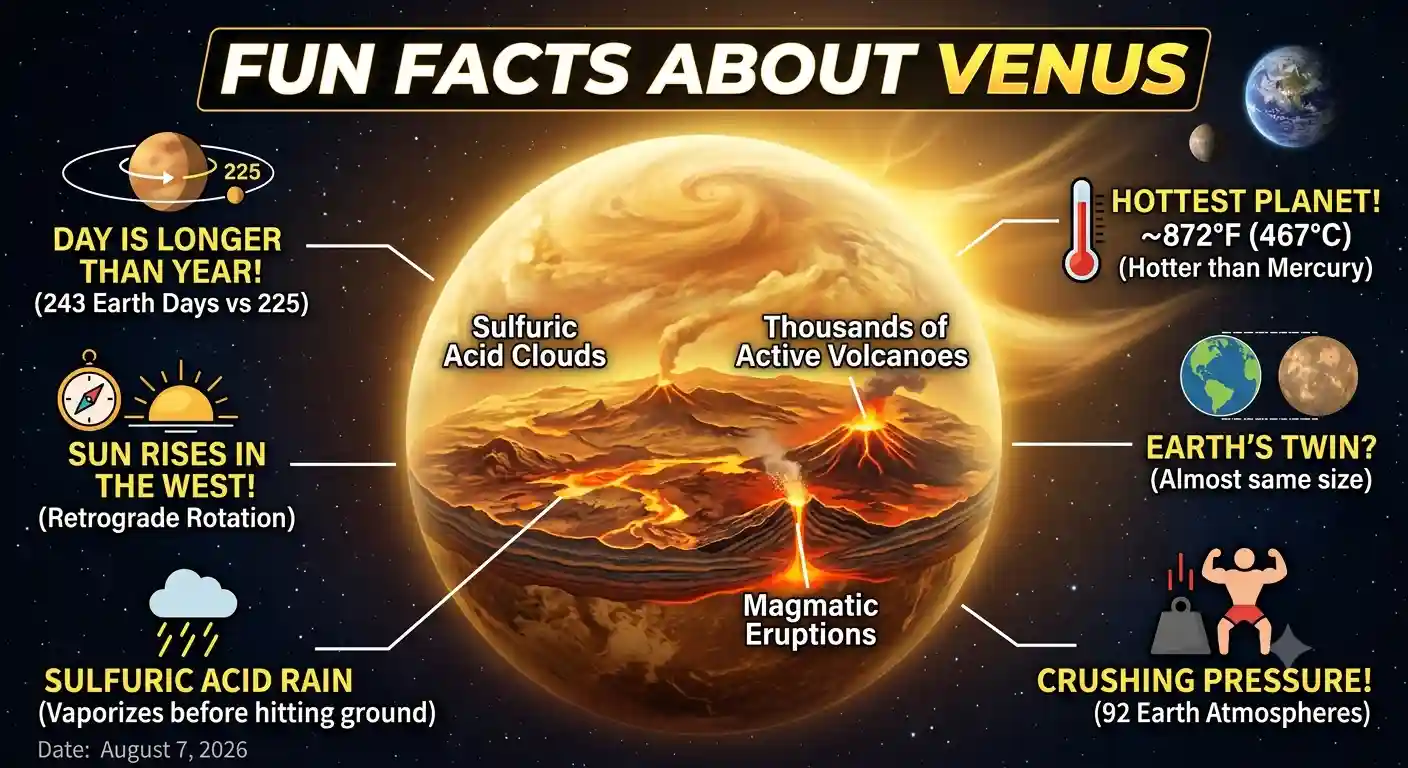
Venus is often called Earth’s “evil twin.” While it shares almost the exact same size, mass, and rock density as our home planet, its environment is a nightmare scenario of runaway climate forces.
Despite being our closest planetary neighbor, discovering fun facts about Venus reveals strange atmospheric anomalies, backward rotation patterns, and crushing physical extremes that challenge everything we know about terrestrial planets. Reading through cool facts about Venus shows just how alien this nearby world truly is.
Quick Venus Snapshot
| Dimension / Metric | Fascinating Reality | Why It Matters |
| Surface Temperature | ~872°F (467°C) | Hottest planet in the solar system, hot enough to melt lead. |
| Surface Pressure | 92 Earth Atmospheres | Crushing force equivalent to 3,000 feet (900m) underwater. |
| Day vs. Year | Day = 243 Earth Days / Year = 225 Earth Days | A single Venusian day lasts longer than its entire orbital year. |
| Atmospheric Composition | 96.5% Carbon Dioxide | Prime example of a runaway greenhouse effect in the solar system. |
Mind-Blowing Science & Venus Facts
1. A Day on Venus is Longer Than Its Year
Venus takes 243 Earth days to complete a single rotation on its axis. However, it orbits the Sun in just 225 Earth days. This means a full day-night cycle on Venus takes longer than its entire year—one of the most surprising Venus facts in astronomy.
Source Data: NASA Venus Overview
2. The Sun Rises in the West and Sets in the East
Venus features retrograde rotation, meaning it spins in the opposite direction of Earth and most other planets. If you could stand on its surface, you would watch the Sun rise in the west and set in the east every 117 Earth days.
Source Data: NASA Space Place
3. It Is Hotter Than Mercury, Despite Being Further From the Sun
Mercury is closest to the Sun, but Venus holds the title of the hottest planet. Its dense carbon dioxide atmosphere traps solar heat in a violent greenhouse loop, keeping surface temperatures at a blistering 872°F (467°C) day and night.
Source Data: NASA Solar System Exploration
4. Atmospheric Pressure Will Instantly Crush Metal
Walking on the surface of Venus feels like standing 3,000 feet underwater on Earth. The surface pressure is 92 times greater than Earth’s sea level, which easily crushed historical landers within hours of arrival.
Source Data: EBSCO Research Starters
5. It Rains Acid, But It Never Touches the Ground
Venusian clouds are made of concentrated sulfuric acid droplets. While it rains acid constantly, the intense surface heat causes the droplets to vaporize mid-air in a process known as virga, long before hitting the terrain.
Source Data: Royal Museums Greenwich
6. High Altitude Winds Travel 60 Times Faster Than the Planet Spins
While the planet’s surface rotates at a slow crawling pace, upper-level cloud winds whip around Venus at speeds over 220 mph (360 km/h). This phenomenon, known as super-rotation, circles the entire globe in roughly 4 days.
Source Data: NASA Venus Facts
7. Thousands of Volcanoes Reshape Its Surface
Venus has more volcanoes than any other planet in our solar system. Radar mapping reveals over 1,600 major volcanic features, with researchers finding ongoing active magmatic eruptions re-surfacing the world.
Source Data: Las Cumbres Observatory
Historical Secrets & Cultural Quirks
8. The Only Planet Named After a Female Figure
In Roman mythology, Venus was the goddess of love and beauty. Because it shone brighter than almost anything else in the night sky, ancient observers named it after their most striking deity. Learning facts about planet Venus unveils that nearly all geographical features on Venus are named after historic or mythical women.
Source Data: NASA Planetary Names
9. Ancient Astronomers Thought It Was Two Separate Objects
Because Venus is visible shortly before sunrise and right after sunset, ancient Greeks called it two distinct names: Phosphorus (the Morning Star) and Hesperus (the Evening Star). It was Pythagoras who first realized both were the exact same planet.
Source Data: Las Cumbres Observatory
10. Soviet Landers Survived Just Long Enough to Capture Photos
During the 1970s and 1980s, the Soviet Venera probes successfully landed on the surface. Operating under catastrophic pressure and temperature, Venera 13 survived for 127 minutes, transmitting the first color panorama photos of Venusian soil before succumbing to the heat.
Source Data: NASA Space Science Data Coordinated Archive
11. It Is the Third Brightest Natural Object in Our Sky
After the Sun and the Moon, Venus is the brightest natural object visible from Earth. Its thick reflective clouds bounce roughly 70% of sunlight back into space, making it visible even during bright twilight hours.
Source Data: Royal Museums Greenwich
12. Venus Lacks a Global Magnetic Field
Unlike Earth, whose spinning liquid iron core generates a protective magnetosphere, Venus has no internal magnetic field. Its weak induced field relies entirely on solar wind interacting directly with the upper atmosphere.
Source Data: Las Cumbres Observatory
Venus By The Numbers
| Metric | Measurement Value |
| Distance from Sun | ~67 million miles (108 million km) |
| Equatorial Radius | 3,760 miles (6,051 km) — ~95% of Earth |
| Surface Gravity | 8.87 m/s² (~90% of Earth’s gravity) |
| Moons | 0 (Zero) |
| Rings | 0 (Zero) |
| Average Orbital Speed | ~78,300 mph (126,000 km/h) |
Facts That Sound 100% Fake (But Are Actually True)
13. High Up in the Clouds, Conditions are Remarkably Earth-Like
About 30 miles (50 km) above the scorched surface, atmospheric pressure and temperature drop to levels nearly identical to Earth. It is one of the most survivable atmospheric zones in the solar system, leading researchers to design concept floating cloud cities.
Source Data: NASA Venus Facts
14. A Pizza Would Cook on the Surface in 7 Seconds
With an ambient temperature sitting at 872°F (467°C), you wouldn’t need an oven. Placing a standard frozen pizza on a rock on Venus would thoroughly bake it in seconds before instantly charring it to ash. These interesting facts about Venus prove how extreme its surface environment really is.
Source Data: NASA Science
15. It May Have Held Liquid Water Oceans for Billions of Years
Climate models suggest early Venus had stable temperatures and surface water oceans for nearly 2 billion years. A runaway greenhouse cycle eventually boiled the oceans away, stripping the water molecules into space.
Source Data: NASA Goddard Institute for Space Studies
“Can You Imagine?” (Visual Analogies)
- Crushing Depth: Standing on Venus feels like having a heavy SUV resting on every square inch of your body.
- Extreme Slow Motion: If you ran a marathon on Venus at a standard pace, you could run around the entire planet multiple times before the sun sets once.
- Heavy Atmosphere: The air on Venus is so thick and dense that walking through it would feel like wading through shallow water rather than air.
Debunking the Myths: Fiction vs. Reality
| The Popular Myth | The Actual Fact | Verification Source |
| “Venus is Earth’s identical twin planet.” | It shares mass and size, but its environment is completely toxic and deadly. | NASA Solar System Exploration |
| “Mercury is the hottest planet because it’s closest to the Sun.” | Venus is significantly hotter than Mercury due to atmospheric heat trapping. | Royal Museums Greenwich |
| “Venus has no active surface changes.” | Volcanic eruptions and lava flows actively alter its topography today. | Magellan Radar Data / ESA |
Mysteries Scientists Still Can’t Explain
16. The Phosphine Gas Debate
In 2020, ground-based telescopes detected trace amounts of phosphine gas in the Venusian cloud layer. On Earth, phosphine is produced by anaerobic microbes. Scientists remain locked in debate over whether this signals unknown chemistry or microbial life.
17. The Mysterious “Dark Absorbers”
Ultraviolet images show vast, dark streaks sweeping across the upper atmosphere. These streaks absorb huge amounts of UV radiation, yet scientists still cannot determine their exact chemical makeup.
18. What Stopped Its Plate Tectonics?
Unlike Earth, Venus lacks active tectonic plates. Instead, its crust appears to periodically lock up and suddenly undergo massive global resurfacing events. Why it evolved without plate subduction remains a major planetary mystery.
Share-This Fact
A day on Venus is longer than its year, and the sun rises in the west!
The Ultimate Venus Brain Teaser
- How long does it take for Venus to complete one full rotation on its axis?
- A) 24 hours
- B) 88 Earth days
- C) 243 Earth days
- D) 365 Earth days
- What are the clouds of Venus primarily made of?
- A) Water vapor
- B) Methane ice
- C) Liquid nitrogen
- D) Sulfuric acid
- Which direction does the Sun rise on Venus?
- A) East
- B) West
- C) North
- D) It does not rise
(Answers: 1-C, 2-D, 3-B)
FAQ (People Also Ask)
Why is Venus so hot?
Venus is extremely hot because its thick atmosphere is composed of 96.5% carbon dioxide. This creates a massive runaway greenhouse effect that traps solar heat, driving surface temperatures to 872°F (467°C).
Can humans survive on Venus?
Humans cannot survive on the surface of Venus. The extreme temperature melts lead, the atmospheric pressure would crush human lungs instantly, and the air is filled with poisonous carbon dioxide and sulfuric acid.
Does Venus have any moons?
No, Venus has no natural moons. Along with Mercury, it is one of only two planets in our solar system that orbits the Sun without a moon companion.
Why does Venus spin backwards?
Scientists suspect that early in its history, Venus was hit by a massive protoplanet collision. This giant impact likely knocked the planet upside down or completely reversed its rotational direction.
How long does it take to travel to Venus?
Using current spacecraft propulsion technology, a travel journey from Earth to Venus takes approximately 3 to 4 months, depending on the orbital alignments of the two planets.
Summary
Exploring these fun facts about Venus highlights how it remains one of the most mysterious and extreme environments in our solar system. Learning all these unusual facts about Venus shows that while it mirrors Earth in size and mass, its crushing pressures, acidic clouds, and runaway temperatures serve as a stark warning of planetary extremes. These interesting facts about planet Venus remind us of the vast unknowns waiting in space. Ongoing space agency missions continue to study its atmosphere to answer how an Earth-like planet transformed into an inferno.

hello! I am Irshad Ullah, and a passionate writer and lifelong learner dedicated to uncovering fascinating facts about science, history, nature, animals, space, and the world around us. I research each topic carefully and transform surprising information into clear, engaging, and enjoyable content. My goal is to satisfy curiosity, inspire learning, and help readers discover something amazing every day.