
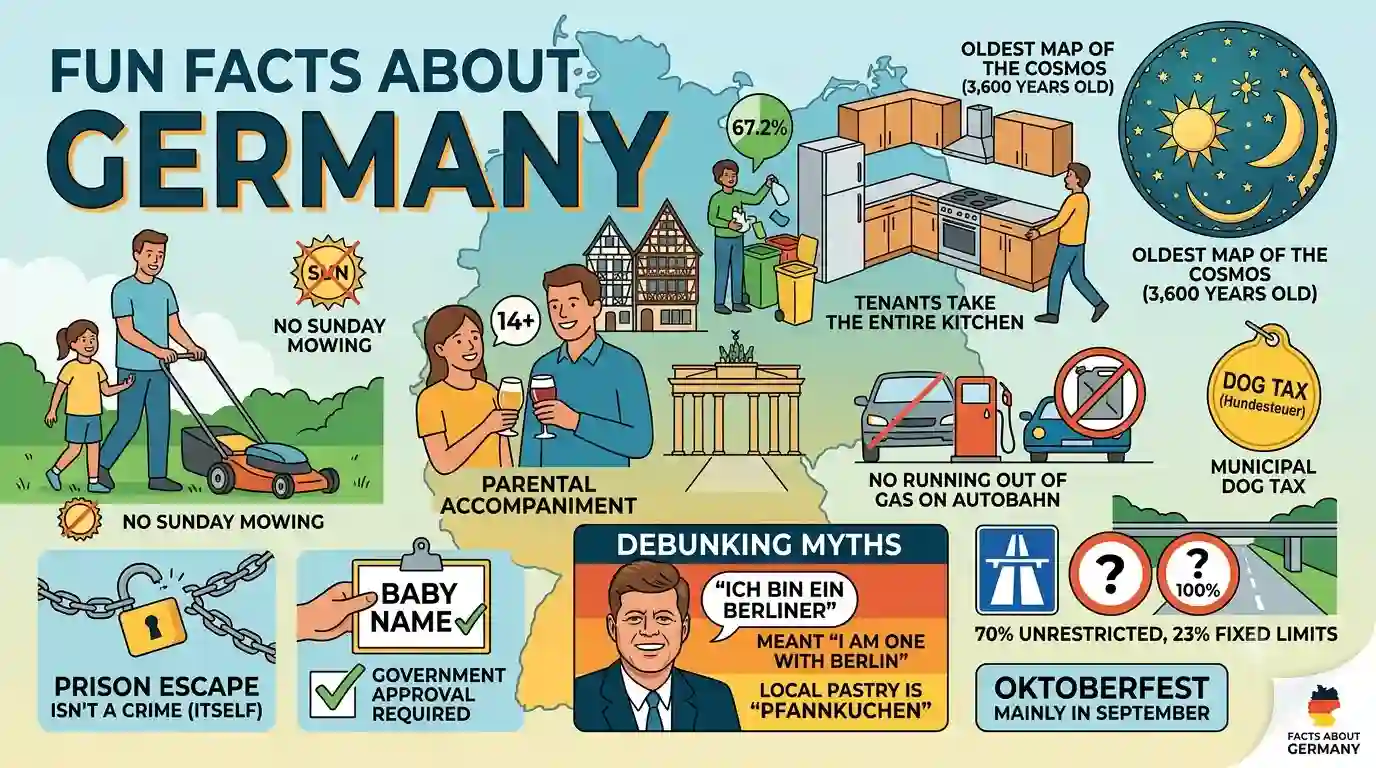
Think you know Germany? You might picture fast cars, crispy schnitzel, and massive mugs of beer. But behind the postcard image lies one of the most surprising countries on Earth. Did you know that running out of gas on the highway can get you a heavy fine? Or that jailbreaks are legally permitted because the desire for freedom is considered a natural human instinct?
Germany is a nation of wild contrasts. Medieval castles sit next to solar-powered eco-cities, and centuries-old bread recipes share the stage with hyper-modern engineering. Beyond standard travel guides, this deep dive uncovers verified unique fun facts about Germany that competitors constantly miss. From bizarre legal loopholes to mind-bending geographic anomalies, these unbelievable fun facts reveal how Germany really works. Get ready to see Germany in a whole new light.
| Dimension / Metric | Fascinating Reality | Why It Matters |
|---|---|---|
| Forest Coverage | ~33% of total land area | Covers 28 million acres of protected woodland (Source: destatis.de). |
| Castles & Palaces | 20,000+ structures | Highest concentration of historical fortresses globally. |
| Recycling Rate | 66.1% waste diverted | Ranks as the world champion in waste management. |
| Narrowest Street | 31 cm (12.2 inches) wide | Confirmed as the world’s narrowest street in Reutlingen (Source: guinnessworldrecords.com). |
Germany — Mind-Blowing Science & Anomalies
1. The World’s Narrowest Street Fits Only One Person Sideways
In the medieval town center of Reutlingen, Spreuerhofstraße squeezes between two houses. At its narrowest point, it measures just 31 centimeters (12.2 inches) across. Guinness World Records officially recognizes it as the world’s narrowest street. City workers built it in 1727 as a quick emergency escape route during a citywide fire reconstruction.
Studying-in-Germany.org
2. A Third of the Country Is Covered in Dense Woodland
Forests cover roughly 33 percent of Germany’s land mass. That equals more than 28 million acres of pine, oak, and beech trees. The Black Forest alone spans over 2,300 square miles. Strict federal laws require that whenever a tree is cut down for construction, another must be planted in its place.
Studying-in-Germany.org
3. Germany Created the World’s First Solar-Powered Train Network
In Lower Saxony, hydrogen and solar-assisted passenger trains operate on regional lines. These zero-emission trains emit only steam and condensed water into the air. They replace old diesel engines, cutting thousands of tons of carbon dioxide every year.
4. The Earth’s Deepest Scientific Hole Was Drilled Here
During the Cold War, German scientists drilled the KTB superdeep borehole in Bavaria. The drill reached 29,856 feet (9.1 kilometers) into the Earth’s crust. Temperatures at the bottom reached 509°F (265°C), forcing engineers to invent new heat-resistant drill bits.
5. Gummy Bears Were Invented as an Energy Snack for Adults
Confectioner Hans Riegel invented gummy bears in Bonn back in 1922. He named his company HARIBO by taking the first two letters of his name and city (HA-RI-BO). He originally designed the chewy gelatin bears to give workers cheap energy during hard economic times.
Airhub
6. The Tallest Church Tower on Earth Pierces the Sky at 530 Feet
Ulm Minster holds the world record for the tallest church building. Its single spire reaches 161.5 meters (530 feet) into the air. Visitors must climb 768 stone steps to reach the top viewing platform, which offers views of the distant Swiss Alps on clear days.
Studying-in-Germany.org
7. MP3 Technology Was Invented by German Researchers
The digital audio revolution started in Erlangen, Germany. Engineer Karlheinz Brandenburg and his team at the Fraunhofer Institute invented the MP3 file format. They squeezed large audio files down by 90 percent without losing noticeable sound quality.
Studying-in-Germany.org
Germany — Historical Secrets & Cultural Quirks
1. Escaping from Prison Is Completely Legal
Under German law, escaping from prison is not considered a punishable crime. The legal system views the desire for freedom as a basic human instinct. However, if an inmate breaks a lock, steals clothes, or assaults anyone while escaping, they will be charged for those specific crimes.
Studying-in-Germany.org+ 1
2. Punctuality Is Protected by Local Silence Laws
Quiet hours, called Ruhezeit, are strictly enforced across Germany. On Sundays and public holidays, it is illegal to mow lawns, use power tools, or throw glass bottles into recycling bins. Neighbors can report violators directly to the local order office (Ordnungsamt).
Jetpac+ 1
3. Over 3,200 Official Varieties of Bread Exist Here
Bread baking is an art form protected by UNESCO cultural heritage status. German bakeries produce more than 3,200 unique bread varieties. The nation relies on heavy rye, whole-grain spelt, and sourdough loaves rather than soft white bread.
Airhub+ 1
4. Running Out of Fuel on the Autobahn Brings a Fine
Stopping without a valid emergency on the high-speed Autobahn is strictly forbidden. Running out of gasoline or battery power is considered preventable negligence, not an emergency. Drivers who stall out face fines starting at €70 ($76) plus safety points on their driver’s license.
Jetpac
5. First Graders Receive Giant Sugar Cones on Their First Day
Every autumn, children starting elementary school receive a Schultüte. Parents fill these massive, decorated cardboard cones with school supplies, toys, and sweets. The tradition began in the 19th century to make the transition into school sweet and memorable.
Studying-in-Germany.org
Fun Facts About Germany By The Numbers
| Metric / Statistic | Exact Figure | Relatable US Comparison |
|---|---|---|
| Castle Structures | 20,000+ castles and ruins | More than twice the number of McDonald’s locations in the US (~13,500) |
| Bridge Count (Berlin) | 1,700+ active bridges | Over four times more bridges than Venice, Italy (~400) |
| Annual Currywurst Consumption | 800,000,000 sausages eaten | Equivalent to 2.4 sausages for every person living in the United States |
| National Zoo Count | 400+ registered zoos & parks | Highest number of animal parks of any European nation |
Facts That Sound 100% Fake (But Are Actually True)
- Bavarian Law Classifies Beer as Food: In the southern state of Bavaria, beer is legally categorized as a basic liquid food item (Flüssigbrot) due to its historical nutritional role. Studying-in-Germany.org
- Oktoberfest Actually Begins in September: Despite its name, the famous Munich beer festival starts in mid-September and ends on the first weekend of October to take advantage of warmer autumn weather. Airhub
- You Can Pay a Federal Tax on Dogs: German pet owners must pay an annual dog ownership tax (Hundesteuer) ranging from €90 to over €600 per year depending on the breed and municipality.
- The First Printed Bible Came from Mainz: Johannes Gutenberg invented the movable-type printing press in Germany around 1440, printing 180 copies of his famous Gutenberg Bible.
“Can You Imagine?” (Visual Analogies)
- Castle Density: Imagine driving across Texas and seeing a medieval castle every 10 miles. That matches the density of Germany’s 20,000 historic fortresses. Airhub
- Tree Cover: If you connected all of Germany’s forests into one unbroken strip, it would create a 2-mile-wide green belt stretching all the way around the equator.
- Currywurst Consumption: Stacking the 800 million Currywurst sausages eaten in Germany each year end-to-end would circle the moon three times over. Rustic Pathways
Debunking the Myths: Fiction vs. Reality
| The Popular Myth | The Actual Fact | The Source / Proof |
|---|---|---|
| The Autobahn has zero speed limits everywhere. | About 30% of the Autobahn has permanent speed limits, with another 15% under temporary limits due to weather or traffic. | Federal Highway Research Institute (BASt) |
| JFK accidentally called himself a jelly donut. | John F. Kennedy said “Ich bin ein Berliner,” which is grammatically correct in Berlin. Locals call jelly donuts Pfannkuchen. | German Linguistic Association |
| All Germans wear Lederhosen daily. | Tracht (traditional dress) is worn almost exclusively during regional festivals in southern Bavaria, not in daily life. | Bavarian Cultural Ministry |
Mysteries Scientists Still Can’t Explain
1. The Mysterious Fairy Circles of the Harz Mountains
In the Harz forest clearings, bare patches of soil form perfect circular rings where no plant life will grow. Scientists tested soil chemistry, radiation, and fungi, but cannot explain why vegetation avoids these geometric spots.
2. The Floating Wandering Stones of the Wadden Sea
Along the northern tidal mudflats, heavy glacial boulders shift positions across flat mud over winter months without visible current force. Marine biologists suspect ice sheet movement, but exact mechanics remain unverified.
3. The Roman Eifel Aqueduct Alignment Anomaly
Built in 80 AD, this ancient aqueduct carried spring water 59 miles through mountain terrain. Engineers marvel at how Roman surveyors maintained a precise downward slope of just 2.4 inches per mile without modern optics.
Share-This Fact
Germany has over 20,000 castles and 3,200 types of bread, but running out of gas on the highway is strictly illegal.
Airhub
The Ultimate Fun Facts About Germany Brain Teaser
1. What happens if a prisoner breaks out of jail in Germany without causing any property damage or violence?
- A) They receive a mandatory 10-year extended sentence.
- B) They face no legal penalty for the escape itself. Studying-in-Germany.org
- C) They must pay a €5,000 fine.
- D) They lose all citizenship rights.
2. Which German city quietly has more than four times as many bridges as Venice, Italy?
- A) Munich
- B) Frankfurt
- C) Berlin Airhub
- D) Hamburg
3. What is the minimum physical width of the world’s narrowest street in Reutlingen?
- A) 31 centimeters (12.2 inches) Studying-in-Germany.org
- B) 55 centimeters (21.6 inches)
- C) 75 centimeters (29.5 inches)
- D) 90 centimeters (35.4 inches)
Answers ↓
- B) They face no legal penalty for the escape itself. German law views freedom as a basic human drive. Studying-in-Germany.org
- C) Berlin. Berlin contains over 1,700 bridges compared to Venice’s 400. Airhub
- A) 31 centimeters. Spreuerhofstraße is officially certified by Guinness World Records. Studying-in-Germany.org
Frequently Asked Questions
Why is running out of gas on the Autobahn illegal?
German traffic law considers running out of fuel a preventable mistake rather than an unpredictable mechanical breakdown. Drivers are required to check fuel levels before entering high-speed zones to protect public safety.
Jetpac
Are all German public universities free for international students?
Most public universities in 15 out of 16 German states offer tuition-free degree programs for domestic and international students. Students pay only a minor administrative fee of around €150–€350 per semester.
Why do Germans give cardboard cones to children on their first day of school?
The Schultüte tradition dates back to 1817 in Saxony. Parents present these gift-filled cones to make the scary transition into formal schooling sweet, fun, and memorable.
Studying-in-Germany.org
Is Oktoberfest held in September or October?
Oktoberfest starts in mid-September and ends during the first weekend of October. Organizers shifted the schedule in 1872 to take advantage of warmer daytime weather and longer September sunlight.
Airhub
What is the longest word in the German language?
German allows compound words of unlimited length. A famous 79-letter official term was Donaudampfschifffahrtselektrizitätenhauptbetriebswerkbauunterbeamtengesellschaft, referring to Danube steamboat electrical headquarters staff.
Rustic Pathways
From legal prison breaks to centuries of master baking, Germany proves far richer and more surprising than basic travel stereotypes suggest. It is a country where hyper-efficient engineering lives right alongside folklore, deep green forests, and quirky local laws.
The Big Picture
Germany’s history goes far beyond classic beer halls and old towns. It is a nation that led the world in scientific Nobel Prizes for decades, created a 3,600-year-old star map, and still holds unsolved historical mysteries, such as the strange death of its famous castle-building king.

hello! I am Irshad Ullah, and a passionate writer and lifelong learner dedicated to uncovering fascinating facts about science, history, nature, animals, space, and the world around us. I research each topic carefully and transform surprising information into clear, engaging, and enjoyable content. My goal is to satisfy curiosity, inspire learning, and help readers discover something amazing every day.