
What do you really know about Thomas Jefferson? Most people know him as the author of the Declaration of Independence. But his life was far wider than politics. He loved books, science, gardens, architecture, food, and wine. He also designed buildings and studied fossils. He helped create the University of Virginia.
As president, he approved the Louisiana Purchase. That deal doubled the size of the United States. Yet Jefferson’s story also has deep contradictions. He wrote about human liberty while enslaving people at Monticello. These fun facts about Thomas Jefferson explore his ideas, habits, achievements, and contradictions. Each fact adds a small piece to the story of one of America’s most complex founders.
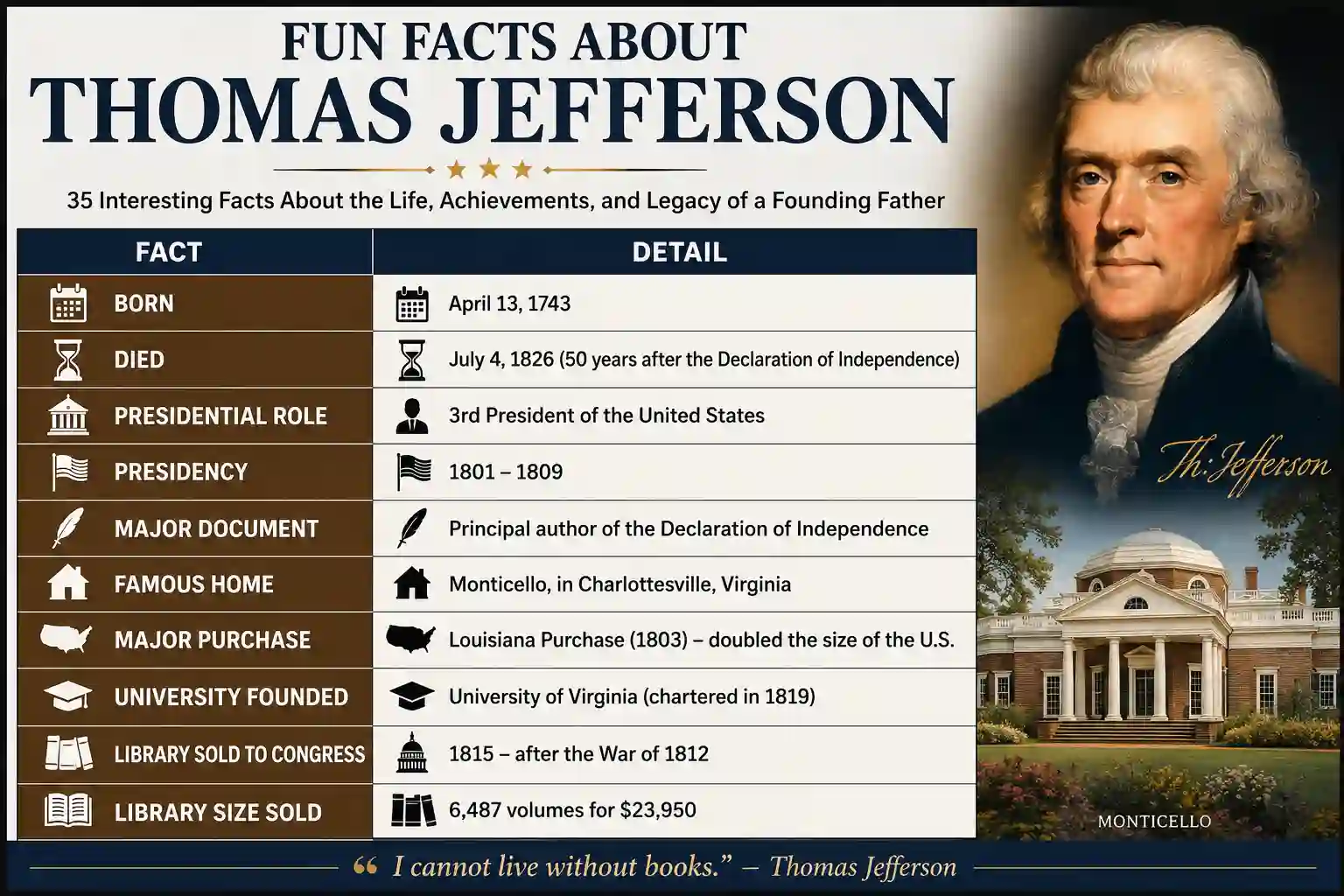
Thomas Jefferson at a Glance
| Fact | Detail |
|---|---|
| Born | April 13, 1743 |
| Died | July 4, 1826 |
| Presidential role | 3rd U.S. president |
| Presidency | 1801–1809 |
| Major document | Declaration of Independence |
| Famous home | Monticello |
| Major purchase | Louisiana Purchase |
| University founded | University of Virginia |
| Library sold to Congress | 1815 |
| Library size sold | 6,487 volumes |
Library of Congress — Thomas Jefferson Exhibition
1. The Revolutionary Writer Behind the Declaration
1. Jefferson was the principal author of the Declaration
Thomas Jefferson wrote the main draft of the Declaration of Independence in 1776. A five-person committee had been chosen to prepare it. The committee then assigned Jefferson to draft the document. His words became one of the most famous statements in American history.
Source: Library of Congress.
2. He was only 33 when he wrote the Declaration
Jefferson was born in 1743. He drafted the Declaration in 1776. That made him 33 years old at the time. His young age makes his role even more striking.
Source: Library of Congress; U.S. Department of State.
3. He wrote the Virginia Statute for Religious Freedom
Jefferson drafted the Virginia Statute for Religious Freedom. The Virginia legislature adopted it in 1786. The law became an important part of Jefferson’s religious-liberty legacy.
Source: Library of Virginia.
4. Jefferson cared deeply about education
Jefferson saw education as vital to a free republic. He believed informed citizens were important for self-government. This idea later shaped his work on the University of Virginia.
Source: Library of Congress.
5. He wrote a book about Virginia
Jefferson wrote Notes on the State of Virginia. It was first published in 1787. The work covered Virginia’s land, plants, animals, government, and society.
Source: Thomas Jefferson Foundation at Monticello.
Library of Congress — Declaration of Independence Exhibition
2. His Presidency Changed the Map
6. Jefferson was America’s third president
Jefferson became the third president of the United States. He served from 1801 to 1809. Before that, he had served as vice president and secretary of state.
Source: U.S. Department of State; Library of Virginia.
7. The Louisiana Purchase doubled the nation’s size
In 1803, Jefferson’s administration completed the Louisiana Purchase. The deal doubled the size of the United States. France transferred the vast territory for $15 million.
Source: U.S. Department of State.
8. Jefferson originally wanted New Orleans
Jefferson’s immediate goal was access to New Orleans. Control of the port mattered because of trade on the Mississippi River. France unexpectedly offered the much larger Louisiana Territory.
Source: National Archives.
9. The Louisiana deal created a constitutional puzzle
Jefferson was known for favoring a strict reading of the Constitution. Yet the Constitution did not clearly explain a presidential power to buy vast foreign territories. Jefferson therefore faced a major constitutional question.
Source: National Archives.
10. The purchase covered about 828,000 square miles
The Louisiana Purchase involved about 828,000 square miles. It stretched across a huge part of the continent. The acquisition transformed America’s future westward expansion.
Source: National Archives.
11. Jefferson sent Lewis and Clark west
Jefferson supported an expedition to explore the newly acquired territory. Meriwether Lewis and William Clark led the expedition. Their journey began in 1804 and continued through 1806.
Source: Library of Virginia.
[Visual opportunity: Use a historical map showing the Louisiana Purchase and the Lewis and Clark route.]
3. Jefferson Was a Serious Book Lover
12. Jefferson owned 6,487 books when Congress bought his library
Congress purchased Jefferson’s library in 1815. The collection contained 6,487 volumes. Those books helped rebuild the Library of Congress after its earlier collection was destroyed.
Source: Library of Congress.
13. Congress paid $23,950 for the collection
Congress paid Jefferson $23,950 for his library. The purchase followed the burning of the Capitol and congressional library during the War of 1812.
Source: Library of Congress.
14. His library helped shape today’s Library of Congress
Jefferson’s books became the nucleus of the modern Library of Congress. His collection greatly expanded the range of subjects available to Congress.
Source: Library of Congress.
15. Jefferson collected books in several languages
Jefferson read books in French, Italian, Spanish, Greek, Latin, and Anglo-Saxon. He often collected books in their original languages. His reading interests crossed many fields.
Source: Thomas Jefferson Foundation at Monticello.
16. He organized books by subjects
Jefferson organized his library using a system based on Francis Bacon’s divisions of knowledge. The system reflected his broad view of learning. His approach later influenced the organization of his library at the University of Virginia.
Source: Thomas Jefferson Foundation at Monticello; UVA Library.
17. His first major library was lost in a fire
Jefferson’s family home at Shadwell burned in 1770. His books were among the losses. The event deeply affected him and helped shape his later passion for collecting books.
Source: Thomas Jefferson Foundation at Monticello.
4. He Was an Architect, Gardener, and Innovator
Thomas Jefferson Foundation at Monticello — Science and Technology
18. Jefferson designed Monticello
Jefferson designed his famous home, Monticello. He kept changing and improving the building over many years. Its design shows his strong interest in architecture.
Source: Thomas Jefferson Foundation at Monticello.
19. He helped design the University of Virginia
Jefferson founded the University of Virginia. He also planned its campus and educational system. The university was chartered in 1819.
Source: University of Virginia.
20. He designed a special plow moldboard
Jefferson developed a moldboard designed to reduce resistance while plowing. He recorded his design in 1788. A Monticello plow used the wooden moldboard in 1794.
Source: Thomas Jefferson Foundation at Monticello.
21. He designed a wheel cipher
Jefferson described a wheel cipher in the early 1790s. The device could encode and decode messages. There is no evidence that he actually had his design constructed for practical use.
Source: Thomas Jefferson Foundation at Monticello.
22. He was fascinated by fossils
Jefferson collected fossils and studied extinct animals. He was especially interested in mammoths and mastodons. His interest in fossils came before paleontology became a formal scientific field.
Source: Thomas Jefferson Foundation at Monticello.
23. His garden was a living laboratory
Jefferson experimented with 330 varieties of more than 70 vegetable species at Monticello. His garden included plants from several parts of the world. He carefully recorded planting and harvest information.
Source: Thomas Jefferson Foundation at Monticello.
[Visual opportunity: Show Monticello, its vegetable garden, and Jefferson’s garden records.]
5. His Food and Wine Interests Were Surprisingly Modern
Thomas Jefferson Foundation at Monticello — Food & Drink
24. Jefferson loved French food
Jefferson developed a strong taste for French cuisine. His meals included French-style dishes and desserts. His years in France strongly influenced his food preferences.
Source: Thomas Jefferson Foundation at Monticello.
25. He kept a famous ice cream recipe
A handwritten ice cream recipe survives in Jefferson’s papers. It is considered the first recorded American ice cream recipe. He served ice cream during his presidency.
Source: Thomas Jefferson Foundation at Monticello.
26. Jefferson did not invent macaroni and cheese
A popular story credits Jefferson with bringing macaroni and cheese to America. The evidence does not support that claim. Jefferson helped popularize pasta dishes, but he did not invent macaroni and cheese.
Source: Thomas Jefferson Foundation at Monticello.
27. He collected wines from around the world
Jefferson developed a large wine collection. He imported wines from France and other European regions. He also tried to grow European grape varieties at Monticello.
Source: Thomas Jefferson Foundation at Monticello.
28. His vineyards often struggled
Jefferson wanted to make wine at Monticello. Many imported vines failed to grow well. Some arrived in poor condition, while others struggled with local growing conditions.
Source: Thomas Jefferson Foundation at Monticello.
6. His Legacy Has a Deep Contradiction
Thomas Jefferson Foundation at Monticello — The Practice of Slavery at Monticello
29. Jefferson was both a liberty writer and enslaver
Jefferson wrote famous words about human liberty. He also enslaved people throughout his adult life. This contradiction is central to understanding his historical legacy.
Source: Thomas Jefferson Foundation at Monticello; Library of Congress.
30. He inherited 30 enslaved people from his father
Jefferson became a slaveholder at age 21. In 1764, he inherited 30 enslaved people from his father, Peter Jefferson.
Source: Thomas Jefferson Foundation at Monticello.
31. His plantations used skilled enslaved labor
Enslaved workers at Monticello worked in many trades. These included blacksmithing, carpentry, weaving, cooking, gardening, and nail making. Their labor supported daily life and plantation production.
Source: Thomas Jefferson Foundation at Monticello.
32. James Hemings trained as a French chef
Jefferson took James Hemings to France. Hemings trained as a chef there. He later prepared sophisticated French-style food for Jefferson and his household.
Source: Thomas Jefferson Foundation at Monticello.
33. Jefferson had children with Sally Hemings
Historical evidence supports that Jefferson fathered children with Sally Hemings. Hemings was an enslaved woman at Monticello. Their relationship remains an important part of Jefferson’s history.
Source: Thomas Jefferson Foundation at Monticello; Encyclopedia Virginia.
34. About 200 enslaved people lived at Monticello when Jefferson died
Around 200 enslaved people lived and worked at Monticello at the time of Jefferson’s death. Their labor was deeply tied to the plantation’s economy.
Source: Thomas Jefferson Foundation at Monticello.
35. Jefferson died on July 4
Jefferson died on July 4, 1826. That was exactly 50 years after the Declaration of Independence was adopted. John Adams, another major founder, also died on the same day.
Source: Library of Virginia; U.S. Department of State.
Sounds Fake but True
Jefferson’s life contains several facts that sound almost invented. He owned thousands of books, experimented with hundreds of vegetable varieties, designed a cipher, studied fossils, and helped create a major university. Yet his greatest contradiction may be the simplest. He became famous for writing about liberty while remaining an enslaver.
By the Numbers
- 1743 — Jefferson’s birth year.
- 1776 — Year he drafted the Declaration.
- 1801–1809 — His presidential years.
- 1803 — Year of the Louisiana Purchase.
- 6,487 — Books Congress bought from Jefferson.
- $23,950 — Price paid for his library.
- 1819 — Year the University of Virginia was chartered.
- 1826 — Year Jefferson died.
A Quick Thomas Jefferson Quiz
- Which major land deal doubled the size of the United States during Jefferson’s presidency?
- What university did Jefferson found?
- What famous document did Jefferson help draft in 1776?
Answers: 1. The Louisiana Purchase. 2. The University of Virginia. 3. The Declaration of Independence.
FAQ About Thomas Jefferson
What was Thomas Jefferson’s favorite subject?
Jefferson had wide-ranging interests. He studied history, science, architecture, agriculture, languages, philosophy, and natural history. His surviving library reflects this broad curiosity.
Did Thomas Jefferson really invent the swivel chair?
Jefferson is often linked with a rotating chair. However, claims that he invented the swivel chair are too strong. He owned and used an adapted rotating chair.
Did Jefferson speak French?
Yes. Jefferson spent several years in France as an American diplomat. He became deeply familiar with French culture, food, wine, and intellectual life.
What was Jefferson’s favorite book?
There is no reliable evidence for one single favorite book. His reading interests covered many subjects and several languages.
Why is Monticello important today?
Monticello preserves Jefferson’s home, plantation history, architecture, and the stories of the people who lived and worked there. It helps visitors study both Jefferson’s achievements and slavery.
What did Jefferson put on his tombstone?
Jefferson selected an epitaph that listed three achievements. It named him as the author of the Declaration of American Independence and the Virginia Statute for Religious Freedom. It also called him the father of the University of Virginia.
Was Jefferson an inventor?
He was more accurately an innovator. He improved existing designs and created some new devices. His moldboard plow is one of his best-known innovations.
Why did Jefferson sell his library to Congress?
The British burned the Capitol and the congressional library during the War of 1812. Jefferson offered his own collection as a replacement. Congress accepted his offer in 1815.
Why Thomas Jefferson Still Fascinates Us
Thomas Jefferson was far more than a president or a name on a monument. He was a writer, reader, architect, gardener, farmer, scientist, and political thinker. His actions helped shape the United States in lasting ways. The Louisiana Purchase changed the nation’s map. His library helped rebuild the Library of Congress. His vision helped create the University of Virginia. Yet his life also exposes a painful contradiction between liberty and slavery. That tension makes fun facts about Thomas Jefferson more than a list of trivia. They reveal a complicated person who helped shape a complicated nation.

hello! I am Irshad Ullah, and a passionate writer and lifelong learner dedicated to uncovering fascinating facts about science, history, nature, animals, space, and the world around us. I research each topic carefully and transform surprising information into clear, engaging, and enjoyable content. My goal is to satisfy curiosity, inspire learning, and help readers discover something amazing every day.