
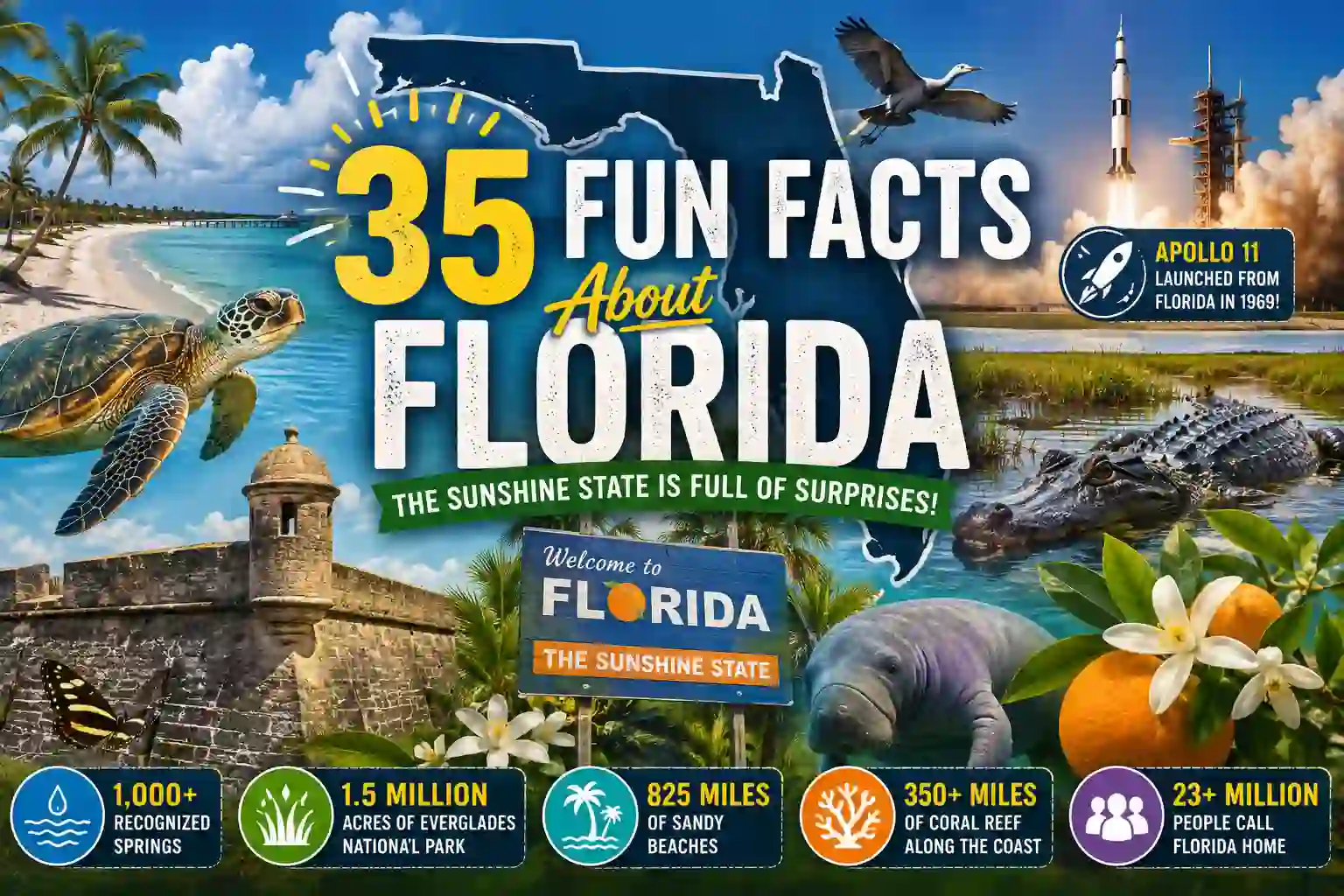
What makes Florida so unusual? Fun facts about Florida go far beyond beaches and theme parks. The state has a huge population, deep springs, vast wetlands, coral reefs, and a very old colonial history. Florida also has one of the lowest highest points of any U.S. state. Its waters shelter rich marine life. Its Everglades form a world-famous wetland ecosystem. And its space coast has hosted missions that changed human history. Here are 35 fascinating facts about Florida, mixing nature, history, science, culture, food, and modern life.
Florida at a Glance (Unbelievable Fun Facts)
| Feature | Florida fact |
|---|---|
| State capital | Tallahassee |
| Population | 23,462,518 estimated in 2025 (U.S. Census Bureau) |
| Total area | 65,758 square miles (Florida Department of State) |
| Highest natural point | Britton Hill, 345 feet (Florida Department of State) |
| Sandy beaches | 825 miles (Florida Department of Environmental Protection) |
| Largest lake | Lake Okeechobee (Florida Fish and Wildlife Conservation Commission) |
| Major coral reef | Florida Reef |
| Famous wetland | Everglades |
| State flower | Orange blossom Florida Department of State |
Geography That Makes Florida Different
1. Florida Has a Surprisingly Low High Point
Florida is famous for being flat. Its highest natural point is Britton Hill. It reaches only 345 feet above sea level. Florida Department of State That makes Florida’s highest point unusually low compared with other states. The hill sits in Walton County in the Panhandle. It is a fun reminder that Florida’s landscape is very different from America’s mountain states.
2. The State Has 825 Miles of Sandy Beaches
Florida has 825 miles of sandy coastline along the Atlantic Ocean, Gulf of America, and Straits of Florida. (Florida Department of Environmental Protection) These beaches are more than places for swimming. They provide habitat for birds, marine turtles, plants, and other wildlife. The sandy coast also plays a major role in Florida’s environment and economy.
3. Florida’s Coastline Is Even Longer Than Its Beaches
The state’s official geographical facts list 1,350 statute miles of coastline. (Florida Department of State) The larger figure includes many coastal areas that are not sandy beaches. This helps explain why Florida can have a huge coastal footprint while its sandy beaches cover a smaller distance.
4. Florida Has Thousands of Lakes
Florida has about 7,700 lakes larger than 10 acres. (Florida Department of State) Many are natural freshwater systems. Others have been changed by human development. These lakes support fish, birds, reptiles, plants, and people. Florida’s water landscape is therefore much more varied than its famous beaches suggest.
5. Lake Okeechobee Is Florida’s Largest Lake
Lake Okeechobee is Florida’s largest lake. It covers roughly 730 square miles and averages only about 9 feet deep. Florida Fish and Wildlife Conservation Commission Its name comes from a Seminole language and means “big water.” The lake is also part of the much larger Greater Everglades watershed.
Wild Florida Is Full of Surprises
6. Florida Has More Than 1,000 Recognized Springs
Florida has more than 1,000 recognized springs. (Florida Department of Environmental Protection) These springs form where groundwater reaches the surface. Some are popular swimming spots. Others support rivers and rare wildlife. Florida’s springs also provide a window into the state’s underground water system.
7. Wakulla Springs Reaches Remarkable Depths
Wakulla Springs is one of the world’s largest and deepest freshwater springs. Its main spring vent reaches about 185 feet deep. Florida Department of Environmental Protection The spring is also linked to a long underwater cave system. This makes the area important for both recreation and scientific study.
8. The Everglades Is a River Without a Normal Riverbed
The Everglades is often called the “River of Grass.” Water moves slowly across its broad wetland landscape. (National Park Service) Instead of flowing through one narrow channel, water spreads across marshes, sawgrass, mangroves, and other habitats. This unusual system helps make the Everglades one of Florida’s most distinctive natural areas.
9. Everglades National Park Covers About 1.5 Million Acres
Everglades National Park protects about 1.5 million acres of wetland, forest, and marine habitat. (National Park Service) It was established as the first national park created specifically for its biodiversity. The park protects many habitats in one connected landscape. It is also recognized internationally for its ecological importance.
10. The Everglades Has Three Major International Designations
Everglades National Park has been recognized as a World Heritage Site, an International Biosphere Reserve, and a Wetland of International Importance. (National Park Service) Few places have such a strong combination of international environmental recognition. These designations reflect the global value of the Everglades ecosystem.
[Visual opportunity: Show an aerial Everglades scene with sawgrass, mangroves, alligators, and shallow waterways.]
11. Florida’s Coral Reef Is Huge
Florida’s Coral Reef extends for more than 350 miles from the Dry Tortugas toward the St. Lucie Inlet. NOAA Florida Keys National Marine Sanctuary It is the only state in the continental United States with extensive shallow coral reef formations near its coast. The reef supports an enormous variety of marine life.
12. Florida Has the Continental U.S.’s Only Coral Barrier Reef
The Florida Keys National Marine Sanctuary contains the only coral barrier reef in the continental United States. (NOAA Florida Keys National Marine Sanctuary) The sanctuary also protects seagrass, mangroves, reefs, and other underwater habitats. Together, these systems create a complex marine environment around the Florida Keys.
Florida’s History Is Older Than It Looks
13. St. Augustine Dates to 1565
St. Augustine was established in 1565 by Pedro Menéndez de Avilés. It is recognized as the oldest continuously occupied European settlement in the continental United States. The city still preserves streets, buildings, and cultural landscapes linked to its Spanish colonial past.
14. Florida Has America’s Oldest Masonry Fortress
Castillo de San Marcos in St. Augustine is the oldest masonry fortification in the continental United States. Spanish construction began in 1672. The fort was built from coquina, a soft limestone made largely from shell fragments.
15. Coquina Helped Protect the Fort From Cannon Fire
Castillo de San Marcos was built from coquina stone. The material behaves differently from harder stone when struck by cannonballs. Instead of simply shattering, its small shell fragments could absorb some of the impact. This unusual building material became part of the fort’s defensive strength. National Park Service
16. Dry Tortugas Has Seven Main Islands
Dry Tortugas National Park includes a cluster of seven islands made largely of coral reefs and sand. The islands sit almost 70 miles west of Key West.Their remote location gives the park a very different feel from mainland Florida.
17. Fort Jefferson Sits in the Dry Tortugas
Fort Jefferson is the central historic feature of Dry Tortugas National Park. The National Park Service describes it as one of the nation’s largest masonry forts from the 1800s. National Park Service The fort stands among tropical waters, coral reefs, and small islands. That mix makes the site both historic and unusual.
Florida’s Space and Modern Wonders
18. Apollo 11 Launched From Florida
Apollo 11 lifted off from Kennedy Space Center in Florida on July 16, 1969. The mission carried Neil Armstrong, Buzz Aldrin, and Michael Collins. It achieved the first crewed lunar landing and became one of the most famous events in modern history.
19. Florida Helped Turn Space Travel Into a Public Spectacle
Florida’s Space Coast became a major center for American spaceflight. Kennedy Space Center hosted launches that sent astronauts toward the Moon and beyond. Apollo 11 is the best-known example. Its launch from Florida connected the state to one of humanity’s most important technological milestones. NASA
20. Florida’s Population Is Larger Than Many Countries
The U.S. Census Bureau estimated Florida’s population at 23,462,518 people on July 1, 2025. That makes Florida one of America’s most populous states. Its population also continues to make the state important in national culture, business, tourism, and politics.
21. Florida Grew Rapidly After 2020
Florida’s population estimate rose by 8.9% between April 1, 2020, and July 1, 2025. That growth reflects a major shift in the state’s recent demographic story. Florida has attracted residents for its climate, economy, retirement communities, and lifestyle.
Florida Has Some Unusual State Symbols
22. The Orange Blossom Is Florida’s State Flower
Florida’s official state flower is the orange blossom. The choice fits the state’s long connection with citrus farming. The flower is small and fragrant. Its association with orange groves gives it a strong cultural link to Florida.
23. Orange Juice Is the State Beverage
Florida officially lists orange juice as its state beverage. Citrus has long been part of the state’s identity. Orange juice therefore represents more than breakfast. It also reflects Florida’s agricultural heritage and famous citrus industry.
24. The Florida Panther Is the State Animal
The Florida panther is Florida’s official state animal. Florida Department of State The animal is closely tied to the state’s wild landscapes. Its status as a state symbol also highlights the importance of protecting Florida’s native wildlife and remaining habitat.
25. The Manatee Is Florida’s State Marine Mammal
Florida’s state marine mammal is the manatee. These gentle aquatic mammals are closely associated with Florida’s warm coastal waters, rivers, and springs. Their presence adds another distinctive species to the state’s unusual mix of tropical and temperate wildlife.
26. The Alligator Is the State Reptile
The American alligator is Florida’s official state reptile. Alligators are strongly linked with wetlands across the state. They are especially associated with places such as the Everglades. Few animals represent Florida’s wild side more clearly.
[Visual opportunity: Create a state-symbol collage featuring the orange blossom, alligator, manatee, Florida panther, and zebra longwing.]
More Strange and Fascinating Fun Facts About Florida
27. Florida’s Official Symbols Include a State Gem
Florida’s state gem is moonstone. The choice has an unusual connection with space history. Moonstone was selected as the state gem partly to honor Florida’s role in the American space program. It gives the state’s symbol collection a distinctly cosmic touch.
28. Florida’s State Stone Is Agatized Coral
Florida’s official state stone is agatized coral. It forms when silica replaces the original coral material while preserving its structure. The result can show patterns that reveal its ancient biological origin. It is a striking example of Florida’s geological story.
29. Florida Has a State Horse With a Distinctive Name
The Florida Cracker Horse is Florida’s official state horse. The breed is tied to the state’s early ranching culture. Its name reflects the old term “Florida Cracker,” used for people associated with the state’s cattle and frontier traditions.
30. Florida’s State Butterfly Is the Zebra Longwing
The zebra longwing is Florida’s official state butterfly. Florida Department of State Its black-and-yellow pattern makes it easy to recognize. The butterfly is another reminder that Florida’s official symbols are strongly connected to its native plants and wildlife.
31. Florida’s State Tree Is the Sabal Palm
Florida’s official state tree is the sabal palm. You can see this palm across many parts of the state. Its ability to handle Florida’s heat and coastal conditions makes it a fitting symbol of the Sunshine State.
32. The Dry Tortugas Were Named for Turtles
Spanish explorers used the name “Las Tortugas” for the islands because of their abundant sea turtles. Later, the word “Dry” was added because the islands lacked fresh drinking water. The name therefore preserves a small piece of the area’s early exploration history.
33. Florida’s Marine Sanctuary Protects Thousands of Animal Species
More than 6,000 animal species are found in the Florida Keys National Marine Sanctuary. NOAA Florida Keys National Marine Sanctuary The sanctuary contains reefs, seagrass, and other underwater habitats. This makes the Keys important not only for tourism but also for marine biodiversity.
34. Florida Has a Very Long Underwater Story
The Florida platform began accumulating sediments nearly 200 million years ago as the Atlantic Ocean basin formed. Much of the state’s geological foundation consists of carbonate rocks. Florida’s modern beaches, reefs, caves, and springs are linked to this ancient geological history.
35. Florida Is Much More Than Sunshine and Beaches
The best fun facts about Florida reveal a state shaped by water, wildlife, history, geology, and technology. Florida has ancient rock platforms beneath modern reefs. It has enormous wetlands beside growing cities. It has colonial forts and modern rocket launches. It also has springs, coral reefs, and unusual state symbols. That mix makes Florida one of the most varied states in the United States.
Florida is where ancient wetlands, coral reefs, colonial history, and spaceflight meet in one state.
Sounds Fake but True
Florida’s highest natural point is only 345 feet above sea level.
The state has more than 1,000 recognized springs.
A major coral reef system stretches for more than 350 miles along Florida’s coast.
Apollo 11 launched from Florida before becoming the first crewed mission to land on the Moon.
By the Numbers
- 23,462,518 — Florida’s estimated population in 2025.
- 825 miles — Florida’s sandy coastline.
- 345 feet — height of Britton Hill.
- 730 square miles — approximate area of Lake Okeechobee.
- 1,000+ — recognized springs in Florida.
- 350+ miles — length of Florida’s Coral Reef.
Quick Florida Quiz
1. Which city is the oldest continuously occupied European settlement in the continental United States?
A. Miami
B. St. Augustine
C. Tampa
D. Orlando
Answer: B. St. Augustine
2. What is Florida’s highest natural point?
A. Mount Florida
B. Everglades Peak
C. Britton Hill
D. Sugarloaf Mountain
Answer: C. Britton Hill
3. Which Florida site launched Apollo 11?
A. Cape Canaveral area
B. Miami Beach
C. Key West
D. Jacksonville
Answer: A. Cape Canaveral area
FAQ About Florida
What is Florida best known for?
Florida is best known for its beaches, warm climate, theme parks, wetlands, wildlife, and space industry. Its identity also includes historic cities, coral reefs, springs, and citrus culture.
Why is Florida called the Sunshine State?
Florida’s official nickname is the Sunshine State. The name reflects its generally sunny climate and became closely linked with Florida’s tourism image.
What is Florida’s state flower?
Florida’s state flower is the orange blossom.
What is Florida’s state motto?
Florida’s state motto is “In God We Trust.” Florida Department of State
What is Florida’s state bird?
Florida’s state bird is the mockingbird.
What is Florida’s longest river?
The St. Johns River is Florida’s longest river. The Florida Department of State lists its length as 273 miles.
What makes the Florida Keys special?
The Florida Keys contain extensive coral reefs, seagrass habitats, and marine ecosystems. The surrounding sanctuary supports thousands of animal species.
Why is Florida important to space history?
Florida’s Space Coast has hosted major American space launches. Apollo 11 lifted off from Kennedy Space Center in 1969 on its historic Moon mission.
Final Thoughts
Florida is easy to picture as beaches and palm trees. The deeper story is far more surprising. The state combines huge wetlands, ancient geology, coral reefs, freshwater springs, colonial history, and space exploration. Its wildlife is equally varied. Alligators, manatees, panthers, sea turtles, and countless marine species share this unusual landscape. These fun facts about Florida show why the Sunshine State stands apart. Florida is not simply a warm vacation destination. It is a place where natural history and human history meet at an extraordinary scale.

hello! I am Irshad Ullah, and a passionate writer and lifelong learner dedicated to uncovering fascinating facts about science, history, nature, animals, space, and the world around us. I research each topic carefully and transform surprising information into clear, engaging, and enjoyable content. My goal is to satisfy curiosity, inspire learning, and help readers discover something amazing every day.