
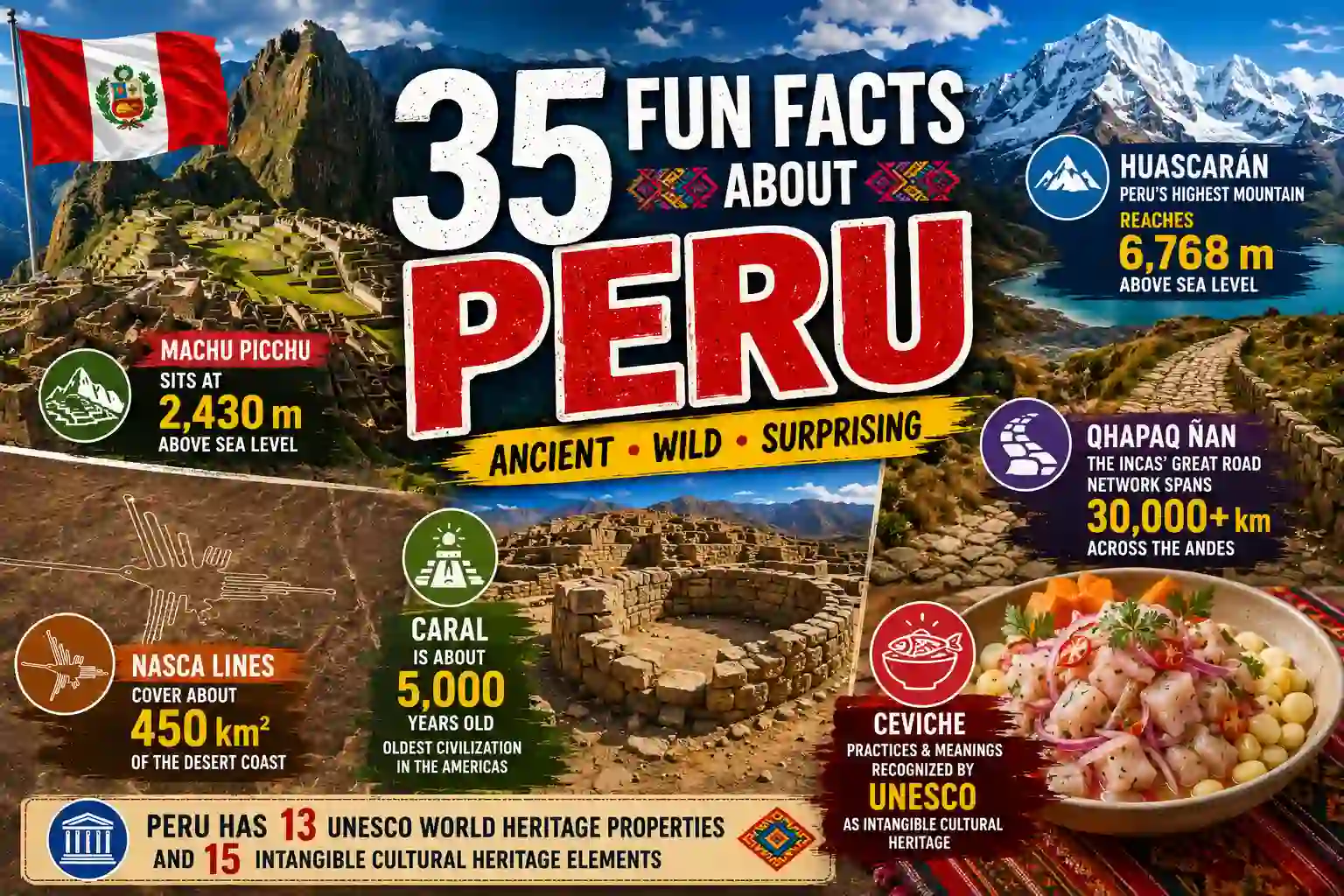
Fun facts about Peru reach far beyond Machu Picchu. The country has ancient cities, huge deserts, high Andes, and Amazon forests. Its past includes cultures that flourished long before the Inca Empire. Peru also has one of the world’s great road networks. Its famous Nasca Lines still raise questions today. Even its food carries deep cultural meaning.
Ceviche entered UNESCO’s Intangible Cultural Heritage List in 2023. Peru also recognizes 48 Indigenous and origin languages. These facts show a country where ancient knowledge, rich nature, and living traditions meet. Here are 35 facts that make Peru one of South America’s most remarkable countries.
Peru at a Glance
UNESCO — Peru World Heritage Convention profile
| Feature | Peru |
|---|---|
| Capital | Lima |
| Historical capital | Cusco |
| Major mountain system | Andes |
| Major rainforest region | Amazon |
| UNESCO World Heritage properties | 13 |
| Indigenous and origin languages | 48 |
| Famous ancient site | Machu Picchu |
| Famous geoglyphs | Nasca Lines |
| Famous traditional dish | Ceviche |
| National spirit | Pisco |
1. Peru’s Landscape Changes Dramatically
MINAM — Peru’s forests and biodiversity
1. Peru has three striking natural regions
Peru is often described through three broad landscapes. The coast is largely dry. The Andes dominate the highlands. The eastern side reaches into the Amazon rainforest. These regions create huge differences in climate, plants, animals, and daily life.
Source: Peru Ministry of Environment.
2. Peru is one of the world’s megadiverse countries
Peru is recognized as one of the world’s megadiverse countries. Its ecosystems support enormous biological variety. The country’s marine waters, forests, mountains, and other habitats all contribute to that richness.
Source: Peru Ministry of Environment.
3. Peru is one of the world’s major tropical-forest countries
Peru is the fourth-largest country by tropical-forest area. Much of this forest lies in the Amazon region. The forests also support many Indigenous communities and traditional cultures.
Source: Peru Ministry of Environment.
4. Peru’s Amazon forests cover a huge area
Peruvian Amazon forests occupy large parts of the country’s eastern territory. Loreto contains the country’s largest area of humid Amazon forest. Ucayali and Madre de Dios also contain major forest areas.
Source: Peru Ministry of Environment.
5. Peru reaches from deserts to snowy mountains
Peru’s geography changes sharply over short distances. Dry coastal landscapes sit far below the high Andes. Some Andean peaks rise above 6,000 meters. This dramatic range helped create many distinct ecosystems.
Source: UNESCO.
[Visual opportunity: Use a three-part landscape graphic showing Peru’s coast, Andes, and Amazon.]
2. Peru’s Ancient Past Goes Far Beyond the Incas
UNESCO — Peru World Heritage sites
6. Caral shows that complex civilization is very old in Peru
Caral is one of the earliest known centers of civilization in the Americas. Its society developed in the Supe Valley. Monumental buildings and planned spaces show a highly organized society.
Source: UNESCO.
7. Caral used an early form of quipu
Evidence from Caral includes early use of quipu as a recording device. Quipus later became strongly associated with the Inca world. Caral therefore offers clues about much older Andean traditions.
Source: UNESCO.
8. Chavín developed long before the Inca Empire
The Chavín culture flourished between about 1500 and 300 B.C. Its ceremonial center stood in the high Andes. The site became an important religious and cultural center.
Source: UNESCO.
9. Chavín attracted people from different regions
Chavín was more than a local religious site. People came from different parts of the Andes. The center helped spread religious and cultural ideas across a wide area.
Source: UNESCO.
10. Chan Chan was an enormous ancient city
Chan Chan was the capital of the Chimú Kingdom. UNESCO describes it as the largest earthen architecture city in pre-Columbian America. Its design included large compounds separated by high walls.
Source: UNESCO.
11. Chan Chan had nine major citadels
The central part of Chan Chan contained nine large rectangular compounds. These were often called citadels or palaces. Each formed an organized unit within the enormous city.
Source: UNESCO.
3. The Inca World Was an Engineering Marvel
UNESCO — Qhapaq Ñan, Andean Road System
12. Cusco was the heart of the Inca Empire
Cusco became the capital of the Tawantinsuyu. The city developed into a major religious and administrative center. Spanish builders later built churches and palaces over parts of the Inca city.
Source: UNESCO.
13. Cusco stands about 3,400 meters above sea level
Cusco sits high in the Peruvian Andes. Its elevation is about 3,400 meters. The city developed in a fertile valley surrounded by mountains.
Source: UNESCO.
14. The Inca road network covered more than 30,000 kilometers
The Qhapaq Ñan was an enormous communication, trade, and defense network. UNESCO describes it as covering more than 30,000 kilometers. It connected communities across difficult Andean terrain.
Source: UNESCO.
15. The Inca roads crossed extreme landscapes
The Qhapaq Ñan crossed mountains, deserts, valleys, and rainforests. Some routes reached elevations above 6,000 meters. Bridges, stairs, drains, and paved roads solved difficult engineering problems.
Source: UNESCO.
16. Four main routes began at Cusco
The main Qhapaq Ñan routes originated from Cusco’s central square. Smaller routes connected to this larger network. Together they created a broad system linking settlements and production centers.
Source: UNESCO.
17. Machu Picchu sits high in the Andes
Machu Picchu stands at about 2,430 meters above sea level. The site sits among steep mountain slopes and tropical forest. Its terraces and stone structures blend closely with the surrounding landscape.
Source: UNESCO.
18. Machu Picchu contains about 200 structures
The archaeological complex contains approximately 200 structures. They include religious, ceremonial, agricultural, and astronomical spaces. The buildings stand along a steep mountain ridge.
Source: UNESCO.
4. Peru Has Some of the World’s Most Mysterious Ancient Sites
UNESCO — Nasca Lines and Chankillo
19. The Nasca Lines cover about 450 square kilometers
The Nasca and Palpa geoglyphs occupy about 450 square kilometers. They lie on Peru’s dry coastal plain. Their huge scale makes many figures difficult to understand from ground level.
Source: UNESCO.
20. The Nasca Lines date back more than 1,500 years
Many of the famous lines were made between 500 B.C. and A.D. 500. Their survival is remarkable. The extremely dry coastal environment helped protect the markings.
Source: UNESCO.
21. The Nasca Lines show animals and plants
The geoglyphs include figures of living creatures and plants. They also include geometric shapes. Some lines extend for several kilometers.
Source: UNESCO.
22. Their exact purpose remains debated
Researchers have linked the Nasca geoglyphs with ritual and astronomical functions. Their full meaning is still not completely understood. That uncertainty keeps the site fascinating.
Source: UNESCO.
23. Chankillo used the sun as a calendar
Chankillo is an ancient astronomical complex on Peru’s north-central coast. Its structures were designed to track the sun. The site shows impressive knowledge of seasonal solar movement.
Source: UNESCO.
24. Chankillo has 13 towers
A line of 13 cubical towers stands along a ridge at Chankillo. Their positions helped observers track the sun during the year. The system could mark dates with striking precision.
Source: UNESCO.
5. Peru’s Food Is Part of Its Cultural Heritage
UNESCO — Ceviche and Peruvian culinary tradition
25. Ceviche became UNESCO cultural heritage
UNESCO added the practices and traditions linked to Peruvian ceviche to its Representative List in 2023. The inscription recognizes more than the dish itself. It also recognizes the knowledge surrounding its preparation and consumption.
Source: UNESCO.
26. Ceviche varies across Peru
Peruvian ceviche does not have one single regional form. Recipes change from place to place. Local fish, produce, and preparation methods create different versions.
Source: UNESCO.
27. Ceviche connects fishing and farming
Ceviche culture involves more than cooks. It connects fishers, farmers, food producers, and families. Knowledge passes between generations through everyday practice.
Source: UNESCO.
28. Pisco has protected Peruvian origin status
Pisco is a Peruvian denomination of origin. It is made by distilling recently fermented fresh grape musts. Its authorized production areas are defined by Peruvian law.
Source: INDECOPI.
29. Pisco became Peru’s first denomination of origin
Peru recognized Pisco as its first denomination of origin in 1990. The designation protects the name and defines where qualifying Pisco can be produced.
Source: INDECOPI.
6. Peru Has Remarkable Linguistic and Natural Diversity
Peru Ministry of Education — Peru’s 48 Indigenous and origin languages
30. Peru recognizes 48 Indigenous and origin languages
Peru has 48 Indigenous and origin languages. They include Quechua, Aymara, Asháninka, Awajún, Wampis, and Shipibo. These languages form an important part of the country’s cultural heritage.
Source: Peru Ministry of Education.
31. Millions of Peruvians speak an origin language
Around four million people speak one of Peru’s Indigenous or origin languages. This makes linguistic diversity part of everyday life in many communities.
Source: Peru Ministry of Education.
32. Quechua is still widely spoken
Quechua remains one of Peru’s major Indigenous language groups. It has deep roots in the Andes. Its continued use links modern communities with long cultural traditions.
Source: Peru Ministry of Education.
33. Peru has 13 UNESCO World Heritage properties
Peru currently has 13 properties on the UNESCO World Heritage List. They include cultural, natural, and mixed properties. Machu Picchu is one of the country’s mixed sites.
Source: UNESCO.
34. Peru’s newest World Heritage site is Chankillo
Chankillo joined the UNESCO World Heritage List in 2021. Its recognition highlights Peru’s long history of astronomical observation. The site is especially notable for its solar calendar system.
Source: UNESCO.
35. Peru’s intangible heritage is still growing
Peru’s cultural heritage is not limited to ancient ruins. UNESCO’s Intangible Cultural Heritage records include living traditions. In 2025, Sarawja, an Aimara music and dance tradition from Moquegua, joined the Representative List.
Source: UNESCO.
Sounds Fake but True
Peru has an ancient solar calendar made from 13 towers.
Chankillo’s towers formed a natural-looking skyline. Ancient observers could use their changing positions against the sun to track the year. The system shows that sophisticated astronomical knowledge existed in Peru long before modern instruments.
Myths vs. Reality
| Myth | Reality |
| Machu Picchu is Peru’s only major ancient site. | Peru has many major archaeological sites, including Caral, Chavín, Chan Chan, and Chankillo. |
| The Nasca Lines are only animal drawings. | They also include plants and large geometric figures. |
| Peruvian culture is mainly Inca culture. | Peru’s history includes many civilizations that existed before and after the Inca. |
| Ceviche is one fixed recipe. | Recipes vary across Peru and use local ingredients. |
By the Numbers
- 13 — UNESCO World Heritage properties in Peru.
- 48 — Indigenous and origin languages recognized in Peru.
- 30,000+ km — Approximate extent of the Qhapaq Ñan road network.
- 450 km² — Approximate area of the Nasca geoglyph landscape.
- 13 — Towers forming Chankillo’s solar observation line.
- 2,430 m — Elevation of Machu Picchu.
- 3,400 m — Elevation of Cusco.
- 2023 — Year UNESCO inscribed Peru’s ceviche traditions.
A Quick Peru Quiz
- Which ancient site used 13 towers to track the sun?
- How many Indigenous and origin languages does Peru recognize?
- Which famous Peruvian dish entered UNESCO’s Intangible Cultural Heritage List in 2023?
Answers: 1. Chankillo. 2. 48. 3. Ceviche.
FAQ About Peru
What is Peru best known for?
Peru is widely known for Machu Picchu, the Inca civilization, the Andes, the Amazon, and the Nasca Lines. Its cuisine and Indigenous cultures are also major parts of its identity.
Why are the Nasca Lines so famous?
Their huge figures were created on an arid coastal plain. Some designs are several kilometers long. Their purpose remains an important subject of archaeological study.
What was Peru called before the Incas?
There was no single name for the entire region. Many different societies and cultures existed before the Inca state. Caral, Chavín, Nasca, and Chimú are several important examples.
Is Machu Picchu an Inca city?
Machu Picchu was an Inca settlement. UNESCO describes it as an extraordinary urban creation from the height of the Inca Empire.
Why is Cusco historically important?
Cusco became the capital of the Inca Empire. Its surviving urban fabric combines Inca foundations with later Spanish colonial architecture.
What makes Peru’s biodiversity special?
Peru contains forests, mountains, coastal ecosystems, and marine habitats. This wide environmental range supports exceptional biological diversity.
Is Pisco only a type of grape brandy?
Pisco is a Peruvian grape spirit with a protected denomination of origin. Its production follows defined rules for grapes, production methods, and geographic areas.
Why is Caral important?
Caral provides evidence of an early complex civilization in the Americas. Its monumental architecture shows organized social and political development long before the Inca Empire.
Why These Fun Facts About Peru Matter
Peru is much bigger than one famous mountain citadel. Its story stretches from ancient cities to living Indigenous languages. It includes desert geoglyphs, enormous road systems, solar observation towers, and rainforest ecosystems. Its food traditions also remain active today. That mix makes fun facts about Peru especially rewarding. Each fact opens a door to a different part of the country. Peru’s greatest surprise may be its continuity. Ancient knowledge still shapes modern culture. Old landscapes still hold unanswered questions. And traditions continue to evolve while carrying memories from the past.
SEO Metadata
SEO Title: 35 Fun Facts About Peru: Ancient Sites, Nature & Culture
Meta Description: Explore 35 fun facts about Peru, from Machu Picchu and Nasca Lines to 48 languages, ancient cities, ceviche, biodiversity, and Inca roads.
Suggested Slug: fun-facts-about-peru

hello! I am Irshad Ullah, and a passionate writer and lifelong learner dedicated to uncovering fascinating facts about science, history, nature, animals, space, and the world around us. I research each topic carefully and transform surprising information into clear, engaging, and enjoyable content. My goal is to satisfy curiosity, inspire learning, and help readers discover something amazing every day.