
Most people know that the Sun is a giant ball of burning gas and that light takes roughly eight minutes to reach Earth. However, when you dig deeper into solar physics, our local star gets far stranger. From light particles trapped inside its interior for thousands of years to magnetic storms that once set telegraph paper on fire, the Sun operates in ways that defy everyday human logic.
If you think you already know everything about our closest star, prepare to be surprised. Beyond the standard trivia taught in elementary school lies a world of acoustic vibrations, plasma rivers, and mystery heat gradients. This breakdown delivers unusual fun facts and verified insights that go far beyond recycled internet lists.
Quick Snapshot: Solar Core Metrics
| Dimension / Metric | Fascinating Reality | Why It Matters |
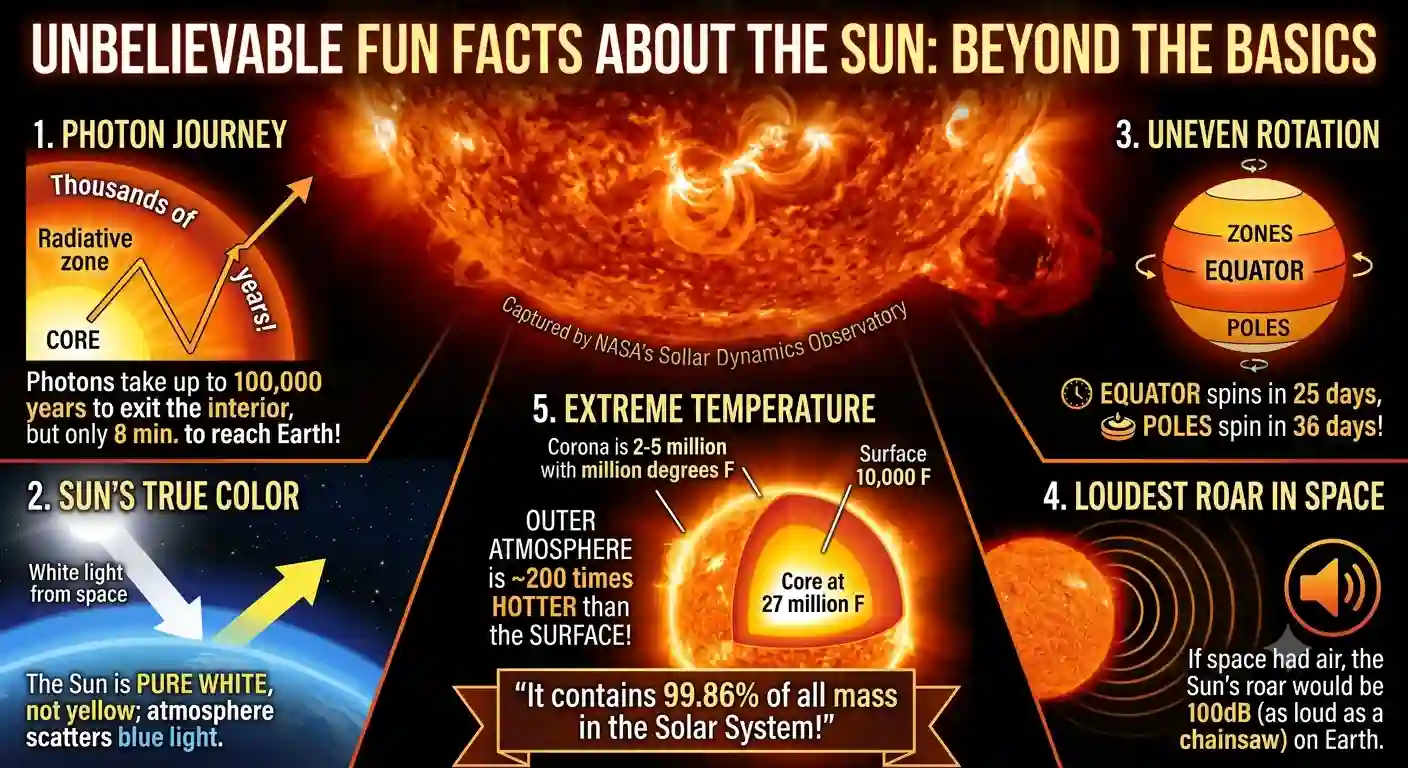
| Core Temperature | ~27 million °F (15 million °C) | Drives nuclear fusion, fusing 600 million tons of hydrogen every second. |
| Mass Share | 99.86% of the solar system | Its immense gravity anchors every planet, asteroid, and comet in orbit. |
| Shape Precision | ~6-mile (10 km) polar variance | It is the most perfectly round natural object ever measured in space. |
| Rotational Speed | 25 days (equator) vs 36 days (poles) | Because it is plasma, different latitudes rotate at different speeds. |
The Sun — Mind-Blowing Science & Anomalies
1. Light takes up to 100,000 years to escape the Sun’s interior
While solar light takes just eight minutes to travel from the Sun’s surface to Earth, the photons actually take anywhere from 10,000 to 100,000 years to escape from the core. Energy created in the core bounces around in a dense “random walk” through the radiative zone before finally breaking free into space.
2. The Sun rotates at different speeds simultaneously
Unlike solid rocky planets, the Sun is entirely composed of super-hot plasma. This allows for differential rotation. The solar equator completes a full spin every 25 Earth days, while the polar regions take as long as 36 days to complete a single revolution.
3. Sunspots are actually blindingly bright
Sunspots look like dark specks on the Sun’s surface only because the surrounding plasma is so intensely radiant. In reality, a single large sunspot removed from the Sun and placed in our night sky would shine significantly brighter than the full moon.
4. The Sun loses 4 million tons of weight every second
Through nuclear fusion, the Sun converts hydrogen into helium. During this mass-energy conversion ($E=mc^2$), roughly 4 million metric tons of solar matter are destroyed and transformed into pure radiant energy every single second.
5. The outer atmosphere is hundreds of times hotter than the surface
The visible surface of the Sun (photosphere) sits at around 10,000°F (5,500°C). Yet, its wispy outer atmosphere, known as the corona, jumps to temperatures between 1.8 million and 5 million°F (1 million to 3 million°C). Scientists call this the coronal heating problem.
6. The Sun is white, not yellow
The Sun emits light across all visible wavelengths almost equally, making its true space color pure white. It only looks yellow or orange from Earth because our atmosphere scatters shorter blue light wavelengths away, leaving warmer tones behind.
7. Solar sound waves make the Sun ring like a giant bell
Convective plasma currents create giant sound waves inside the Sun that bounce around its interior. Helioseismologists study these acoustic waves to map internal solar structures, revealing that the star pulsates rhythmically every five minutes.
8. Earth actually travels through the Sun’s atmosphere
The solar wind creates a protective magnetic bubble surrounding our solar system called the heliosphere. Because this stream of energetic particles extends far beyond Pluto, Earth technically resides inside the extended atmosphere of our star.
The Sun — Historical Secrets & Cultural Quirks
1. The 1859 Carrington Event set telegraph paper on fire
In September 1859, a massive coronal mass ejection struck Earth’s magnetosphere. The solar storm generated powerful electrical currents in telegraph lines across North America and Europe, shocking operators and literally setting telegraph paper ablaze.
2. The Faint Young Sun Paradox confuses geologists
When the Sun formed 4.6 billion years ago, it was roughly 25% to 30% dimmer than it is today. According to basic physics models, early Earth should have been frozen solid, yet geological records prove liquid water oceans existed—a puzzle known as the Faint Young Sun Paradox.
3. Helium was discovered on the Sun before Earth
In 1868, French astronomer Pierre Janssen and English astronomer Norman Lockyer independently analyzed spectral lines in sunlight during an eclipse. They discovered a brand-new element that had never been seen on Earth. They named it helium, after Helios, the Greek god of the Sun.
4. Earth is closest to the Sun during Northern Hemisphere winter
Many people assume seasons are caused by distance to the Sun. However, Earth reaches its closest point to the Sun (perihelion) in early January each year, right in the middle of winter for North America and Europe.
5. Dust rings trace planet orbits around the Sun
NASA spacecraft have confirmed that subtle rings of space dust circle the Sun along the orbital paths of Earth and Venus. These cosmic dust structures are gravitational leftovers trapped by the movement of the planets over billions of years.
Fun Facts About the Sun By The Numbers
Here are key statistical facts broken down with easy-to-understand comparisons:
| Metric | Official Measurement | Relatable Comparison |
| Total Diameter | 865,000 miles (1.39 million km) | Roughly 109 Earths lined up side-by-side. |
| Total Volume | $1.4 \times 10^{18}\text{ km}^3$ | Could easily fit 1.3 million Earths inside. |
| Core Density | ~150 grams per cubic centimeter | Nearly 13 times denser than solid lead. |
| Speed Through Space | 450,000 mph (720,000 km/h) | Travels fast enough to circle Earth’s equator in 3.3 minutes. |
| Galactic Orbit Time | 225–250 million years | Last time the Sun was here, dinosaurs were just emerging. |
Facts That Sound 100% Fake (But Are Actually True)
- Precious metals exist in plasma state: Spectral analysis reveals that the Sun contains billions of tons of gold, platinum, and silver suspended as ionized gases.
- The Sun would roar if space had air: If a vacuum could carry sound, the acoustic energy of solar convection would reach Earth as a constant 100-decibel roar—about as loud as a chainsaw or lawnmower.
- The magnetic poles flip every 11 years: At the peak of each solar cycle (solar maximum), the Sun’s magnetic field completely flips its orientation—North becomes South, and South becomes North.
- The Sun is a middle-aged star: At roughly 4.6 billion years old, our star has burned through about half of its core hydrogen fuel and will remain stable for another 5 billion years.
“Can You Imagine?” (Visual Analogies)
- The Beach Ball & Sand Grain: If the Sun were scaled down to the size of a standard beach ball (2 feet wide), Earth would be a tiny grain of sand sitting 215 feet away.
- The Energy Output: In a single second, the Sun produces more energy than humanity has used across all of recorded human history.
- The Gravitational Tug: A 150-pound person standing on the surface of the Sun (if it were solid) would weigh over 4,000 pounds due to its immense gravitational pull.
Debunking the Myths: Fiction vs. Reality
| The Popular Myth | The Actual Fact | Source / Proof |
| Myth: The Sun is a ball of fire burning oxygen. | Fact: There is no combustion or fire on the Sun; it is powered entirely by nuclear fusion. | Widely documented (NASA/ESA) |
| Myth: The Sun stays stationary in space. | Fact: The Sun orbits the center of the Milky Way galaxy at high speeds. | Widely documented (Astrobiology) |
| Myth: Solar eclipses emit dangerous special rays. | Fact: Sunlight emitted during an eclipse is identical to normal sunlight; it is only dangerous because people look directly at it without protection. | Widely documented (NOAA/NASA) |
Mysteries Scientists Still Can’t Explain
- The Corona Heating Mystery: Why the Sun’s outer atmosphere is millions of degrees hotter than its surface remains one of astrophysics’ biggest open questions.
- Solar Cycle Predictability: While we know solar activity peaks roughly every 11 years, scientists cannot reliably predict the strength or exact timing of individual cycles in advance.
- The Missing Neutrino Anomaly (Solved but Historic): For decades, instruments detected only a fraction of the solar neutrinos predicted by physics models, which was later resolved by proving neutrinos change types in transit.
Share-This Fact 🔥
Photons created in the Sun’s core take up to 100,000 years to reach its surface, but only 8 minutes to reach Earth.
The Ultimate Fun Facts About the Sun Brain Teaser
Question 1: How long does a photon take to work its way out from the Sun’s core to its surface?
A) 8 minutes
B) 24 hours
C) 100 years
D) Up to 100,000 years
Question 2: Which chemical element was discovered on the Sun before it was found on Earth?
A) Hydrogen
B) Helium
C) Neon
D) Carbon
Question 3: What is the true space color of sunlight before entering Earth’s atmosphere?
A) Yellow
B) Orange
C) White
D) Red
Frequently Asked Questions
What are three interesting fun facts about the sun?
First, the Sun contains 99.86% of all mass in our solar system. Second, its outer atmosphere is actually hundreds of times hotter than its surface. Third, it takes up to 100,000 years for light to travel from the core to the surface.
Why is the Sun called a yellow dwarf if it is white?
Stars are classified by temperature spectral types. Yellow dwarf (G-type) is an astronomical classification category. Though the light emitted in space is pure white, atmospheric optics make it look yellow from Earth.
How old is the Sun and when will it die?
The Sun is about 4.6 billion years old. It has enough hydrogen fuel in its core to continue shining steadily for roughly another 5 billion years before expanding into a red giant star.
Does the Sun rotate on an axis?
Yes, but because it is made of plasma, it spins unevenly. The equator rotates once every 25 Earth days, while the polar regions take up to 36 days to complete a spin.
What would happen if the Sun suddenly disappeared?
Earth would continue orbiting normally for 8 minutes and 20 seconds before flying off in a straight line into space, losing solar light and heat shortly after.
Conclusion
Our Sun is far more complex than just a warm circle in the sky. From differential plasma rotation to acoustic resonance that rings like a bell, fascinating fun facts prove that solar physics is full of surprises. The fact that light hitting your face today began its journey inside the core thousands of years ago puts our relationship with our local star into a whole new perspective.

hello! I am Irshad Ullah, and a passionate writer and lifelong learner dedicated to uncovering fascinating facts about science, history, nature, animals, space, and the world around us. I research each topic carefully and transform surprising information into clear, engaging, and enjoyable content. My goal is to satisfy curiosity, inspire learning, and help readers discover something amazing every day.