
Most travel guides tell you the exact same things about Japan. You hear about vending machines on every corner, square watermelons, and bow-ing deer in Nara. But the real story of this island nation goes far deeper than basic tourist trivia.
Japan sits on four major tectonic plates, creating a landscape shaped by intense volcanic activity, isolated ecosystems, and ancient forests. Over thousands of years, this geographic setup created unique fun facts and cultural traditions you will not find anywhere else on Earth.
From underwater mystery pyramids to real-world phantom islands and train networks managed by atomic clocks, Japan is a land of precise science and bizarre anomalies.
Here are 25 fascinating fun facts about Japan that prove reality is often weirder than fiction.
Quick Snapshot: Japan at a Glance
| Metric | Fascinating Reality | Why It Matters |
| Total Islands | 14,125 islands (re-counted in 2023) | More than double the previous official count of 6,852 due to digital mapping. |
| Oldest Company | Kongo Gumi (Founded 578 AD) | Operated continuously for over 1,400 years building Buddhist temples. |
| Forest Coverage | ~67% of land mass | One of the most heavily forested industrial nations in the world. |
| Active Volcanoes | 111 active volcanoes | Accounts for roughly 10% of all active volcanoes on Earth. |
Fun Facts About Japan — Mind-Blowing Science & Anomalies
1. Japan Gained Over 7,000 “New” Islands in 2023
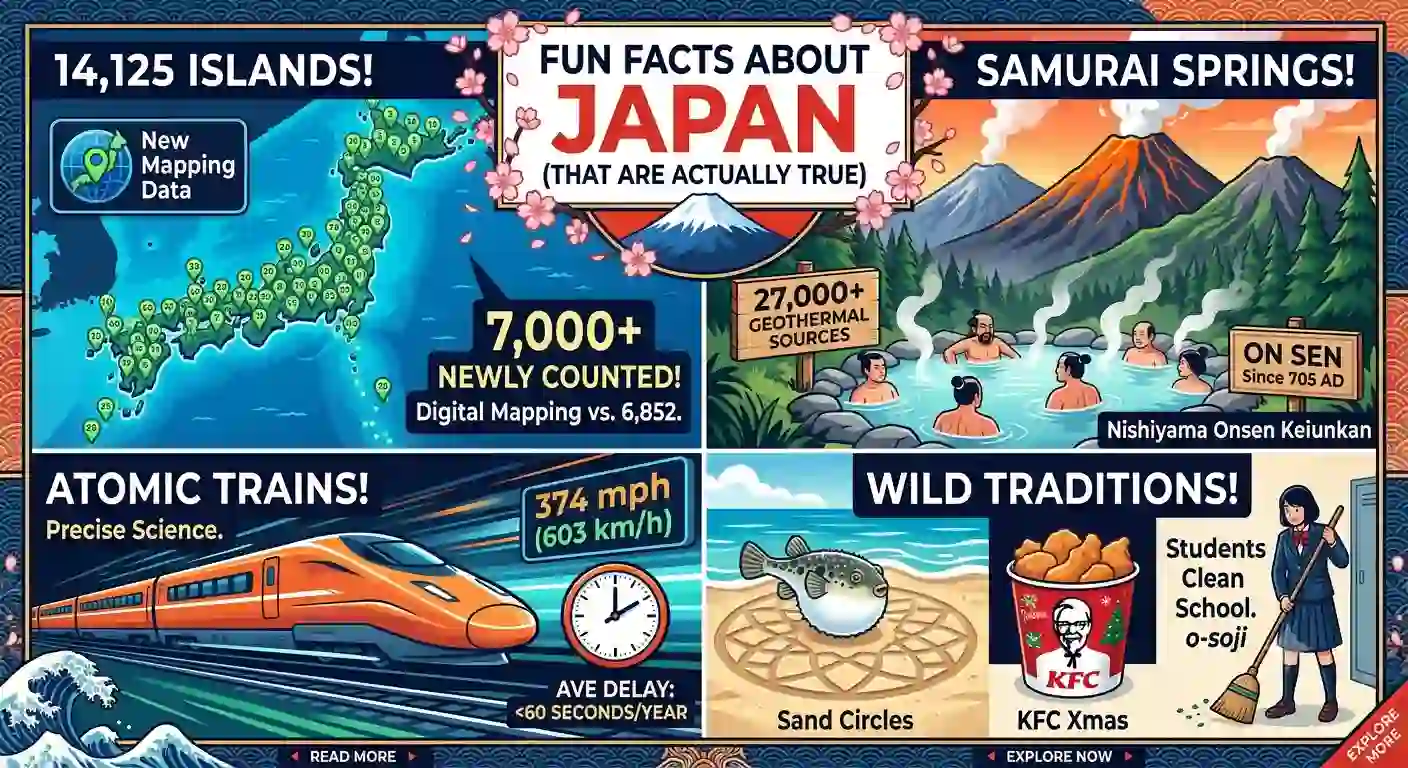
Using modern 3D electronic land maps, the Geospatial Information Authority of Japan recounted the nation’s islands in 2023. The official total jumped from 6,852 to 14,125 islands. The physical land didn’t change; mapping technology just got much better at spotting small landmasses.
2. Deep-Sea “Forests” of Glass Sponges Flourish in Sagami Bay
Deep beneath Sagami Bay, researchers discovered dense reefs made of glass sponges. Their skeletons are constructed entirely from silica—the same compound used to make glass. These ancient creatures create intricate fiberglass-like towers that support unique deep-sea life.
3. Earthquakes Create Natural Heat Spas Across 27,000 Geothermal Springs
Because Japan rests along the Pacific Ring of Fire, volcanic energy heats underground groundwater nationwide. There are more than 27,000 thermal hot spring sources (onsen) across the country. Scientists estimate these thermal pools discharge millions of liters of mineral-rich water every single day.
4. A New Volcanic Island Sprang Up in 2023
In November 2023, an underwater volcanic eruption off the coast of Iwo Jima created a brand-new mini-island. Sea waves began eroding the island shortly after its birth, demonstrating how quickly Japanese geography changes in real time.
5. Mt. Fuji is Actually Three Volcanoes Stacked on Top of Each Other
Mount Fuji looks like a single peaceful mountain. In reality, geology shows it consists of three overlapping volcanoes: Komitake at the bottom, Kofuji in the middle, and Shin-Fuji at the top. The current peak reached its famous shape around 10,000 years ago.
6. Magnetic Levitation Trains Outspeed Commercial Airplanes
Japan’s L0 Series Maglev train shattered speed records by reaching 374 mph (603 km/h) during tests. Floating on powerful magnetic fields above the tracks, these trains eliminate track friction completely to deliver unbelievable fun facts about future transportation.
7. Toxic Blowfish Ocean Sculptures Fooled Scientists for Decades
Male white-spotted pufferfish near Amami Oshima carve intricate geometric circles into the sea floor using their fins. These 6-foot-wide sand patterns look like crop circles. Males build them over seven days solely to attract mates, representing one of nature’s most detailed animal constructions.
Fun Facts About Japan — Historical Secrets & Cultural Quirks
1. High-Speed Trains Average Less Than 60 Seconds of Delay Per Year
Punctuality is a strict science in Japan. The average annual delay for a Tokaido Shinkansen bullet train is routinely under one minute. Railway operators issue formal apology certificates to passengers if a train leaves even 20 seconds early.
2. High School Students Clean Their Own Classrooms Every Afternoon
Japanese schools rarely hire janitors for daily maintenance. Under a custom known as o-soji, students spend 15 to 20 minutes every day sweeping floors, wiping blackboards, and taking out trash. The tradition teaches personal responsibility and respect for shared spaces.
3. Ancient Japanese Architecture Built Wooden Towers Without Nails
Classic Japanese pagodas have survived massive earthquakes for over a thousand years. Master carpenters used kanawa-tsugi—intricate interlocking wooden joints built entirely without metal nails or glue. The central pillar acts as a pendulum that absorbs seismic shocks.
4. Japan Homes the World’s Oldest Operating Hotel
The Nishiyama Onsen Keiunkan hot spring hotel in Yamanashi was founded in 705 AD. It has been run by the same family for over 50 generations. Guests have soaked in its mineral waters for more than 1,300 years, including ancient samurai and emperors.
5. A Medieval Law Mandated Planting Millions of Cedar Trees
During the Edo period, local rulers enforced strict forest management laws to prevent soil erosion. Citizens planted millions of Japanese cedar trees (sugi). Today, those forests cover vast mountain slopes—though they also cause massive seasonal pollen alerts every spring.
Fun Facts About Japan By The Numbers
| Metric | Data Figure | Relatable U.S. Comparison |
| Total Vending Machines | ~4 million units | Roughly 1 machine for every 30 people |
| Vending Sales Revenue | $40+ Billion annually | Equal to the yearly revenue of major U.S. fast-food chains |
| Train Ridership (Shinjuku Station) | 3.5 Million daily passengers | Equals the entire population of Los Angeles passing through one station daily |
| Lifespan Expectancy | ~84.6 years average | About 7 years longer than the average U.S. lifespan |
Facts That Sound 100% Fake (But Are Actually True)
- Melons Can Sell for the Price of a Used Car: Premium Yubari King melons are grown with extreme care in Hokkaido. In luxury auctions, a perfect pair has sold for over $45,000 as a prestigious corporate gift.
- Nap Time at Work Proves You Are Dedicated: The cultural practice of inemuri (“sleeping while present”) lets employees nap at their desks or in meetings. It signals that you worked until total physical exhaustion.
- KFC is a Major Christmas Dinner Tradition: Thanks to a clever 1974 marketing campaign (“Kentucky for Christmas”), millions of Japanese families eat fried chicken on Christmas Eve. Orders are placed months in advance.
- Slurping Noodles Compliments the Chef: Making loud slurping noises while eating ramen or buckwheat noodles is good table manners. It cools down hot broth and enhances flavor perception.
- A Remote Island is Ruled by Feline Citizens: On Aoshima island in Ehime prefecture, stray cats outnumber human residents by a ratio of roughly 6 to 1. The cats were originally brought in to control mice on fishing boats.
“Can You Imagine?” (Visual Scale Analogies)
- The Tokyo Metro Network: If you stretched all railway tracks in Greater Tokyo end-to-end, they would run over 3,000 miles—longer than the driving distance from New York City to Los Angeles.
- The Vending Machine Density: If you lined up all 4 million Japanese vending machines side-by-side, they would form a continuous wall running from Miami, Florida to Seattle, Washington.
- The Snowfall in Aomori: Aomori City receives over 26 feet (8 meters) of snow each winter. That is tall enough to completely bury a two-story residential home.
Debunking the Myths: Fiction vs. Reality
| The Popular Myth | The Actual Fact | Source / Proof |
| “Being overweight is illegal in Japan.” | The Metabo Law requires adults aged 40–74 to measure waistlines annually to offer health support, but there are no fines or legal penalties for individuals. | Ministry of Health, Labour and Welfare |
| “Square watermelons are grown to be eaten.” | Square watermelons are picked before ripening so they fit into square glass boxes. They are virtually inedible and sold purely as ornamental gifts. | Japan Agricultural Cooperatives |
| “Geishas are high-end courtesans.” | Geishas are highly trained traditional artists skilled in classical music, dance, and conversation. | Cultural Heritage Documentation |
Mysteries Scientists Still Can’t Explain
- The Yonaguni Underwater Formation: Off Japan’s southernmost island, divers found massive underwater stone structures with flat terraces and sharp 90-degree angles. Geologists still debate whether natural ocean currents carved the rocks or if an ancient civilization built them.
- The Marimo Moss Ball Phenomena: Lake Akan in Hokkaido produces giant, perfectly round moss balls (marimo) up to 12 inches in diameter. Scientists still do not fully understand how underwater currents roll the algae so evenly without breaking them apart.
- Unusual Dragon Triangle Waves: The Devil’s Sea (or Dragon’s Triangle) off the south coast of Tokyo is famous for sudden magnetic anomalies and rogue waves that have baffled maritime researchers for decades.
Share-This Fact
Japan’s bullet trains operate with an average delay of under 60 seconds per year, making them the most precise transit network on Earth.
The Ultimate Fun Facts About Japan Brain Teaser
Test your knowledge with these three fast questions:
- How many official islands did Japan officially record in its 2023 recount?
- A) 3,000
- B) 6,852
- C) 14,125
- D) 25,000
- Why were square watermelons originally created?
- A) To make them sweeter
- B) To stack and ship easily inside small refrigerators
- C) To stop them from rolling off mountain slopes
- D) To feed livestock
- What is the primary reason that students clean their own schools during o-soji?
- A) To save budget money on cleaning staff
- B) As punishment for poor grades
- C) To build responsibility and respect for shared spaces
- D) To prepare for national military service
Frequently Asked Questions
What are 3 unusual fun facts about Japan?
Japan recounts its islands using modern digital mapping, has an island where cats outnumber humans 6-to-1, and features a hotel that has been open continuously since 705 AD.
Why does Japan have so many vending machines?
Low crime rates, high population density, and a culture that values convenience make outdoor vending machines safe and profitable everywhere. They sell cold drinks, hot canned coffee, soups, and umbrellas.
Are Japanese bullet trains really never late?
Yes, punctuality is legendary. The average annual delay per train is usually under one minute. If a train leaves even 20 seconds early, the company issues official public apologies.
Is it true that people sleep on the job in Japan?
Yes, the practice is called inemuri. Napping at your desk or during meetings can signal to employers that you have worked to the point of exhaustion for the team.
Why are fruits like melons so expensive in Japan?
In Japan, high-end fruit is grown with extreme precision to serve as luxury gifts. Farmers spend months perfecting single melons, controlling light, water, and temperature to achieve peak appearance and sweetness.
Conclusion
Japan is a country where ancient traditions coexist with futuristic engineering. Whether you get amazed by its thousands of newly mapped islands, its world-leading train precision, or its deep-sea geological wonders, these unusual fun facts prove there is always more to learn.

hello! I am Irshad Ullah, and a passionate writer and lifelong learner dedicated to uncovering fascinating facts about science, history, nature, animals, space, and the world around us. I research each topic carefully and transform surprising information into clear, engaging, and enjoyable content. My goal is to satisfy curiosity, inspire learning, and help readers discover something amazing every day.