
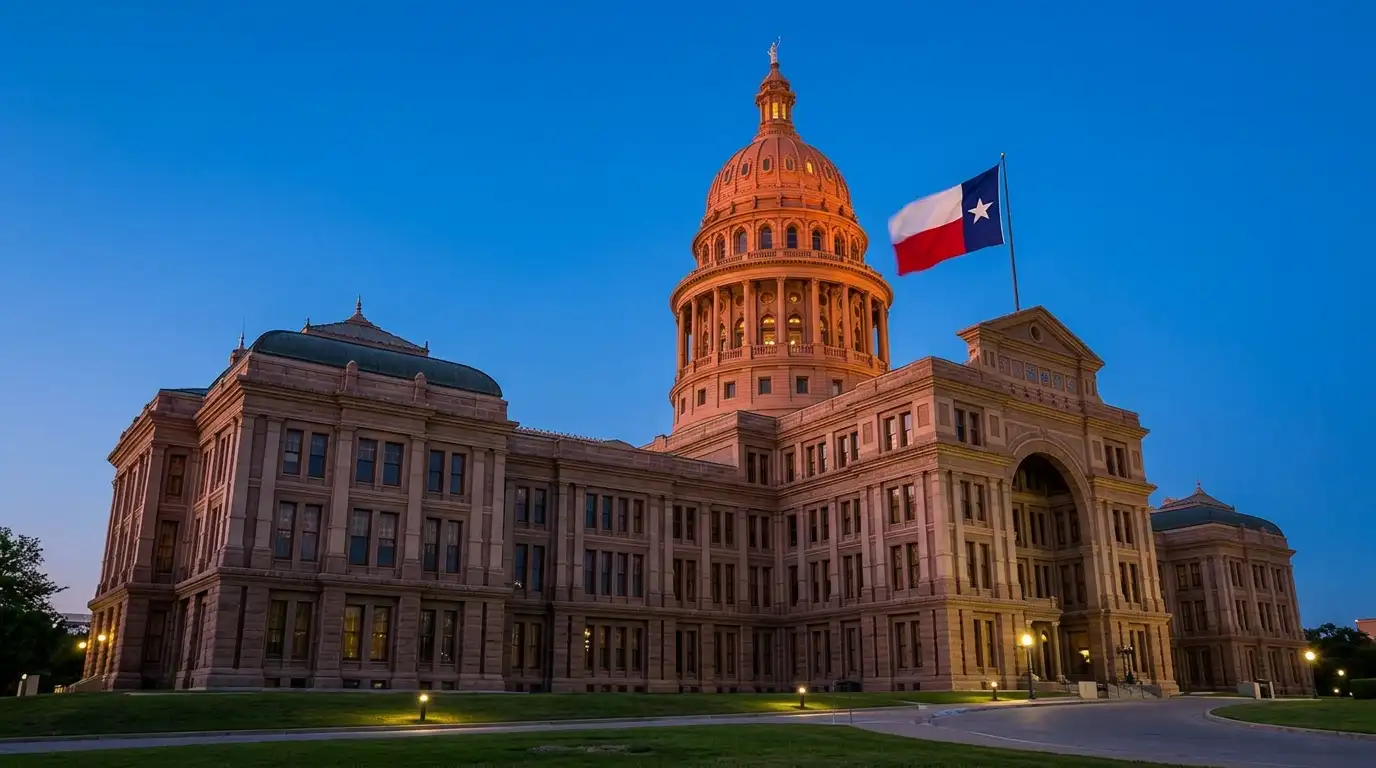
Texas is famous for being big. But its most interesting facts go far beyond size. The state once existed as an independent republic. Its oil history changed global energy markets. Big Bend protects a desert landscape with mountains, river canyons, and remarkable wildlife. Texas also has official symbols that include a state dinosaur, a state flying mammal, and a state small mammal.
The numbers are striking, too. Texas had an estimated 31.7 million residents in 2025. Its land area exceeds 261,000 square miles. Big Bend National Park alone covers more than 800,000 acres. These facts reveal a state shaped by scale, history, nature, and human ambition.
Texas at a Glance
| Fact | Detail |
|---|---|
| State capital | Austin |
| Statehood | December 29, 1845 |
| Land area | 261,267.85 square miles |
| 2025 population estimate | 31,709,821 |
| State motto | Friendship |
| State flower | Bluebonnet |
| State bird | Northern mockingbird |
| State small mammal | Nine-banded armadillo |
| Largest state park | Big Bend Ranch State Park |
| Highest point | Guadalupe Peak, 8,751 feet |
Texas Is Huge, but Its Story Is Even Bigger
1. Texas is the second-largest U.S. state by land area.
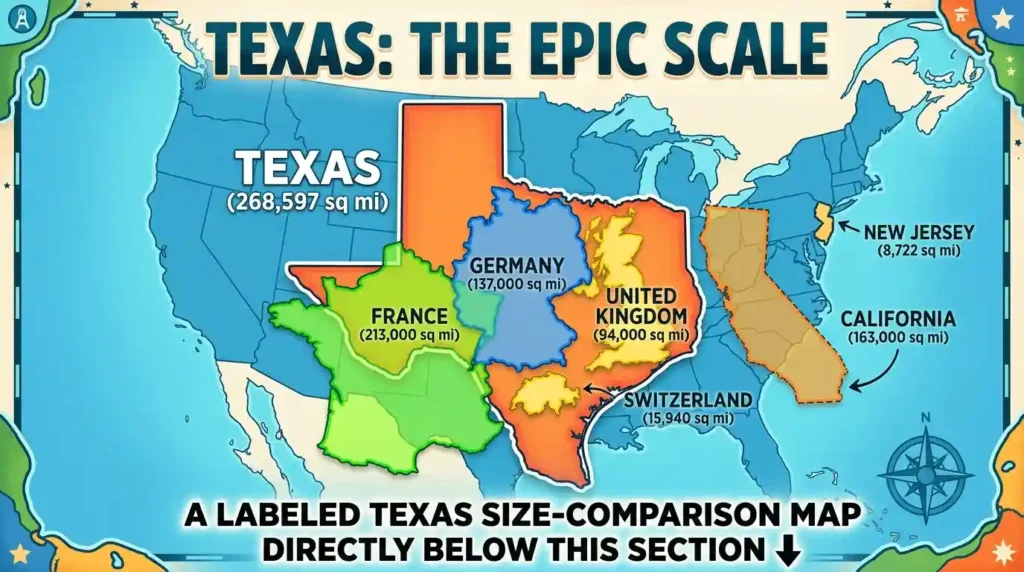
Texas has about 261,268 square miles of land. Only Alaska is larger. That size creates dramatic regional differences. East Texas has forests and wetlands. West Texas has deserts and mountains. The Gulf Coast adds beaches and marshes. Texas feels less like one landscape and more like several regions joined together.
2. More than 31 million people now live in Texas.
The U.S. Census Bureau estimated Texas had 31,709,821 residents on July 1, 2025. That figure is higher than the 29.1 million recorded in the 2020 census. Population estimates can change each year. So population claims should always carry a date when published.
3. Texas has one of the lowest population densities among large states.
The 2020 Census recorded about 111.6 people per square mile. That average hides huge regional differences. Large parts of West Texas have very few residents. Major metropolitan areas are much denser. This contrast helps explain why Texas can feel both highly urban and remarkably empty.
4. Texas has more land than many countries.
Its land area is roughly comparable to the combined size of several European countries. That comparison helps put Texas into perspective. I find area comparisons easier to picture than raw numbers. A map makes the scale even clearer.
Source: U.S. Census Bureau — Texas QuickFacts
Texas Was Once an Independent Republic
5. Texas declared independence from Mexico in 1836.
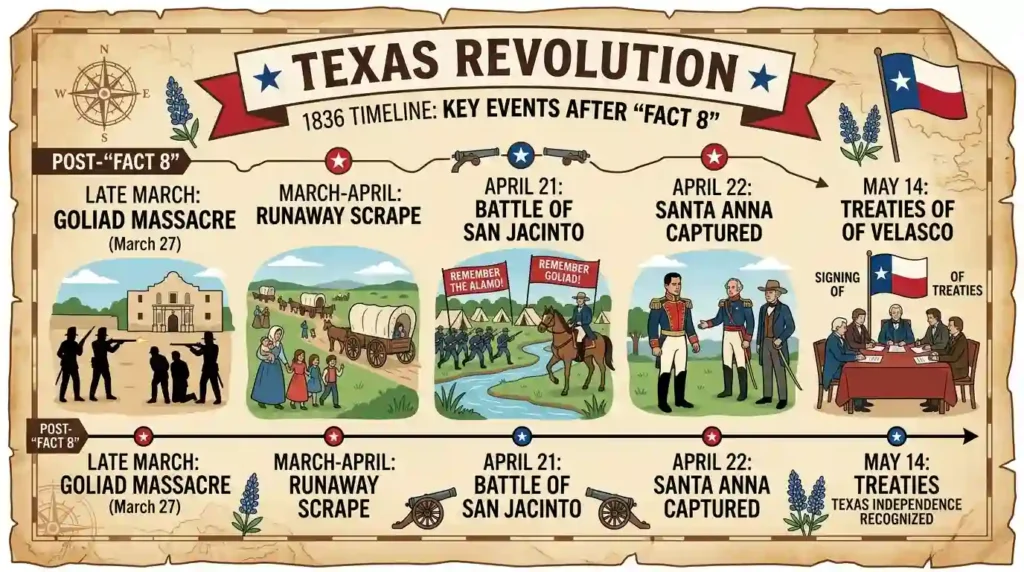
Delegates meeting at Washington-on-the-Brazos declared Texas independent on March 2, 1836. The declaration followed growing conflict with the Mexican government. George C. Childress served as the document’s chief writer. Texas then operated as an independent republic before joining the United States.
6. The Alamo siege lasted 13 days.
Mexican forces under General Santa Anna attacked the Alamo in San Antonio in 1836. The siege lasted 13 days before Mexican troops captured the mission. The event became one of the best-known episodes of the Texas Revolution. Historians still discuss details surrounding the defenders and battle.
7. The Battle of San Jacinto lasted about 18 minutes.
On April 21, 1836, Sam Houston’s Texan army attacked Santa Anna’s forces near the San Jacinto River. The decisive fighting lasted about 18 minutes. Santa Anna was captured soon afterward. The victory effectively secured Texas independence from Mexican military control.
8. Texas remained an independent republic for nearly nine years.
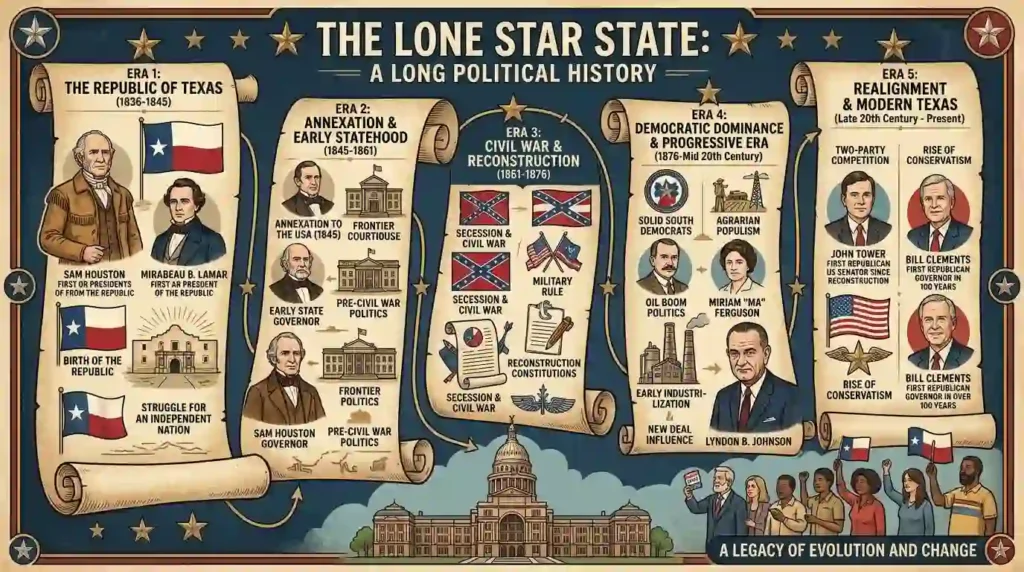
Texas did not immediately become part of the United States. It existed as the Republic of Texas from 1836 to 1845. The republic developed its own government, diplomacy, military, and national symbols. Texas joined the United States in December 1845.
Source: Library of Congress — Texas Declaration and Revolution History
The Lone Star Has a Long Political History
9. Texas adopted the lone-star symbol before statehood.
The lone star was already associated with Texas during the revolution. The Texas Provisional Government adopted a single five-pointed star as an emblem on March 12, 1836. The symbol later became central to Texas identity. It also explains the state’s famous nickname, the Lone Star State.
10. The bluebonnet became Texas’ official flower in 1901.
The Texas Legislature selected the bluebonnet as the official state flower in 1901. Several lupine species are commonly associated with Texas bluebonnets. Spring displays can cover roadsides, fields, and open countryside. The flower has become one of the state’s strongest visual symbols.
11. Texas has an official state dinosaur.
Texas officially recognizes Pleurocoelus as its state dinosaur. The designation was made in 1997. The sauropod is associated with fossils found in central Texas. This gives Texas an unusual state-symbol combination: its official symbols reach from modern wildlife to animals that lived millions of years ago.
12. Texas has an official state flying mammal.
The Mexican free-tailed bat became Texas’ official state flying mammal in 1995. Texas is well known for large bat colonies. These bats are also important insect predators. Their evening emergence can create spectacular natural events at several Texas caves and bridges.
Texas State Library and Archives Commission — Texas State Symbols
Oil Turned Texas Into an Energy Powerhouse
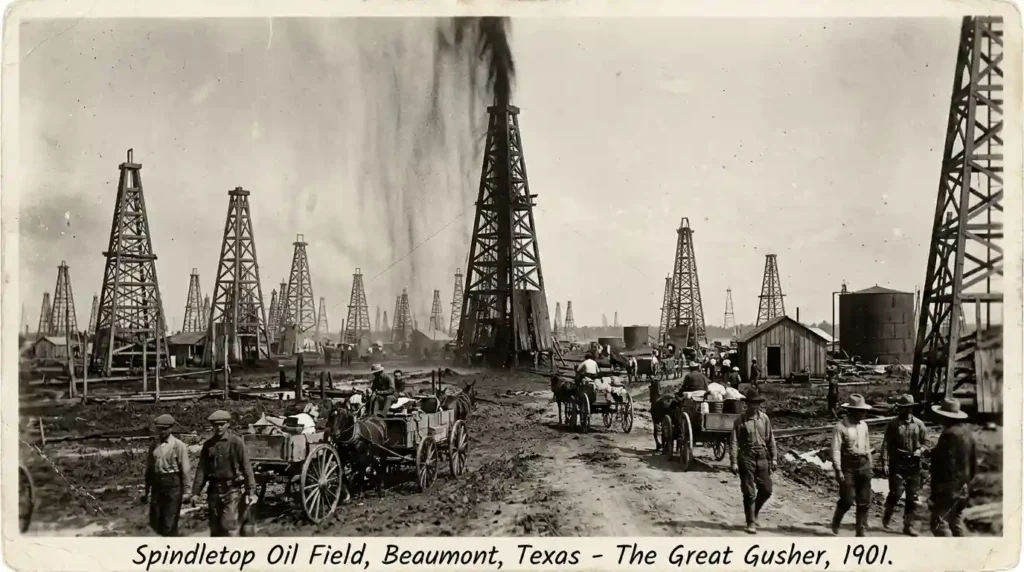
13. Texas’ major oil boom began at Spindletop in 1901.
The Spindletop discovery near Beaumont changed Texas history. The field produced oil on a scale that helped launch a huge petroleum industry. Thousands of people and businesses followed the boom. Texas soon became closely linked with oil, drilling, refining, transportation, and energy technology.
14. Spindletop helped reshape the American oil industry.
The 1901 discovery did more than create local excitement. It encouraged major investment in petroleum production and infrastructure. Refineries, pipelines, and transportation networks expanded. The discovery also helped turn petroleum into a central part of Texas’ modern economy and identity.
15. Texas began producing oil before the famous Spindletop boom.
Oil drilling in Texas dates back to the nineteenth century. The Oil Springs area near Nacogdoches saw drilling activity as early as 1866. Spindletop was therefore not the beginning of Texas oil. It was the breakthrough that transformed the scale of production.
16. Texas has a long history of regulating oil production.
The Railroad Commission of Texas became deeply involved in oil regulation as production expanded. During the East Texas oil boom, the commission used proration to control production rates. The policy aimed to prevent waste and manage reservoir pressure while supporting orderly development.
Source: Railroad Commission of Texas — Spindletop and Oil History
Big Bend Shows a Different Texas
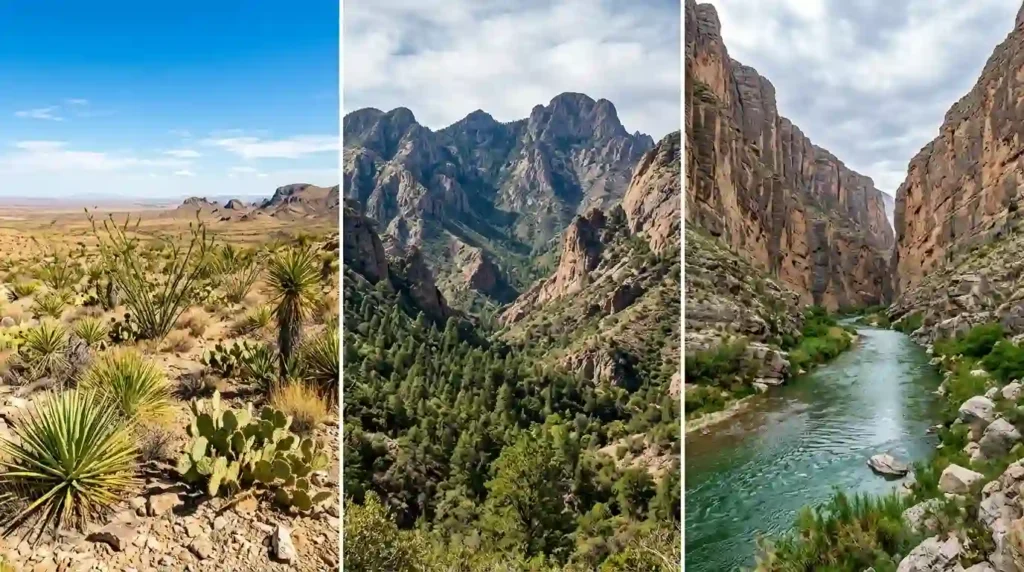
17. Big Bend National Park covers 801,163 acres.
Big Bend National Park covers about 1,252 square miles, or 801,163 acres. It is one of the largest national parks in the contiguous United States. The park contains desert, mountains, river canyons, and wide open spaces. Its size makes wilderness a major part of the experience.
18. Emory Peak rises 7,832 feet above Big Bend.
Emory Peak is the highest point in Big Bend National Park. It reaches 7,832 feet above sea level. That elevation stands in sharp contrast with the Rio Grande valley below. The difference creates several habitats within a relatively compact part of West Texas.
19. Big Bend contains rocks about 500 million years old.
The park preserves an unusually long geological record. Some exposed rocks date back roughly 500 million years. Other formations record much younger geological events. Fossils also occur throughout the park. Together, these layers help scientists reconstruct ancient environments and major geological changes.
20. The Rio Grande forms part of Big Bend’s international boundary.
The Rio Grande runs along the park’s southern edge. Big Bend shares an international boundary with Mexico. The park contains about 118 miles of U.S.-Mexico border. This makes the landscape both a natural environment and an important international border region.
National Park Service — Big Bend National Park Statistics
Texas Wildlife Has Some Strange Tricks
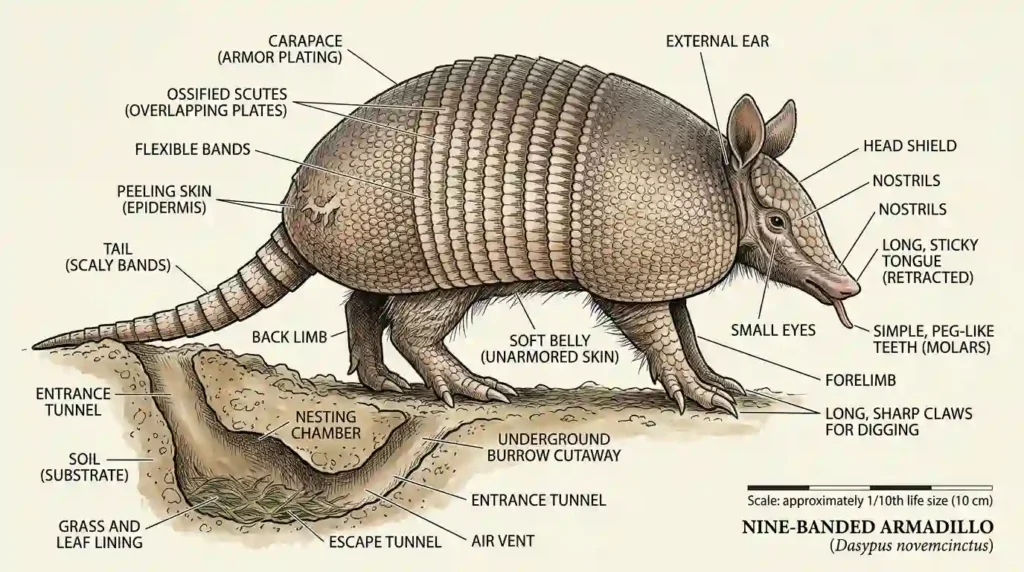
21. Armadillos can produce four identical young.
Female nine-banded armadillos normally give birth to four identical quadruplets. The young develop from a single fertilized egg. They are always the same sex. This unusual reproductive pattern makes the species especially interesting to biologists. The armadillo is also Texas’ official small mammal.
22. Armadillos can cross water in surprising ways.
An armadillo’s bony shell is heavy enough to make swimming difficult. In narrow water crossings, it can sometimes walk along the bottom. In wider water, it can swallow air and increase its buoyancy. This strange adaptation gives the animal another way to cross its habitat.
23. Armadillos are powerful diggers.
Nine-banded armadillos use strong claws to dig for insects and larvae. They also create burrows for shelter. Their abandoned burrows can later provide homes for other animals. Soil therefore shapes where armadillos can thrive. Very hard ground makes digging much more difficult.
24. The armadillo is not native to most of Texas’ ancient wildlife story.
The nine-banded armadillo originally came from South America. Its range expanded northward over time. Today, it occurs across most of Texas, although it is absent from the western Trans-Pecos region. Its spread is a reminder that modern Texas wildlife has a changing history.
Source: Texas Parks and Wildlife Department — Nine-Banded Armadillo
Texas Parks Can Be Bigger Than You Expect
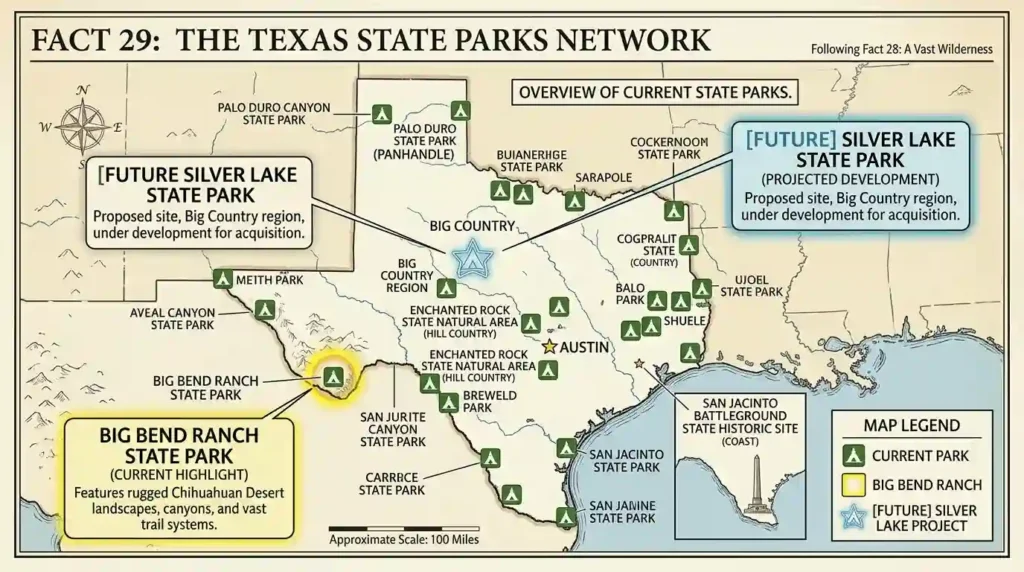
25. Big Bend Ranch State Park is Texas’ largest state park.
Big Bend Ranch State Park covers more than 300,000 acres in far West Texas. It stretches along the Rio Grande near the Mexican border. The park contains desert mountains, canyons, river frontage, and remote roads. It is also an International Dark Sky Park, making it valuable for night-sky viewing.
26. Big Bend Ranch State Park was once working ranchland.
The park’s landscape has a strong ranching history. Texas acquired the major ranch property in 1988 for $8.8 million. That purchase added more than 200,000 acres to the state park system. Today, visitors can still see traces of its former ranching life.
27. Texas’ largest state park is built for rugged travel.
Big Bend Ranch State Park offers hundreds of miles of trails and remote roads. Visitors can hike, bike, ride horses, paddle, or explore by vehicle. Some routes require four-wheel drive. The park’s remote setting is part of its appeal, but summer heat can be severe.
28. Texas continues adding major protected landscapes.
In 2026, Texas Parks and Wildlife announced the acquisition of nearly 54,000 acres for what will become Silver Lake State Park. Once developed, it is planned to become Texas’ second-largest state park. The acquisition shows that Texas’ protected-land story is still changing.
Source: Texas Parks and Wildlife Department — Big Bend Ranch State Park
Myths vs. Reality
Myth: Texas was always part of the United States.
Reality: Texas was an independent republic from 1836 until its annexation in 1845.
Myth: Spindletop was Texas’ first oil discovery.
Reality: Texas oil drilling began decades earlier. Spindletop created the first major statewide oil boom.
Myth: Texas is only flat prairie.
Reality: Texas contains deserts, mountains, forests, wetlands, coastal habitats, canyons, and river valleys.
Myth: The Texas lone star was created after statehood.
Reality: The lone-star symbol was adopted during the Texas revolutionary period in 1836.
Frequently Asked Questions About Texas
What is Texas best known for?
Texas is widely known for its large size, independent history, ranching culture, oil industry, major cities, and diverse landscapes. It also has distinctive state symbols, including the bluebonnet, longhorn, mockingbird, and nine-banded armadillo.
How big is Texas compared with other states?
Texas is the second-largest U.S. state by land area. Its land area is about 261,268 square miles. Only Alaska covers more land.
Why is Texas called the Lone Star State?
Texas is called the Lone Star State because the single star became an important symbol during the Texas Revolution. The symbol represented Texas independence and later became a lasting part of state identity.
When did Texas become a state?
Texas joined the United States on December 29, 1845. Before statehood, it existed as the independent Republic of Texas from 1836 to 1845.
What is the largest state park in Texas?
Big Bend Ranch State Park is Texas’ largest state park. It covers more than 300,000 acres along the Rio Grande in far West Texas.
What animal is the Texas state small mammal?
The nine-banded armadillo is Texas’ official small mammal. It is known for its protective bony armor, digging ability, and unusual production of identical quadruplets.
Why is Texas important in oil history?
The 1901 Spindletop discovery near Beaumont triggered a major petroleum boom. It helped establish Texas as a major center of oil production and energy development.
What makes Big Bend National Park special?
Big Bend combines desert, mountains, river canyons, fossils, wildlife, and dark skies. Its Rio Grande border also gives the park an unusual international setting.
Conclusion
The best fun facts about Texas are not simply about being big. They show how many different stories can exist inside one state. Texas was once a republic. Its oil discoveries helped reshape modern energy. Its official symbols range from flowers to dinosaurs. Its western parks preserve deserts, mountains, fossils, and dark skies.
The state also keeps changing. New protected lands are being added while cities continue to grow. That mix makes Texas unusually rich for trivia. Look closely, and the Lone Star State keeps offering another surprise.

hello! I am Irshad Ullah, and a passionate writer and lifelong learner dedicated to uncovering fascinating facts about science, history, nature, animals, space, and the world around us. I research each topic carefully and transform surprising information into clear, engaging, and enjoyable content. My goal is to satisfy curiosity, inspire learning, and help readers discover something amazing every day.