
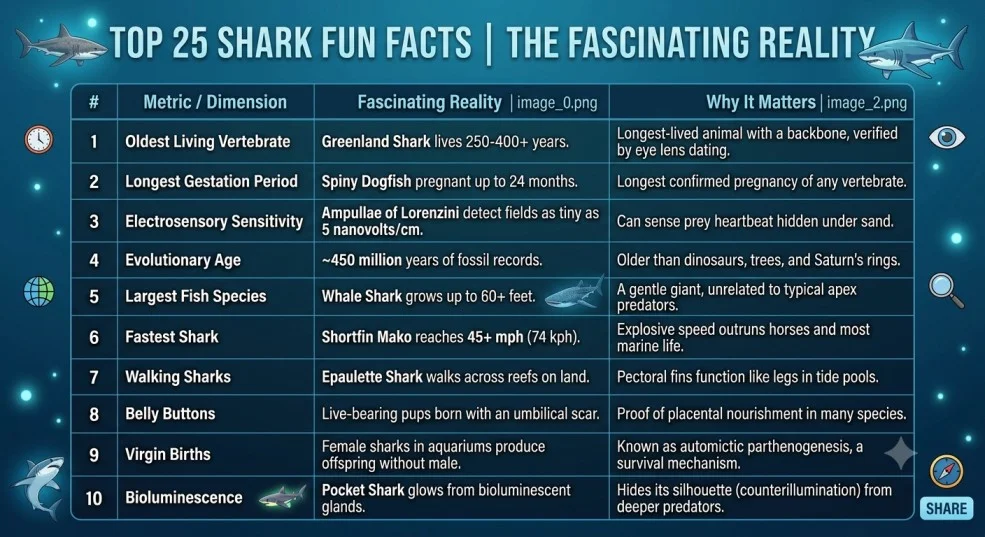
Looking for the most mind-blowing fun facts about sharks that you haven’t already heard a hundred times? Most listicles just repeat the same basic trivia: sharks don’t have bones, they have a sharp sense of smell, and they existed before trees. While those are true, they barely scratch the surface of these ancient marine predators.
Sharks deploy glow-in-the-dark weapons, consume their siblings in the womb, and navigate using the Earth’s invisible magnetic fields. Below are verified, unusual, and truly amazing fun facts about sharks that go far beyond what you usually see on nature shows.
Shark Fast-Facts
| Metric / Dimension | Verified Reality | Why It Matters |
| Oldest Living Vertebrate | Greenland Shark (Somniosus microcephalus) living 250 to 400+ years. | Testing proteins in their eyes shows they live longer than any other animal with a backbone. |
| Gestation Record | Spiny dogfish (Squalus acanthias) carry embryos for up to 24 months. | This is the longest pregnancy of any animal with a backbone. |
| Electrosensory Nodes | Ampullae of Lorenzini detect fields as tiny as 5 nanovolts per centimeter. | Helps sharks sense the faint electrical pulse of a prey animal’s heartbeat hidden under sand. |
| Evolutionary Age | ~450 million years of fossil records. | Sharks are older than dinosaurs, trees, and the rings around Saturn. |
Sharks — Mind-Blowing Science & Anomalies
1. Embryos Engagement in Intrauterine Cannibalism
In species like the sand tiger shark, the strongest baby shark eats its brothers and sisters inside the mother’s womb. This process makes sure that only the largest and strongest pup survives to be born.
2. Tail-Whipping as a Kinetic Weapon
Thresher sharks have a tail fin that is as long as the rest of their body. By snapping their tail at speeds over 50 mph, they make powerful underwater shockwaves that stun whole schools of fish instantly.
3. Glow-in-the-Dark Counterillumination
The pocket shark squirts a glowing fluid from small openings near its front fins. This light hides its shape from below, making it invisible to larger hunters swimming beneath it.
4. Pocket-Sized Predators Punch Above Their Weight
The cookiecutter shark uses suction-cup lips and saw-like bottom teeth to scoop round, cookie-shaped chunks of meat out of whales, submarines, and even great white sharks.
5. Livers Serve as Internal Buoyancy Tanks
Because sharks do not have air bladders to stay afloat, they rely on massive livers packed with oily squalene. This oil makes up to a quarter of their total body weight and keeps them floating easily.
6. Thermal Muscle Elevators
Certain sharks, like Great Whites and Makos, have special net-like blood vessels. These vessels heat their muscles above the surrounding water temperature, giving them bursts of incredible speed in cold ocean currents.
7. Natural Magnetic Navigation
Sharks use internal magnetic sensors to travel across huge ocean distances. By reading small changes in Earth’s magnetic fields through their skin, they can travel thousands of miles without getting lost.
8. Regeneration of Tooth Sets
Sharks never run out of teeth because their jaws work like a continuous conveyor belt. A single sandbar shark can lose and replace about 35,000 teeth during its life.
Sharks — Historical Secrets & Cultural Quirks
9. Ancient Armor and Tooling
In ancient Polynesian cultures, people used shark teeth to make special battle weapons called leiomano. They lined the sharp edges of hand-carved wooden clubs with razor-sharp tiger shark teeth.
10. Shark Skin Was Used as Commercial Sandpaper
Long before modern sandpaper was invented, dried shark skin—called shagreen—was bought and sold as high-grade sandpaper because of its rough, tooth-like skin surface.
11. Indigenous Shark Deities
In traditional Hawaiian culture, ancestral family spirits called Aumakua often took the form of sharks. Instead of being feared, specific shark gods like Kamohoaliʻi were respected and honored.
12. Fossilized Feces Reveal Prehistoric Diets
Ancient fossilized shark poop, called coprolites, shows spiral patterns inside. These patterns come from the unique spiral shape of a shark’s intestines, which helps scientists learn what ancient sharks ate.
13. Shark-Tooth Fossil Folklore
For hundreds of years in Europe, people found large Megalodon tooth fossils and believed they were petrified dragon tongues. People even dipped them into wine, thinking they could protect against poison.
Sharks By The Numbers
| Metric | Measurement / Figure | Relatable Comparison | Source / Basis |
| Smallest Shark | 6.7 to 8 inches (Etmopterus perryi) | Small enough to rest in an adult human hand | NOAA Fisheries |
| Top Swimming Speed | ~45 mph (Shortfin Mako) | Swims faster than a racehorse can run | Florida Museum |
| Jaw Bite Force | ~18,000 Newtons (Great White) | About 20 times stronger than a human bite | Computer Biomechanical Models |
| Max Lifespan | ~400+ years (Greenland Shark) | Some sharks alive today were swimming when the Renaissance happened | Radiocarbon Eye Lens Data |
| Olfactory Sensitivity | 1 part per billion | Can smell a single drop of scent in an Olympic-sized swimming pool | Florida Museum |
Facts That Sound 100% Fake (But Are Actually True)
- Some Sharks Have Belly Buttons: Sharks that give birth to live young, like hammerheads and bull sharks, feed their babies through an umbilical cord inside the womb. When born, pups have a small umbilical scar that heals over time.
- Walking on Land: The epaulette shark uses its front and back fins like tiny legs to “walk” across shallow coral reefs. It can even crawl out of the water to move between tide pools.
- Virgin Births (Parthenogenesis): Female sharks in aquariums—including hammerheads and zebra sharks—have given birth without any male shark involved.
- Tonic Immobility: If you gently flip a shark upside down, it enters a natural, peaceful trance state where it stays completely still for a short time.
- No Bones Whatsoever: A shark’s body has zero hard bones. Its entire frame is made of smooth, flexible cartilage—the exact same flexible material found in your own ears and nose.
“Can You Imagine?” (Visual Analogies)
- The Megalodon Scale: Picture a full-sized school bus lined with teeth as big as a human hand. The prehistoric Megalodon grew up to 50 feet long and could swallow large ocean creatures in a single bite.
- Hydrodynamic Denticles: A shark’s skin feels smooth if you stroke it from head to tail, but like rough sandpaper if you rub it backward. Its skin is covered in tiny tooth-like scales that cut through water resistance so well that engineers designed high-tech swimsuits based on it.
Debunking the Myths: Fiction vs. Reality
| The Popular Myth | The Actual Fact | Source / Proof |
| Sharks must swim constantly or die. | Many shark species can rest motionless on the seafloor while using cheek muscles to pump water over their gills. | Florida Museum of Natural History |
| Sharks actively target human swimmers. | Humans are not on the shark menu; most bites happen because of poor water visibility or curiosity. | International Shark Attack File (ISAF) |
| Sharks are immune to cancer. | Scientists have documented tumors in dozens of different shark species over many years of research. | National Institutes of Health (NIH) |
| Sharks have poor eyesight. | Most sharks have great vision, specialized layers for seeing in the dark, and can even see colors. | NOAA Fisheries |
Mysteries Scientists Still Can’t Explain
- The White Shark Café: Every winter, great white sharks in the Pacific Ocean swim thousands of miles to an empty area of open water between Hawaii and Mexico. Scientists still do not know why they gather in this ocean desert.
- Deep-Sea Longevity Secrets: The exact biological secrets that allow Greenland sharks to live for hundreds of years without getting heart disease are still a mystery.
- Mass Synchronized Aggregations: At times, thousands of female hammerhead sharks gather around underwater mountains, swimming in precise shapes for reasons that have nothing to do with mating or feeding.
Share-This Fact
Female spiny dogfish sharks carry embryos for 2 full years—the longest confirmed pregnancy of any vertebrate on Earth.
The Ultimate Shark Brain Teaser
- Which shark species secretes a glowing liquid near its fins to hide from deep-sea predators?
- A) Epaulette Shark
- B) Pocket Shark
- C) Thresher Shark
- D) Cookiecutter Shark
- What unusual feature do newborn hammerhead and bull shark pups possess?
- A) Primary feathers
- B) Temporary scales
- C) An umbilical scar (belly button)
- D) Calcium tusks
- How do thresher sharks primarily hunt schooling fish?
- A) Electric shocks
- B) Tail-whipping at supersonic speeds
- C) Crushing jaw pressure
- D) Camouflage trapping
Answers ↓
1. B (Pocket Shark) | 2. C (An umbilical scar/belly button) | 3. B (Tail-whipping at high speeds)
Frequently Asked Questions
Do any sharks have genuine belly buttons?
Yes. Sharks that give live birth connect to their babies through an umbilical cord. When the pups are born, they have a small scar on their belly that heals and disappears over a few weeks.
What is the longest a shark can live?
The Greenland shark can live between 250 and 400 years (or even longer), making it the longest-living animal with a backbone known to science.
Are all sharks forced to swim continuously to breathe?
No. Some sharks must keep moving to push water through their gills, but many others can lie completely still on the ocean floor while pumping water over their gills using their cheek muscles.
Why does shark skin feel like sandpaper?
Shark skin is covered in tiny scales shaped like microscopic teeth. These scales all point toward the back of the body to cut down water resistance when the shark swims.
Can sharks reproduce without a male?
Yes. Female sharks kept in aquariums have occasionally given birth without any male involved through a process where the egg develops all on its own.
Conclusion
Sharks are far more amazing than simple ocean hunters. Whether they are walking across shallow pools, navigating by reading Earth’s magnetic fields, or living for four centuries in icy seas, these ancient fish are master survivors.

hello! I am Irshad Ullah, and a passionate writer and lifelong learner dedicated to uncovering fascinating facts about science, history, nature, animals, space, and the world around us. I research each topic carefully and transform surprising information into clear, engaging, and enjoyable content. My goal is to satisfy curiosity, inspire learning, and help readers discover something amazing every day.