
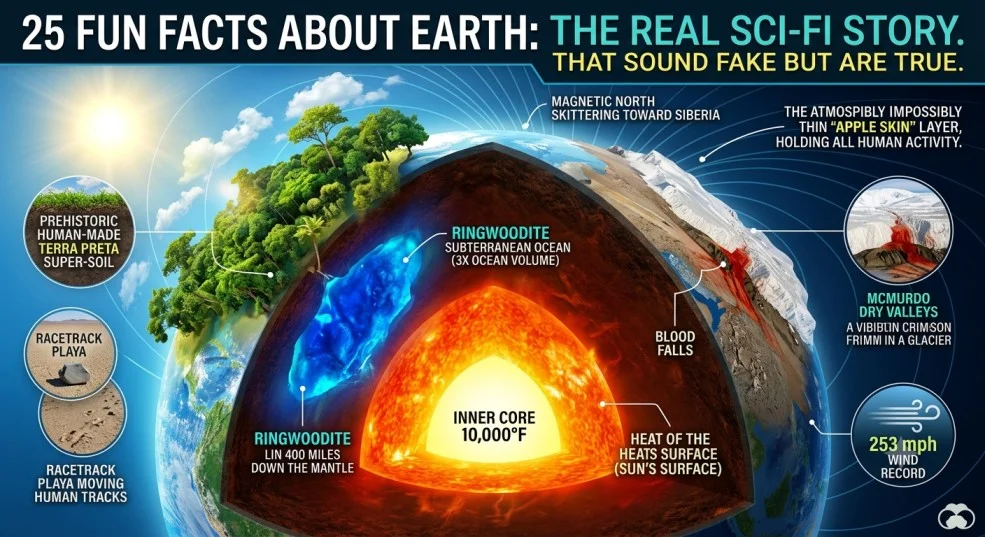
Did you know that Earth actually has a huge amount of water trapped deep inside the ground—about three times as much as all our oceans combined? Most people searching for fun facts about earth think of a solid blue marble floating in space. But beneath our feet is a busy, strange planet that acts more like something out of a sci-fi story than a simple ball of rock.
While most trivia lists repeat the same old points about Mount Everest and the equator, the real story of our home goes much deeper. From a spot where it hasn’t rained in 14 million years to a magnetic field that is due to flip, these unusual fun facts about earth reveal how wild and dynamic our planet truly is.
Quick Snapshot (Interesting Fun Facts about Earth)
| Dimension / Metric | Fascinating Reality | Why It Matters |
| Deep Water | Ringwoodite holds ~3x ocean volume 400 miles down | Explains where Earth’s surface water originated |
| Oldest Crust | 4-billion-year-old bedrock in Northern Canada | Reveals conditions of early planetary formation |
| Extreme Dryness | McMurdo Dry Valleys have had no rain for 14M years | Serves as NASA’s testbed for Mars missions |
| Atmospheric Edge | Karman line set at 100 km (62 miles) altitude | Defines the legal boundary between air and space |
Earth — Mind-Blowing Science & Anomalies
1. A Hidden “Ocean” Exists 400 Miles Down
Deep inside the Earth lies a blue mineral called ringwoodite. It acts like a giant sponge, trapping water inside its structure under high heat and pressure. Scientists estimate this deep underground area holds about three times as much water as all the surface oceans put together. (Source: nature.com)
2. The Planet’s Shape Has a “Bulge”
Earth is not a perfect sphere. Because it spins at around 1,000 miles per hour at the equator, the spinning motion pushes the middle outward. This shape means that if you stand at the equator, you are actually a little farther from the center of the Earth than if you stood at the poles.
3. Gravity Isn’t Uniform Everywhere
Earth’s mass is spread out unevenly due to mountains, deep trenches, and underground magma. Because of this, gravity pulls a bit differently depending on where you stand. For example, Canada’s Hudson Bay area has slightly lower gravity than surrounding areas because the ground is still slowly springing back from the weight of ice from the last Ice Age.
4. Antarctica Hosts a Waterfall That Runs Red
At Taylor Glacier in Antarctica, a waterfall called “Blood Falls” flows red. The water comes from an underground lake sealed away from light and air, filled with dissolved iron. When this trapped saltwater breaks out to the surface, the iron mixes with air, rusts instantly, and turns the ice bright red.
5. Magnetic North is Skittering Toward Siberia
Unlike the geographic North Pole, Earth’s magnetic north pole is always moving because liquid iron is churning in the outer core. Over the last few decades, it has speeded up its trip from the Canadian Arctic toward Siberia, moving at about 30 miles every year. (Source: noaa.gov)
6. Earth’s Core is as Hot as the Sun’s Surface
At roughly 10,000 degrees Fahrenheit, the middle of the Earth is just as hot as the surface of the Sun. Even at this extreme temperature, heavy pressure keeps the inner core squeezed into a solid ball of iron and nickel. This core helps create the protective magnetic shield that guards our air from harmful solar radiation.
7. Earth Has “Quakes” Caused by the Moon
Tectonic plates are not the only things that shake the ground. Just like the Moon’s gravity pulls on the oceans to create tides, it also pulls on Earth’s solid land. This gentle stretching and squeezing causes small ground movements deep underground known as earth tides or moonquakes.
Earth — Historical Secrets & Cultural Quirks
8. The Amazon Rainforest Was Built on Super-Soil
Thousands of years ago, ancient people in the Amazon created super-rich black soil called Terra Preta. They made it by mixing charcoal, bone, and organic waste into the poor jungle dirt. Today, large parts of the rainforest still grow strong thanks to this ancient soil recipe.
9. A Mediterranean “Desiccation” Sealed the Sea
About 5.6 million years ago, moving tectonic plates closed the Strait of Gibraltar and cut off the Mediterranean Sea from the Atlantic Ocean. The sea almost completely dried up, leaving behind thick layers of salt. Later, a giant flood—the Zanclean flood—broke through and refilled it.
10. The Deepest Artificial Hole Took 20 Years to Drill
During the Cold War, Russian scientists drilled a hole called the Kola Superdeep Borehole. It reached a depth of 40,230 feet (7.6 miles). They had to stop digging when temperatures down below reached 356 degrees Fahrenheit, which turned the deep granite rock into a soft, sticky paste.
11. White Sands holds 20,000-Year-Old Human Tracks
In New Mexico’s White Sands National Park, ancient human footprints are frozen in time alongside prints from mammoths and giant ground sloths. These preserved tracks prove that humans lived in North America thousands of years earlier than experts used to think. (Source: nps.gov)
12. Earth Once Experienced a “Snowball” Era
About 650 million years ago, Earth cooled down so much that almost the entire planet froze from pole to pole. Scientists call this period “Snowball Earth.” This deep freeze lasted for millions of years until volcanic eruptions released enough carbon dioxide to trap heat and melt the global ice.
Earth By The Numbers (Unbelievable Fun Facts)
| Metric / Record | Numerical Value | Relatable Comparison |
| Surface Area | 196.9 million sq mi | Equals ~50 United States laid side-by-side |
| Ocean Depth Record | 35,876 feet | Deep enough to submerge Mount Everest with 1.2 miles to spare |
| Global Lightning Strikes | ~8 million per day | About 100 strikes hitting the ground every single second |
| Atmospheric Weight | 5.5 quadrillion tons | Equivalent to roughly 50 million fully loaded aircraft carriers |
| Fastest Wind Speed | 253 mph (Barrow Island) | Outpaces a top-speed Formula 1 race car |
Facts That Sound 100% Fake (But Are Actually True)
Rocks Can Travel Across Deserts Unassisted
In California’s Death Valley, heavy rocks slide across the flat ground of Racetrack Playa, leaving long tracks behind. During winter, thin sheets of ice form around the rocks. When the morning sun melts the ice and light winds blow, the ice acts like a sail and pushes hundred-pound boulders across the wet mud.
Earth Spins Slower Every Century
Our planet is spinning a little bit slower over time because of the gravitational pull of the Moon on our oceans. Every 100 years, an Earth day gets about 1.7 milliseconds longer. Back when dinosaurs walked the Earth, a full day lasted only about 23 hours.
The Driest Place on Earth Has Zero Moisture
Parts of the McMurdo Dry Valleys in Antarctica have not seen any rain or snow for about 14 million years. Powerful winds blow through these valleys and strip away all moisture, making these icy mountain spots even drier than the Sahara Desert.
Exploding Lakes Are a Very Real Danger
Lake Nyos in Cameroon sits on top of a pocket of magma that leaks carbon dioxide gas into the deep water. In 1986, the lake suddenly disturbed, releasing a giant, invisible cloud of 100,000 tons of carbon dioxide. The cloud rushed down into nearby valleys and suffocated whole villages up to 15 miles away.
“Can You Imagine?” (Visual Analogies)
Shrinking the Planet to a Pool Ball
If you could shrink the Earth down to the size of a standard billiard ball, it would feel incredibly smooth. The tallest mountains like Everest and the deepest ocean spots like the Mariana Trench would feel like tiny, barely noticeable scratches on an otherwise smooth surface.
The Apple-Skin Atmosphere
Imagine holding a regular red apple. All the breathable air on Earth—the thin layer that holds every cloud, storm, airplane, and living thing—is proportionally thinner than the thin red skin on the outside of that apple.
Debunking the Myths: Fiction vs. Reality
| The Popular Myth | The Actual Fact | The Source / Proof |
| Mount Everest is the highest mountain on Earth | Mauna Kea is taller from base to peak (~33,500 ft vs 29,031 ft) | widely documented (USGS / NOAA) |
| Earth revolves in a perfect circle around the Sun | Earth’s orbit is elliptical; we are closest to the Sun in January | NASA Earth Observatory |
| The equator is the hottest region on the planet | Subtropical deserts (like Death Valley and Lut Desert) hit higher temps | World Meteorological Organization |
| Earth’s core is liquid throughout | The inner core is solid iron-nickel, held firm by pressure | USGS Geophysics |
Mysteries Scientists Still Can’t Explain
- The Origin of Tectonic Plates: Geologists know how tectonic plates move today, but they still do not agree on what caused Earth’s outer crust to break into huge sliding pieces billions of years ago.
- The “Blobs” Deep in the Mantle: Two giant, continent-sized lumps of strange material sit near the bottom of Earth’s mantle—one under Africa and one under the Pacific Ocean. Scientists are still debating if they are pieces of old ocean floor or leftover parts from an ancient planet collision.
- The Exact Source of Water: Even though we know water is trapped in deep minerals, scientists still debate whether Earth’s water was brought here by icy asteroids or if it was already present in the dust and gas that built the planet.
Share-This Fact
Earth’s magnetic poles flip every 200,000 to 300,000 years, swapping North and South completely—and we are long overdue for the next swap.
The Ultimate Earth Brain Teaser
1. Where is Earth’s oldest known intact continental crust located?
- A) The Australian Outback
- B) Northern Quebec, Canada
- C) The Siberian Traps
- D) The Brazilian Highlands
2. How much longer is an Earth day now compared to 100 years ago?
- A) 1.7 milliseconds
- B) 2.5 seconds
- C) 1.2 minutes
- D) 5.0 milliseconds
3. What mineral deep in the mantle holds three times the ocean’s water volume?
- A) Olivine
- B) Ringwoodite
- C) Quartz
- D) Basalt
Answers ↓
- B | 2. A | 3. B
Frequently Asked Questions
What is the hottest place on Earth?
Satellites have measured ground temperatures in Iran’s Lut Desert and the Sonoran Desert reaching over 159°F (70.7°C). Meanwhile, Death Valley in California holds the record for the highest official air temperature at 134°F (56.7°C).
How old is the planet Earth?
By testing ancient rocks and meteorites, scientists have confirmed that Earth formed about 4.54 billion years ago, give or take 50 million years.
Why does gravity vary across different parts of Earth?
Gravity changes because Earth’s weight is spread out unevenly, the surface has high mountains and deep spots, and the middle bulges out. Heavy mountain ranges pull a bit harder, while areas recovering from old glacier weight (like Hudson Bay) have slightly lower gravity.
Is Earth’s magnetic pole actually moving?
Yes, the magnetic north pole moves all the time because liquid iron moves inside the outer core. Over the last hundred years, it has drifted over 600 miles toward Russia, moving up to 34 miles a year.
Could Earth ever lose its magnetic field?
The magnetic field gets weaker at times and flips every few hundred thousand years, but it will not completely disappear. The spinning liquid iron in the core acts like a generator that will keep running for billions of years.
Conclusion
Our home planet is much stranger than what most science textbooks show us. Beneath our feet lies a world powered by a core as hot as the Sun, holding giant hidden water reservoirs, shifting magnetic poles, and deserts that have stayed dry for millions of years. Every new geological finding reminds us that Earth is an active, surprising planet.

hello! I am Irshad Ullah, and a passionate writer and lifelong learner dedicated to uncovering fascinating facts about science, history, nature, animals, space, and the world around us. I research each topic carefully and transform surprising information into clear, engaging, and enjoyable content. My goal is to satisfy curiosity, inspire learning, and help readers discover something amazing every day.