
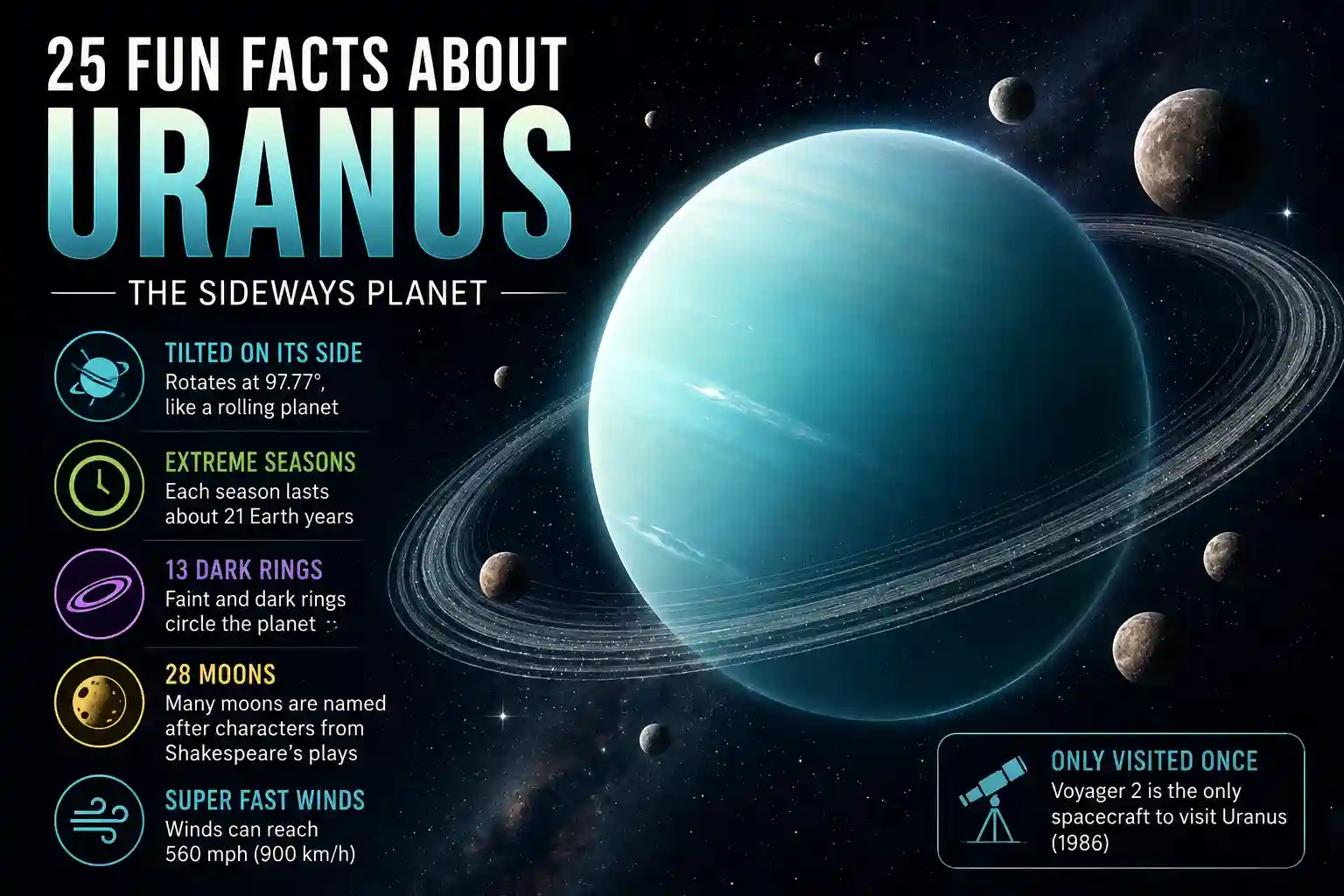
Uranus is one of the strangest planets in our solar system. It is the seventh planet from the Sun and the third-largest by diameter. It is also an ice giant, along with Neptune. Unlike Earth, Uranus has no solid surface to stand on. Its atmosphere contains methane, which gives the planet its blue-green color. But its most famous feature is its extreme tilt.
Uranus is tilted about 98 degrees, so it appears to roll around the Sun on its side. This creates seasons that can last about 21 Earth years. Uranus also has 13 faint rings, 28 known moons, powerful winds, and a strangely tilted magnetic field. Even more surprising, it can become colder than Neptune. Here are 25 verified fun facts about Uranus, that show why Uranus is one of the most unusual worlds in our solar system.
Quick Facts About Uranus
| Feature | Uranus |
|---|---|
| Position from Sun | 7th planet |
| Planet type | Ice giant |
| Diameter | About 4 times Earth’s |
| Day | About 17 hours |
| Year | About 84 Earth years |
| Axial tilt | 97.77° |
| Known moons | 28 |
| Known rings | 13 |
| Main atmospheric gases | Hydrogen and helium |
| Key color-causing gas | Methane |
| Maximum wind speed | About 560 mph (900 km/h) |
| Closest spacecraft visit | Voyager 2, 1986 |
The figures above are based mainly on current NASA data.
1. Uranus Is the Seventh Planet From the Sun
Uranus is the seventh planet in our solar system. Only Neptune is farther from the Sun.
At its average distance, Uranus is about 2.8 billion kilometers from the Sun. That huge distance helps explain why sunlight is so weak there.
2. Uranus Was the First Planet Discovered With a Telescope
Ancient people knew about Mercury, Venus, Mars, Jupiter, and Saturn. These planets can be seen without a telescope.
Uranus was different.
William Herschel discovered Uranus in 1781 while studying the sky. At first, he thought the object might be a comet or a star. Later observations showed that it was a new planet.
Why this matters: The interesting fact about Uranus is that it was the first new planet added to the known solar system in modern history.
3. Uranus Spins Almost Completely on Its Side
This is probably the strangest Uranus fact.
Its rotation axis is tilted about 97.77 degrees. Earth is tilted only about 23.5 degrees.
So Uranus looks as if someone knocked it over.
Scientists think a huge collision early in the solar system’s history may have caused this tilt. However, the exact story is still being studied. Other ideas have also been proposed.
4. A Season on Uranus Can Last About 21 Years
Uranus takes about 84 Earth years to travel around the Sun.
Because of its extreme tilt, each season lasts about one-quarter of that trip. That means a Uranian season can last roughly 21 Earth years.
Near the poles, sunlight can stay away for decades. Some areas can experience darkness for up to about 42 years.
5. A Day on Uranus Is Much Shorter Than Its Year
Uranus spins quickly.
One rotation takes about 17 hours. But one trip around the Sun takes about 84 Earth years.
So Uranus has a short day but an extremely long year.
6. Uranus Has 13 Known Rings
Saturn is famous for its rings, but Uranus has rings too.
NASA currently lists 13 known rings around Uranus. Most are narrow and faint. Some are so dark that they are difficult to see.
7. Uranus’s Rings Were Discovered in a Clever Way
Astronomers did not first discover Uranus’s rings by taking a clear picture of them.
In 1977, they watched Uranus pass in front of a distant star. The star’s light briefly dimmed several times before and after the planet blocked it.
Those repeated dips showed that rings were surrounding Uranus.
That is a great example of how scientists can discover something without seeing it directly.
8. Some Uranus Rings Are Extremely Dark
Uranus’s rings do not look like Saturn’s bright rings.
Many Uranian ring particles reflect very little sunlight. NASA research has described the rings as among the darkest material known in the solar system.
This darkness is one reason the rings were so difficult to detect.
9. Uranus Has 28 Known Moons
Uranus currently has 28 known moons, according to NASA.
Five of the major moons are:
- Miranda
- Ariel
- Umbriel
- Titania
- Oberon
The number can change as astronomers find and confirm additional small objects.
10. Uranus’s Moons Have Literary Names
Many planets have moons named after figures from ancient mythology.
Uranus is different.
Many of its moons are named after characters from the works of William Shakespeare. Others come from the works of Alexander Pope.
That is why Uranus’s moons are sometimes called its literary moons.
11. Miranda Has Huge Canyons
Miranda is one of Uranus’s five major moons.
Its surface looks surprisingly strange. It has giant fault canyons, terraces, and regions that appear to have very different ages.
Some of Miranda’s canyons are estimated to be about 12 times deeper than the Grand Canyon.
This makes Miranda one of the most unusual-looking moons in the solar system.
12. Uranus Is an Ice Giant
Uranus is not a gas giant like Jupiter or Saturn.
It belongs to a different group called ice giants. Neptune is the other ice giant.
Deep inside Uranus, scientists think much of the planet consists of hot, dense fluids containing water, ammonia, and methane.
Here, “ice” does not simply mean frozen ice like the ice in your freezer. It refers to materials that scientists call planetary ices because of their chemical makeup.
13. Uranus Has No True Surface
You could not land on Uranus like you could land on Earth or Mars.
Uranus does not have a solid surface that you could stand on. Its atmosphere becomes deeper and denser as you move downward.
The pressure and temperature would become extreme long before a spacecraft could reach its deep interior.
14. Methane Gives Uranus Its Blue-Green Color
Why does Uranus look blue-green?
The answer is partly methane in its atmosphere.
Methane absorbs much of the red light that reaches it. More blue and green light is reflected back toward space.
That gives Uranus its familiar blue-green appearance.
15. Uranus Can Be Colder Than Neptune
Here is a surprising fact: Uranus can have lower temperatures than the more distant Neptune.
NASA reports a minimum atmospheric temperature on Uranus of about 49 K, or −224.2°C.
So being farther from the Sun does not automatically make a planet colder. Uranus’s unusual internal heat and atmosphere help make its temperature pattern especially interesting.
16. Uranus Has Very Fast Winds
Uranus may look calm in many images.
Its atmosphere is not calm.
Winds can reach about 560 miles per hour (900 km/h). Modern observations also show changing clouds and bright atmospheric features.
That makes Uranus a windy world despite its smooth-looking appearance.
17. Uranus Has a Strange Magnetic Field
Earth’s magnetic field is roughly aligned with its rotation.
Uranus’s magnetic field is much stranger.
Its magnetic axis is tilted by nearly 60 degrees from its rotation axis. The magnetic field is also offset from the planet’s center.
This creates a very unusual magnetosphere—the region around a planet controlled by its magnetic field.
18. Uranus’s Magnetic Tail Is Twisted Like a Corkscrew
The strange magnetic field produces another bizarre effect.
As Uranus rotates, its magnetic field lines can become twisted into a long corkscrew-shaped tail behind the planet.
This is very different from the simple mental picture many people have of a planet’s magnetic field.
19. Uranus Has Auroras
Uranus also has auroras.
Auroras happen when energetic particles interact with a planet’s upper atmosphere.
Because Uranus has a strongly tilted and offset magnetic field, its auroras do not behave exactly like Earth’s northern and southern lights.
In 2026, observations from the James Webb Space Telescope gave scientists a new view of Uranus’s upper atmosphere and its auroras.
20. Only One Spacecraft Has Visited Uranus
So far, only one spacecraft has made a close visit to Uranus.
NASA’s Voyager 2 flew past Uranus on January 24, 1986.
It came within about 81,500 kilometers (50,600 miles) of the planet’s cloud tops.
That means most of what we know about Uranus comes from one short spacecraft encounter plus observations from telescopes.
21. Voyager 2 Changed What We Knew About Uranus
Voyager 2 did more than take famous pictures.
During its Uranus encounter, the spacecraft discovered new moons and rings and measured the planet’s unusual magnetic field.
It collected much of its Uranus data during only about six hours of close observation.
That short visit still provides much of the foundation for modern Uranus research.
22. Uranus Is About Four Times Wider Than Earth
Uranus is a huge planet.
Its diameter is about four times Earth’s diameter. Yet its mass is only about 14.5 times Earth’s mass, and its density is much lower than Earth’s.
This shows why size alone does not tell us how massive a planet is.
23. Uranus Is the Second-Least-Dense Planet
Only Saturn has a lower average density than Uranus.
NASA describes Uranus as the second least dense planet in the solar system.
Its large size and relatively low density reflect its different composition compared with rocky planets such as Earth.
24. Uranus Was Almost Named After a King
William Herschel did not originally want to call the planet Uranus.
He proposed the name Georgium Sidus, meaning “George’s Star,” in honor of King George III.
Astronomers later rejected that name. The planet eventually became Uranus, following the tradition of using names from classical mythology.
25. Uranus Is Still Full of Mysteries
Perhaps the most interesting Uranus fact is how much we still do not know.
Only one spacecraft has visited it. Much of our modern information comes from distant observations.
Scientists are still studying its extreme tilt, internal structure, atmosphere, magnetic field, rings, and moons. New observations from powerful telescopes are revealing details that Voyager 2 could not see.
That makes Uranus more than a collection of strange facts. It is one of the least explored major planets in our solar system.
What Is the Weirdest Thing About Uranus?
The most unusual feature of Uranus is probably its extreme 97.77-degree tilt.
That tilt makes the planet appear to roll around the Sun. It also creates seasons that last about 21 years and periods when parts of a hemisphere can remain without direct sunlight for decades.
But Uranus does not stop being strange there. It also has dark rings, literary moons, powerful winds, an off-center magnetic field, unusual auroras, and no solid surface.
Frequently Asked Questions About Uranus
Why does Uranus spin sideways?
Uranus has an axial tilt of about 97.77 degrees. Scientists think a huge collision early in the solar system’s history may have caused this unusual orientation, but the exact cause is not certain.
Is Uranus the coldest planet?
Uranus can have the coldest measured planetary temperatures in the solar system. NASA reports a minimum atmospheric temperature of about −224.2°C. However, its average temperature and the reasons for its unusual cooling are more complex than simply calling it “the coldest planet.”
How many moons does Uranus have?
NASA currently lists 28 known moons. Five major moons are Miranda, Ariel, Umbriel, Titania, and Oberon.
Can humans live on Uranus?
No. Uranus has no solid surface, and its atmosphere and deeper layers have extreme pressure and temperature conditions. It also lacks an environment suitable for humans.
Can you see Uranus without a telescope?
Uranus is extremely faint in the night sky. Under very dark and favorable conditions, it can be near the limit of naked-eye visibility, but a telescope makes it much easier to identify. It was the first planet discovered with the help of a telescope.
Why is Uranus blue?
Methane in Uranus’s atmosphere absorbs much of the red part of sunlight. This leaves more blue and green light to be reflected, giving the planet its blue-green appearance.
Has anyone landed on Uranus?
No. No spacecraft has landed on Uranus. Voyager 2 is the only spacecraft to have made a close visit to the planet so far.
Final Thought
Uranus may look like a quiet blue-green ball from far away, but it is anything but ordinary. It rolls around the Sun on its side, has seasons lasting decades, hides 13 dark rings around its equator, and carries a strangely tilted magnetic field. Its moons have literary names, its winds can race at hundreds of miles per hour, and its atmosphere can reach temperatures colder than −220°C. Most surprising of all, we have explored Uranus only once with a spacecraft. There is still much more to discover about this strange ice giant.

hello! I am Irshad Ullah, and a passionate writer and lifelong learner dedicated to uncovering fascinating facts about science, history, nature, animals, space, and the world around us. I research each topic carefully and transform surprising information into clear, engaging, and enjoyable content. My goal is to satisfy curiosity, inspire learning, and help readers discover something amazing every day.