
Egypt is a place where history can feel almost unreal.
Thousands of years ago, ancient Egyptians built huge stone monuments that still stand today. They created a complex writing system, recorded medical treatments, made detailed works of art, and preserved human and animal bodies as mummies.
But there is much more to Egypt than pyramids and pharaohs.
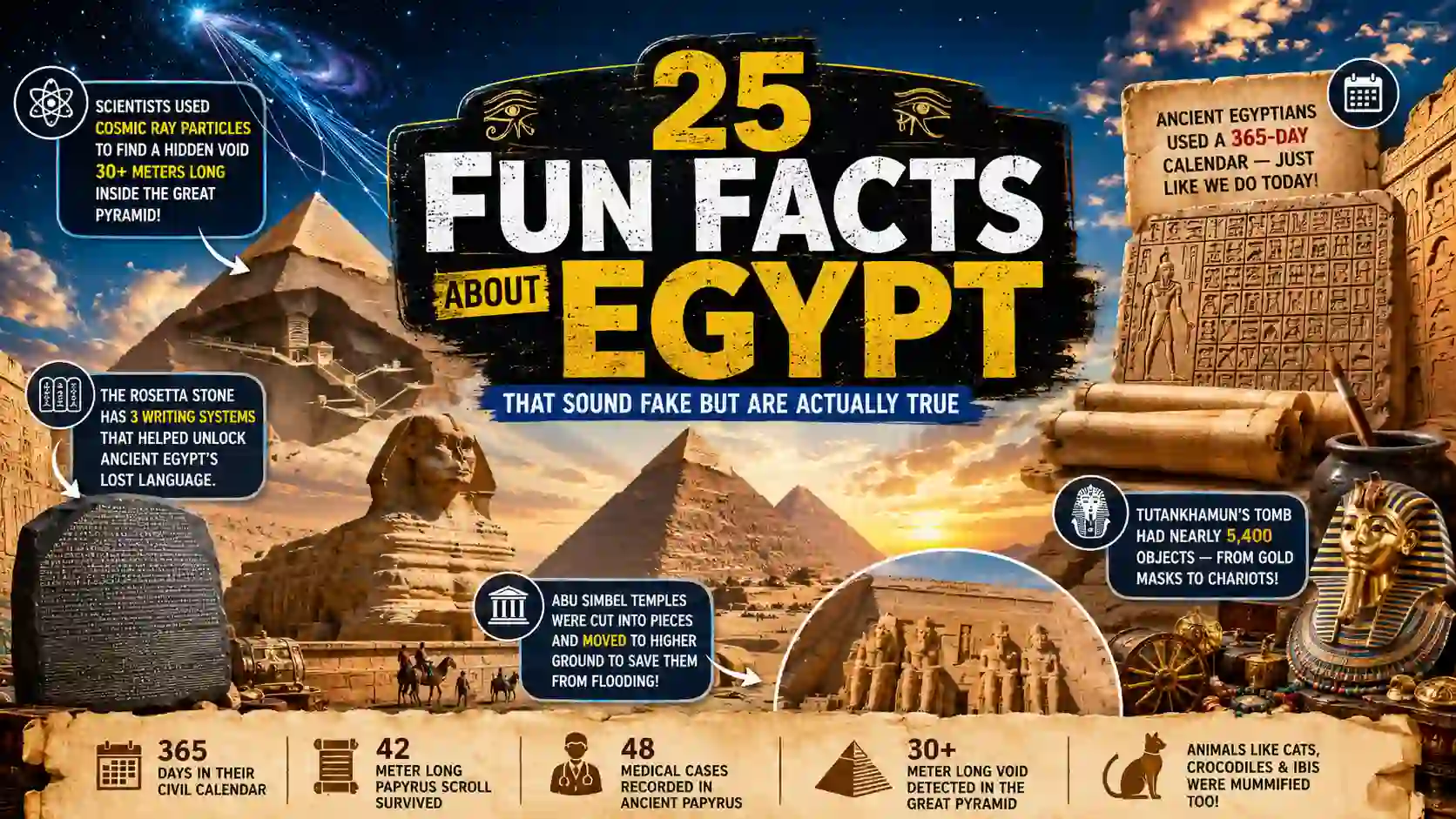
For example, scientists found a huge hidden space inside the Great Pyramid without breaking through its walls. The Rosetta Stone helped scholars understand ancient Egyptian writing. Ancient Egyptians also used a 365-day calendar.
These fun facts about Egypt show how advanced, creative, and organized this ancient civilization was. They also explain why ancient Egypt facts continue to fascinate people around the world.
Some facts are easy to believe. Others sound completely impossible.
Yet they are supported by archaeological evidence, museum collections, historical records, and scientific research.
So, get ready for some of the most interesting facts about Egypt—including strange discoveries, ancient inventions, surprising traditions, and mysteries that researchers are still trying to understand.
Quick Snapshot: Egypt at a Glance
| Dimension | Fascinating Reality | Why It Matters |
|---|---|---|
| Great Pyramid | The Great Pyramid of Giza is the only surviving wonder of the ancient world. | It remains one of humanity’s greatest architectural achievements. |
| Ancient writing | Egyptian hieroglyphs were used for thousands of years. | They preserve direct evidence of ancient Egyptian language and culture. |
| Hidden pyramid space | Scientists detected a void at least 30 meters long inside Khufu’s pyramid. | Modern science can reveal hidden spaces without taking ancient monuments apart. |
| Abu Simbel | The temples were dismantled and moved to higher ground to save them from flooding. | It became one of the world’s most famous heritage-rescue projects. |
1. Mind-Blowing Science & Ancient Engineering
1.1 The Great Pyramid Is the Last Ancient Wonder Still Standing
The Great Pyramid of Giza was one of the famous Seven Wonders of the ancient world.
Today, it is the only one still standing.
UNESCO lists the Great Pyramid as the only surviving wonder of the ancient world. The area around it also contains many other pyramids, tombs, and monuments.
This is one of the most amazing Egypt facts because the pyramid has survived for thousands of years.
1.2 Scientists Found a Huge Void Inside the Great Pyramid
This sounds like something from a science-fiction movie.
Scientists used particles called muons to study the inside of the Great Pyramid. Muons are produced when cosmic rays interact with Earth’s atmosphere.
The research revealed a large space above the Grand Gallery. It is at least 30 meters long.
Scientists still do not know exactly why this space was built.
This is one of the most fascinating fun facts about ancient Egypt because modern physics helped scientists study a monument built thousands of years ago.
1.3 Egypt’s First Pyramid Was a Step Pyramid
The Great Pyramid was not Egypt’s first pyramid.
The Step Pyramid of Djoser at Saqqara came earlier. It was built in a series of levels that look like giant steps.
This design shows how Egyptian builders developed the pyramid shape over time.
The Step Pyramid is therefore an important part of the story of ancient Egyptian history. It shows that pyramid building was a process, not a single invention.
1.4 Ancient Egyptians Used a 365-Day Calendar
Here is a fact that sounds surprisingly modern.
Ancient Egyptians used a calendar with 365 days.
Their year had 12 months. Each month had 30 days. They then added five extra days at the end of the year.
Their calendar was not exactly the same as the modern calendar because it did not have our leap-year system.
Still, the use of 365 days is one of the most interesting facts about ancient Egypt.
1.5 Egyptian Medicine Could Be Remarkably Systematic
Ancient Egyptian medicine was more organized than many people realize.
The Edwin Smith Papyrus contains descriptions of injuries and treatments. It includes observations, diagnoses, possible outcomes, and treatments.
The document mainly deals with physical injuries.
This does not mean ancient medicine was the same as modern medicine. However, it shows that Egyptian healers used careful observation and practical methods.
That makes it one of the most useful Egyptian history facts for understanding everyday life in the ancient world.
1.6 Ancient Egyptians Had Portable Makeup Kits
Ancient Egyptians cared about appearance and personal grooming.
They used kohl around the eyes. Archaeologists have found containers and small tools used for cosmetics.
Some ancient Egyptian beauty kits included items such as mirrors, razors, tweezers, and other grooming tools.
So, one of the fun facts about Egypt is that ancient Egyptians had something surprisingly similar to a modern personal-care kit.
The materials were different, but the idea was familiar.
1.7 Egyptians Used Papyrus Like an Ancient Writing Material
Papyrus was one of the most important writing materials in ancient Egypt.
It was made from the papyrus plant. Workers cut the plant into strips and placed the strips together to create sheets.
People used papyrus to record many kinds of information. These included religious texts, government records, medical information, and everyday matters.
Many surviving papyri are thousands of years old.
They give historians a valuable look at ancient Egyptian culture.
1.8 The Great Harris Papyrus Was About 42 Meters Long
Ancient documents were not always short.
The Great Harris Papyrus was originally about 42 meters long.
It contains information about royal donations and religious institutions during the reign of Ramesses III.
A 42-meter document is enormous by modern standards.
This is one of those amazing facts about Egypt that makes it easier to imagine how much written information ancient Egyptians could produce and preserve.
1.9 Ancient Egyptians Built Without Modern Construction Machinery
The pyramids were built long before modern cranes, trucks, engines, and construction machines existed.
Yet Egyptian workers moved huge stones and built enormous monuments.
Researchers still debate the exact methods used for some parts of pyramid construction. However, archaeological evidence shows that large teams of workers, including skilled craftsmen, were involved.
The real story is impressive enough.
It required planning, food supplies, transportation, stone cutting, organization, and skilled labor.
2. Historical Secrets & Cultural Quirks
2.1 The Rosetta Stone Uses Three Writing Systems
The Rosetta Stone is famous because the same decree appears in three forms of writing.
They are:
- Hieroglyphs
- Demotic
- Ancient Greek
Scholars could already read Greek. This helped them compare the texts and understand Egyptian writing.
The stone dates to 196 BC.
Its discovery became a major step toward understanding hieroglyphs and is one of the most important ancient Egypt facts in the history of archaeology.
2.2 Hieroglyphs Were Used for Thousands of Years
Hieroglyphs were not used for only a few centuries.
Egyptians used this writing system for thousands of years.
Other forms of Egyptian writing, such as hieratic and Demotic, were also used for different purposes.
The last known hieroglyphic inscription at Philae dates to AD 394.
That means Egyptian writing traditions continued for an extremely long time.
2.3 Ancient Egypt Had Cities Far More Complex Than Pyramids Suggest
Many people picture ancient Egypt as a land filled only with pyramids and temples.
The reality was much more complex.
Ancient Egyptian cities had homes, workshops, temples, administrative buildings, storage areas, and other facilities.
Memphis was one of the most important centers of ancient Egypt.
These remains show that Egypt was a large and organized society, not simply a civilization that built pyramids.
2.4 Ancient Egyptians Loved Bread and Beer
Bread and beer were important parts of the ancient Egyptian diet.
They were not simply treats. They were also connected with work and payment.
Workers could receive food and drink as part of their rations.
Ancient Egyptian beer was also different from the beer many people drink today. It was often thick and cloudy.
This is one of the more unusual fun facts about Egypt because bread and beer were closely connected with everyday life and the economy.
2.5 Egyptians Mummified Animals, Too
Mummies were not limited to humans.
Ancient Egyptians also mummified animals.
Archaeologists have found mummified cats, crocodiles, ibises, snakes, bulls, fish, and other animals.
Animal mummies were often connected with religious beliefs.
Some animals were associated with particular gods or religious practices.
This is one of the most surprising Egypt facts for people who only know about human mummies.
2.6 Egyptian Women Could Own Property
Ancient Egyptian women had some legal rights that may surprise modern readers.
Evidence shows that women could own property, inherit property, conduct business, and take legal action.
Some women could also divorce their husbands.
This does not mean ancient Egypt had modern gender equality. Life was still strongly shaped by social status and family roles.
However, the legal position of Egyptian women was more complex than the common stereotype suggests.
2.7 Tutankhamun’s Tomb Contained Thousands of Objects
Tutankhamun’s tomb became one of the most famous archaeological discoveries in history.
When the tomb was cleared, archaeologists recorded almost 5,400 individual objects.
These included furniture, jewelry, weapons, containers, clothing, ceremonial objects, and burial items.
The famous golden mask is only one part of the enormous collection.
The tomb gives historians a remarkable picture of royal life and burial practices in ancient Egypt.
3. Fun Facts About Egypt by the Numbers
| Number | What It Represents |
| 365 | Days in the ancient Egyptian civil calendar |
| 30 | Days in each of its 12 standard months |
| 5 | Extra days added at the end of the year |
| 42 m | Original approximate length of the Great Harris Papyrus |
| 48 | Case descriptions recorded in the Edwin Smith Papyrus |
| 30+ m | Minimum length of the Great Pyramid’s newly detected Big Void |
| 196 BC | Date of the Rosetta Stone’s decree |
| 3 | Writing systems on the Rosetta Stone |
| 38+ | Pyramids identified within the Memphis necropolis by UNESCO |
| 22 | Architectural complexes moved or protected during the UNESCO Nubian campaign |
| 4,000+ years | Age range represented by surviving Egyptian papyri and monuments |
These numbers show just how large and long-lasting ancient Egyptian civilization was.
From a 365-day calendar to a 42-meter papyrus, the numbers behind these interesting facts about Egypt make the history easier to understand.
4. Facts That Sound 100% Fake — But Are Actually True
4.1 A Pyramid Contains a Space Detected by Cosmic Particles
Scientists found a large hidden space inside the Great Pyramid.
They used muons, which are particles created by cosmic rays, to study the pyramid without opening it.
The hidden space is at least 30 meters long.
Its exact purpose is still unknown.
This is one of the best weird facts about Egypt because it combines ancient architecture with modern particle physics.
4.2 A Temple Was Literally Moved to Save It
Abu Simbel was once in danger of being flooded because of the Aswan High Dam project.
An international effort was launched to save important ancient monuments.
The temples were carefully cut into sections and rebuilt at a higher location.
The project took place from 1960 to 1980.
Moving an ancient temple sounds impossible.
But engineers and archaeologists actually did it.
4.3 The World’s Famous “Code-Breaking Stone” Was a Priest’s Decree
The Rosetta Stone sounds like a mysterious secret code.
It was not.
The stone contains a formal decree connected with Ptolemy V.
Its importance came from the fact that the decree was written in three scripts.
Because scholars could read Greek, the stone helped them understand Egyptian writing.
4.4 Cats Were Not the Only Animals Turned Into Mummies
Cats are strongly linked with ancient Egypt.
But they were not the only animals that were mummified.
Archaeologists have found mummies of crocodiles, ibises, snakes, bulls, fish, and other animals.
These animal mummies can tell researchers about Egyptian religion, culture, and daily life.
That makes them an important part of fun facts about ancient Egypt.
4.5 A 42-Meter Ancient Document Survived
The Great Harris Papyrus was about 42 meters long in its original form.
It contains information about royal gifts and religious institutions.
Imagine holding a document that long.
It would be far too large to read like a normal modern sheet of paper.
Its survival gives historians valuable information about the time of Ramesses III.
4.6 Ancient Egyptian Doctors Recorded Case Histories
The Edwin Smith Papyrus contains 48 medical cases.
The cases describe injuries and include observations, diagnoses, predictions about recovery, and treatments.
This shows that ancient Egyptian medicine included careful observation.
It was not based only on magic or religious beliefs.
That makes the papyrus an important source for understanding the history of medicine.
5. Can You Imagine? Egypt in Visual Analogies
5.1 Imagine a 42-Meter Scroll
Imagine measuring a distance of 42 meters.
Now imagine that entire distance covered by one ancient document.
That is roughly how long the Great Harris Papyrus was.
It shows how large some ancient Egyptian written records could be.
5.2 Imagine Finding a Hidden Room Without Opening the Wall
Imagine standing outside a huge stone pyramid.
You cannot see inside.
You do not drill through the wall.
Instead, you study particles passing through the stone.
That is roughly how scientists detected the hidden space inside the Great Pyramid.
Modern science allowed researchers to study an ancient monument without damaging it.
5.3 Imagine Moving an Ancient Temple
Imagine taking a huge ancient temple apart.
Then imagine moving its massive stone pieces to another location and putting everything back together.
That is what happened with major monuments during the UNESCO Nubian campaign.
Abu Simbel was moved to protect it from flooding.
It remains one of the most remarkable examples of modern heritage conservation.
5.4 Imagine 5,400 Objects in One Tomb
Tutankhamun’s tomb contained almost 5,400 individual objects.
Imagine trying to record, photograph, protect, and study thousands of objects from one tomb.
There were furniture pieces, jewelry, weapons, containers, and many other objects.
This explains why the discovery was so important for our understanding of ancient Egyptian royal life.
6. Debunking the Myths: Fiction vs. Reality
| Popular Myth | Actual Fact | Source / Proof |
| Slaves built the pyramids. | Evidence from Giza points toward a large Egyptian workforce that included skilled workers and manual laborers. | Harvard Digital Giza |
| The pyramids are the only major ancient Egyptian monuments. | Egypt has temples, tombs, palaces, settlements, workshops, and many other structures. | UNESCO |
| Hieroglyphs were just pictures. | Hieroglyphs could represent sounds, words, and ideas. | British Museum |
| The Rosetta Stone contains a secret code. | It contains a priestly decree written in three scripts. | British Museum |
| Only humans were mummified. | Egyptians also mummified many kinds of animals. | British Museum |
| Everything about the pyramids is already solved. | Researchers still debate some construction methods, and modern technology has found previously unknown spaces. | Nature |
These myths show why it is useful to check facts about ancient Egypt against reliable archaeological and museum evidence.
The real history is already fascinating without adding myths.
7. Mysteries Scientists Still Can’t Fully Explain
Ancient Egypt has given researchers many answers.
But it has also left many questions.
7.1 What Was the Great Pyramid’s Big Void For?
Scientists know that a large void exists inside the Great Pyramid.
They also know that it is at least 30 meters long.
But researchers still do not know exactly why the builders created it.
It may have had a structural purpose, but its exact function remains uncertain.
7.2 Exactly How Were the Largest Pyramid Stones Moved?
Researchers know that ancient Egyptians had organized workers, tools, transportation systems, and strong planning skills.
However, the exact methods used to move and raise every large stone are still debated.
Different ideas include ramps, sledges, lifting systems, and combinations of methods.
The important point is that the pyramids were built by skilled human workers—not by supernatural forces.
7.3 Why Were Some Animals Mummified in Such Huge Numbers?
Ancient Egyptians created huge numbers of animal mummies.
Researchers know that many were connected with religious beliefs.
But questions remain about how the animals were raised or collected, why certain species were chosen, and how these practices changed over time.
Animal mummies continue to provide new information about ancient Egyptian religion and society.
7.4 What Happened Inside Every Lost Egyptian Archive?
Not every ancient Egyptian document survived.
Papyrus can decay. Buildings can be destroyed. Documents can be reused or lost.
This means historians are working with only part of the ancient record.
We know a great deal about Egypt, but there are still many missing pieces.
Some of the most interesting ancient Egypt facts may be hidden in information that has not survived.
7.5 How Much More Is Still Hidden?
Egypt has been studied for hundreds of years.
Yet researchers still make important discoveries.
The hidden space inside the Great Pyramid is a good example.
A monument studied for generations still contained something that scientists had not known about.
That tells us that Egypt’s archaeological story is far from finished.
8. Share-This Fact
Scientists used cosmic-ray particles to detect a hidden void at least 30 meters long inside Egypt’s Great Pyramid.
This is one of the most shareable fun facts about Egypt because it connects an ancient monument with modern science.
9. The Ultimate Fun Facts About Egypt Brain Teaser
Think you know Egypt?
Try these questions before looking at the answers.
9.1 Which writing systems appear on the Rosetta Stone?
A. Egyptian, Latin, Arabic
B. Hieroglyphs, Demotic, Greek
C. Greek, Roman, Coptic
D. Hieroglyphs, Latin, Hebrew
Answer: B -Hieroglyphs, Demotic, and Ancient Greek.
9.2 How long was the Great Harris Papyrus originally?
A. About 4 meters
B. About 14 meters
C. About 42 meters
D. About 100 meters
Answer: C -About 42 meters.
9.3 What helped scientists detect a hidden void inside the Great Pyramid?
A. Radar from an airplane
B. X-rays from satellites
C. Cosmic-ray muons
D. Underground drilling
Answer: C -Cosmic-ray muons.
Score yourself:
3/3: Egyptologist energy.
2/3: Strong explorer.
1/3: Time for another trip through ancient Egypt.
0/3: The pharaohs demand a rematch.
10. Frequently Asked Questions About Fun Facts About Egypt
10.1 What is the most interesting fact about Egypt?
One of the most surprising facts is that scientists found a huge hidden space inside the Great Pyramid.
They detected it using cosmic-ray muons. The space is at least 30 meters long, but researchers still do not know exactly what it was built for.
10.2 What is Egypt famous for besides pyramids?
Egypt is famous for many things besides pyramids.
These include hieroglyphs, temples, mummies, the Nile, ancient cities, tombs, papyri, pharaohs, and monuments such as Abu Simbel and Karnak.
These are some of the most important Egyptian history facts for understanding the country’s ancient culture.
10.3 Did ancient Egyptians really use a 365-day calendar?
Yes.
Ancient Egyptians used a civil calendar with 365 days. It had 12 months of 30 days each, followed by five extra days.
However, it did not use a leap year like the modern calendar.
10.4 Did Egyptians really mummify cats?
Yes.
Ancient Egyptians mummified cats, but cats were not the only animals treated this way.
Archaeologists have also found mummified crocodiles, ibises, snakes, bulls, fish, and other animals.
Animal mummies were often connected with religious practices.
10.5 Were the pyramids built by slaves?
The popular story is misleading.
Evidence from Giza suggests that a large workforce of Egyptian laborers and skilled workers built the pyramids.
The workers needed food, housing, tools, and organization.
This gives us a better picture of the large society behind these monuments.
10.6 Why is the Rosetta Stone so important?
The Rosetta Stone contains the same decree in three writing systems.
These are hieroglyphs, Demotic, and Greek.
Because scholars could read Greek, they could compare the texts and use them to understand Egyptian writing.
It became a key to deciphering hieroglyphs.
10.7 How old is ancient Egyptian civilization?
Egyptian civilization has a very long history.
Writing appeared in Egypt by the late fourth millennium BC, while the political unification of Egypt is traditionally linked with around 3000 BC.
Egypt then went through many dynasties and political periods over thousands of years.
11. Why Egypt Still Captivates the World
Egypt is much more than a country famous for pyramids.
It is a record of what humans can achieve.
The pyramids show the power of planning, engineering, teamwork, and organization. The papyri show how Egyptians recorded medicine, religion, government, and daily life.
The Rosetta Stone shows how one ancient object can help recover lost knowledge.
Modern science is still adding new pieces to this story.
Scientists can now study hidden spaces inside ancient monuments. Archaeologists can examine animal mummies. Historians can read documents written thousands of years ago.
That is why fun facts about Egypt never seem to end.
Every discovery gives us another piece of the puzzle.
Conclusion
Egypt is much more than pyramids, mummies, and ancient pharaohs. Its history is full of amazing discoveries, clever inventions, huge monuments, and fascinating traditions. From the 365-day calendar to the hidden space inside the Great Pyramid, these fun facts about Egypt show how creative and skilled ancient Egyptians were.
The Rosetta Stone, ancient papyri, animal mummies, and medical records also give us a closer look at their daily lives and beliefs. Even today, scientists and archaeologists continue to find new clues about this ancient civilization.

hello! I am Irshad Ullah, and a passionate writer and lifelong learner dedicated to uncovering fascinating facts about science, history, nature, animals, space, and the world around us. I research each topic carefully and transform surprising information into clear, engaging, and enjoyable content. My goal is to satisfy curiosity, inspire learning, and help readers discover something amazing every day.