
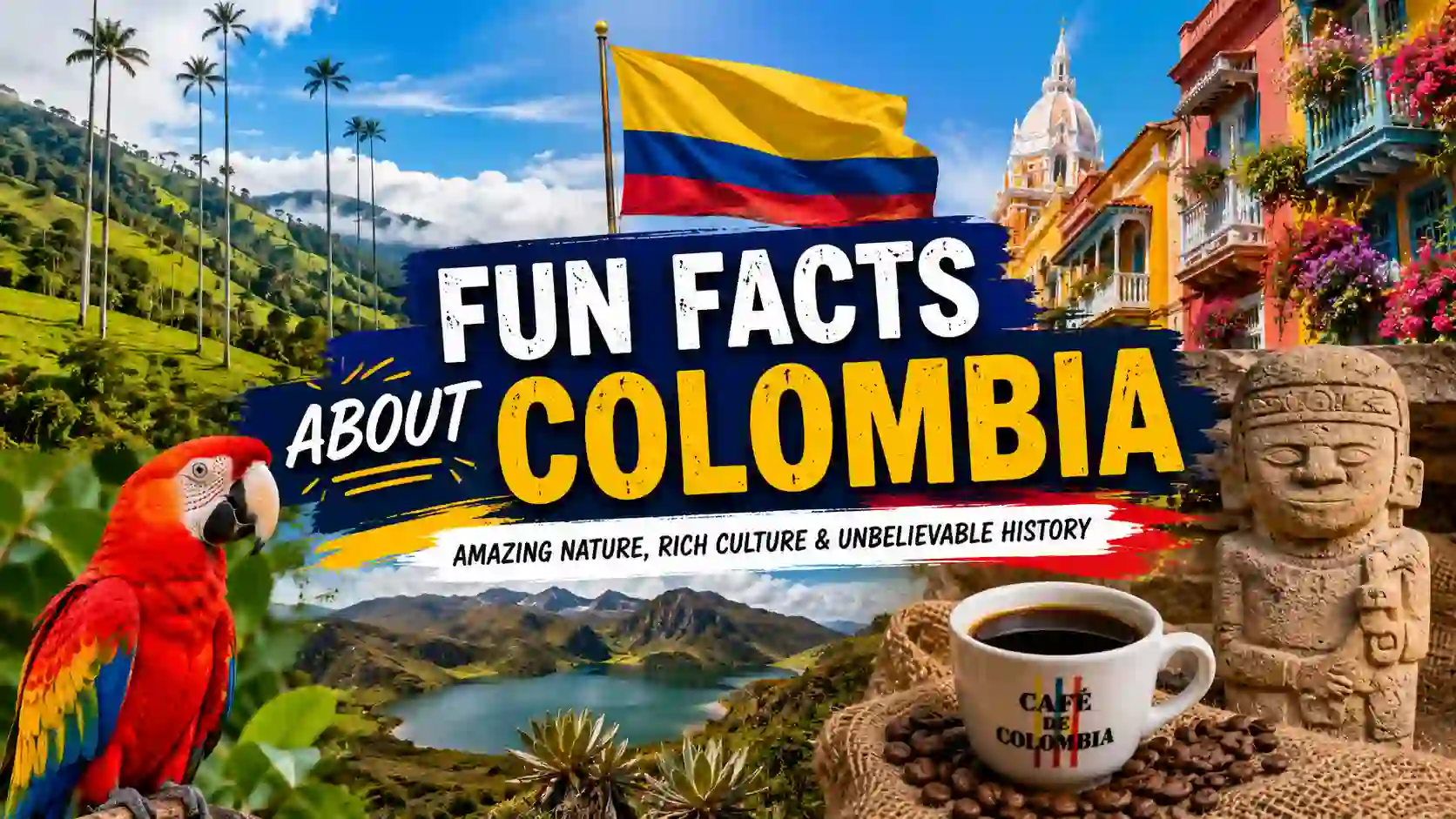
What is the most surprising fact about Colombia? Colombia is the second most biodiverse country on Earth, packing about 10% of all known species on the planet into a landmass that covers less than 1% of the world’s surface. It’s the only South American country with coastlines on two different oceans, and it grows nearly every emerald you’ve ever seen in a jewelry store window.
Why does a country this size hold so much wonder? Geography is the short answer. Colombia sits where the Amazon, the Andes, two oceans, and a wide stretch of Caribbean coast all meet in one territory. That collision of landscapes builds a country that feels like five countries stitched together.
Below are 27 fun facts about Colombia that cover its wild biodiversity, strange history, record-breaking numbers, and a few myths worth clearing up. Some will sound invented. They aren’t.
Quick Snapshot: Colombia in Numbers
| Dimension | Fascinating Reality | Why It Matters |
|---|---|---|
| Biodiversity rank | 2nd most biodiverse country on Earth, after Brazil | Colombia holds roughly 10% of the planet’s known species on 0.7% of its land |
| Coastlines | Only South American country touching both the Pacific and the Caribbean | Gives it two very different climates, cultures, and cuisines in one nation |
| Emeralds | Produces an estimated 70–90% of the world’s emeralds | Colombian emeralds are considered the finest quality on the market |
| Bird species | Home to more bird species than any other country, over 1,900 | More birds live here than in all of Europe and North America combined |
Mind-Blowing Science & Nature Facts About Colombia
1. Colombia holds 10% of Earth’s species in less than 1% of its land
Colombia covers just 0.7% of the planet’s land surface, yet it hosts roughly 10% of all known species on Earth. Rainforest, mountains, desert, and two coastlines all sit inside one country’s borders, and each ecosystem adds its own set of plants and animals to the tally.
2. It has more bird species than any country on the planet
Colombia is home to more species of bird than all of Europe and North America combined (source). Bird-watchers travel from around the world just to check species off their lists here, and new ones are still being found in remote cloud forests.
3. A river runs in five colors at once
Caño Cristales, nicknamed the “Liquid Rainbow,” turns red, yellow, blue, green, and black between June and November. Aquatic plants on the riverbed bloom during that window, and the mix of colors under clear water has never been fully copied anywhere else on Earth.
4. Roses here grow with unnaturally straight stems
Colombia sits almost exactly on the equator, which means sunlight hits its flower farms at a steady angle all year. That consistency produces some of the straightest rose stems in the world, one reason Colombia exports so many roses for Valentine’s Day and Mother’s Day bouquets worldwide.
5. The Amazon takes up more than a third of the country
Roughly a third of Colombia’s territory sits inside the Amazon basin, filled with rivers, dense jungle, and wildlife found nowhere else. Most Colombians never set foot there, since the region is remote and sparsely populated compared to the Andean cities.
6. Pink dolphins swim through its rivers
The Amazon basin in Colombia is home to boto dolphins, freshwater dolphins that turn pink as they age. Local legends claim they can shapeshift into handsome men at village parties, a story still told along the riverbanks today.
7. Colombia has more orchid species than almost anywhere else
Over 4,000 types of orchid grow across the country’s mountains and forests, more than in most other nations combined. The orchid is also Colombia’s national flower, chosen partly because so many unique varieties exist nowhere else.
8. One coastline sits in permanent drought, the other floods with rain
Colombia’s Caribbean side includes a genuine desert, La Guajira, while its Pacific coast is one of the wettest places on the planet. Both extremes exist within the same national border, separated by a few hundred miles of mountains.
Historical Secrets & Cultural Quirks
9. The country is named after a man who never set foot there
Colombia takes its name from explorer Christopher Columbus, who never actually visited the land that would later carry his name. The country adopted the name as a tribute during its early republic years, long after Columbus had died.
10. A lost city predates Machu Picchu by centuries
Ciudad Perdida, built by the Tayrona people in the Sierra Nevada mountains, dates back to around 800 AD, making it centuries older than Peru’s Machu Picchu. It stayed hidden in dense jungle until the 1970s, when looters stumbled onto its stone terraces.
11. The legend of El Dorado started with a real ritual
Long before anyone imagined a lost golden city, the Muisca people held a real ceremony at Lake Guatavita. A new chief was covered in gold dust, then rowed to the lake’s center to make offerings, a ritual Spanish conquistadors later twisted into the myth of a city made of gold.
12. A Colombian writer won a Nobel Prize for turning reality into magic
Gabriel García Márquez won the Nobel Prize in Literature in 1982 for novels built around magical realism, a style that blends the everyday with the impossible. His hometown of Aracataca inspired the fictional town of Macondo in “One Hundred Years of Solitude.”
13. Its coffee owes its flavor to a volcano
Colombia’s coffee-growing zone sits on volcanic soil at high altitude, a combination that gives the beans their smooth, mild flavor. The region is called the Paisaje Cultural Cafetero, a UNESCO World Heritage site where families still farm coffee by hand on steep hillsides.
14. A city once known for danger became a design icon
Medellín spent decades associated with violence before rebuilding itself around public transit, libraries, and public art. It later won an international award for urban innovation, a transformation now studied by city planners around the world.
Colombia By The Numbers
| Metric | Figure |
|---|---|
| Population | Around 52 million people |
| Capital | Bogotá |
| Bird species | Over 1,900, the most of any country |
| Plant species | Over 56,000 |
| Butterfly species | Over 3,000 |
| Share of world emerald production | An estimated 70–90% |
| Age of Ciudad Perdida | Roughly 1,200 years |
| Official languages | Spanish, plus more than 60 indigenous languages |
Facts About Colombia That Sound Fake (But Are Actually True)
15. Colombia grows nearly every fine emerald on the planet
Colombia is estimated to produce 70 to 90 percent of the world’s emerald market, more than every other emerald-producing country combined. Gem experts also rank Colombian stones as the finest in color and clarity available anywhere.
16. There’s a desert and a rainforest a short flight apart
You can stand in the bone-dry dunes of La Guajira in the morning and land in dripping Pacific rainforest by afternoon. Few countries this size hold two such opposite climates within a single domestic flight.
17. A river changes color depending on the season
Caño Cristales only shows its full rainbow during a short window each year. Too much rain washes the colors out, and too little sun stops the plants from blooming, so the display depends on a narrow, delicate balance of conditions.
18. Colombia has snow-capped peaks near the equator
Glaciers still cling to a few of Colombia’s highest Andean peaks, even though the country sits almost exactly on the equator. Altitude, not latitude, keeps the ice frozen at the summit while lowland valleys nearby stay tropical year-round.
19. One tiny frog here can kill with a touch
The golden poison frog, found in Colombia’s rainforests, carries enough toxin in its skin to be lethal to predators many times its size. Indigenous groups historically used the toxin to coat blowgun darts for hunting.
20. A whole cave system glows in the dark
Certain caves in Colombia host colonies of bioluminescent insects and fungi that light up passageways without any artificial light source. Explorers describe walking through some sections feeling like stepping into a starlit tunnel underground.
Can You Imagine? Colombia By Scale
- If Colombia’s known species were rice grains, each grain would fill roughly one-tenth of a stadium, since the country holds about 10% of all species on Earth despite its small share of the planet’s land.
- If every emerald mined in Colombia last century were laid end to end, the line would circle several city blocks, given the country supplies the vast majority of the world’s supply year after year.
- If Ciudad Perdida and Machu Picchu raced through time, the Colombian city would already be centuries old by the point Machu Picchu’s first stone was laid.
Debunking the Myths: Fiction vs. Reality About Colombia
| The Popular Myth | The Actual Fact |
|---|---|
| El Dorado was a lost city made of gold | It began as a real Muisca ritual involving a gold-dusted chief, not a literal golden city |
| Colombia is mostly jungle and nothing else | It also holds deserts, snow-capped peaks, savannahs, and two distinct coastlines |
| Colombian emeralds are rare and hard to find | Colombia is the world’s leading emerald producer, supplying most of the global market |
| The whole country is unsafe to visit | Major cities like Medellín and Bogotá have transformed into popular, developed travel destinations |
Mysteries Scientists Still Can’t Explain
- Why some Colombian frog species carry far more toxin than any known predator would ever require, more than survival alone seems to explain.
- What the exact mechanism is behind Caño Cristales’ seasonal color shift, since researchers still debate why the display appears in some years brighter than others.
- How many undiscovered species remain hidden in Colombia’s most remote Amazon and Chocó forest zones, areas scientists still haven’t fully surveyed.
- Why certain isolated mountain ecosystems in Colombia hold such a high share of endemic species found absolutely nowhere else on the planet.
Share-This Fact
Colombia covers under 1% of Earth’s land but holds roughly 10% of all its known species.
The Ultimate Colombia Brain Teaser
1. What percentage of the world’s emeralds does Colombia produce? A) 10-20% B) 30-40% C) 70-90% D) 100%
Answer: C
2. Which explorer is Colombia named after, despite never visiting the country? A) Vasco da Gama B) Christopher Columbus C) Ferdinand Magellan D) Hernán Cortés
Answer: B
3. Roughly how old is the lost city of Ciudad Perdida? A) 300 years B) 600 years C) 900 years D) 1,200 years
Answer: D
Comment your score below.
Frequently Asked Questions About Colombia
What makes Colombia one of the most biodiverse countries in the world? Its location combines the Amazon, the Andes, two oceans, and tropical plains in one territory. Each ecosystem supports its own set of species, which is why such a small country holds such a massive share of global biodiversity.
Is Colombia the largest coffee producer in the world? No. Brazil and Vietnam produce more coffee by volume. Colombia is known instead for growing some of the highest-quality arabica beans, thanks to volcanic soil and high-altitude farms.
What language do most people speak in Colombia? Spanish is the official language spoken nationwide, but the country also recognizes more than 60 indigenous languages, spoken by communities across the Amazon and Andean regions.
Why is Caño Cristales called the river of five colors? A plant called Macarenia clavigera blooms on the riverbed during a short window each year, turning the clear water red, yellow, green, blue, and black all at once.
Did the Tayrona people build Ciudad Perdida before or after Machu Picchu? Long before. Ciudad Perdida dates to around 800 AD, while Machu Picchu was built roughly 600 years later by the Inca civilization in the 15th century.
How many indigenous groups still live in Colombia today? Colombia recognizes dozens of distinct indigenous communities, many concentrated in the Amazon, the Sierra Nevada de Santa Marta, and remote Andean valleys, each with its own language and traditions.
What is Colombia’s national flower and why was it chosen? The orchid is Colombia’s national flower, selected in part because the country hosts over 4,000 orchid species, more variety than almost anywhere else on Earth.
Conclusion
Colombia packs an astonishing range of extremes into one country: deserts next to rainforests, a river that changes color, a lost city older than Machu Picchu, and enough biodiversity to rival continents many times its size. Few places on Earth compress this much wonder into one set of borders.

hello! I am Irshad Ullah, and a passionate writer and lifelong learner dedicated to uncovering fascinating facts about science, history, nature, animals, space, and the world around us. I research each topic carefully and transform surprising information into clear, engaging, and enjoyable content. My goal is to satisfy curiosity, inspire learning, and help readers discover something amazing every day.