
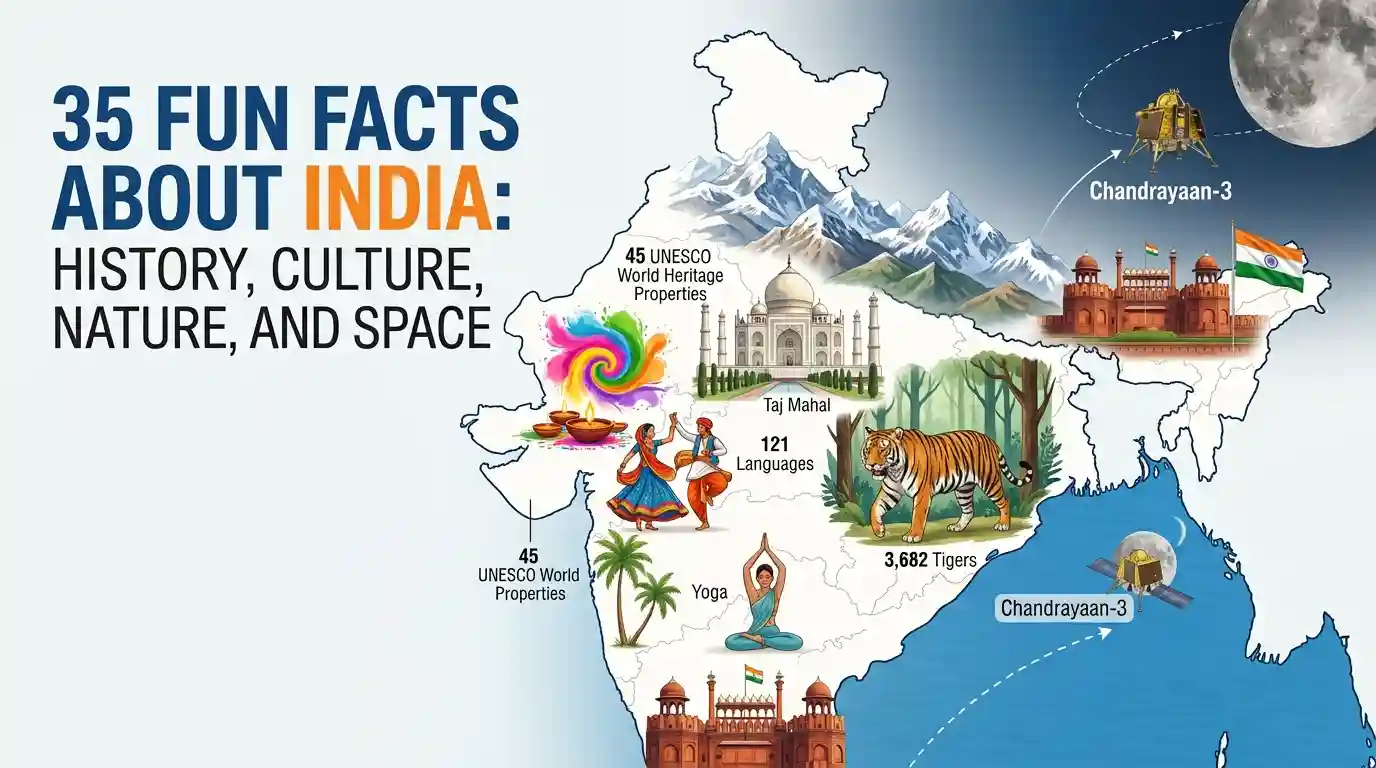
India is a country of huge variety. It has ancient cities, high mountains, tropical forests, and modern space technology. These fun facts about India show just how diverse the country is. India has 45 UNESCO World Heritage properties, according to UNESCO’s latest country listing. It is also home to thousands of tigers and one of the world’s richest language landscapes. India even reached the Moon’s south polar region with Chandrayaan-3 in 2023. From yoga and festivals to wildlife and ancient sites, India offers facts that are both surprising and useful.
India at a Glance
| Feature | Fact | Source |
| Official name | India, also called Bharat | Constitution of India |
| Administrative units | 28 states and 8 Union Territories | Government of India |
| World ranking by area | 7th largest country | National Portal of India |
| Population census | 2011 census recorded India’s population | Census of India |
| World Heritage | 45 UNESCO World Heritage properties | UNESCO |
| Estimated tigers | 3,682 in the 2022 national estimate | Government of India |
| First Moon landing | Chandrayaan-3 landed in 2023 | ISRO |
| Intangible heritage | 16 elements are listed by UNESCO | UNESCO |
A Country Shaped by Mountains, Seas, and Rivers
1. India is the world’s seventh-largest country by area.
India covers a vast part of South Asia. The National Portal of India describes it as the world’s seventh-largest country. The country stretches from the Himalayan region in the north toward the Indian Ocean in the south. Its location gives India many different landscapes, from high mountains to coastal plains.
Source: National Portal of India.
2. The Himalayas form India’s northern mountain wall.
The Himalayas mark much of India’s northern boundary. They separate the Indian subcontinent from the highlands farther north. The mountains also shape India’s climate, rivers, farming, and ecosystems. This makes the Himalayas much more than a scenic landmark.
Source: National Portal of India.
3. India touches both the Arabian Sea and the Bay of Bengal.
India’s mainland faces the Arabian Sea on the west and the Bay of Bengal on the east. Both are parts of the Indian Ocean. This position has influenced India’s trade, climate, fishing, ports, and coastal cultures for centuries.
Source: National Portal of India.
4. The Tropic of Cancer crosses India.
The Tropic of Cancer passes through India. It crosses several parts of the country and helps divide India’s broad climate zones. This is one reason India contains both tropical and subtropical environments.
Source: National Portal of India.
5. India’s population density was 382 people per square kilometer in 2011.
The 2011 Census recorded an average population density of 382 people per square kilometer. Density differs greatly between regions. Some areas are crowded plains and cities, while mountain and desert regions are much less populated.
Source: Government of India, Know India.
India’s History Lives in Stone
6. India has 45 UNESCO World Heritage properties.
UNESCO’s latest India listing shows 45 properties on the World Heritage List. They include cultural, natural, and mixed sites. Famous examples include the Taj Mahal, Ajanta Caves, Sundarbans, Western Ghats, and Khangchendzonga National Park.
Source: UNESCO World Heritage Centre.
7. The Taj Mahal became a World Heritage Site in 1983.
The Taj Mahal was added to the UNESCO World Heritage List in 1983. UNESCO classifies it as a cultural property. The site is located in Agra and is managed by the Archaeological Survey of India.
Source: UNESCO World Heritage Centre.
8. India’s Constitution was adopted on November 26, 1949.
The Preamble of the Constitution records November 26, 1949, as the date when the Constituent Assembly adopted the Constitution. The document later became the foundation of India’s constitutional system.
Source: Legislative Department, Government of India.
9. The Constitution came into force on January 26, 1950.
Article 394 states that the remaining provisions of the Constitution came into force on January 26, 1950. That date is officially described as the commencement of the Constitution.
Source: Legislative Department, Government of India.
10. India’s national flag was adopted before independence.
The Constituent Assembly adopted the present national flag on July 22, 1947. India became independent on August 15, 1947. The flag has three horizontal colors and a navy-blue Ashoka Chakra with 24 spokes.
Source: National Portal of India.
Languages Make India Sound Different From Region to Region
11. India’s 2011 language data identified 121 languages.
The 2011 Census language tables group India’s language diversity into 121 languages. These include languages from many different language families. This helps explain why language patterns can change sharply from one region to another.
Source: Census of India, 2011.
12. The 2011 Census identified 270 mother tongues with at least 10,000 speakers.
Census data recorded 270 identifiable mother tongues that each had at least 10,000 speakers at the national level. This is a reminder that India’s language diversity goes far beyond a short list of major languages.
Source: Census of India, 2011.
13. Hindi is only one part of India’s huge language picture.
The Census language tables list many major languages, including Hindi, Bengali, Marathi, Telugu, Tamil, Gujarati, Urdu, Kannada, Malayalam, Odia, Punjabi, and Assamese. India’s linguistic map is therefore highly regional and complex.
Source: Census of India, 2011.
14. India’s census also measures bilingualism and trilingualism.
The Census of India has a dedicated table for bilingualism and trilingualism. It records people who speak additional languages beyond their mother tongue. This gives researchers a deeper view of how Indians use languages in daily life.
Source: Census of India, 2011.
15. India’s Constitution calls the country “India, that is Bharat.”
Article 1 of the Constitution begins with the wording “India, that is Bharat.” Both names therefore appear in the country’s constitutional text. The wording is part of India’s formal constitutional identity.
Source: Constitution of India.
India’s Living Culture Has Global Reach
16. Yoga is on UNESCO’s Intangible Cultural Heritage list.
UNESCO inscribed yoga on the Representative List of the Intangible Cultural Heritage of Humanity in 2016. The listing describes yoga as an Indian practice involving poses, meditation, controlled breathing, and chanting.
Source: UNESCO.
17. India has 16 UNESCO-listed intangible cultural heritage elements.
UNESCO’s current India listing contains 16 elements of intangible cultural heritage. These include yoga, Kumbh Mela, Garba, Durga Puja, and traditional arts and performance traditions.
Source: UNESCO.
18. Garba became UNESCO-listed in 2023.
Garba of Gujarat was added to UNESCO’s Representative List in 2023. The traditional dance is strongly connected with Gujarat’s cultural life. Its listing places the tradition within an international heritage framework.
Source: UNESCO.
19. Kumbh Mela is also UNESCO-recognized.
Kumbh Mela was added to UNESCO’s Representative List of the Intangible Cultural Heritage of Humanity in 2017. It is one of India’s major cultural and religious gatherings.
Source: UNESCO.
20. Deepavali was added to UNESCO’s list in 2025.
UNESCO’s current India heritage records show Deepavali on the Representative List in 2025. This makes it one of the newest Indian cultural elements added to the list.
Source: UNESCO.
India’s Wildlife Can Surprise You
21. India had an estimated 3,682 tigers in 2022.
The All India Tiger Estimation for 2022 gave an average national estimate of 3,682 tigers. The estimated range was 3,167 to 3,925. The assessment used extensive field and camera-trap data.
Source: Ministry of Environment, Forest and Climate Change, Government of India.
22. India’s tiger estimate rose sharply since 2006.
The national tiger estimate increased from 1,411 in 2006 to 3,682 in 2022. The government reports an annual growth rate of about 6% when consistently sampled areas are compared.
Source: Ministry of Environment, Forest and Climate Change.
23. India is home to more than 70% of the world’s wild tigers.
Government reporting based on the 2022 tiger assessment places India as home to more than 70% of the world’s wild tiger population. This makes India’s tiger conservation work globally important.
Source: Government of India.
24. India’s 2022 tiger survey covered more than 641,000 square kilometers on foot.
The National Tiger Conservation Authority reports that the 2022 assessment surveyed more than 641,000 square kilometers on foot. It also used camera trapping and other scientific methods to estimate tiger numbers.
Source: National Tiger Conservation Authority.
25. India has 58 notified tiger reserves.
Government information published in 2025 states that 58 tiger reserves had been notified in India. Together, they cover nearly 2.5% of the country’s geographical area.
Source: Ministry of Environment, Forest and Climate Change.
National Tiger Conservation Authority — Tiger Estimation
India Reached the Moon
26. Chandrayaan-3 made India’s first successful Moon landing.
India’s Chandrayaan-3 mission achieved a successful soft landing on the Moon on August 23, 2023. The Vikram lander touched down near the lunar south polar region.
Source: Indian Space Research Organisation.
27. India became the fourth country to soft-land on the Moon.
ISRO states that Chandrayaan-3 made India the fourth country to accomplish a soft landing on the lunar surface. The mission marked a major step in India’s space program.
Source: ISRO.
28. Chandrayaan-3 reached the Moon’s south polar region.
The mission landed near the Moon’s south pole. ISRO described India as the first country to land near this region. The area is scientifically important because it has unusual terrain and permanently shadowed regions nearby.
Source: ISRO.
29. Chandrayaan-3 carried a rover named Pragyan.
The Chandrayaan-3 mission included the Vikram lander and the Pragyan rover. The rover carried out scientific experiments on the lunar surface. These experiments examined properties such as lunar soil and minerals.
Source: ISRO.
30. India has its own regional satellite navigation system.
ISRO identifies NavIC as India’s regional navigation satellite system. It is designed to provide positioning and timing services over India and parts of the surrounding region.
Source: Indian Space Research Organisation.
More India Facts That Are Easy to Remember
31. India’s national flag has 24 spokes in its Ashoka Chakra.
The navy-blue wheel in the center of India’s flag is the Ashoka Chakra. It has 24 spokes. The design comes from the wheel shown on the Sarnath Lion Capital associated with Emperor Ashoka.
Source: National Portal of India.
32. India has both cultural and natural World Heritage sites.
UNESCO’s India list includes cultural sites such as the Taj Mahal and natural sites such as the Sundarbans and Western Ghats. India also has Khangchendzonga National Park as a mixed property.
Source: UNESCO World Heritage Centre.
33. The Western Ghats are a UNESCO natural World Heritage property.
The Western Ghats were inscribed as a UNESCO natural World Heritage property in 2012. The site is important for its biological diversity and distinctive mountain ecosystems.
Source: UNESCO World Heritage Centre.
34. The Sundarbans are part of India’s UNESCO natural heritage.
Sundarbans National Park was inscribed on the UNESCO World Heritage List in 1987. It is part of the larger Sundarbans landscape, famous for its mangrove ecosystem and Bengal tiger habitat.
Source: UNESCO World Heritage Centre.
35. India’s heritage list keeps growing.
India’s UNESCO World Heritage record is not fixed forever. New properties can be added when they meet UNESCO’s requirements. The 2025 inscription of Maratha Military Landscapes of India shows that India’s recognized heritage continues to expand.
Source: UNESCO World Heritage Centre.
Frequently Asked Questions About India
What is India famous for?
India is famous for its cultural diversity, ancient heritage, languages, food, festivals, wildlife, yoga, monuments, and space program. UNESCO currently lists 45 World Heritage properties in India.
Source: UNESCO.
How many UNESCO World Heritage Sites does India have?
India has 45 properties on UNESCO’s World Heritage List according to the latest UNESCO country record. They include cultural, natural, and mixed properties.
Source: UNESCO World Heritage Centre.
What is India’s oldest major civilization?
India has a very long archaeological history. The Indus or Harappan civilization is one of the major early urban civilizations associated with the Indian subcontinent. For specific archaeological dates and sites, researchers rely on excavation records and archaeological evidence rather than a single starting date.
How many languages are spoken in India?
The 2011 Census identified 121 languages in its language classification. It also recorded 270 identifiable mother tongues with at least 10,000 speakers each. Source: Census of India.
When did India become a republic?
India’s Constitution came into force on January 26, 1950. Article 394 identifies that date as the commencement of the Constitution. Source: Legislative Department, Government of India.
When did India land on the Moon?
India landed on the Moon on August 23, 2023, when Chandrayaan-3’s Vikram lander completed its successful soft landing. Source: ISRO.
How many tigers are in India?
The 2022 All India Tiger Estimation produced an average estimate of 3,682 tigers. The reported range was 3,167 to 3,925. Source: Government of India.
What Indian tradition is recognized by UNESCO as intangible heritage?
Yoga is one such tradition. UNESCO inscribed yoga on its Representative List of the Intangible Cultural Heritage of Humanity in 2016. India’s list now contains 16 elements. Source: UNESCO.
Conclusion
These fun facts about India show why the country is so difficult to describe with a few words. India combines ancient heritage with modern science. Its languages create a huge cultural map. Its forests support major wildlife populations. Its traditions have gained global recognition. Its monuments connect the present with the past. And Chandrayaan-3 showed that India’s story also reaches beyond Earth. The most interesting part is this: India is not one simple story. It is many stories about living together across mountains, cities, villages, languages, forests, temples, and technology.

hello! I am Irshad Ullah, and a passionate writer and lifelong learner dedicated to uncovering fascinating facts about science, history, nature, animals, space, and the world around us. I research each topic carefully and transform surprising information into clear, engaging, and enjoyable content. My goal is to satisfy curiosity, inspire learning, and help readers discover something amazing every day.