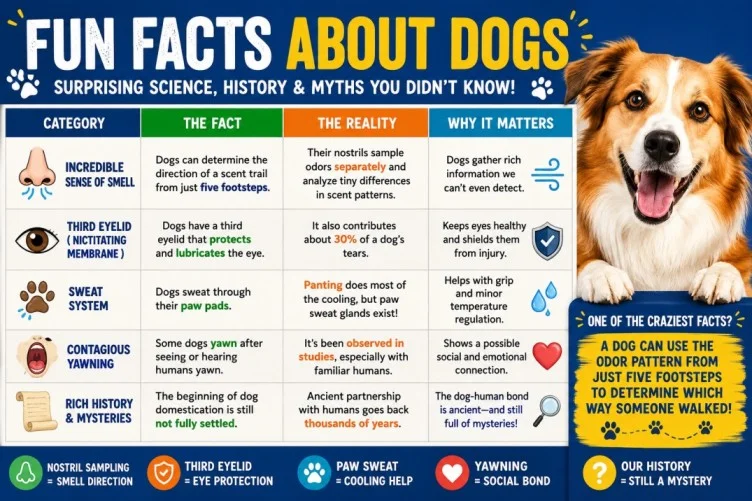
A dog can use the airflow around its nose to help locate where a smell comes from. Each nostril samples odor separately, while the nose’s unusual airflow keeps scent information available longer than a simple human-style sniff. Your dog is not merely “smelling harder.” Its nose is built like a tiny biological tracking system.
That is just one reason dogs are far stranger—and more impressive—than the usual “dogs have a great sense of smell” trivia. These fun facts about dogs go beyond the same recycled list of nose prints, dreams, and wagging tails. Here, you’ll find unusual canine science, historical surprises, strange anatomy, real mysteries, and facts that make ordinary dog behavior look completely different.
Quick Snapshot: Dogs by the Numbers
| Dimension / Metric | Fascinating Reality | Why It Matters |
|---|---|---|
| Smell | Each nostril can sample odors separately | Dogs can gather directional scent information |
| Sniffing | Some scent-tracking studies found dogs could determine direction from just five footsteps | Tiny odor differences can carry surprisingly rich information |
| Sweat | Dogs have cooling sweat glands in their paw pads | Panting does most of the cooling work |
| Yawning | Dogs can sometimes catch human yawns | Social behavior may cross the human-dog boundary |
| Eye protection | Dogs have a third eyelid | It helps protect and lubricate the eye |
Sources: pmc.ncbi.nlm.nih.gov, PubMed, akc.org.
Dogs — Mind-Blowing Science & Anomalies
1. A Dog’s Nose Can Compare Smells From Two Directions
A dog’s nostrils can collect separate odor samples. Scientists have proposed that this bilateral sampling helps dogs compare scent intensity and locate where an odor is coming from. Your dog may be building a directional “smell map” with every sniff. Source: pmc.ncbi.nlm.nih.gov.
2. Dogs Do Not Exhale Like Tiny Humans
During sniffing, airflow inside a dog’s nose follows unusual pathways. Air entering the olfactory region can remain in contact with scent-sensitive tissue while exhaled air is directed differently. This helps explain why a dog can keep investigating a smell through repeated sniffing. Source: pmc.ncbi.nlm.nih.gov.
3. Five Footsteps Can Reveal Which Way Someone Walked
In one scent-tracking experiment, dogs could determine the direction of a person’s trail from five sequential footsteps. They could not reliably do it when the same footprints were rearranged. The clue was the changing odor pattern—not simply the presence of footprints. Source: PubMed.
4. A Dog’s Nose Can Be a Left-Right Decision Maker
Research has found that dogs may use their nostrils differently depending on the emotional or familiar nature of a smell. Some studies have observed shifts between nostril use as odors become familiar or remain emotionally significant. The nose may be doing more than detecting scent; it may also be processing context. Human fact-check note: exact nostril preferences can vary by study and stimulus. Source: PMC.
5. Dogs Sweat—But Their Paws Do Most of the Visible Sweating
Dogs do have sweat glands in their paw pads. However, sweating plays only a small role in cooling them. Panting is the main cooling mechanism, helping moisture evaporate from respiratory surfaces.
Source: akc.org.
6. A Dog’s “Third Eyelid” Is Real
Dogs have an upper eyelid, a lower eyelid, and a third eyelid called the nictitating membrane. This membrane helps protect and lubricate the eye. Its associated gland contributes a significant portion of the eye’s tears. Source: akc.org.
7. Dogs Can Catch Human Yawns
Experiments have found that some dogs yawn after watching or hearing humans yawn. In one study, familiar human yawns appeared more likely to trigger the response than unfamiliar ones. The behavior is fascinating—but scientists still debate exactly what it means. Source: PubMed.
8. A Dog’s Nose Is Designed for Continuous Scent Sampling
A dog’s nose does not simply inhale once and stop analyzing. Specialized airflow patterns can help carry odor molecules toward sensory tissue and keep scent information available during the sniffing process. The canine nose is a remarkable piece of biological engineering. Source: PMC.
Dogs — Historical Secrets & Cultural Quirks
1. The Beginning of Dog Domestication Is Still Not Fully Settled
Dogs were among the earliest animals domesticated by humans. Yet researchers still debate exactly when, where, and how the human-dog relationship began. The story is ancient—but the precise beginning remains surprisingly difficult to pin down. Source: Smithsonian Institution.
2. One Famous “Oldest Dog Ever” Record Was Later Withdrawn
Bobi was once recognized as the oldest dog ever, with a claimed age of more than 30 years. In 2024, Guinness World Records withdrew the title after reviewing the available evidence and concluding that it could not conclusively verify his date of birth. Source: Guinness World Records.
3. A Dog Breed Can Be Named After a Fictional Character
The Dandie Dinmont Terrier is named after a fictional character from Sir Walter Scott’s novel Guy Mannering. That makes the breed’s name a rare example of fiction becoming part of real-world dog history.
Source: akc.org.
4. Ancient Human-Dog History Is Still Full of Missing Pieces
Archaeologists can study ancient bones, burials, and settlements, but those clues do not always reveal exactly how early humans and dogs interacted. The relationship may have developed gradually over a long period rather than through one single “domestication event.” Human fact-check note: the exact timeline remains debated. Source: Smithsonian Institution.
5. Dogs Have Been Shaped by Humans Into an Astonishing Range of Forms
Modern dogs include animals with dramatically different body shapes, sizes, coats, and working abilities. Yet all belong to the same domesticated species. The visual variety is one of the most striking results of long-term selective breeding.
6. A Dog’s History Is Not Just About Pets
Dogs have worked as hunters, herders, guardians, trackers, messengers, and companions. Their relationship with humans has been shaped by practical cooperation as well as affection. That is one reason dog history is also part of human history.
Fun Facts About Dogs by the Numbers
| Number | What It Represents | Why It’s Surprising |
|---|---|---|
| 5 | Footsteps used in one study to determine trail direction | Dogs extracted direction from odor sequence |
| 1 cm | Approximate “reach” of a dog’s nostril airflow in one airflow study | The nose actively draws in nearby air |
| 12–13% | Approximate portion of inhaled airflow directed toward the olfactory region in cited research | Not every breath follows the same path |
| 30% | Approximate contribution of the third-eyelid gland to a dog’s tears | The “extra eyelid” has a major job |
| 31 years, 165 days | Bobi’s claimed age when he died | The record was later withdrawn because the age could not be conclusively verified |
Sources: pmc.ncbi.nlm.nih.gov, PubMed, akc.org, Guinness World Records.
Facts That Sound 100% Fake (But Are Actually True)
1. A Dog Can Use Five Footsteps to Work Out Direction
In a controlled scent-tracking experiment, dogs could determine which way a person had walked using a sequence of just five footsteps. Rearranging the footsteps destroyed the directional information.
Source: PubMed.
2. Dogs Have a Third Eyelid
It is not a science-fiction feature. The nictitating membrane helps protect and lubricate the eye. Source: akc.org.
3. A Famous 30-Year-Old Dog Record Was Cancelled
Bobi was once recognized as the oldest dog ever. Guinness World Records later withdrew the recognition because it could not conclusively verify his birth date. Source: Guinness World Records.
4. Your Dog May React to Your Yawn
Some research has found contagious yawning between humans and dogs. The exact reason is still uncertain, but the behavior is real enough to have been tested experimentally. Source: PubMed.
5. A Dog’s Nose Can Sample Different Sides of the Smell World
Each nostril can receive separate odor information. This may help dogs compare scent intensity and locate an odor source. Source: PMC.
Can You Imagine? Visual Analogies
- Five footsteps: Imagine a dog reading a tiny invisible trail that changes from step to step—and using those changes to work out the direction of travel.
- One centimeter of airflow reach: Picture a miniature invisible bubble of air around each nostril. A sniff can draw nearby odor-filled air into that sensory system.
- A third eyelid: Imagine having a built-in windshield wiper that can slide across your eye to help protect and lubricate it.
- A dog’s history: Imagine a partnership so old that scientists can still debate its exact beginning thousands of years later.
Debunking the Myths: Fiction vs. Reality
| The Popular Myth | The Actual Fact | The Source / Proof |
|---|---|---|
| Dogs do not sweat | Dogs have sweat glands in their paw pads, although panting does most cooling | akc.org |
| A dog has only two eyelids | Dogs also have a third eyelid, the nictitating membrane | akc.org |
| Dogs only smell “strongly” | Their nasal airflow and separate nostril sampling support complex odor analysis | PMC research |
| The oldest dog record is permanently settled | Bobi’s record was later withdrawn after Guinness reviewed the evidence | Guinness World Records |
| A dog yawning after you yawn is just coincidence | Experimental studies have documented contagious yawning in dogs, though its meaning remains debated | PubMed |
Mysteries Scientists Still Can’t Explain
1. Exactly How Did Wolves Become Dogs?
Scientists agree that dogs descended from ancient wolf populations, but the precise pathway to domestication remains debated. Did humans actively capture and breed wolves? Did friendlier wolves gradually approach human settlements? The full story is still incomplete.
2. What Does Contagious Yawning Really Mean in Dogs?
Dogs can sometimes respond to human yawns, but researchers still debate whether the behavior reflects empathy, social attention, arousal, simple behavioral contagion, or another mechanism. The behavior is easier to observe than its meaning is to explain.
3. How Much Can Dogs Build a “Scent Map” of the World?
Dogs clearly use complex odor information. Studies show that scent can provide directional clues. But scientists are still investigating how dogs combine odor, airflow, memory, and other senses to create a usable picture of their surroundings.
Share-This Fact
A dog can use the odor pattern from just five footsteps to determine which way someone walked.
The Ultimate Fun Facts About Dogs Brain Teaser
1. What can a dog use to determine the direction of a scent trail in one study?
A. One footprint
B. Five footsteps
C. A visual map
D. A sound recording
2. What is the nictitating membrane?
A. A dog’s inner ear
B. A scent receptor
C. A third eyelid
D. A sweat gland
3. What happened to Bobi’s record as the oldest dog ever?
A. It was transferred to a new breed
B. It was permanently confirmed
C. It was withdrawn after evidence was reviewed
D. It was never officially recognized
Answers ↓
- B — Five footsteps
- C — A third eyelid
- C — It was withdrawn after evidence was reviewed
People also Search:
What are some fun facts about dogs that most people do not know?
Dogs can use separate odor samples from their nostrils, determine scent-trail direction from a small sequence of footsteps, sweat through their paw pads, and use a third eyelid to help protect their eyes. Some dogs also respond to human yawns.
Can dogs really tell which direction a person walked?
Yes. In one controlled study, dogs were able to determine the direction of a person’s scent trail from five sequential footsteps. They could not reliably do so when the same footprints were rearranged, showing that the changing odor pattern mattered.
Do dogs have three eyelids?
Yes. Along with upper and lower eyelids, dogs have a third eyelid called the nictitating membrane. It helps protect and lubricate the eye, and its associated gland contributes a substantial portion of a dog’s tears.
Do dogs sweat through their paws?
Yes, dogs have sweat glands in their paw pads. However, sweating is only a small part of their cooling system. Dogs mainly regulate body temperature through panting and the evaporation of moisture from their respiratory system.
Why do some dogs yawn after humans yawn?
Studies have found that human yawns can sometimes trigger yawning in dogs. Researchers have proposed several explanations, including social attention and emotional connection, but the exact mechanism is still not fully settled.
Is the oldest dog ever record still Bobi?
No. Guinness World Records withdrew Bobi’s record in 2024 after reviewing the available evidence and concluding that it could not conclusively verify his date of birth.
Conclusion
Dogs are fascinating not only because they can smell extraordinarily well. Their noses sample the world in complex ways. Their eyes have a hidden third eyelid. Their paws can sweat. Their behavior can even echo ours through contagious yawning. And the ancient story of how dogs became our companions is still not completely solved.
The most surprising fact may be the smallest: in one study, just five footsteps carried enough changing odor information for dogs to work out a direction. That is a remarkable reminder that dogs experience a world filled with invisible information we barely notice.

hello! I am Irshad Ullah, and a passionate writer and lifelong learner dedicated to uncovering fascinating facts about science, history, nature, animals, space, and the world around us. I research each topic carefully and transform surprising information into clear, engaging, and enjoyable content. My goal is to satisfy curiosity, inspire learning, and help readers discover something amazing every day.