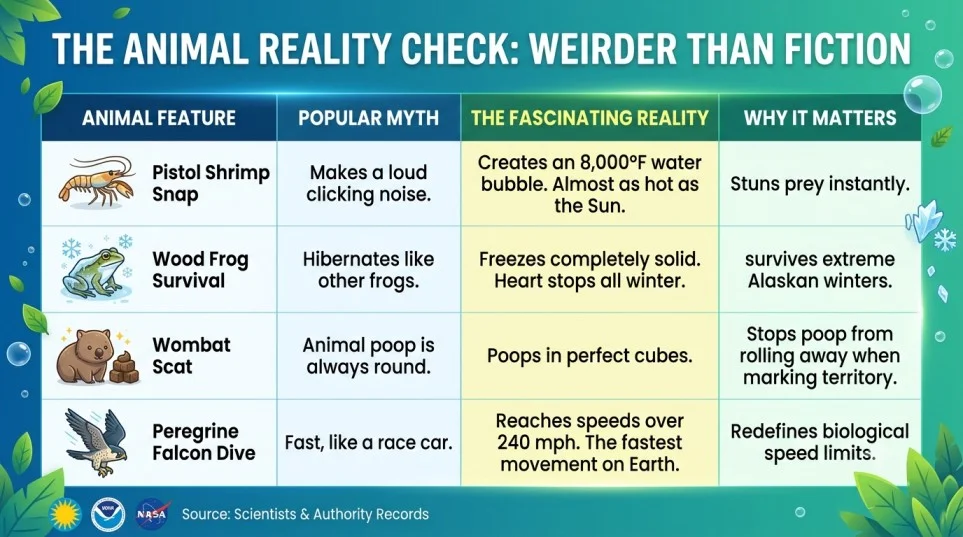
Think you know everything about animals? Think again. Most websites tell you the same old stories—like how flamingos turn pink from eating shrimp or how fast cheetahs can run. But nature is way stranger, wilder, and more surprising than what you learned in school.
From ocean creatures that bend the rules of physics to small forest mammals with amazing hidden abilities, nature works in super weird ways. Did you know a tiny pistol shrimp can make a water bubble almost as hot as the surface of the sun? Or that wood frogs freeze solid like ice cubes all winter and just wake up in the spring?
We skipped the boring, overused facts to bring you real, scientist-approved animal discoveries. Whether you want to impress your friends or just love learning cool things, these facts show how wild the animal world really is.
Quick Snapshot
| Dimension / Metric | Fascinating Reality | Why It Matters |
| Loudest Animal (Relative Size) | The tiny 12mm Water Boatman bug makes a 99-decibel sound by rubbing its belly. | Shows that an animal doesn’t need to be big to make a huge noise. |
| Maximum Animal Density | Grassy fields can hold an average of 50,000 spiders in every single acre. | Shows how many hidden spiders are constantly hunting pest insects. |
| Highest Altitude Mammal | The Andean leaf-eared mouse lives 22,000 feet high up in the mountains. | Changes what scientists thought animals need to breathe super thin air. |
| Extreme Fur Density | Sea otters have up to 1 million hairs packed into one square inch of skin. | Keeps them warm in freezing water without needing extra body fat. |
Animals — Mind-Blowing Science & Anomalies
1. Pistol Shrimp Snap Bubbles Hotter Than the Sun’s Surface
When a pistol shrimp snaps its claw shut fast, it shoots out a quick jet of water. This jet creates a tiny bubble that immediately collapses. Inside that collapsing bubble, temperatures briefly reach over 8,000 degrees Fahrenheit, creating a loud bang that knocks out prey.
Source: ocean.si.edu
2. Wood Frogs Freeze Solid and Stop Their Hearts All Winter
To survive freezing Alaskan winters, wood frogs flood their organs with body sugar, which works like a natural antifreeze. Up to 60% of the water in their body turns to solid ice, their hearts completely stop, and they stop breathing. When spring arrives, they simply thaw out and hop away.
3. Hagfish Produce Liters of Slime in Milliseconds
When an enemy attacks, the deep-sea hagfish squirts specialized slime threads out of its skin. In less than a second, this tiny bit of fluid mixes with ocean water and expands into over a gallon of thick, sticky slime. Predators bite down, start choking on the goo, and let go right away.
Source: noaa.gov
4. Alston’s Singing Mice Take Turns Talking Like Humans
Alston’s singing mice talk to each other using high-pitched songs, and they follow strict rules just like humans do when talking. They pause and wait for their friend to stop singing before they reply, taking turns in under a split second. Scientists study their brains to learn more about human speech.
5. Fire Salamanders Glow Under Ultraviolet Light
Even though scientists in Europe have studied fire salamanders for over 250 years, they recently found a cool hidden trick. Under special ultraviolet (UV) light, the salamander’s skin glows in bright colors. Researchers think this glowing trick helps salamanders recognize each other in dark forests.
6. Wombat Droppings Are Shaped Like Cubes
Wombats are the only animals in the world that poop in the shape of little cubes. Their intestines have stretchy and stiff spots that squeeze their digesting food into flat blocks right before it comes out. Since wombats leave poop on top of rocks to mark their territory, the square shape keeps it from rolling away.
7. Mantis Shrimp Punch with the Acceleration of a Bullet
A mantis shrimp can punch its club-like front legs underwater so fast that it speeds up like a bullet fired from a gun. The punch reaches speeds of 50 mph, making the water around it vaporize into flash-boiling bubbles and creating shockwaves strong enough to crack glass aquarium walls.
8. Immortal Jellyfish Can Reset Their Age Clock
The immortal jellyfish (Turritopsis dohrnii) has a real life cheat code. When it gets hurt, starves, or faces severe stress, it can turn its full-grown adult cells back into baby cells. By constantly hitting this reset button, it can theoretically avoid dying of old age forever.
Animals — Historical Secrets & Cultural Quirks
1. Ancient Humans Carried Wolves to Islands and Cared for Them
Digger sites on far-away islands show that ancient humans took wild wolves on boats across the ocean thousands of years ago. By looking at the wolf bones, scientists found that humans fed, protected, and raised these wolves, proving people formed deep bonds with wild animals long ago.
2. Cuban Crocodiles Can Gallop Across Land Like Horses
Unlike most alligators and crocodiles that drag their bellies on the ground, Cuban crocodiles have long, athletic legs. These strong legs allow them to run on land in a true bounding gallop, reaching speeds up to 11 mph to chase down prey.
Source: nationalzoo.si.edu
3. Koalas Have Fingerprints Indistinguishable From Humans
Koala fingerprints look so much like human fingerprints that even crime scene investigators using high-tech microscopes can’t easily tell them apart. Koalas evolved these swirly patterns on their paws to get a tight grip on smooth eucalyptus branches, occasionally confusing police in Australia.
4. Pigeons Can Recognize Individual Human Faces Across Years
Tests show that neighborhood pigeons easily remember human faces and hold long grudges. They remember which specific people give them bread crumbs and which people shoo them away. Even if a person changes their clothes, the pigeons still recognize their face years later.
5. Elephants Have Elaborate Death Rituals
When an elephant dies, its family members gather around, gently stroke the body with their trunks, and stay in quiet mourning for days. Even stranger, completely random elephant herds passing by will stop, inspect the bones, and stand quietly before moving along.
6. Sea Lions Can Naturally Keep Complex Musical Beats
Sea lions are among the only non-human mammals that can naturally dance to a beat. In science labs, sea lions quickly learned how to bob their heads perfectly in time with upbeat songs, proving their brains can naturally connect what they hear to how they move.
Fun Facts About Animals By The Numbers
| Statistic | Subject Animal | Real-World Context |
| 100,000+ | Sea Otter (Hairs / $cm^2$) | The thickest fur on Earth, trapping warm air bubbles close to the skin. |
| 242 mph | Peregrine Falcon (Dive Speed) | The fastest dive on the planet, hit when hunting birds from the sky. |
| 14,000 | Microscopic Snail Teeth | Tiny, hard teeth lined up on a scratchy tongue used to scrape up food. |
| 22,000 ft | Leaf-Eared Mouse Habitat | The highest place any mammal lives, recorded high in the Andes mountains. |
| 3 Miles | Howler Monkey Call Distance | How far a monkey’s loud territorial roar can travel through thick jungle trees. |
Facts That Sound 100% Fake (But Are Actually True)
- Ghost Crabs Growl Using Teeth Inside Their Stomachs: To scare off bullies, ghost crabs rub hard, tooth-like structures inside their stomach together. This makes a loud growling noise without the crab ever having to open its claws.
- Male Fruit Flies Produce 2mm Sperm Cells: Tiny fruit flies make giant reproductive cells that are nearly two millimeters long—over 1,000 times bigger than human ones—and tightly coil them up to fit inside their bodies.
- Horned Lizards Shoot Blood Out of Their Eyes: When a coyote or dog corners a horned lizard, the lizard squeezes blood vessels in its head until they pop, shooting a stream of gross-tasting blood out of its eyes up to 3 feet away.
- Rats Crack Up When You Tickle Their Backs: Rats love being tickled! When scientists gently tickle a rat’s back, the rat makes happy, high-pitched squeaks that humans can only hear with special equipment. They will even chase the scientist’s hand to get tickled more.
- Bees Use Five Eyes to Navigate: On top of the two big eyes on the sides of their head, bees have three extra simple eyes right on top of their forehead. These extra eyes help them sense light brightness and fly safely.
“Can You Imagine?” (Visual Analogies)
- Blue Whale Tongue: A full-grown blue whale’s tongue weighs around 6,000 pounds—which is the exact same weight as a huge female Asian elephant or a big delivery truck.
- Colossal Squid Eye: A colossal squid’s eye measures about 11 inches across—making it the exact same size as an official NBA basketball, helping it see glowing prey in the pitch-black ocean depths.
- Jackrabbit Leaping Power: A white-tailed jackrabbit can jump 21 feet in just one single hop—clearing a distance longer than three adult men lying down head-to-toe.
Debunking the Myths: Fiction vs. Reality
| The Popular Myth | The Actual Fact | The Source / Proof |
| Goldfish only have a 3-second memory. | Goldfish remember things for months, can learn tricks, and recognize their owners. | Widely documented fish memory experiments |
| If you touch a baby bird, its mom will abandon it. | Birds actually have a very weak sense of smell and won’t reject a chick handled by humans. | Bird biology consensus / Audubon Society |
| Lemmings jump off ocean cliffs on purpose. | A movie crew purposefully tricked and chased lemmings off a cliff for a 1958 film. | Documentary movie history records |
| Polar bear fur is colored pure white. | Polar bear hairs are actually clear, hollow tubes that reflect sunlight to look white. | National Wildlife Federation |
Mysteries Scientists Still Can’t Explain
1. How Eels Navigate Thousands of Miles to Spawn
European and American eels spend most of their lives swimming in freshwater rivers. But when it is time to have babies, they swim thousands of miles into the middle of the Atlantic Ocean to an area called the Sargasso Sea. Scientists have never actually caught wild adult eels laying eggs there, and nobody knows how baby eels find their way back to the exact rivers their parents came from.
2. Why Whales and Dolphins Mass Strand Themselves
Even though whales and dolphins use incredible built-in sonar to see underwater, whole groups of them still swim onto beaches together and get stuck. While scientists guess it might be caused by underwater noise pollution, solar storms messing up their navigation, or following a sick leader, nobody knows the exact reason why it happens.
3. The True Mechanism Behind Bird Magnetoreception
Scientists know migratory birds can feel Earth’s invisible magnetic field to fly in the right direction, but they can’t figure out how birds actually feel it. Some scientists think special proteins inside a bird’s eyes let them literally “see” magnetic fields, while others think tiny magnetic particles inside their beaks act like a built-in compass.
Share-This Fact 🔥
Pistol shrimp snap their claws so fast that the collapsing bubble briefly reaches 8,000°F—nearly as hot as the surface of the sun!
The Ultimate Fun Facts About Animals Brain Teaser
Question 1: Which creature uses teeth inside its stomach to produce a growling sound?
A) Electric Eel
B) Ghost Crab
C) Fire Salamander
D) Mantis Shrimp
Question 2: How high above sea level does the Andean leaf-eared mouse live?
A) 10,000 feet
B) 14,000 feet
C) 18,000 feet
D) 22,000 feet
Question 3: What happens when a pistol shrimp snaps its claw shut?
A) It creates a bubble as hot as the sun’s surface.
B) It shoots blood out of its eyes.
C) It freezes solid instantly.
D) It secretes a gallon of thick slime.
Frequently Asked Questions
What animal has the strongest bite force relative to its size?
The coconut crab has one of the strongest grips of any creature on land for its size. Their large claws can squeeze with over 700 pounds of force, letting them pop open tough coconuts like soft fruit.
How do wood frogs survive being frozen solid?
Wood frogs fill their bodies with extra blood sugar that acts like a built-in shield. This prevents sharp ice crystals from popping their cells while allowing the rest of their body water to freeze safely until spring.
Are there any mammals that lay eggs instead of giving live birth?
Yes! Monotremes are a special group of egg-laying mammals. The platypus and four species of echidna (spiny anteaters) are the only living mammals that lay eggs instead of giving birth to live babies.
Why do wombats produce cube-shaped droppings?
Wombats have unique intestines with stiff and soft sides that press food waste into square blocks right before they poop. The cube shape stops their droppings from rolling off rocks when marking their territory.
Can animals actually communicate using structured turns?
Yes! Alston’s singing mice talk to each other by taking clean, polite turns. They pause to let their friend finish singing before chiming in, switching turns in just a fraction of a second.
Unlocking Nature’s Weirdest Marvels
The animal kingdom is full of unbelievable surprises. From tiny mice making homes on frigid 22,000-foot mountain tops to ocean shrimp making heat hot enough to rival the sun, nature’s tricks are cooler than anything in movies. The more scientists explore deep forests and hidden oceans, the clearer it becomes that our world is packed with amazing living wonders.
Which mind-blowing fact surprised you the most? Tell us in the comments below, and share this page with a friend who loves cool animal facts!

hello! I am Irshad Ullah, and a passionate writer and lifelong learner dedicated to uncovering fascinating facts about science, history, nature, animals, space, and the world around us. I research each topic carefully and transform surprising information into clear, engaging, and enjoyable content. My goal is to satisfy curiosity, inspire learning, and help readers discover something amazing every day.