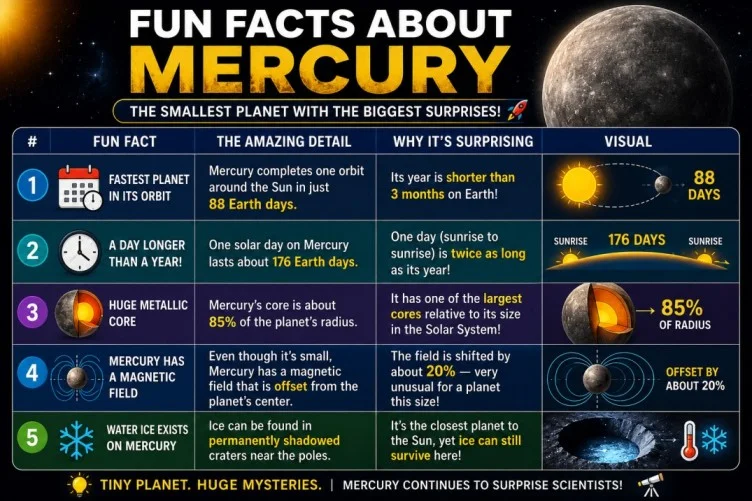
Mercury has a strange secret: the planet closest to the Sun is not the hottest planet in the Solar System. That title belongs to Venus.
But Mercury may be even more surprising. It has a huge metallic core, a magnetic field that is strangely offset, water ice hiding in permanent darkness, and mysterious bright hollows that scientists still cannot fully explain. Some of its surface features may be only about 100,000 years old—astonishingly young compared with a planet that formed billions of years ago.
These fun facts about Mercury go beyond the usual “smallest planet” and “closest to the Sun” trivia. Here, you will find unusual geology, strange orbital behavior, extreme temperatures, ancient history, and mysteries that spacecraft have revealed but not completely solved.
Quick Snapshot: Mercury at a Glance
| Dimension / Metric | Fascinating Reality | Why It Matters |
|---|---|---|
| Distance from the Sun | About 58 million km on average | Sunlight is far more intense than on Earth |
| Year | Only 88 Earth days | Mercury completes the fastest planetary orbit |
| Solar day | About 176 Earth days | One sunrise-to-sunrise cycle lasts twice as long as its year |
| Core | About 85% of the planet’s radius | Mercury has an unusually large metallic interior |
| Surface temperature | About 430°C by day and −180°C at night | Its thin exosphere cannot retain heat effectively |
NASA identifies Mercury as the smallest planet and the fastest planet in its orbit around the Sun. Its extreme day-night temperatures and enormous core make it one of the Solar System’s most unusual rocky worlds.
Mercury — Mind-Blowing Science & Anomalies
1. Mercury Has a Giant Core for Such a Small Planet
Mercury’s metallic core occupies roughly 85% of the planet’s radius. That is an enormous proportion compared with the rocky planets we know best.
This unusual interior is one of Mercury’s biggest scientific puzzles. Scientists have proposed several explanations for its metal-rich composition, but no single formation story explains every feature perfectly.
2. Mercury Has a Magnetic Field Despite Being Tiny
Mercury is small, but its interior is not completely dead. It has an active magnetic field generated by processes inside its core.
The field is much weaker than Earth’s, yet it is strong enough to create a magnetosphere and interact with the solar wind. That makes Mercury an important natural laboratory for studying planetary interiors.
3. Its Magnetic Field Is Surprisingly Off-Center
Mercury’s magnetic field is not perfectly centered on the planet. Observations showed that the field is offset along the planet’s spin axis by about 20% of Mercury’s radius.
That is a strange feature. It gives scientists clues about how Mercury’s interior works and how its magnetic field is generated.
4. Mercury Has Mysterious “Hollows”
Thousands of strange, shallow depressions cover parts of Mercury’s surface. Scientists call them hollows.
They can range from about 18 meters to more than 1.6 kilometers across. Their exact formation process remains uncertain, and they appear to be unique among known planetary landforms.
5. Some of Mercury’s Weirdest Features May Be Young
Mercury’s hollows are bright and relatively young compared with the planet’s ancient craters.
Some estimates place their average age at roughly 100,000 years, although the exact timing and formation process remain active areas of research. On a planet billions of years old, that is incredibly recent.
6. Water Ice Exists on the Planet Closest to the Sun
This sounds impossible at first. Mercury can become hot enough to reach about 430°C.
Yet some deep polar craters never receive direct sunlight. These permanently shadowed regions can remain cold enough for water ice to survive.
7. Mercury’s Atmosphere Is Not Really Like Earth’s
Mercury does not have a thick atmosphere like Earth, Venus, or Mars. Instead, it has an extremely thin exosphere.
Particles can come from the solar wind, sunlight-driven processes, and material released from the surface. Because this environment cannot trap heat effectively, Mercury experiences huge temperature swings.
8. The Sun Would Look More Than Three Times Larger
From Mercury, the Sun would appear more than three times larger than it appears from Earth.
Sunlight can also be up to about seven times brighter than sunlight at Earth. The view would be spectacular—and the environment would be brutally hostile.
9. Mercury’s Surface Is Still Changing
Mercury is not simply a frozen museum of ancient craters. Its surface has experienced geological changes, and features such as hollows may still be evolving.
This makes Mercury more dynamic than its heavily cratered appearance might suggest.
10. Mercury’s Formation Is Still a Major Scientific Puzzle
Mercury contains an unusually large metal-rich interior, but scientists still debate exactly how it formed.
Possible explanations include collisions, unusual conditions in the early Solar System, and processes that removed or limited silicate material. Current models do not perfectly explain all of Mercury’s unusual chemical and physical properties.
Historical Secrets & Cultural Quirks
1. Mercury Was Named for a Speedy Roman God
The planet received its name from Mercury, the Roman god associated with speed.
The name fits perfectly because Mercury travels around the Sun faster than any other planet.
2. Mercury’s Fast Orbit Made It a Calendar Outlier
A year on Mercury lasts only 88 Earth days.
That means four Mercury years pass in roughly one Earth year. But its slow rotation creates a bizarre contrast: a complete solar day lasts about 176 Earth days.
3. Mercury Is Difficult to Study from Earth
Mercury stays close to the Sun in our sky. That makes it difficult to observe because it is usually visible only near sunrise or sunset.
Spacecraft have therefore been crucial for revealing details that ground-based observations cannot easily provide.
4. MESSENGER Changed Our View of Mercury
NASA’s MESSENGER mission photographed and studied Mercury in detail, revealing features such as hollows, unusual surface chemistry, polar deposits, and important clues about the planet’s interior.
5. Mercury’s Surface Can Look Surprisingly Moon-Like
Large impact craters cover much of Mercury’s surface.
This gives the planet a familiar appearance, but its extreme temperatures, magnetic field, enormous core, and unusual hollows make it fundamentally different from Earth’s Moon.
Fun Facts About Mercury by the Numbers
| Mercury Fact | Number | Relatable Comparison |
|---|---|---|
| Average distance from Sun | 58 million km | About 0.4 times Earth’s average distance |
| Orbital period | 88 Earth days | Less than three months |
| Rotation period | 59 Earth days | Nearly two Earth months |
| Solar day | 176 Earth days | Twice as long as its year |
| Radius | 2,440 km | A little over one-third of Earth’s |
| Daytime high | About 430°C | Hot enough for extreme surface conditions |
| Nighttime low | About −180°C | A massive temperature plunge |
| Core size | About 85% of radius | An unusually metal-rich interior |
The numbers show why Mercury is so unusual: its year is shorter than its solar day. That single fact makes Mercury’s time system unlike anything humans experience on Earth.
Facts That Sound 100% Fake (But Are Actually True)
1. Mercury Is Not the Hottest Planet
Venus is hotter overall because its thick atmosphere traps heat far more effectively.
Mercury can reach about 430°C during the day, but its lack of a substantial atmosphere allows heat to escape dramatically at night.
2. A Mercury Solar Day Lasts Two Mercury Years
Mercury completes one orbit in 88 Earth days. Yet one sunrise-to-sunrise cycle takes about 176 Earth days.
So, one solar day on Mercury lasts two Mercury years.
3. Water Ice Can Exist on the Closest Planet to the Sun
Deep polar craters can remain permanently shaded.
Those cold traps can preserve water ice even while other parts of the planet experience extreme heat.
4. A Tiny Planet Has an Enormous Metallic Core
Mercury’s core takes up about 85% of its radius.
Its unusual interior is one of the major clues scientists use to investigate how rocky planets form.
5. Mercury Has Landforms Scientists Still Cannot Fully Explain
Its mysterious hollows are widespread, bright, and relatively young.
Their formation remains an active scientific question.
Can You Imagine? Mercury in Visual Analogies
- Mercury’s year: Imagine celebrating New Year’s Day roughly every three months.
- Mercury’s solar day: Imagine waiting 176 Earth days for the Sun to return to the same position in the sky.
- The Sun from Mercury: Imagine the Sun appearing more than three times larger than it does from Earth.
- Mercury’s core: Imagine a small rocky world with a disproportionately huge metallic heart.
These comparisons turn Mercury from a list of numbers into a world with a truly strange sense of scale.
Debunking the Myths: Fiction vs. Reality
| The Popular Myth | The Actual Fact | The Source / Proof |
|---|---|---|
| Mercury is the hottest planet | Venus is hotter overall because its dense atmosphere traps heat | NASA |
| Mercury has no atmosphere at all | It has an extremely thin exosphere | NASA |
| Nothing can freeze so close to the Sun | Permanently shadowed polar regions can preserve water ice | NASA |
| Mercury is geologically dead | Its unusual hollows and interior activity show that its story is more complex | NASA |
| Mercury’s year and day are roughly similar | A solar day lasts about 176 Earth days, while its year lasts 88 | NASA |
Mysteries Scientists Still Can’t Explain
1. What Exactly Created Mercury’s Huge Core?
Several formation ideas exist, but Mercury’s unusual metal-to-rock ratio remains difficult to explain with one simple story.
2. How Exactly Do the Hollows Form?
Scientists know the hollows are real, widespread, bright, and unusual. But the precise process that creates them is still not fully settled.
3. Why Does Mercury Have Such an Unusual Chemical Composition?
MESSENGER found unexpected amounts of several moderately volatile elements. These observations have ruled out some simple formation scenarios but have not solved Mercury’s entire origin story.
4. What Happened During Mercury’s Early Formation?
Scientists continue to investigate whether impacts, solar-system chemistry, and other processes shaped Mercury’s unusual interior and surface.
Share-This Fact
A solar day on Mercury lasts 176 Earth days—twice as long as a year there.
The Ultimate Mercury Brain Teaser
1. Which planet is hotter overall than Mercury?
A. Mars
B. Venus
C. Jupiter
D. Earth
Answer: B. Venus.
2. What are Mercury’s mysterious hollows?
A. Frozen lakes
B. Impact craters filled with water
C. Strange shallow surface depressions
D. Volcanic oceans
Answer: C. Strange shallow surface depressions
3. How long is one complete solar day on Mercury?
A. 24 Earth hours
B. 88 Earth days
C. 176 Earth days
D. 365 Earth days
Answer: C. 176 Earth days
Frequently Asked Questions
What is the most interesting fact about Mercury?
One of the strangest facts is that a complete solar day on Mercury lasts about 176 Earth days, while a year lasts only 88 Earth days. In other words, one Mercury solar day lasts twice as long as one Mercury year.
Why is Mercury not the hottest planet?
Mercury is extremely close to the Sun, but it has no thick atmosphere to hold heat. Venus is hotter overall because its dense atmosphere traps heat efficiently. Mercury’s surface can become extremely hot during the day but much colder at night.
Does Mercury have water ice?
Yes. Water ice can survive inside permanently shadowed polar craters where sunlight never reaches the crater floors. These regions can remain cold enough to preserve ice despite Mercury’s proximity to the Sun.
What are the hollows on Mercury?
Hollows are shallow, irregular depressions found across Mercury’s surface. They are often bright and appear to be relatively young features. Scientists have proposed explanations for them, but their exact formation process remains uncertain.
Why does Mercury have such a large core?
Scientists are still investigating the full explanation. Mercury’s unusual metal-rich composition may reflect processes during the Solar System’s early formation, but no single explanation accounts for every observed feature.
How long is a year on Mercury?
A year on Mercury lasts 88 Earth days. That is the shortest orbital period of any major planet in the Solar System.
How hot and cold does Mercury get?
Mercury’s surface can reach about 430°C during the day and fall to roughly −180°C at night. Its extremely thin exosphere cannot distribute and retain heat like Earth’s atmosphere.
Conclusion
Mercury is much more than a small, hot planet racing around the Sun. It is a world with a giant metallic core, a strange magnetic field, frozen water in permanent darkness, and bright hollows whose origins remain uncertain. Its strangest feature may be its relationship with time: one solar day lasts twice as long as one year.
The more scientists study Mercury, the less ordinary it looks. Its extreme conditions and unresolved mysteries offer clues about how rocky planets form and evolve.

hello! I am Irshad Ullah, and a passionate writer and lifelong learner dedicated to uncovering fascinating facts about science, history, nature, animals, space, and the world around us. I research each topic carefully and transform surprising information into clear, engaging, and enjoyable content. My goal is to satisfy curiosity, inspire learning, and help readers discover something amazing every day.