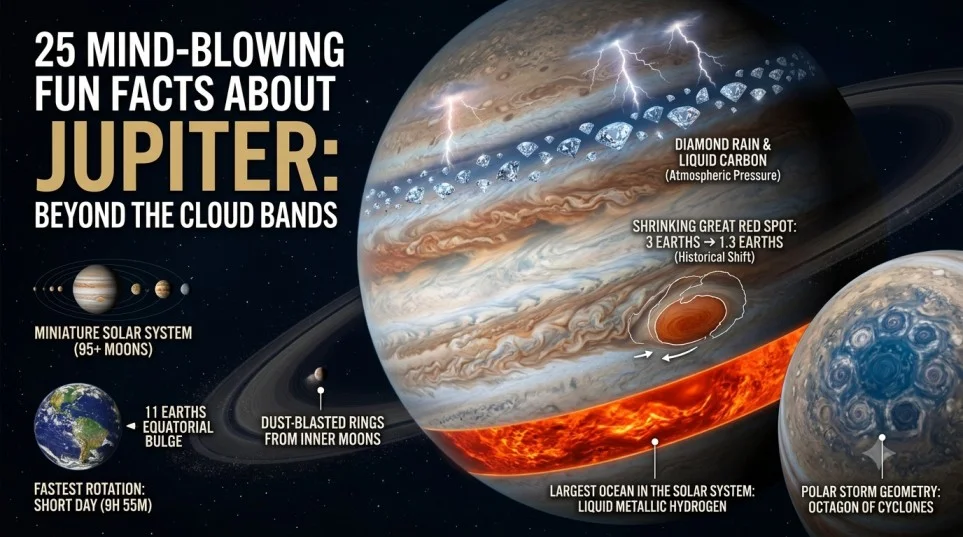
Jupiter is the biggest heavyweight in our solar neighborhood. It has twice as much stuff in it as all the other planets combined. But if you think you already know this giant planet just because you learned about its Great Red Spot in school, think again.
Most lists on the internet just repeat the same basic points. They tell you that it is huge, has a lot of moons, and looks like it has colorful stripes. But modern space missions, like NASA’s Juno spacecraft, have shown us a completely new side of Jupiter. Beneath those fluffy clouds lies a strange world made of crushed diamonds, oceans of liquid metal, storms shaped like geometric patterns, and a wild history that changed the whole solar system.
Whether you love space or just want to learn some awesome trivia, these fun facts about jupiter bring you the coolest, real details about our solar system’s biggest planet.
Quick Snapshot (Unique Fun Facts about Jupiter )
| Dimension / Metric | Fascinating Reality | Why It Matters |
| Equatorial Diameter | ~88,846 miles (142,984 km) | It is so wide that 11 Earths could sit side-by-side across its middle. |
| Day Length | 9 hours, 55 minutes | It spins faster than any other planet in our solar system. |
| Atmospheric Pressure | Millions of times Earth’s sea-level pressure | The heavy squeezing turns normal hydrogen gas into a liquid metal that carries electricity. |
| Magnetic Field | 20,000 times stronger than Earth’s | It creates a giant wall of radiation that can easily break unshielded electronics. |
Jupiter — Mind-Blowing Science & Anomalies
1. Jupiter Has a “Fuzzy” Dilute Core
For a long time, science books said Jupiter had a hard, solid ball of rock and iron at its center. But information from NASA’s Juno spacecraft proved that wrong. Scientists learned that Jupiter’s core is actually a messy, slushy mix of melted rocks and liquid metallic hydrogen. They think a huge planet smashed right into Jupiter billions of years ago, breaking apart its solid center and mixing it all together.
(Source: science.nasa.gov)
2. Its Ocean Is Made of Liquid Metallic Hydrogen
Deep under Jupiter’s thick clouds sits the biggest ocean in our solar system. But it isn’t made of water. Instead, the intense pressure squeezes hydrogen gas so hard that parts of its atoms pop off. This turns the gas into an electric, liquid metal that flows a lot like liquid mercury.
(Source: nasa.gov)
3. Its Polar Cyclones Form Geometric Shapes
On Earth, big storms wander all over the map. On Jupiter, storms at the top and bottom form neat geometric shapes. At the north pole, eight giant storms circle around one main storm to make an eight-sided octagon. At the south pole, five storms form a five-sided pentagon. These massive storms stay locked in these neat shapes for years without bumping into each other.
4. Jupiter Bulges Noticeably at Its Equator
Jupiter is not a perfectly round ball. Because it spins around so fast—one full turn every 10 hours—the middle gets pushed outward. This makes the planet stick out so much at its equator that its middle is over 5,000 miles wider than its height from top to bottom. You can even see this flattened egg shape through a small home telescope.
5. Its Magnetic Tail Reaches All the Way to Saturn
Jupiter makes a larger magnetic field than any other planet. On the side turned away from the Sun, space winds blow this magnetic bubble far out into space, creating a long tail. This invisible tail stretches about 600 million miles, which is long enough to reach past the orbit of Saturn.
6. Diamond Rain Likely Falls Through Its Atmosphere
High up in Jupiter’s air, giant lightning bolts hit methane gas and break it down into soot. As this soot falls deeper into the planet, high heat and intense pressure turn it into hard graphite, and then into real diamonds. Farther down, it gets so hot that these falling diamonds melt into liquid carbon rain.
7. Jupiter’s Dark Rings Come From Dust-Blasted Moons
Saturn gets all the attention for its bright ice rings, but Jupiter has a set of faint rings too. NASA’s Voyager 1 spacecraft found them in 1979. They do not have ice in them. Instead, they are made of tiny dust bits knocked off Jupiter’s small inner moons when tiny space rocks crash into them.
(Source: science.nasa.gov)
Jupiter — Historical Secrets & Cultural Quirks
1. Ancient Babylonians Used Abstract Geometry to Track Jupiter
More than 2,000 years ago, stargazers in ancient Babylon tracked Jupiter across the night sky. Old clay tablets show that they figured out how fast Jupiter was moving by drawing four-sided shapes on graphs and measuring their space. This clever math trick was used in Babylon over 1,400 years before European scientists thought of it.
2. Observing Jupiter’s Moons Shattered Human History
In 1610, the Italian scientist Galileo Galilei pointed his early telescope at Jupiter and saw four little dots of light nearby. Over a few nights, he watched them circle around the giant planet. This showed real proof that not everything in space goes around Earth, which changed how people understood the universe forever.
3. A Danish Astronomer Used Jupiter to Measure the Speed of Light
In 1676, a Danish astronomer named Ole Rømer was watching Jupiter’s moon Io. He noticed that when Earth was farther away from Jupiter, Io’s shadows happened a little later than planned. Rømer realized this delay was caused by light taking time to travel through space, using Jupiter to give us our first real measurement of light speed.
4. The Word “Jovian” Comes From Jupiter’s Alternate Name
In old Roman stories, Jupiter was also called Jove, the king of the gods. The name Jupiter comes from words meaning “Sky Father.” That is why space scientists today use the word “Jovian” when talking about Jupiter or other huge gas planets far away.
5. Radiation Around Jupiter Almost Destroyed NASA’s Pioneer Probe
When NASA’s Pioneer 10 probe flew past Jupiter in 1973, it got zapped with 1,000 times more radiation than a person could survive. Jupiter’s magnet field shoots tiny energetic particles around at almost the speed of light. This heavy blast confused Pioneer’s computer controls and broke some tools, but the spacecraft managed to survive and send back the first close-up pictures.
Interesting Fun Facts About Jupiter By The Numbers
| Metric | Scientific Value | Relatable Real-World Comparison |
| Mass | $1.898 \times 10^{27}\text{ kg}$ | 318 times heavier than planet Earth |
| Volume | $1.43 \times 10^{15}\text{ km}^3$ | Big enough to hollow out and pack 1,300 Earths inside |
| Orbital Period | 11.86 Earth years | One Jupiter year is nearly 12 human birthdays |
| Equatorial Wind Speeds | Up to 335 mph (539 km/h) | Faster than the world’s highest recorded hurricane gust |
Facts That Sound 100% Fake (But Are Actually True)
1. Jupiter Does Not Technically Orbit the Sun’s Center
Because Jupiter is so heavy, the balancing point of gravity between it and the Sun isn’t inside the Sun at all. Instead, that balance point sits about 30,000 miles above the Sun’s surface. That means both Jupiter and the Sun circle around a shared spot in open space.
2. You Cannot Land on Jupiter, But You Would Crush Instantly
Jupiter has no hard ground to stand on. If you dropped a space probe into its clouds, it would just fall through thousands of miles of gas and liquid without hitting a floor. Long before reaching the middle, the heavy air pressure and hot temperature would crush and melt the titanium probe into a gas.
3. Its Great Red Spot Is Actually Shrinking
Stargazers have been watching Jupiter’s famous Great Red Spot storm since 1878. Back in the late 1800s, the storm was about 30,000 miles wide—big enough to fit three Earths inside it. Today, measurements show it has shrunk down to about 10,000 miles wide. Scientists are watching closely to see if it will settle down or tear apart over time.
4. Jupiter’s Moons Hold Ocean Worlds
Jupiter has 95 known moons, but four of them are super famous. Its icy moon Europa hides a global ocean of salty water underneath a thick layer of ice. Scientists think Europa holds more liquid water than all of Earth’s oceans put together, making it one of the best places to look for alien life.
“Can You Imagine?” (Visual Analogies)
- The Basketball and the Grape: If you shrank Jupiter down to the size of a full-sized basketball, planet Earth would look like a tiny green grape sitting right next to it.
- The Cosmic Vacuum Cleaner: Think of Jupiter as a big gravity shield. Its strong pull acts like a magnet, catching or kicking away incoming comets and asteroids before they can head toward Earth.
- The Miniature Solar System: Jupiter’s massive family of 95 moons works like a mini solar system of its own. Its four biggest moons loop around the planet with incredible clockwork timing.
Debunking the Myths: Fiction vs. Reality
| The Popular Myth | The Actual Fact | The Source / Proof |
| “Jupiter is a failed star.” | Jupiter is made of the same stuff as the Sun (hydrogen and helium), but it is not heavy enough to start burning like a star. It would need to be 80 times heavier to shine like a small red star. | Widely documented by astrophysicists |
| “Jupiter’s Great Red Spot is stationary.” | The storm spins backward at speeds over 400 mph, making it a huge, swirling windstorm. | NASA Juno Mission Data |
| “Jupiter protects Earth from every collision.” | Even though Jupiter catches many space rocks, its strong gravity can also kick distant comets off track and send them flying straight toward us. | Orbital dynamic studies |
Mysteries Scientists Still Can’t Explain
- Why Is the Great Red Spot Red? Scientists know the storm’s clouds have ammonia, sulfur, and water in them. But they still argue over which chemical reaction turns the storm its rusty orange-red color.
- What Powers Jupiter’s High Atmospheric Heat? Jupiter’s upper sky is hundreds of degrees hotter than it should be from Sun warmth alone. Scientists call this the “energy crisis” and are trying to see if space waves or northern lights are pumping in extra heat.
- How Deep Do the Cloud Belts Go? Measurements show Jupiter’s colorful stripes go down thousands of miles, but researchers are still trying to figure out how far down those fast winds keep blowing.
Share-This Fact
Jupiter rotates so quickly that a single day lasts under 10 hours, creating 300 mph jet streams and a 5,000-mile equatorial bulge.
The Ultimate Fun Facts About Jupiter Brain Teaser
1. What causes the dark, faint ring system surrounding Jupiter?
A) Frozen water crystals leaking from Europa
B) Dust blasted off small inner moons by micrometeoroid impacts
C) Trapped solar flare particles
D) Debris left behind by ancient comet collisions
2. How did ancient Babylonian astronomers track Jupiter’s movement across the sky?
A) They built the world’s first glass lenses
B) They calculated the area of geometric trapezoids on time-velocity graphs
C) They used magnetic compasses
D) They measured shadows cast by sun dials
3. What happens to the barycenter (center of mass) between Jupiter and the Sun?
A) It sits at the exact center of the Sun
B) It sits inside Jupiter’s metallic hydrogen ocean
C) It sits roughly 30,000 miles above the Sun’s surface in open space
D) It constantly shifts between Mars and Jupiter
- B (Dust blasted off small inner moons by micrometeoroid impacts)
- B (They calculated the area of geometric trapezoids on time-velocity graphs)
- C (It sits roughly 30,000 miles above the Sun’s surface in open space)
Frequently Asked Questions
What are the 3 most important facts about Jupiter?
Jupiter is the biggest planet in our solar system, weighing twice as much as all other planets combined. It spins faster than any other planet, with a day taking under 10 hours. It also has no hard ground, holding a deep ocean of liquid metallic hydrogen under its clouds.
Why is Jupiter called a gas giant?
Jupiter is called a gas giant because it is made almost completely of hydrogen and helium gas, just like the Sun. It does not have a hard, rocky ground to stand on like Earth or Mars.
Does Jupiter have rings like Saturn?
Yes, Jupiter has four faint rings made mostly of tiny dust bits. NASA’s Voyager 1 spacecraft found them in 1979. They are hard to see because they do not have shiny ice in them like Saturn’s rings do.
What is the core of Jupiter made of?
Information from NASA’s Juno spacecraft shows Jupiter has a “fuzzy,” slushy core. Instead of a solid ball of iron, its center is a hot, liquid mix of heavy rock and metal mixed together with fluid hydrogen.
How long would it take to fly to Jupiter from Earth?
Travel time depends on the path and rocket power you use. NASA’s Galileo mission took about six years to reach Jupiter, while the Juno spacecraft made the trip in about five years.
Conclusion
Jupiter is a true wonder in our night sky. From ancient Babylonians tracking its path with simple drawings to modern NASA space probes exploring its slushy core and metal oceans, this giant planet keeps surprising us. It is much more than just a big ball of gas—it is an exciting world with diamond rain, geometric pole storms, and dozens of water-rich moons.

hello! I am Irshad Ullah, and a passionate writer and lifelong learner dedicated to uncovering fascinating facts about science, history, nature, animals, space, and the world around us. I research each topic carefully and transform surprising information into clear, engaging, and enjoyable content. My goal is to satisfy curiosity, inspire learning, and help readers discover something amazing every day.