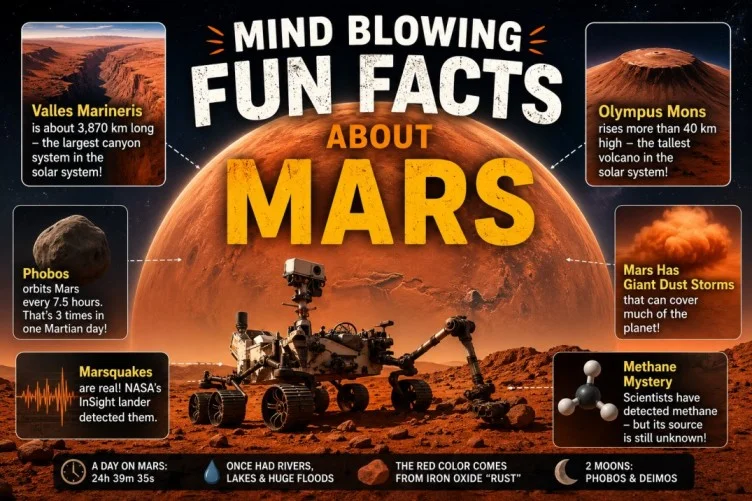
Mars is not simply a red dot in the night sky. It is a planet of giant volcanoes, planet-sized canyons, blue sunsets, mysterious gases, and strange moons that race around it several times a day.
The most surprising part? Mars may look quiet, but it is still geologically active. Its thin atmosphere can create planet-wide dust storms. Its surface can shake from marsquakes. And one of its moons may be slowly falling toward the planet.
These fun facts about Mars go beyond the usual “Mars is red” trivia. You will discover strange science, forgotten history, extreme numbers, real mysteries, and facts that sound like science fiction—but are supported by planetary science.
Quick Snapshot: Mars at a Glance
| Dimension / Metric | Fascinating Reality | Why It Matters |
|---|---|---|
| Surface | Mars has a canyon system about 3,870 km long | It is the largest canyon system known in the solar system |
| Volcano | Olympus Mons rises more than 40 km from base to summit | It is the tallest known volcano in the solar system |
| Moon | Phobos orbits only about 6,000 km above Mars | No known moon orbits closer to its planet |
| Day | A Martian day lasts about 24 hours, 39 minutes, and 35 seconds | A Mars day is surprisingly similar to an Earth day |
| Atmosphere | Mars has a very thin atmosphere dominated by carbon dioxide | This helps explain its cold, dry surface |
Source: nasa.gov
Mars — Mind-Blowing Science & Anomalies
1. Mars Has a Canyon That Could Stretch Across the United States
Valles Marineris runs for about 3,870 kilometers. NASA compares its scale to the distance from California to New York. It is also roughly 600 kilometers wide in places and reaches about 9.3 kilometers deep.
That makes the Grand Canyon look tiny by comparison. Mars does not just have valleys—it has a planetary-scale scar.
Source: nasa.gov
2. Olympus Mons Is Taller Than Mount Everest—By a Lot
Olympus Mons rises more than 40 kilometers from its base to its summit. Mount Everest reaches 8.848 kilometers above sea level.
The Martian volcano is so enormous that its base covers an area comparable to the U.S. state of Arizona. On Mars, “mountain” can mean something on a completely different scale.
Source: nasa.gov
3. One Martian Moon Races Around Mars Three Times a Day
Phobos is the larger of Mars’s two moons. It orbits only about 6,000 kilometers above the Martian surface and completes an orbit in roughly 7.5 hours.
That means an observer on Mars could see Phobos rise and set several times during one Martian day. It is one of the strangest moon-and-planet relationships in the solar system.
Source: nasa.gov
4. Marsquakes Are Real—but Mars Does Not Shake Like Earth
NASA’s InSight lander detected marsquakes and studied the planet’s interior. The recorded quakes were generally, with no detected quakes larger than magnitude 3.7, but ~4.2 in 2021 and up to ~4.7–5 in 2022 “monster” quakes were recorded in the mission, results summarized by NASA’s Jet Propulsion Laboratory.
Mars may look dead from space, but its interior still moves.
Source: jpl.nasa.gov
5. A Meteorite Impact Can Shake Mars Deep Into Its Mantle
Scientists matched impact craters seen by NASA’s Mars Reconnaissance Orbiter with seismic signals recorded by InSight. The results showed that some meteoroid impacts sent seismic energy deeper into Mars than scientists had previously expected.
A rock hitting the surface can therefore reveal clues about what lies far below it.
Source: jpl.nasa.gov
6. Mars Can Have Dust Storms That Cover Much of the Planet
Mars has a thin atmosphere, but that does not mean its weather is weak. Winds can lift dust into huge storms that spread across large areas and, in some cases, cover much of the planet.
After a major storm, the dust can take months to settle. A world with almost no breathable air can still have dramatic weather.
Source: nasa.gov
7. Mars Once Had Rivers, Lakes, and Huge Floods
Mars is dry today, but its surface preserves evidence of an ancient wetter past. Scientists have identified ancient valley networks, deltas, lakebeds, and minerals that formed in liquid water.
Some geological features also suggest that enormous floods occurred roughly 3.5 billion years ago.
Source: nasa.gov
8. Mars’s Red Color Is Basically Planetary Rust
Mars looks red because iron-bearing materials in its rocks, soil, and dust have oxidized. In simple terms, much of the planet’s surface has undergone a process similar to rusting.
The Red Planet’s famous color is not paint, fire, or molten rock. It is chemistry spread across an entire world.
Source: nasa.gov
9. Mars Has a Strange Methane Mystery
Some observations have reported methane in the Martian atmosphere, while other measurements have failed to find it. The mystery matters because methane can be produced by biological processes on Earth—but it can also form through non-biological geological processes.
So even if methane is confirmed in a particular location, it would not automatically prove life.
Source: nasa.gov
Mars — Historical Secrets & Cultural Quirks
1. Ancient Egyptians Called Mars “The Red One”
Mars’s striking color influenced how ancient civilizations named it. The ancient Egyptians referred to the planet as “Her Desher,” meaning “the red one.”
Thousands of years later, the Romans connected the same red appearance with blood and named the planet after Mars, their god of war.
Source: nasa.gov
2. Mars’s Moons Were Found in 1877
Astronomer Asaph Hall discovered Phobos and Deimos in 1877. The search was frustrating enough that Hall was reportedly close to giving up.
His wife, Angelina, encouraged him to continue. He discovered Deimos the next night and Phobos six nights later. Phobos’s largest crater was later named Stickney after Angelina’s maiden name.
Source: nasa.gov
3. Mars Once Inspired a Famous “Canal” Debate
For centuries, observers wondered whether Mars might contain life. In the late 19th and early 20th centuries, some astronomers interpreted surface markings as artificial canals.
Later observations showed that the supposed canal network was not evidence of an advanced Martian civilization. The episode remains one of astronomy’s most famous examples of how human expectations can influence observation.
4. Mars Has Inspired Both Science and Science Fiction
Mars became one of humanity’s favorite fictional worlds because it is close enough to imagine visiting but strange enough to feel alien.
Its ancient water, giant volcanoes, mysterious moons, and possible past habitability have kept Mars at the center of both planetary science and popular culture.
5. Mars Is the Only Planet Where Rovers Have Driven Across Another World
Mars is the only planet where humans have successfully sent rovers to explore the surface remotely. These machines have examined rocks, weather, soil, and geological history while traveling across an alien landscape.
That makes Mars more than a distant object to observe. It is a world where robotic explorers have actually driven.
Source: nasa.gov
Mars By The Numbers
| Mars Fact | Number | Relatable Comparison |
|---|---|---|
| Length of Valles Marineris | ~3,870 km | Roughly California to New York |
| Depth of Valles Marineris | ~9.3 km | More than 10 times the depth of Earth’s Grand Canyon |
| Olympus Mons height | >40 km | More than four times Everest’s height above sea level |
| Phobos’s distance above Mars | ~6,000 km | Extremely close for a planetary moon |
| Phobos orbital period | ~7.5 hours | Several orbits in one Martian day |
| Mars’s longest recorded day | ~24 hours, 39 minutes, 35 seconds | Only about 40 minutes longer than an Earth day |
| Ancient massive floods | ~3.5 billion years ago | Deep in Mars’s geological past |
Source: nasa.gov; jpl.nasa.gov
Facts That Sound 100% Fake (But Are Actually True)
1. A Moon Can Orbit Its Planet Three Times in One Day
Phobos circles Mars so quickly that it completes roughly three orbits during a Martian day.
2. Mars Has a Canyon Nearly 4,000 Kilometers Long
Valles Marineris is not merely a large valley. It is a planetary-scale canyon system.
3. Mars Has a Volcano More Than 40 Kilometers Tall
Olympus Mons is the largest known volcano in the solar system.
4. A Planet Can Have Weather Without Much Air
Mars’s atmosphere is extremely thin, yet winds can still lift dust into storms that spread across huge areas.
5. Mars Can Shake When Space Rocks Hit It
Meteoroid impacts can produce seismic waves that travel deep through the Martian interior.
Sources: nasa.gov; jpl.nasa.gov
Can You Imagine? Mars in Visual Analogies
- Valles Marineris: Imagine a canyon long enough to cross a large part of the United States.
- Olympus Mons: Imagine a volcano more than four times the height of Mount Everest.
- Phobos: Imagine looking up and seeing the same moon rise and set repeatedly within a single Martian day.
- A Mars dust storm: Imagine a storm so large that dust can spread across a huge portion of an entire planet.
Debunking the Myths: Fiction vs. Reality
| The Popular Myth | The Actual Fact | The Source / Proof |
|---|---|---|
| Mars is completely dead and geologically inactive | Mars has experienced marsquakes and seismic activity | NASA/JPL |
| Mars is just a frozen desert | Evidence shows it had ancient rivers, lakes, and floods | NASA |
| Methane on Mars proves aliens exist | Methane can have biological or geological origins | NASA |
| Mars’s red color comes from fire | Its color is linked to oxidized iron-bearing materials | NASA |
| Mars has only tiny geological features | It has the solar system’s largest known volcano and canyon system | NASA |
Source: nasa.gov; jpl.nasa.gov
Mysteries Scientists Still Can’t Explain
1. Where Did Mars’s Ancient Atmosphere Go?
Mars once had a much thicker atmosphere and a wetter environment. Scientists continue to study how the planet lost so much of its atmosphere and water over geological time.
2. Was Mars Ever Home to Life?
Mars once had environments that could have been more favorable to life than the planet’s surface is today. But scientists still do not have confirmed evidence that life ever existed there.
3. Why Do Methane Measurements Disagree?
Some observations have detected methane, while others have not. Scientists are still working to understand whether the disagreement comes from changes in the atmosphere, measurement differences, or another explanation.
Source: nasa.gov
4. What Exactly Happened to Mars’s Global Magnetic Protection?
Mars does not have the global magnetic field that protects Earth from much of the solar wind. Understanding how and when Mars lost its global magnetic protection is part of the larger mystery of how the planet changed from a wetter world into today’s cold desert.
Share-This Fact
Phobos orbits Mars so fast that it circles the planet roughly three times in one Martian day.
Source: nasa.gov
The Ultimate Mars Brain Teaser
1. Which Martian feature is about 3,870 kilometers long?
A. Olympus Mons
B. Valles Marineris
C. Phobos
D. Hellas Planitia
B. Valles Marineris. It is the largest known canyon system in the solar system.
2. How many times can Phobos orbit Mars in roughly one Martian day?
A. Once
B. Twice
C. About three times
D. About ten times
C. About three times.
3. What can create seismic waves that travel deep into Mars?
A. Only volcanic eruptions
B. Meteoroid impacts
C. Solar eclipses
D. Dust clouds
B. Meteoroid impacts. Scientists have matched impact craters with seismic signals detected by NASA’s InSight mission.
Source: nasa.gov; jpl.nasa.gov
Conclusion
Mars is fascinating because it is both familiar and deeply alien. It has a day only slightly longer than Earth’s, yet it also has a canyon thousands of kilometers long, a volcano more than 40 kilometers high, and a moon that races around it several times a day.
The planet’s biggest mystery may be its transformation from a wetter ancient world into the cold desert we see today. Even now, Mars can shake, produce giant dust storms, and challenge scientists with unanswered questions about methane and possible past life.

hello! I am Irshad Ullah, and a passionate writer and lifelong learner dedicated to uncovering fascinating facts about science, history, nature, animals, space, and the world around us. I research each topic carefully and transform surprising information into clear, engaging, and enjoyable content. My goal is to satisfy curiosity, inspire learning, and help readers discover something amazing every day.